
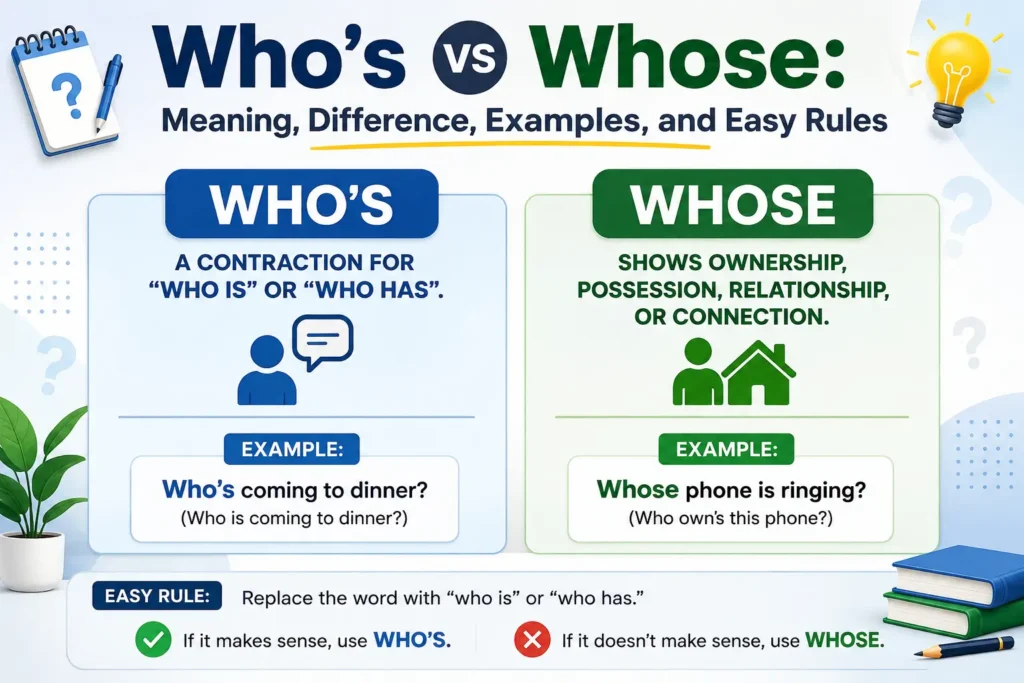
Who’s vs whose is a common grammar confusion because both words sound the same but have different meanings. Many writers choose the wrong word because they focus on the apostrophe instead of the sentence meaning.
Who’s is a contraction that means who is or who has, while whose shows ownership, possession, relationship, or connection. Understanding this grammar difference helps you write cleaner sentences, avoid common mistakes, and improve your overall English writing.
For example, “Who’s calling?” means “Who is calling?” but “Whose phone is ringing?” asks who owns the phone. This simple apostrophe rule can make your writing look more polished and professional. In this guide, you’ll learn the meaning of who’s and whose, see clear examples, use an easy swap test, and follow simple grammar rules to choose the correct word every time.
Quick Answer: Who’s or Whose?
| Word | Meaning | Use It When | Example |
| Who’s | Who is / who has | You can replace it with “who is” or “who has” | Who’s coming to dinner? |
| Whose | Belonging to whom / connected to whom | You are asking about ownership or connection | Whose phone is this? |
Here is the fastest test:
Replace the word with “who is” or “who has.”
If the sentence still makes sense, use who’s.
If it does not make sense, use whose.
Example:
- Who’s at the door?
- Who is at the door?
That works, so who’s is correct.
Now look at this sentence:
- Who’s bag is this?
- Who is bag is this?
That does not work. The correct sentence is:
- Whose bag is this?
Read this also: Startup or Start-Up: Which Spelling Is Correct?
What Does “Who’s” Mean?
Who’s is a contraction. A contraction combines two words into one shorter word.
For example:
| Full Form | Contraction |
| do not | don’t |
| cannot | can’t |
| it is | it’s |
| she has | she’s |
| who is | who’s |
| who has | who’s |
So, who’s can mean only two things:
- who is
- who has
That’s all.
It does not show possession. It does not mean “belonging to who.” That is where most mistakes happen.
Many people see the apostrophe in who’s and think it works like John’s car or Sarah’s book. But in this case, the apostrophe does not show ownership. It shows that letters are missing.
Use “Who’s” When You Mean “Who Is”
Use who’s when the sentence means who is.
Examples:
- Who’s ready to start?
- Who’s at the door?
- Who’s your teacher?
- Who’s coming with us?
- Do you know who’s leading the meeting?
Now expand each sentence:
- Who is ready to start?
- Who is at the door?
- Who is your teacher?
- Who is coming with us?
- Do you know who is leading the meeting?
Each sentence still makes sense. That means who’s is correct.
Use “Who’s” When You Mean “Who Has”
Who’s can also mean who has.
Examples:
- Who’s finished the assignment?
- Who’s taken my notebook?
- Who’s been sitting here?
- Who’s seen my glasses?
- Do you know who’s already submitted the form?
Now expand them:
- Who has finished the assignment?
- Who has taken my notebook?
- Who has been sitting here?
- Who has seen my glasses?
- Do you know who has already submitted the form?
These sentences also work, so who’s is correct.
You will often see who’s before words like:
- been
- done
- finished
- taken
- seen
- started
- completed
Example:
| Sentence | Expanded Meaning |
| Who’s been here? | Who has been here? |
| Who’s done the work? | Who has done the work? |
| Who’s seen my phone? | Who has seen my phone? |
What Does “Whose” Mean?
Whose shows ownership, possession, relationship, or connection.
It asks or tells who something belongs to or who something is linked with.
Examples:
- Whose phone is this?
- Whose idea was it?
- Whose turn is it?
- Whose car is parked outside?
- The student whose essay won the prize smiled.
In these sentences, whose connects a person to something.
| Sentence | What “Whose” Connects |
| Whose phone is this? | A person and a phone |
| Whose idea was it? | A person and an idea |
| Whose turn is it? | A person and a turn |
| The student whose essay won | A student and an essay |
Remember, whose does not always mean physical ownership. You can own a phone, but you do not “own” an idea in the same way. Still, an idea can come from someone. That is why whose idea is correct.
Use “Whose” for Ownership
The easiest use of whose is ownership.
Use it when you ask who owns something.
Examples:
- Whose bag is this?
- Whose laptop is charging?
- Whose shoes are by the door?
- Whose coat did you borrow?
- Whose keys are on the table?
Each sentence asks the same basic question:
Who owns this thing?
That points to whose.
Common Ownership Phrases
| Correct Phrase | Example |
| Whose bag | Whose bag is on the chair? |
| Whose phone | Whose phone keeps ringing? |
| Whose car | Whose car is outside? |
| Whose keys | Whose keys are these? |
| Whose shoes | Whose shoes are by the door? |
Now compare the wrong and right versions:
| Incorrect | Correct | Why |
| Who’s bag is this? | Whose bag is this? | The bag belongs to someone. |
| Who’s car is outside? | Whose car is outside? | The car belongs to someone. |
| Who’s keys are these? | Whose keys are these? | The keys belong to someone. |
The wrong versions fail the expansion test:
Who is bag is this?
That sentence does not work, so use whose.
Use “Whose” for Relationship or Connection
Whose can also show a relationship or connection. This use often appears in formal writing, essays, stories, and news articles.
Examples:
- The teacher whose class won the contest thanked everyone.
- The author whose book became famous gave an interview.
- The student whose project won first place looked proud.
- The company whose policy changed sent an email.
- The singer whose voice filled the room received applause.
In these examples:
- The class connects to the teacher.
- The book connects to the author.
- The project connects to the student.
- The policy connects to the company.
- The voice connects to the singer.
This is not always simple ownership. It is often association or connection.
You can also use whose with words like:
- decision
- answer
- advice
- responsibility
- mistake
- role
- result
Examples:
- Whose decision caused the delay?
- Whose answer was correct?
- Whose advice helped you?
- Whose responsibility is this?
- Whose mistake created the problem?
Can “Whose” Refer to Things?
Yes, whose can refer to things. It usually refers to people, but it can also refer to animals, companies, places, and objects.
Examples:
- The dog whose collar was red ran across the yard.
- The company whose sales increased hired more workers.
- The house whose roof leaked needs repair.
- The book whose cover was torn sat on the shelf.
- The city whose roads flooded closed several streets.
Some writers use of which for objects, but that can sound stiff.
Compare these sentences:
- The house, the roof of which was damaged, needs repair.
- The house whose roof was damaged needs repair.
The second sentence sounds smoother and more natural.
The Main Difference Between Who’s and Whose
The main difference is meaning.
Who’s means who is or who has.
Whose shows ownership or connection.
| Sentence | Meaning | Correct Word |
| ___ coming to the party? | Who is coming? | Who’s |
| ___ party is this? | Who owns or organized the party? | Whose |
| ___ been using my desk? | Who has been using it? | Who’s |
| ___ desk is near the window? | Who owns or uses the desk? | Whose |
| ___ ready for lunch? | Who is ready? | Who’s |
| ___ lunch is in the bag? | Who owns the lunch? | Whose |
Here is another useful comparison:
- Who’s responsible?
This means who is responsible? - Whose responsibility is this?
This asks who owns or carries the responsibility.
Both sentences may point to the same person, but the grammar is different.
Why the Apostrophe Causes Confusion
The apostrophe is the main reason people confuse these words.
In English, apostrophes often show possession.
Examples:
- Sarah’s book
- the dog’s leash
- the teacher’s desk
But apostrophes also show missing letters in contractions.
Examples:
- don’t = do not
- can’t = cannot
- it’s = it is
- who’s = who is / who has
So, when people see who’s, they often think it shows possession. That guess feels logical, but it is wrong.
Look at this phrase:
- Who’s idea
It may look correct at first, but expand it:
- Who is idea
That does not make sense.
The correct phrase is:
- Whose idea
The apostrophe in who’s does not mean ownership. It means letters are missing.
The Simple Swap Test
The easiest way to choose the right word is the swap test.
Replace who’s with who is or who has.
If the sentence still makes sense, use who’s.
If the sentence sounds wrong, use whose.
Use “Who’s” if “Who Is” Works
Examples:
- Who’s waiting outside?
Who is waiting outside? - Who’s your favorite writer?
Who is your favorite writer? - Do you know who’s speaking first?
Do you know who is speaking first?
Use “Who’s” if “Who Has” Works
Examples:
- Who’s completed the work?
Who has completed the work? - Who’s been calling all morning?
Who has been calling all morning? - The student who’s improved the most deserves praise.
The student who has improved the most deserves praise.
Use “Whose” if the Swap Fails
Examples:
- Whose shoes are by the door?
Who is shoes are by the door? Wrong. - Whose opinion matters here?
Who has opinion matters here? Wrong. - Whose name did you write?
Who is name did you write? Wrong.
If both expanded forms fail, use whose.
Look at the Word After It
The word after who’s or whose can give you a clue.
If a noun comes right after the word, whose often fits.
Examples:
- whose phone
- whose idea
- whose fault
- whose turn
- whose name
- whose answer
If a verb or verb phrase comes after the word, who’s often fits.
Examples:
- who’s going
- who’s calling
- who’s waiting
- who’s been working
- who’s responsible
- who’s ready
However, this is only a clue. It is not a perfect rule.
For example:
- Who’s your teacher?
A noun phrase comes after who’s, but the sentence is still correct because it means:
- Who is your teacher?
So, use the word-after-it trick as a clue, then use the swap test to confirm your choice.
Common Mistakes With Who’s and Whose
“Who’s Idea” or “Whose Idea”?
The correct phrase is:
Whose idea
An idea can come from someone, so the sentence needs whose.
Correct examples:
- Whose idea was this?
- Do you know whose idea changed the plan?
- I wonder whose idea started the project.
Incorrect:
- Who’s idea was this?
Expanded version:
- Who is idea was this?
That does not work.
“Who’s Fault” or “Whose Fault”?
The correct phrase is:
Whose fault
Fault connects to responsibility, blame, or cause.
Correct examples:
- Whose fault was it?
- Nobody knew whose fault caused the delay.
- Stop arguing about whose fault it is.
Incorrect:
- Who’s fault was it?
However, who’s can be correct in a different structure:
- Who’s at fault?
This means:
- Who is at fault?
| Correct Sentence | Meaning |
| Whose fault was it? | Who is connected to the fault? |
| Who’s at fault? | Who is responsible? |
“Who’s Turn” or “Whose Turn”?
The correct phrase is:
Whose turn
A turn belongs to a person in a sequence.
Correct examples:
- Whose turn is it?
- Ask whose turn comes next.
- I forgot whose turn it was to speak.
Incorrect:
- Who’s turn is it?
Expanded version:
- Who is turn is it?
That sounds wrong, so use whose turn.
“Who’s There” or “Whose There”?
The correct phrase is:
Who’s there
This sentence means:
Who is there?
Correct examples:
- Who’s there?
- Do you know who’s there with him?
- Tell me who’s there before you open the door.
Incorrect:
- Whose there?
There is no ownership in this sentence. It asks who is present.
“Who’s Name” or “Whose Name”?
The correct phrase is:
Whose name
A name belongs to someone or identifies someone.
Correct examples:
- Whose name is on the list?
- Do you know whose name they called?
- Whose name should appear on the certificate?
Incorrect:
- Who’s name is on the list?
But who’s named can be correct.
Example:
- Who’s named as the winner?
This means:
- Who is named as the winner?
Small changes matter. Whose name and who’s named are not the same structure.
Who, Who’s, and Whose
These three words look related, but each one has a different job.
| Word | Job | Example |
| Who | Asks about a person | Who opened the door? |
| Who’s | Means who is / who has | Who’s opening the door? |
| Whose | Shows possession or connection | Whose door is open? |
Examples:
- Who called you?
- Who’s calling you?
- Whose number called you?
The first sentence asks about a person.
The second means who is calling you.
The third asks whose phone number appeared.
Incorrect and Correct Examples
Mistakes are easier to fix when you see them side by side.
| Incorrect | Correct | Why |
| Who’s car is outside? | Whose car is outside? | The car belongs to someone. |
| Whose coming to dinner? | Who’s coming to dinner? | It means “who is coming.” |
| Who’s fault was it? | Whose fault was it? | Fault connects to someone. |
| Whose been calling me? | Who’s been calling me? | It means “who has been calling.” |
| Who’s idea won? | Whose idea won? | The idea came from someone. |
| Whose ready now? | Who’s ready now? | It means “who is ready.” |
| Who’s turn is next? | Whose turn is next? | The turn belongs to someone. |
| Whose in charge? | Who’s in charge? | It means “who is in charge.” |
These mistakes may look small, but they can make writing look rushed. In school, they can cost marks. In business, they can make an email look less polished. In blog writing, they can reduce trust.
Clear grammar helps your message look careful and professional.
Easy Memory Tricks
1. Expand the Contraction
Before using who’s, say the full version.
Ask yourself:
- Can I say who is?
- Can I say who has?
If yes, use who’s.
Example:
- Who’s going to call?
- Who is going to call?
That works.
Now test this:
- Who’s phone is this?
- Who is phone is this?
That fails, so the correct sentence is:
- Whose phone is this?
2. Ask “Belongs to Whom?”
If the sentence asks who owns something, use whose.
Examples:
- Whose backpack is this?
- Whose account was used?
- Whose signature appears on the form?
Each sentence asks:
This belongs to whom?
That means whose is correct.
3. Remember “Its” and “It’s”
The difference between who’s and whose is similar to it’s and its.
| Contraction | Possessive |
| it’s = it is / it has | its = belonging to it |
| who’s = who is / who has | whose = belonging to whom |
Examples:
- It’s raining. = It is raining.
- The dog wagged its tail. = The tail belongs to the dog.
- Who’s calling? = Who is calling?
- Whose phone rang? = The phone belongs to someone.
The apostrophe marks a contraction. It does not always mark possession.
Practice: Choose “Who’s” or “Whose”
Choose the correct word for each sentence.
- ___ phone is on silent?
- ___ been sitting here?
- ___ ready for the next question?
- ___ backpack did you borrow?
- ___ name appears first?
- ___ going to explain the answer?
- ___ dog ran across the street?
- ___ finished the project already?
- ___ turn is it to speak?
- ___ responsible for the final decision?
Practice Answers
| Sentence | Correct Answer | Why |
| ___ phone is on silent? | Whose | The phone belongs to someone. |
| ___ been sitting here? | Who’s | Means “who has been.” |
| ___ ready for the next question? | Who’s | Means “who is ready.” |
| ___ backpack did you borrow? | Whose | The backpack belongs to someone. |
| ___ name appears first? | Whose | The name identifies someone. |
| ___ going to explain the answer? | Who’s | Means “who is going.” |
| ___ dog ran across the street? | Whose | The dog belongs to someone. |
| ___ finished the project already? | Who’s | Means “who has finished.” |
| ___ turn is it to speak? | Whose | A turn belongs to someone. |
| ___ responsible for the final decision? | Who’s | Means “who is responsible.” |
Quick Cheat Sheet
| If You Mean | Use | Example |
| who is | who’s | Who’s ready? |
| who has | who’s | Who’s finished? |
| belonging to whom | whose | Whose bag is this? |
| connected to whom | whose | The artist whose painting sold smiled. |
| who owns this? | whose | Whose car is outside? |
| who is doing this? | who’s | Who’s driving? |
Best short rule:
If “who is” or “who has” fits, use who’s. If not, use whose.
Frequently Asked Questions
Q1. What is the main difference between who’s and whose?
Who’s means who is or who has. Whose shows ownership, possession, relationship, or connection.
Examples:
- Who’s calling? = Who is calling?
- Whose phone is ringing? = Who owns the phone?
Q2. Can who’s show possession?
No. Who’s never shows possession in standard English. It is always a contraction.
Incorrect:
- Who’s bag is this?
Correct:
- Whose bag is this?
Q3. Why does whose not have an apostrophe?
Whose does not need an apostrophe because it is already possessive. It works like his, hers, ours, and theirs.
Examples:
- his book
- their house
- whose jacket
Q4. Which is correct: who’s responsible or whose responsible?
Who’s responsible is correct because it means who is responsible.
Correct:
- Who’s responsible for the mistake?
Incorrect:
- Whose responsible for the mistake?
However, this sentence is also correct:
- Whose responsibility was it?
Q5. Which is correct: who’s idea or whose idea?
Whose idea is correct because the idea is connected to someone.
Correct:
- Whose idea was this?
Incorrect:
- Who’s idea was this?
The sentence asks who the idea came from, so it needs whose, not who’s.
Final Takeaway
Understanding who’s vs whose becomes easy when you check the meaning of the sentence. Use who’s when you can replace it with who is or who has. Use whose when the sentence shows ownership, possession, relationship, or connection. The apostrophe in who’s does not show possession; it only shows that letters are missing.
That is why “Who’s bag is this?” is incorrect, while “Whose bag is this?” is correct. The best grammar rule is to use the swap test before choosing the word. If “who is” or “who has” fits, write who’s. If the sentence asks who owns or is connected to something, write whose. With practice, this English grammar rule will become simple, natural, and easy to remember.
