
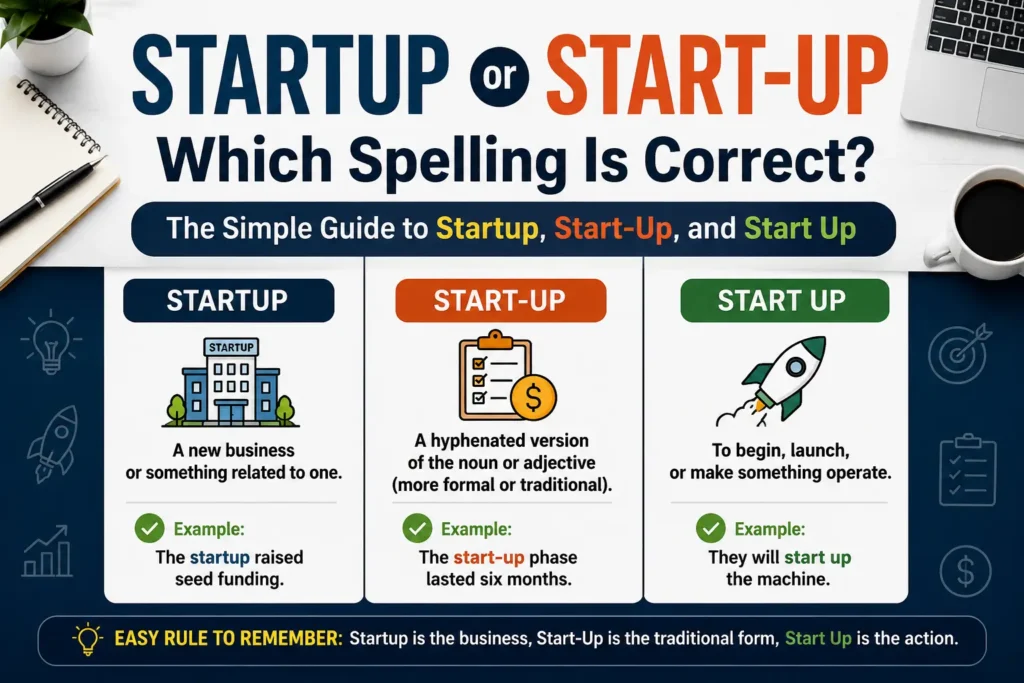
Startup or start-up is a common spelling question for writers, students, founders, and business owners. The purpose is simple: you need to know which form looks correct, clear, and professional in your writing.
In most modern US English, startup is the best choice when you mean a young business. Use start-up when a formal style guide prefers the hyphen. Use start up when you mean the action of beginning something.
This small spelling choice can affect a pitch, blog post, business plan, funding application, or website content. When your words look clean, readers trust your message faster. That’s why understanding startup spelling, start-up meaning, and start up grammar helps you write with more confidence.
Quick Answer: Startup, Start-Up, or Start Up?
Use startup when you mean a new business.
She joined a startup that builds AI tools for schools.
Choose start-up when you follow a style guide that prefers the hyphen or when you want a more formal spelling.
The company listed its start-up costs in the first report.
Write start up when you need a verb phrase.
They plan to start up a small marketing agency this year.
Here is the easiest rule:
| Form | Meaning | Example |
| Startup | A new business or something related to one | The startup raised seed funding. |
| Start-up | A hyphenated version of the noun or adjective | The start-up phase lasted six months. |
| Start up | To begin, launch, or make something operate | They will start up the machine. |
For most modern US business writing, startup is the safest and cleanest choice.
Read this also: ETSJavaApp Release Date: Current Status, eTrueSports Link, and Safe Download Guide
What Does Startup Mean?
A startup is a young business that usually tries to build, test, and grow something new.
That “new” part matters. A startup may focus on a fresh idea, an unproven product, a new business model, or a fast-growth plan. Many startups also look for funding from angel investors, venture capital firms, accelerators, or strategic partners.
A startup does not have to be a Silicon Valley tech company. It can appear in many industries, including:
- software
- fintech
- health technology
- education technology
- food delivery
- clean energy
- e-commerce
- logistics
- consumer products
- creator tools
A startup may begin with two founders in a small room. Another one might begin inside a university lab, a corporate incubator, or even a founder’s kitchen. The setting matters less than the goal.
In most cases, a true startup wants to solve a problem, test a scalable model, and grow beyond a small local market.
Startup vs Small Business
People often use startup and small business as if they mean the same thing. They overlap, but they are not identical.
A small business usually focuses on steady income, local customers, and long-term stability. A startup often focuses on growth, testing, scale, and product-market fit.
Think of it this way: a neighborhood bakery may want loyal local customers. A startup bakery platform may want to help thousands of home bakers sell online.
Both can be strong businesses. They simply have different goals.
| Feature | Startup | Small Business |
| Main goal | Fast growth or scalable model | Stable income and long-term service |
| Risk level | Often high | Usually more predictable |
| Funding | May seek investors | Often self-funded or loan-funded |
| Market | Can target regional, national, or global users | Often local or niche |
| Product | May still be experimental | Usually clear from the start |
| Example | A food delivery app | A local sandwich shop |
So, when someone says startup, they usually mean a business built around growth, innovation, or a model that can expand.
What Does Start-Up Mean?
Start-up is the hyphenated form of startup.
It can work as a noun:
The start-up attracted three early investors.
It can also work as an adjective:
The founder underestimated the start-up expenses.
This spelling is still acceptable. You may see it in dictionaries, formal documents, older publications, academic writing, and some British English contexts. However, in modern US business writing, startup usually looks cleaner and more current.
That does not make start-up wrong. It simply gives the word a more traditional or formal feel.
Language changes over time. Hyphenated compounds often lose their hyphens after people use them often enough. That is why many writers now prefer email over e-mail and website over web site. The same pattern helped startup become common.
What Does Start Up Mean?
Start up is different because it is a verb phrase.
It means to begin, launch, create, or make something operate.
Examples:
- They want to start up a design studio.
- The laptop takes too long to start up.
- We helped him start up his first business.
- The engine would not start up on a cold morning.
Here is a simple trick: if you can change the phrase to started up or starting up, use two words.
Correct:
They started up the company in 2022.
Correct:
The computer is starting up slowly.
Incorrect:
They startup the company in 2022.
The last sentence sounds wrong because startup is not a verb. It works as a noun or adjective.
Startup vs Start-Up vs Start Up
The difference becomes easier when you compare all three forms together.
| Form | Part of Speech | Best Use | Example |
| Startup | Noun | A new business | The startup launched its app. |
| Startup | Adjective | Related to a startup | She works in startup marketing. |
| Start-up | Noun | Hyphenated variant | The start-up hired five people. |
| Start-up | Adjective | Traditional adjective form | They reviewed start-up costs. |
| Start up | Verb phrase | To begin or launch | They will start up next month. |
The most important difference is grammar. For a noun or adjective, startup is usually the best modern choice. When you describe an action, write start up as two words. If your style guide asks for the hyphen, use start-up.
Is Startup One Word?
Yes, startup is commonly written as one word in modern US English.
This spelling works well when you talk about a company, founder, team, ecosystem, investor, product, or business stage.
Examples:
- startup founder
- a new startup company
- early-stage team
- fresh business idea
- funding for startups
- investor pitch
- startup accelerator
- business incubator
- the startup ecosystem
- company culture in startups
Writers often prefer startup because it feels simple and natural. It also matches the way people in business, marketing, and technology usually talk.
You will see it in sentences like:
She works at a startup.
He mentors startup founders.
The startup ecosystem is growing fast.
Startup funding can be difficult to secure.
When in doubt, use startup for the noun and adjective in US writing.
Is Start-Up Hyphenated?
Start-up can be hyphenated, but the hyphen is not always necessary.
The hyphenated form has a long history. It also appears in formal writing and dictionary entries. Some editors still prefer it because the hyphen clearly shows that start and up work together as one compound term.
Modern business writing, however, has moved strongly toward startup.
That matters when you write for readers who expect fast, clear, current language. A founder’s blog, SaaS website, marketing page, or pitch deck will usually look more natural with startup.
Compare these two sentences:
Our startup helps small teams manage invoices.
Our start-up helps small teams manage invoices.
Both are understandable. The first one simply feels more natural for most modern US readers.
When Should You Use Startup?
Use startup when you mean a new business or something connected to one.
This spelling works best in:
- blog posts
- business articles
- founder stories
- SaaS websites
- investor updates
- LinkedIn posts
- resumes
- pitch decks
- case studies
- marketing copy
Examples:
- The startup raised $2 million in seed funding.
- A strong startup team moves quickly.
- She writes about startup strategy.
- His startup helps restaurants manage orders.
- Many startups fail because they misread demand.
The word also works as an adjective.
Startup life can feel exciting, chaotic, and exhausting.
In that sentence, startup describes life.
When Should You Use Start-Up?
Use start-up when your teacher, editor, publication, client, or brand style guide requires it.
You can also use start-up if you want a more traditional tone.
Examples:
- The report reviewed the company’s start-up costs.
- The start-up period required careful budgeting.
- Several start-ups joined the business program.
The hyphen can feel useful when the term appears before a noun.
Start-up costs can include rent, software, permits, equipment, and legal fees.
Still, if you are writing for a modern US audience, startup costs also works well.
The key is consistency. Do not write startup in one paragraph and start-up in the next unless you have a clear style reason.
When Should You Use Start Up?
Use start up when you describe an action.
This form works with people, companies, machines, systems, conversations, projects, engines, and programs.
Examples:
- She plans to start up a consulting firm.
- The system will start up after the update.
- They helped the nonprofit start up its first program.
- He tried to start up a conversation at the event.
- The factory will start up production next quarter.
Notice how the phrase changes tense:
- start up
- starts up
- started up
- starting up
That flexibility proves it is a verb phrase. You cannot use startup that way.
Grammar Tips for Startup, Start-Up, and Start Up
Grammar does not need to feel complicated. These simple checks will help you choose the right form.
Check the job of the word
Ask yourself whether the word names a thing or shows an action.
If it names a company or business concept, use startup.
The startup hired a product manager.
When the phrase shows action, use start up.
They will start up the project tomorrow.
Try changing the tense
If you can say started up, use two words.
The team started up a new branch.
You cannot say:
The team startup a new branch.
That sentence is incorrect because startup cannot work as a verb.
Look at the word after it
When the term comes before another noun, it may work as an adjective.
Examples:
- startup founder
- early business costs
- startup capital
- company culture in startups
For modern US writing, startup usually works well in these phrases.
Follow one style
Pick one spelling for the noun and adjective. Then stay with it.
Weak:
The startup raised funding. Later, the start-up hired developers.
Better:
The startup raised funding. Later, the startup hired developers.
Consistency gives your writing a cleaner finish.
Real-Life Examples of Startup
Here are natural sentences you can use as models.
Business writing:
The startup built a simple tool for freelance designers.
Investor update:
The startup reached 10,000 active users in eight months.
Resume:
Led content strategy for an early-stage startup.
LinkedIn post:
Working at a startup taught me how to move fast without losing focus.
Blog article:
A startup needs more than a clever idea. It needs proof that people actually want the product.
Pitch deck:
Our startup helps local clinics reduce missed appointments.
The word feels smooth because it names the business directly.
Real-Life Examples of Start-Up
These examples show the hyphenated form in a natural way.
Formal report:
The start-up required outside funding during its first year.
Business plan:
Projected start-up costs include inventory, insurance, software, and legal fees.
Academic writing:
The study examined how start-ups survive during economic uncertainty.
Traditional editorial style:
Several start-up companies entered the renewable energy market.
Financial writing:
The founder underestimated early start-up expenses.
None of these examples are wrong. They simply sound more traditional.
Real-Life Examples of Start Up
Now compare those with the two-word verb phrase.
Business:
They plan to start up a new logistics company.
Technology:
The app takes a few seconds to start up.
Operations:
The factory will start up again after maintenance.
Everyday speech:
My old car does not always start up in winter.
Project planning:
We need to start up the campaign before the holiday rush.
In each case, someone or something begins operating. That is the action test.
Common Mistakes With Startup or Start-Up
Small spelling errors can make professional writing look rough. These mistakes appear often.
Mistake 1: Using “start up” as a noun
Incorrect:
She works at a start up.
Correct:
She works at a startup.
You need the noun here, so use one word.
Mistake 2: Using “startup” as a verb
Incorrect:
They will startup the company next month.
Correct:
They will start up the company next month.
The action needs two words.
Mistake 3: Switching between startup and start-up
Weak:
The startup grew quickly. The start-up hired ten people.
Better:
The startup grew quickly. The startup hired ten people.
Pick one style and stay consistent.
Mistake 4: Capitalizing “up” in normal sentences
Incorrect:
The Start-Up hired a designer.
Correct:
The start-up hired a designer.
Capitalize only when title case requires it.
Correct title case:
Startup or Start-Up: Which Spelling Is Correct?
Mistake 5: Overusing “startup business”
The phrase startup business is not always wrong. However, it can sound repetitive because startup already means a young business.
Wordy:
She launched a startup business.
Cleaner:
She launched a startup.
Shorter usually sounds better.
Memory Tricks That Make the Difference Easy
Here are a few quick tricks.
One-word company, two-word action
A startup is a company. To start up is an action.
That is the main rule.
The tense test
If you can say started up, use start up.
Examples:
- They started up the app.
- The engine started up.
- She started up a business.
The “a” test
If you can put a before it, use startup.
Examples:
- a startup
- a tech startup
- a small startup
In modern business writing, a start up looks less polished.
The style-guide test
When someone gives you a style guide, follow it. Without a required style guide, startup is the better default for modern US writing.
Startup as a Noun
As a noun, startup names a young company.
Examples:
- A startup needs customers, not just compliments.
- The startup launched its first product in March.
- Investors liked the startup’s early traction.
The noun can also become plural.
Examples:
- Many startups struggle with cash flow.
- Successful startups learn from customers quickly.
- Some startups grow through bootstrapping rather than funding.
The plural form is simple: startups. No apostrophe is needed unless you show possession.
Startup as an Adjective
As an adjective, startup describes another noun.
Examples:
- startup costs
- early business capital
- startup founder
- founding team
- business mentor
- accelerator program
- startup strategy
- marketing for startups
- funding for startups
In these phrases, startup does not name the company directly. It describes the noun after it.
Startup funding often depends on traction, market size, and founder experience.
Here, startup describes funding.
Possessive Forms of Startup
Possessive forms show ownership or connection.
| Form | Use | Example |
| startup’s | One startup owns or has something | The startup’s founder spoke first. |
| startups’ | Multiple startups own or have something | The startups’ investors attended the event. |
| startup founders’ | Multiple founders connected to startups | Startup founders’ schedules can be demanding. |
Use ’s for one startup and s’ for more than one.
Startup Synonyms
Sometimes you do not want to repeat startup too many times in one paragraph. These alternatives can help when they fit the meaning.
| Synonym | Best Use |
| New company | General, simple writing |
| Young company | Business articles |
| Early-stage company | Investor or founder content |
| Emerging business | Formal writing |
| New venture | Entrepreneurial writing |
| Small business | Only when growth and scale are not the focus |
| Tech company | When the industry matters |
| Venture-backed company | When investors fund it |
| Growth company | When expansion is the focus |
Be careful with synonyms. A small business is not always a startup. Most startups aim for a scalable model, while many small businesses serve a local market and grow slowly by design.
Related Startup Terms
These terms often appear near the word startup.
| Term | Meaning |
| Founder | A person who starts the business |
| Co-founder | One of two or more founders |
| Seed funding | Early investment used to build or grow |
| Bootstrapping | Building without major outside funding |
| MVP | A basic version of a product used for testing |
| Product-market fit | Proof that customers want the product |
| Accelerator | A program that helps startups grow faster |
| Incubator | A support program for early business ideas |
| Pitch deck | A presentation used to explain the business |
| Burn rate | How quickly a startup spends cash |
| Runway | How long the startup can operate before money runs out |
| Scale | To grow operations, customers, or revenue |
These words help readers understand the broader startup world.
Mini Case Study: Why One Word Can Change the Tone
Imagine two websites.
The first says:
We help start-up companies grow through better marketing.
The second says:
We help startups grow through better marketing.
Both sentences make sense. However, the second sentence sounds sharper and more natural for a modern business audience.
Now imagine a legal or academic report:
The study reviewed start-up costs across 200 new businesses.
In that setting, start-up costs may feel more formal. The hyphen gives the phrase a traditional tone.
That is the real lesson. The best spelling depends on audience, context, and style. For most websites, blogs, and business pages, startup feels cleaner.
Which Spelling Should You Use on a Website?
For a website, use startup in most cases.
It matches modern search behavior and fits how founders, investors, marketers, and tech readers usually write the word.
Use startup in places like:
- page titles
- blog posts
- service pages
- category pages
- LinkedIn content
- author bios
- founder profiles
- SaaS landing pages
Good website examples:
- How to Build a Startup Brand
- Best Startup Tools for Small Teams
- Startup Funding Guide for First-Time Founders
- What Every Startup Founder Should Know
You can still include start-up and start up naturally where they belong. That helps cover different reader searches without stuffing the page.
SEO Tips for Startup or Start-Up Content
If you are writing an article about startup or start-up, your goal is simple: answer the grammar question fast, then give useful examples.
Readers do not want a long grammar lecture. They want clarity.
Use the main keyword naturally in these places:
- title
- introduction
- one main heading
- first answer section
- conclusion
- examples
- FAQs
You can also include related phrases such as:
- startup vs start-up
- startup or start up
- start-up or startup
- is startup one word
- is start-up hyphenated
- startup spelling
- start up meaning
Do not force these phrases into every paragraph. Search engines understand natural language better than ever, so write for people first.
That is where good SEO starts.
Common Sentence Patterns
Use these patterns when you are unsure.
For a company
- The startup raised funding.
- A startup needs clear customer feedback.
- The startup’s first product failed.
For a business-related adjective
- The startup team worked late.
- Startup costs can surprise new founders.
- She joined a startup accelerator.
For an action
- They will start up the business next quarter.
- The app should start up faster after the update.
- He helped his friend start up a small agency.
For traditional style
- The start-up phase required careful planning.
- Several start-ups joined the program.
- The report listed start-up costs.
Startup or Start-Up in Titles
Titles can make this word look more confusing because capitalization rules come into play.
In title case, capitalize major words.
Correct title:
Startup or Start-Up: Which Spelling Is Correct?
In sentence case, keep it simple.
Correct sentence case:
Startup or start-up: which spelling is correct?
Do not capitalize up in regular sentences unless it begins a title or follows title-case rules.
Incorrect:
The Start-Up hired a new designer.
Correct:
The start-up hired a new designer.
For most blog titles, Startup or Start-Up works well because the phrase appears in title case.
Is “Startup Company” Correct?
Yes, startup company is correct. Still, it can be slightly redundant.
The word startup already means a young company. So, in many sentences, startup alone sounds better.
Okay:
She works for a startup company.
Better:
She works for a startup.
However, startup company can help when your audience includes learners, students, or readers who need extra clarity. It can also work in SEO content because people search for that phrase.
Use it sparingly. In most cases, the shorter version sounds cleaner.
Is “Startup Business” Correct?
Startup business is understandable, but it often sounds less polished than startup or new business.
Wordy:
He launched a startup business.
Cleaner:
He launched a startup.
Clearer for general readers:
He launched a new business.
Use startup business only when it helps your reader. Otherwise, choose the shorter option.
Startup or Start-Up in Different Writing Contexts
The right spelling can change depending on the type of writing.
| Context | Best Choice | Reason |
| Blog posts | Startup | Modern and easy to read |
| Business websites | Startup | Cleaner for US readers |
| Pitch decks | Startup | Common in founder and investor language |
| Resumes | Startup | Quick and professional |
| Academic writing | Startup or start-up | Depends on the required style guide |
| Formal reports | Start-up may work | More traditional tone |
| UK writing | Start-up may appear more often | Depends on publication style |
| US writing | Startup | Strong modern preference |
If no style guide exists, choose startup and stay consistent.
Startup or Start-Up in American English
American English strongly favors startup in modern business, tech, and marketing contexts.
That makes startup the best default for US websites, blogs, SaaS companies, resumes, and founder-focused content.
Use start up only for the verb.
Many founders start up companies before they fully understand the market.
In that sentence, start up is the action. Companies is the noun.
Startup or Start-Up in British English
British English may show start-up more often than US English. You may see it in newspapers, academic writing, and formal business contexts.
Still, startup has become common internationally because technology and venture capital language travel fast.
If you write for a UK publication, check its style guide. For a global tech audience, startup will usually feel natural.
Audience matters more than personal preference.
Final Rule for Startup or Start-Up
Here is the cleanest rule:
- Startup is the modern noun.
- Startup also works as the modern adjective.
- Start up is the verb phrase.
- Start-up is the traditional hyphenated form.
This rule will keep your writing correct in almost every situation.
FAQs About Startup or Start-Up
Q1: Is “startup” one word?
Yes, startup is usually one word when it means a new business. For example, “She works at a startup” is correct in modern US English.
Q2: Is “start-up” wrong?
No, start-up is not wrong. It is an accepted spelling, especially in formal writing, older style guides, and some dictionary examples.
Q3: When should I use “start up”?
Use start up when you mean an action. For example, “They want to start up a small company” is correct because it shows someone doing something.
Q4: Which is better for business writing: startup or start-up?
For most modern business writing, startup is better. It looks cleaner, feels current, and matches how many people write about startup companies today.
Q5: What is the easiest way to remember the difference?
Use this simple rule: startup is the business, start-up is the formal spelling, and start up is the action. If you can say “started up,” use two words.
Conclusion: Startup or Start-Up?
The difference between startup, start-up, and start up is easier than it first appears. Use startup when you talk about a new business, especially in modern business writing and US English.
Use start-up when you follow a traditional style guide or want a more formal look. It’s still acceptable, but it feels less common in today’s startup culture.
Use start up as a verb when someone begins, launches, or activates something. For example, a founder can start up a company, but the company itself is a startup.
So, the best rule is simple: startup is the modern noun, start-up is the hyphenated version, and start up is the action. Once you know this, your writing becomes clearer, sharper, and easier to trust.

1 thought on “Startup or Start-Up: Which Spelling Is Correct?”