
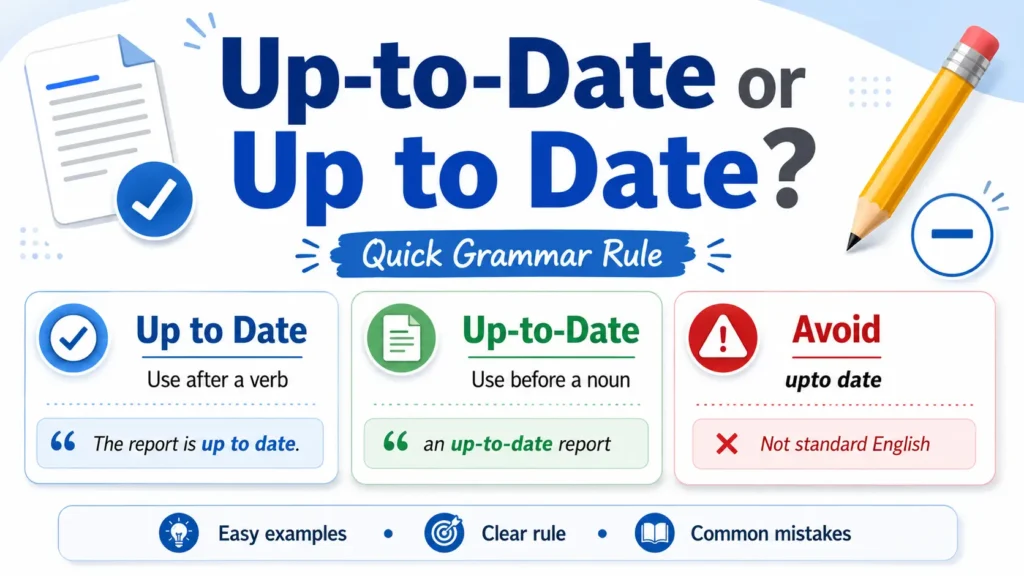
Up-to-date or up to date is a common grammar question because both forms look right, but they work in different ways. The purpose is simple: you need to know when to use the hyphenated form and when to use the open phrase so your writing looks clear, correct, and professional.
In simple English, use up to date after a verb, as in “The report is up to date.” Use up-to-date before a noun, as in “an up-to-date report.” The meaning stays close to the same: something is current, updated, or has the latest information.
This small hyphen rule matters in emails, resumes, business writing, academic writing, blog posts, and everyday messages. When you understand the difference between up to date vs up-to-date, you avoid common mistakes like upto date, improve readability, and make your message easier for readers to trust.
Quick Answer: Up to Date or Up-to-Date?
Use up to date as an open phrase after a verb.
Use up-to-date as a hyphenated adjective before a noun.
Avoid upto date because it is not standard English.
| Form | Correct? | Best Use | Example |
| up to date | Yes | After a verb | The file is up to date. |
| up-to-date | Yes | Before a noun | Send an up-to-date file. |
| upto date | No | Avoid it | “Upto date” is incorrect. |
| up-to date | No | Avoid it | The hyphen pattern is incomplete. |
| up to-date | No | Avoid it | The hyphen placement is wrong. |
Here’s the fastest rule:
Before a noun, use hyphens. After a verb, don’t.
That one sentence solves most of the confusion.
Read this also: Miss, Mrs., or Ms.: Meaning, Difference, and Correct Usage
What Does Up to Date Mean?
Up to date means current, updated, accurate, or informed with the latest available details.
You use up to date when the phrase usually comes after a verb such as is, are, was, stay, keep, bring, or remain.
Examples:
- The software is up to date.
- Please keep me up to date.
- Her records are up to date.
- The team stayed up to date during the project.
- This guide remains up to date for current users.
In these sentences, up to date does not sit directly before a noun. It comes after the thing being described.
Think of it this way:
The phrase tells you the condition of something.
The report is what? Up to date.
The software is what? Up to date.
Your records are what? Up to date.
That’s why the open form works naturally after a verb.
What Does Up-to-Date Mean?
Up-to-date is an adjective. It describes a noun directly.
Use up-to-date when the phrase appears before a noun and works as one describing unit.
Examples:
- an up-to-date report
- an up-to-date website
- an up-to-date database
- an up-to-date resume
- an up-to-date contact list
- an up-to-date medical record
In each example, up-to-date comes right before the noun it describes.
The hyphens connect the words so the reader sees them as one idea. Without hyphens, the phrase can look loose or unfinished.
Compare these:
- Clear: We need an up-to-date policy.
- Awkward: We need an up to date policy.
The first sentence looks cleaner because up-to-date works as a compound adjective.
Up to Date vs Up-to-Date: Key Difference
The main difference between up to date vs up-to-date is sentence position.
| Question | Use | Example |
| Does the phrase come after a verb? | up to date | The schedule is up to date. |
| Does the phrase come before a noun? | up-to-date | We need an up-to-date schedule. |
This is not about meaning. Both forms point to the same basic idea: something is current or updated.
The difference is grammar.
Use Up to Date After a Verb
Use the open form when the phrase follows the subject and verb.
Examples:
- The website is up to date.
- Our records are up to date.
- Your account information looks up to date.
- The manager kept everyone up to date.
- The article needs to stay up to date.
Use Up-to-Date Before a Noun
Use the hyphenated form when the phrase describes a noun directly.
Examples:
- an up-to-date website
- up-to-date records
- an up-to-date article
- an up-to-date account summary
- an up-to-date training manual
Why the Hyphen Matters
Hyphens may look small, but they do real work. They help readers understand which words belong together.
In up-to-date report, the hyphens tell the reader that up-to-date works as one adjective. The whole phrase describes report.
Without hyphens, the phrase can feel clunky:
- Less polished: Please send an up to date report.
- Better: Please send an up-to-date report.
The better version moves faster. It also looks more professional.
This same rule appears in many compound adjectives:
| Open Phrase After a Verb | Hyphenated Before a Noun |
| The author is well known. | a well-known author |
| The job is full time. | a full-time job |
| The decision was last minute. | a last-minute decision |
| The report is up to date. | an up-to-date report |
The pattern stays consistent. When multiple words join together before a noun, hyphens often help.
Is Upto Date Correct?
No, upto date is not correct in standard English.
The correct forms are:
- up to date
- up-to-date
The form upto date often appears because people hear the phrase as one chunk. It also looks similar to words like into, onto, and upon. However, upto is not the correct spelling here.
Incorrect:
- Keep your resume upto date.
- This is an upto date guide.
- Are your records upto date?
Correct:
- Keep your resume up to date.
- This is an up-to-date guide.
- Are your records up to date?
If you write for school, business, blogging, resumes, or client work, avoid upto date completely. It can make otherwise strong writing look careless.
Correct Examples of Up to Date
Use up to date when the phrase comes after a verb or completes the meaning of the sentence.
Everyday Examples
- My phone is up to date.
- Your app is already up to date.
- I like to stay up to date with the news.
- Please keep me up to date on your travel plans.
- The calendar looks up to date now.
Business Examples
- The client file is up to date.
- Our sales dashboard is up to date.
- Keep the project tracker up to date.
- The legal team needs to stay up to date on policy changes.
- Make sure your contact details remain up to date.
Academic Examples
- The research is up to date.
- Students should stay up to date with course announcements.
- The bibliography needs to be up to date.
- This textbook is not fully up to date.
- The professor asked us to keep our notes up to date.
Technology Examples
- The security settings are up to date.
- Your browser must be up to date.
- The backup system stays up to date automatically.
- The database appears up to date.
- Keep your antivirus software up to date.
Correct Examples of Up-to-Date
Use up-to-date before a noun.
Everyday Examples
- Check an up-to-date weather forecast.
- Use an up-to-date map.
- Save an up-to-date emergency contact.
- Bring an up-to-date copy of your ID.
- Read an up-to-date guide before you start.
Business Examples
- We need an up-to-date report.
- Send the up-to-date pricing sheet.
- HR needs an up-to-date employee list.
- The manager requested up-to-date sales data.
- Please attach an up-to-date project timeline.
Academic Examples
- Use up-to-date sources.
- Submit an up-to-date reference list.
- The paper needs up-to-date research.
- Students should review up-to-date course materials.
- A strong thesis needs up-to-date evidence.
Website and SEO Examples
- Publish up-to-date content.
- Add up-to-date product details.
- Keep an up-to-date FAQ section.
- Readers trust up-to-date information.
- Search engines value helpful, accurate, up-to-date pages.
Up to Date or Up-to-Date in Real-Life Writing
Grammar becomes easier when you see it in real situations. Below are examples you can copy, study, and adapt.
Email Example
Correct:
“Hi Sarah, please send the up-to-date invoice list before Friday. Also, keep me up to date if the payment status changes.”
Why it works:
- up-to-date describes invoice list
- up to date comes after keep me
Resume Example
Correct:
“Maintained up-to-date customer records and kept internal documentation up to date.”
Why it works:
- up-to-date describes customer records
- up to date completes the phrase after kept
Blog Example
Correct:
“This article stays up to date with current grammar guidance and includes up-to-date examples for modern writers.”
Why it works:
- up to date comes after stays
- up-to-date describes examples
Software Example
Correct:
“Install the up-to-date version and make sure your system stays up to date.”
Why it works:
- up-to-date describes version
- up to date describes the condition of system
Common Mistakes with Up to Date and Up-to-Date
Even strong writers mix these forms sometimes. The good news? Each mistake has a simple fix.
Mistake: Writing Upto Date
Incorrect:
- Is your profile upto date?
- We need an upto date document.
Correct:
- Is your profile up to date?
- We need an up-to-date document.
Why it matters:
Upto date is not standard English. It looks like a typo.
Mistake: Forgetting Hyphens Before a Noun
Incorrect:
- Please send an up to date report.
- We need up to date information.
Correct:
- Please send an up-to-date report.
- We need up-to-date information.
Why it matters:
Before a noun, the phrase works as one adjective. Hyphens keep it tidy.
Mistake: Adding Hyphens After a Verb
Less ideal:
- The report is up-to-date.
- Your account is up-to-date.
Better:
- The report is up to date.
- Your account is up to date.
Why it matters:
After a verb, the open form usually reads more naturally.
Mistake: Using Both Forms Randomly
Inconsistent:
- The file is up-to-date, and we need an up to date version.
Better:
- The file is up to date, and we need an up-to-date version.
Why it matters:
Consistency helps readers trust your writing.
Mistake: Capitalizing It in the Middle of a Sentence
Incorrect:
- Keep your records Up To Date.
Correct:
- Keep your records up to date.
Only capitalize the phrase in a title or heading when your title style requires it.
Read this also: Miss, Mrs., or Ms.: Meaning, Difference, and Correct Usage
Grammar Tip: Use the Position Test
The easiest grammar trick is the position test.
Ask one question:
Does the phrase come before a noun?
If yes, use up-to-date.
Examples:
- up-to-date records
- up-to-date schedule
- up-to-date version
- up-to-date instructions
Now ask another question:
Does the phrase come after a verb?
If yes, use up to date.
Examples:
- The records are up to date.
- The schedule is up to date.
- The version is up to date.
- The instructions are up to date.
This test works because English often hyphenates compound adjectives before nouns. The same words can lose their hyphens when they appear after the noun.
Mini Case Study: One Hyphen, More Professional Writing
Imagine a small business sends this line to a client:
“Please review the up to date pricing sheet.”
The client understands the meaning, but the phrase looks slightly unfinished. It does not ruin the message. Still, it gives the sentence a rough edge.
Now compare it with this version:
“Please review the up-to-date pricing sheet.”
The second version feels cleaner. It shows attention to detail. That matters in proposals, invoices, contracts, resumes, and client emails.
Now look at another sentence:
“The pricing sheet is up to date.”
Here, the open form works best because the phrase comes after the verb is.
Small fix. Big polish.
That’s the whole point of this rule. You’re not trying to sound fancy. You’re helping the reader move through the sentence without tripping.
Synonyms for Up to Date and Up-to-Date
Sometimes up to date is perfect. Other times, a synonym fits better.
Synonyms for Up to Date
Use these when the phrase comes after a verb.
| Synonym | Example |
| current | The records are current. |
| updated | The file is updated. |
| informed | Keep the team informed. |
| current with | She is current with her training. |
| aware of | Stay aware of policy changes. |
Synonyms for Up-to-Date
Use these before a noun.
| Synonym | Example |
| current | current information |
| latest | latest version |
| updated | updated records |
| modern | modern equipment |
| recent | recent data |
| refreshed | refreshed content |
| revised | revised guidelines |
Which Synonym Should You Choose?
Use latest when you mean the newest version.
Example:
- Download the latest update.
Use current when you mean accurate right now.
Example:
- Enter your current address.
Use modern when you mean not old-fashioned.
Example:
- The office uses modern equipment.
Use updated when something changed recently.
Example:
- Review the updated policy.
Use up-to-date when you want a balanced meaning: current, accurate, and not outdated.
Related Words and Similar Grammar Confusions
The confusion around up to date or up-to-date belongs to a larger pattern in English. Many phrases change spelling depending on how they function in a sentence.
| After a Verb | Before a Noun |
| The job is full time. | a full-time job |
| The author is well known. | a well-known author |
| The plan was last minute. | a last-minute plan |
| The process is long term. | a long-term process |
| The records are up to date. | up-to-date records |
Once you notice the pattern, hyphenation feels less random.
Here are a few related phrases writers often confuse:
Up to Date vs Updated
Updated means someone changed or refreshed something.
Example:
- The manager updated the schedule.
Up to date means something is current now.
Example:
- The schedule is up to date.
The difference is subtle. Updated focuses on the action. Up to date focuses on the current condition.
Current vs Up to Date
Current usually means valid or true right now.
Example:
- Use your current address.
Up to date adds the idea that something has been maintained or refreshed.
Example:
- Keep your address up to date.
Latest vs Up-to-Date
Latest means newest.
Example:
- Install the latest version.
Up-to-date means current and not outdated.
Example:
- Use up-to-date security software.
The latest version is often up to date, but not always. A new file can still contain old information. Sneaky, right?
Read this also: Startup or Start-Up: Which Spelling Is Correct?
Memory Tricks for Up to Date or Up-to-Date
Grammar rules stick better when they come with a simple mental shortcut.
Memory Trick: Noun Nearby, Hyphen Handy
If a noun comes right after the phrase, grab the hyphens.
- up-to-date report
- up-to-date guide
- up-to-date record
No noun right after it? Leave the phrase open.
- The report is up to date.
- The guide is up to date.
- The record is up to date.
Memory Trick: The Sandwich Rule
When the phrase sits before a noun, the hyphens “sandwich” the words together.
up-to-date report
The words hold hands so they can describe the noun as one unit.
Memory Trick: After “Is,” No Hyphens
If the phrase comes after is, are, was, were, stay, keep, or remain, use the open form most of the time.
Examples:
- is up to date
- are up to date
- stay up to date
- keep it up to date
- remain up to date
Quick Reference Table
| Sentence | Correct Form | Why |
| The file is ___ . | up to date | Comes after a verb |
| Send an ___ file. | up-to-date | Comes before a noun |
| Keep me ___ . | up to date | Comes after “keep me” |
| We need ___ data. | up-to-date | Describes “data” |
| Is your resume ___ ? | up to date | Comes after a verb |
| Add an ___ phone number. | up-to-date | Describes “phone number” |
Practice: Choose the Correct Form
Try these before checking the answers.
- The app is ________.
- We need an ________ app.
- Please keep the team ________.
- Use an ________ contact list.
- The training manual is ________.
- She gave us an ________ summary.
- Are your records ________?
- The website needs ________ information.
Answers
- The app is up to date.
- We need an up-to-date app.
- Please keep the team up to date.
- Use an up-to-date contact list.
- The training manual is up to date.
- She gave us an up-to-date summary.
- Are your records up to date?
- The website needs up-to-date information.
FAQs About Up to Date or Up-to-Date
Yes, up to date is correct when it comes after a verb. For example, “The system is up to date” and “Keep me up to date” are both correct. This form means something is current, updated, or has the latest information.
Yes, up-to-date is correct when it comes before a noun. For example, “an up-to-date report,” “an up-to-date resume,” and “up-to-date information” are correct. Here, the words work together as a compound adjective.
The main difference is sentence position. Use up to date after a verb, as in “The document is up to date.” Use up-to-date before a noun, as in “an up-to-date document.” The meaning is similar, but the grammar use is different.
No, upto date is not correct in standard English. It is a common spelling mistake. Use up to date when the phrase comes after a verb, and use up-to-date when it describes a noun before that noun.
Use hyphens in up-to-date when the phrase comes before a noun. For example, write “an up-to-date list” or “up-to-date records.” Do not use hyphens after a verb. Write “The list is up to date,” not “The list is up-to-date.”
Conclusion: Up to Date or Up-to-Date Is Easy Once You Know the Pattern
The difference between up-to-date or up to date becomes easy once you look at the word position. Use up-to-date before a noun because it works as a compound adjective. For example, write “an up-to-date file,” “an up-to-date report,” or “up-to-date information.”
Use up to date after a verb, as in “The file is up to date” or “Keep your records up to date.” This open form sounds natural because it describes the condition of something after the sentence has already named it.
Avoid upto date because it is not the correct form in standard English. A quick way to remember the rule is this: before a noun, use hyphens; after a verb, leave it open. This simple habit helps you write with better grammar accuracy, stronger clarity, and more professional communication.

1 thought on “Up to Date or Up-to-Date: Meaning, Difference, Examples, and Grammar Rule”