
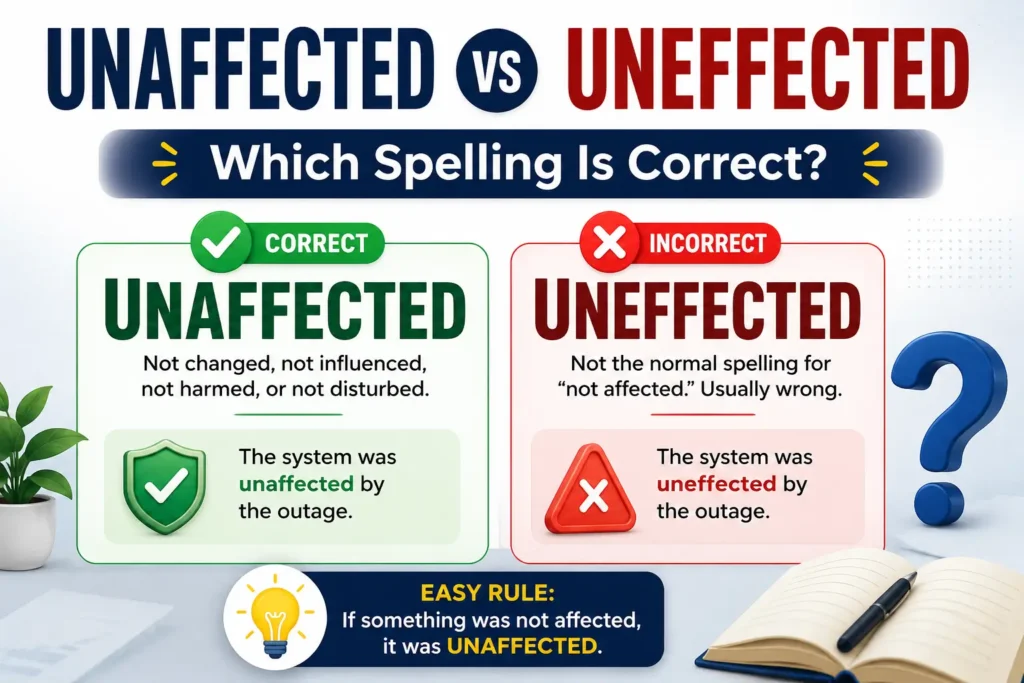
Unaffected vs uneffected is a common spelling confusion because both words look like they should be connected to affect and effect. The correct word in almost all modern American English is unaffected, which means not changed, not influenced, not harmed, or not disturbed. The spelling uneffected is rare and usually wrong when you mean “not affected.”
This difference matters in school essays, work emails, reports, news updates, and everyday writing. If you write “The system was uneffected by the outage,” many readers will see it as a spelling mistake. The correct sentence is “The system was unaffected by the outage.”
The easiest rule is simple: if something was not affected, it was unaffected.
Quick Answer: Unaffected vs Uneffected
Unaffected is the correct word when something is not changed, influenced, harmed, interrupted, or emotionally moved.
Uneffected is not the normal spelling for that meaning. It may appear rarely when someone means “not effected,” or “not brought about,” but that use is uncommon and often unclear.
| Word | Correct Modern Use? | Meaning | Example |
| Unaffected | Yes | Not changed, influenced, harmed, or disturbed | “The schedule was unaffected by the storm.” |
| Uneffected | Rare | Not effected, not carried out, not brought about | “The reform remained uneffected.” |
For everyday writing, academic writing, business communication, and professional content, choose unaffected.
Correct: The files were unaffected by the software update.
Incorrect: The files were uneffected by the software update.
The files were not affected, so they were unaffected.
Read this also: Encorporate vs Incorporate: Which Spelling Is Correct?
What Does Unaffected Mean?
Unaffected is an adjective. It describes something that has not been changed, influenced, harmed, disturbed, or emotionally moved by another person, event, or situation.
Most of the time, unaffected appears with the word by.
Examples:
- “The meeting was unaffected by the delay.”
- “Her confidence was unaffected by the criticism.”
- “The price remained unaffected by the new policy.”
- “The building was unaffected by the earthquake.”
In each sentence, something could have caused a change, but it did not.
Unaffected Meaning: Not Changed or Influenced
The most common meaning of unaffected is not changed or influenced.
Use it when something stays the same even after an event, action, or condition happens.
Examples:
- “The results were unaffected by the small error.”
- “His decision was unaffected by public pressure.”
- “The final score was unaffected by the penalty.”
- “Sales remained unaffected by the price increase.”
These examples show that one thing did not influence another thing.
For example, if sales were unaffected by a price increase, the price change did not raise or lower sales in a meaningful way.
Unaffected Meaning: Not Harmed or Disturbed
Unaffected can also mean not harmed, not damaged, or not disturbed. This use is common in news reports, safety updates, technical notices, medical writing, and business communication.
Examples:
- “The water supply was unaffected by the repairs.”
- “Most accounts were unaffected by the security issue.”
- “The road was unaffected by construction.”
- “The patient’s speech was unaffected after the injury.”
Here, unaffected means the person, object, system, or place stayed safe or normal.
A public notice might say:
“Customer data was unaffected by the service outage.”
That means the outage did not damage, expose, or change the customer data.
Unaffected Meaning: Natural, Genuine, or Sincere
Unaffected has another meaning that is slightly different. It can describe a person, style, tone, performance, or manner that feels natural, genuine, sincere, or not fake.
Examples:
- “She has an unaffected way of speaking.”
- “His writing style is clear and unaffected.”
- “The actor gave an unaffected performance.”
- “Her kindness felt warm and unaffected.”
In this sense, unaffected does not mean “not changed.” Instead, it means someone is not acting in a forced, artificial, or pretentious way.
This meaning is common in book reviews, movie reviews, personal descriptions, and literary writing.
Pronunciation, Part of Speech, and Word Forms
Unaffected is an adjective.
Pronunciation: un-uh-FEK-tid
The stress is on FEK.
| Word | Part of Speech | Meaning | Example |
| affect | verb | to influence or change | “Noise can affect sleep.” |
| affected | adjective or verb form | influenced or changed | “The affected area was closed.” |
| unaffected | adjective | not influenced or changed | “The area was unaffected.” |
| unaffectedly | adverb | in a natural or sincere way | “She spoke unaffectedly.” |
| unaffectedness | noun | naturalness or lack of artificiality | “His unaffectedness made him likable.” |
The most useful word for regular writing is unaffected.
You will often see it in phrases like:
- unaffected by the storm
- unaffected by criticism
- unaffected by the update
- largely unaffected
- mostly unaffected
- completely unaffected
Is Uneffected a Real Word?
Uneffected is rare, and it is not the word you should use when you mean not affected.
In modern English, most readers, teachers, editors, and grammar tools will treat uneffected as a mistake if it appears in a sentence like this:
Incorrect: “The schedule was uneffected by the storm.”
The correct word is:
Correct: “The schedule was unaffected by the storm.”
The storm did not affect the schedule. Therefore, the schedule was unaffected.
Why Uneffected Looks Possible
The spelling uneffected looks possible because effect and effected are real words.
That creates this false pattern:
- effect
- effected
- uneffected
However, effected does not mean the same thing as affected.
Affected means influenced or changed.
Effected means caused, produced, or brought about.
Because the meanings are different, the negative forms are different too.
| Positive Word | Meaning | Negative Form | Meaning |
| affected | influenced or changed | unaffected | not influenced or changed |
| effected | brought about or caused | not effected / rare uneffected | not brought about |
Most people who type uneffected actually mean unaffected.
When Uneffected Might Appear
The word uneffected may appear rarely when someone means not effected, or not brought about.
For example:
- “The reform remained uneffected.”
This means the reform was not carried out or not put into action. However, that sentence sounds old-fashioned and unclear to many modern readers.
Clearer alternatives include:
- “The reform was not carried out.”
- “The reform was not implemented.”
- “The reform was never brought about.”
- “The change did not happen.”
For clear modern writing, these alternatives are usually better than uneffected.
Unaffected vs Uneffected: Main Difference
The main difference between unaffected vs uneffected comes from the difference between affected and effected.
Unaffected means not affected.
Uneffected means not effected, but this is rare and usually avoidable.
| Word | Root Word | Meaning | Best Use |
| Unaffected | affected | not changed, influenced, harmed, or disturbed | Standard modern English |
| Uneffected | effected | not brought about, not carried out | Rare or avoidable usage |
Most sentences need unaffected because they describe whether something was influenced, changed, harmed, or disturbed.
Examples:
- “The results were unaffected by the update.”
- “She was unaffected by the rude comment.”
- “The building was unaffected by the storm.”
In each sentence, the meaning is “not affected.”
Why Unaffected and Uneffected Get Confused
The confusion begins with affect vs effect.
In everyday English, affect is usually a verb. It means to influence.
Example:
- “The weather can affect traffic.”
In most cases, effect is a noun. It means a result.
Example:
- “The medicine had a strong effect.”
That basic rule helps, but there is one important exception. Effect can also be a verb meaning to bring about.
Example:
- “The new policy effected change.”
This sentence means the policy caused change to happen.
Because effected is a real verb form, people sometimes write uneffected by mistake.
Affected vs Effected
Affected and effected are both correct words, but they are not interchangeable.
| Word | Meaning | Example |
| Affected | influenced or changed | “The storm affected travel.” |
| Effected | caused or brought about | “The law effected change.” |
Now compare these:
- “Travel was unaffected by the storm.”
- “The change was not effected by the law.”
The first sentence means travel was not changed or influenced.
The second sentence means the change was not brought about.
Most real-life sentences about unaffected vs uneffected need the first meaning.
Affected, Effected, Unaffected, and Uneffected Compared
This table shows how the related words work.
| Word | Part of Speech | Meaning | Correct Example |
| Affected | verb form/adjective | influenced, changed, or impacted | “The affected customers received refunds.” |
| Effected | verb form | caused, produced, or brought about | “The policy effected major change.” |
| Unaffected | adjective | not influenced, changed, harmed, or disturbed | “The customers were unaffected by the error.” |
| Uneffected | rare adjective | not brought about or not carried out | “The proposal remained uneffected.” |
The key point is simple: affected is about influence, while effected is about causing something to happen.
So, if you mean “not influenced,” the correct word is unaffected.
How to Use Unaffected Correctly
Unaffected usually comes after a linking verb such as was, were, is, remained, seemed, or appeared.
Common pattern:
noun + was/were/remained/seemed + unaffected by + cause
Examples:
- “The schedule was unaffected by the storm.”
- “The results were unaffected by the small error.”
- “Her mood seemed unaffected by the comment.”
- “The city remained unaffected by the power outage.”
This structure is clear and natural in American English.
Use “Unaffected By” for Causes
The standard phrase is unaffected by, not unaffected from.
Correct: “The store was unaffected by the outage.”
Incorrect: “The store was unaffected from the outage.”
The word by introduces the cause or event that did not create a change.
More examples:
- “The flight was unaffected by the delay.”
- “The files were unaffected by the virus scan.”
- “The class schedule was unaffected by the holiday.”
Use by when you explain what did not affect something.
Use Unaffected for People and Emotions
When unaffected describes a person, it often means the person was not emotionally moved, bothered, influenced, or shaken.
Examples:
- “She seemed unaffected by the criticism.”
- “He remained unaffected by the pressure.”
- “They appeared unaffected by the announcement.”
- “The athlete looked unaffected by the crowd.”
This meaning can sound neutral, positive, or negative depending on context.
For example, “She was unaffected by the insult” may suggest emotional strength. However, “He was unaffected by the sad news” could sound cold if the situation calls for sympathy.
Use Unaffected for Objects, Places, and Systems
Unaffected works well for physical objects, software, accounts, services, buildings, roads, and places.
Examples:
- “The server was unaffected by the outage.”
- “The road was unaffected by construction.”
- “The building was unaffected by the storm.”
- “Most user accounts were unaffected by the bug.”
This use is common in technical updates and public notices.
A company might write:
“Only a small group of users experienced login issues. All other accounts were unaffected.”
That sentence quickly tells readers which users were not impacted.
Use Unaffected for Style or Personality
When unaffected means natural or sincere, it often describes how someone behaves, speaks, writes, or performs.
Examples:
- “Her tone was warm and unaffected.”
- “He has an unaffected charm.”
- “The essay has an honest, unaffected style.”
- “The speaker’s manner was calm and unaffected.”
This meaning is useful when you want to praise someone for being genuine.
However, it is a little more formal than words like natural, honest, or down-to-earth.
Incorrect Uses of Uneffected
Many writers use uneffected when they should use unaffected. These mistakes usually happen because the writer is thinking about effect instead of affect.
| Incorrect Sentence | Correct Sentence | Why |
| “The system was uneffected by the outage.” | “The system was unaffected by the outage.” | The outage did not affect the system. |
| “She was uneffected by the criticism.” | “She was unaffected by the criticism.” | The criticism did not influence her. |
| “The results were uneffected by the change.” | “The results were unaffected by the change.” | The change did not alter the results. |
| “Our plans were uneffected by the rain.” | “Our plans were unaffected by the rain.” | The rain did not change the plans. |
In each correction, the meaning is not affected, so the right word is unaffected.
Real-Life Examples of Unaffected in American English
Unaffected appears in many types of real American English. You’ll see it in business updates, school writing, public notices, research reports, and everyday conversation.
Business and Workplace Examples
Business writers use unaffected to explain what stayed normal.
Examples:
- “Customer service hours were unaffected by the system upgrade.”
- “Sales remained unaffected by the pricing change.”
- “The deadline is unaffected by the vendor delay.”
- “Employee access was unaffected by the software issue.”
These sentences are useful because they reduce confusion. Readers know exactly what did not change.
News and Public Updates
News writing often uses unaffected to explain the impact of storms, outages, repairs, delays, and safety issues.
Examples:
- “Most flights were unaffected by the storm.”
- “Local schools were unaffected by the power outage.”
- “The water supply was unaffected by the repair work.”
- “Emergency services remained unaffected during the closure.”
This word helps separate affected areas from unaffected ones.
Academic and Research Writing
Academic writers use unaffected to describe results, variables, control groups, and conclusions.
Examples:
- “The control group remained unaffected by the treatment.”
- “The results were largely unaffected by age differences.”
- “The conclusion was unaffected by the small data adjustment.”
- “Student performance was unaffected by the seating arrangement.”
This use is valuable because research writing needs careful, precise language.
Everyday Conversation
In regular conversation, unaffected can describe plans, feelings, pets, traffic, schedules, or daily situations.
Examples:
- “Our plans are unaffected by the rain.”
- “The dog seemed unaffected by the fireworks.”
- “I was unaffected by the noise.”
- “Her confidence was unaffected by the mistake.”
Although unaffected sounds slightly formal, it still works naturally in everyday English.
Case Study: One Wrong Letter in a Professional Email
Imagine a software company sends this message after a service outage:
“Your account was uneffected by yesterday’s login issue.”
The message is understandable, but the spelling weakens the professionalism. Customers may notice the mistake because uneffected is not the standard word for “not affected.”
Better version:
“Your account was unaffected by yesterday’s login issue.”
This version is clear, correct, and professional.
Now compare another sentence:
“The update was not effected.”
This means the update was not carried out or not implemented. That is a different meaning.
So the practical rule is:
- Use unaffected for “not changed or influenced.”
- Use not effected for “not carried out.”
- Avoid uneffected in normal writing.
Common Mistakes with Unaffected vs Uneffected
Errors with unaffected vs uneffected usually come from spelling confusion, affect/effect confusion, or awkward phrasing.
Using Uneffected Instead of Unaffected
This is the most common mistake.
Incorrect: “The final grade was uneffected by the missing assignment.”
Correct: “The final grade was unaffected by the missing assignment.”
The missing assignment did not affect the final grade. Therefore, unaffected is correct.
Thinking Effected Means Affected
Effected does not usually mean influenced. It means brought about or caused to happen.
Compare:
- “The storm affected the city.”
- “The law effected change.”
The storm influenced the city.
The law caused change.
These meanings are related, but they are not the same.
Writing “Unaffected From” Instead of “Unaffected By”
The phrase unaffected from sounds unnatural in standard English.
Incorrect: “The office was unaffected from the outage.”
Correct: “The office was unaffected by the outage.”
Use by after unaffected when naming the cause.
Using Non-Affected Instead of Unaffected
The phrase non-affected can appear in technical, medical, or scientific writing. Still, unaffected is usually smoother for general writing.
Less natural:
- “The non-affected users did not receive an alert.”
Better:
- “The unaffected users did not receive an alert.”
For blog posts, school essays, emails, and professional updates, unaffected is usually the better choice.
Better Alternatives to Unaffected
Sometimes unaffected is correct, but a synonym may sound more natural. The best choice depends on your meaning.
Synonyms for Not Changed or Influenced
Use these when something stays the same:
| Synonym | Best Context | Example |
| unchanged | schedules, rules, results | “The deadline remains unchanged.” |
| unaltered | documents, files, plans | “The original file is unaltered.” |
| untouched | places or physical things | “The room was untouched.” |
| undisturbed | sleep, peace, quiet | “The baby slept undisturbed.” |
| intact | systems, records, objects | “The records remained intact.” |
Synonyms for Not Harmed
Use these when safety or damage is the focus:
- unharmed
- safe
- undamaged
- intact
- untouched
Examples:
- “The children were unharmed.”
- “The documents remained intact.”
- “The house was undamaged after the storm.”
Synonyms for Emotionally Unaffected
When describing emotions, these words may fit better:
- unmoved
- unbothered
- calm
- composed
- unshaken
- unconcerned
Examples:
- “She stayed calm during the argument.”
- “He seemed unbothered by the comment.”
- “The audience was unmoved by the speech.”
Be careful with unconcerned and indifferent. They can sound negative because they may suggest a lack of care.
Synonyms for Natural and Sincere
When unaffected means “not fake,” these alternatives are often clearer:
- genuine
- sincere
- natural
- honest
- unpretentious
- straightforward
- down-to-earth
Examples:
- “Her tone was sincere.”
- “He has a natural charm.”
- “The essay felt honest and direct.”
Related Words You Should Know
Understanding related words makes unaffected vs uneffected much easier.
| Word | Part of Speech | Meaning | Example |
| affect | verb | to influence or change | “Sleep can affect memory.” |
| effect | noun | a result | “The effect was noticeable.” |
| effect | verb | to bring about | “The leader effected change.” |
| affected | adjective/verb form | influenced or changed | “The affected area was closed.” |
| unaffected | adjective | not influenced or changed | “The area was unaffected.” |
| effective | adjective | successful or working well | “The plan was effective.” |
A simple beginner rule is: affect is usually a verb, and effect is usually a noun.
However, remember the advanced exception: effect can be a formal verb meaning “to bring about.”
Grammar Tips for Using Unaffected Correctly
Good word choice also depends on sentence structure. These tips will help you use unaffected naturally.
Use “Unaffected By” After the Noun
The most common structure is:
noun + was/were/remained/seemed + unaffected by + cause
Examples:
- “The schedule remained unaffected by the storm.”
- “The results were unaffected by the update.”
- “The files seemed unaffected by the scan.”
This pattern is standard, clear, and easy to understand.
Use Adverbs to Show Degree
You can use adverbs before unaffected to show how strongly the word applies.
Common combinations include:
- completely unaffected
- largely unaffected
- mostly unaffected
- relatively unaffected
- seemingly unaffected
- apparently unaffected
Examples:
- “The city was largely unaffected by the storm.”
- “He seemed completely unaffected by the insult.”
- “The data was relatively unaffected by the missing responses.”
These phrases make your meaning more precise.
Choose Simpler Words in Casual Writing
Unaffected is correct, but simpler wording may sound better in casual situations.
Formal:
- “The plan was unaffected by the delay.”
Casual:
- “The delay didn’t change the plan.”
Both sentences are correct. The better choice depends on your audience.
How to Remember Unaffected vs Uneffected
A simple memory trick can help you avoid the mistake every time.
Use the “Affected” Test
Ask yourself:
Did something affect it?
If the answer is no, use unaffected.
Examples:
- The storm did not affect the trip.
- The trip was unaffected by the storm.
Another example:
- The update did not affect the files.
- The files were unaffected by the update.
This test works in most everyday sentences.
Use the “Effected Change” Test
Use effected only when you mean brought about, caused, or made happen.
Example:
- “The new policy effected change.”
That means the policy caused change.
If your sentence does not mean “brought about,” avoid effected and uneffected.
Simple Memory Trick
Remember these connections:
- Affect = influence
- Affected = influenced
- Unaffected = not influenced
- Effect = result
- Effected = brought about
So, when you mean “not influenced,” choose unaffected.
Quick Decision Guide
Use this table when you’re unsure which word to choose.
| Meaning You Want | Correct Choice | Example |
| Not changed | unaffected | “The rule is unaffected.” |
| Not influenced | unaffected | “She was unaffected by pressure.” |
| Not harmed | unaffected | “The files were unaffected.” |
| Natural or sincere | unaffected | “He has an unaffected style.” |
| Not carried out | not effected | “The change was not effected.” |
| Rare wording for not carried out | uneffected | Usually better avoided |
In short, unaffected is almost always the word you need.
Practice: Unaffected or Uneffected?
Choose the best answer for each sentence.
| Sentence | Best Answer | Why |
| “The final score was ___ by the penalty.” | unaffected | The penalty did not change the score. |
| “Her confidence seemed ___ by the criticism.” | unaffected | The criticism did not influence her confidence. |
| “The change was never fully ___.” | effected or carried out | The meaning is “brought about.” |
| “Most users were ___ by the app update.” | unaffected | The update did not affect them. |
| “His speech had an ___ honesty.” | unaffected | Here, it means natural and sincere. |
| “The files were ___ by the software update.” | unaffected | The update did not change or harm the files. |
Notice that unaffected fits most examples because most sentences mean “not affected.”
FAQs About Unaffected vs Uneffected
Q1: Is “uneffected” a real word?
Uneffected exists in rare usage, but it is not the standard word for not affected. In modern American English, you should usually avoid it. Use unaffected when you mean not changed, not influenced, not harmed, or not disturbed.
Q2: Which is correct: unaffected or uneffected?
Unaffected is correct in almost all everyday, academic, business, and professional writing.
Correct:
- “The schedule was unaffected by the storm.”
Incorrect:
- “The schedule was uneffected by the storm.”
The storm did not affect the schedule, so unaffected is the right word.
Q3: What does unaffected mean?
Unaffected means not changed, influenced, harmed, disturbed, or emotionally moved. It can also mean natural, sincere, or not artificial.
Examples:
- “The results were unaffected.”
- “She seemed unaffected by the comment.”
- “His style is simple and unaffected.”
Q4: Why do people write uneffected by mistake?
People often write uneffected because they confuse affect and effect. Since effect is a common word, uneffected may look logical.
However, when the meaning is “not influenced,” the base word is affected. The correct negative form is unaffected.
Q5: Can I use uneffected in formal writing?
Avoid uneffected in formal writing unless you clearly mean “not effected,” or “not brought about.” Even then, clearer phrases like not carried out, not implemented, or not brought about are usually better.
For school, work, blogging, journalism, and business writing, use unaffected.
Q6: Is it “unaffected by” or “unaffected from”?
The correct phrase is unaffected by.
Correct:
- “The area was unaffected by the storm.”
Incorrect:
- “The area was unaffected from the storm.”
Use by to show the cause that did not create a change.
Q7: Is “non-affected” correct?
Non-affected can appear in technical or medical writing, especially when comparing affected and non-affected groups. Still, unaffected is usually more natural for general writing.
Better:
- “The unaffected accounts were not included in the alert.”
Less natural:
- “The non-affected accounts were not included in the alert.”
Q8: Can unaffected describe emotions?
Yes. Unaffected can describe someone who is not emotionally moved, bothered, influenced, or disturbed.
Example:
- “She seemed unaffected by the rude comment.”
This means the comment did not visibly upset or influence her.
Q9: Can unaffected describe personality?
Yes. Unaffected can describe a natural, sincere, or unpretentious personality.
Example:
- “He has an unaffected charm.”
This means his charm feels genuine rather than forced or fake.
Q10: What is the opposite of unaffected?
The most direct opposite of unaffected is affected.
Other opposites include:
- changed
- influenced
- altered
- harmed
- disturbed
- moved
- impacted
Example:
- “The affected areas lost power.”
- “The unaffected areas remained open.”
Read this also: Grately vs Greatly: Correct Spelling, Meaning, Grammar, and Examples
Conclusion: Unaffected vs Uneffected
Unaffected vs uneffected may look like a small spelling issue, but the difference comes from affect and effect. Use unaffected when something is not changed, not influenced, not harmed, not disturbed, or not emotionally moved.
The word uneffected is rare and should not replace unaffected in modern American English. If you use uneffected to mean “not affected,” most readers will treat it as a mistake.
For clear writing, remember this rule:
If something was not affected, it was unaffected.
So, write “unaffected by the storm,” “unaffected by criticism,” “unaffected by the update,” and “unaffected by the change.” Avoid uneffected unless you have a rare and specific reason to mean not effected, or not brought about.
