Bring vs Take: Meaning, Difference, Rules, and Easy Examples

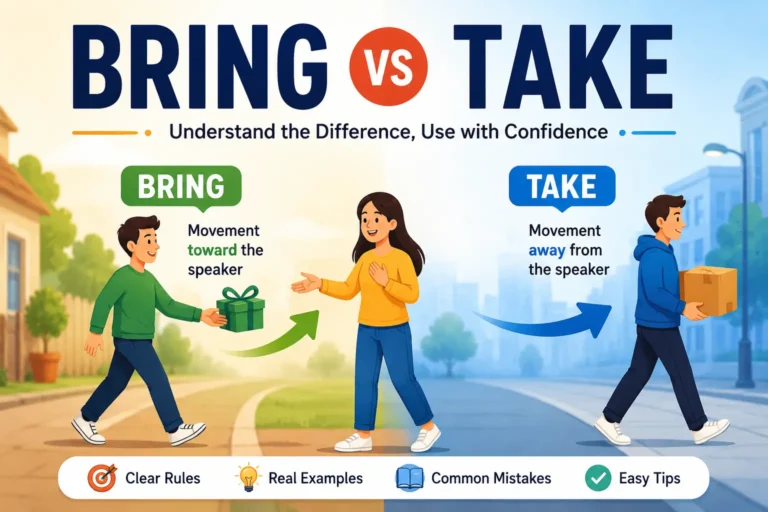
Bring vs Take showing the difference between movement toward and away

Bring vs take can be confusing because both verbs describe moving a person or thing from one place to another. The main difference is direction and perspective. Generally, use bring when something moves toward the speaker, listener, or a relevant destination. Use take when something moves away from that point. For example, “Please bring your … Read more

Neither vs Either: Meaning, Usage, and Grammar Rules

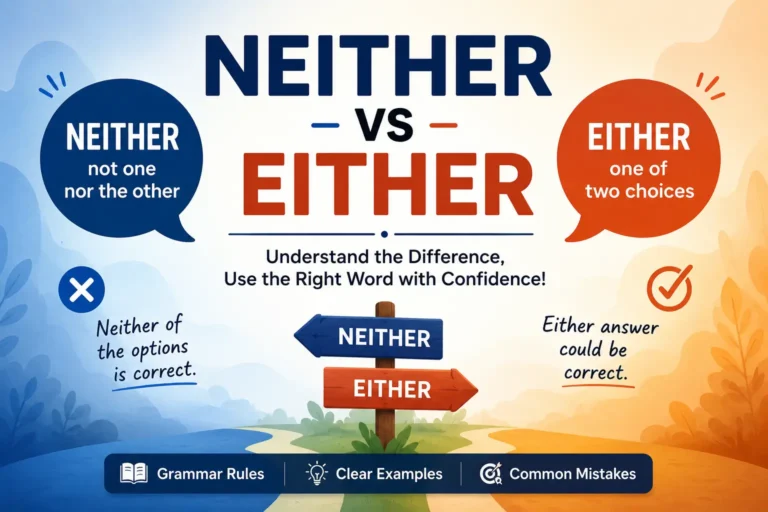
Neither vs Either showing the difference between two choices and rejecting both options

Neither vs Either is a common English grammar question because both words are used when talking about two choices, but they don’t mean the same thing. Either usually means one of two options, while neither means not one and not the other. Knowing this difference helps you choose the right word and avoid common grammar … Read more

Among vs Between: Meaning, Differences, Rules, and Examples

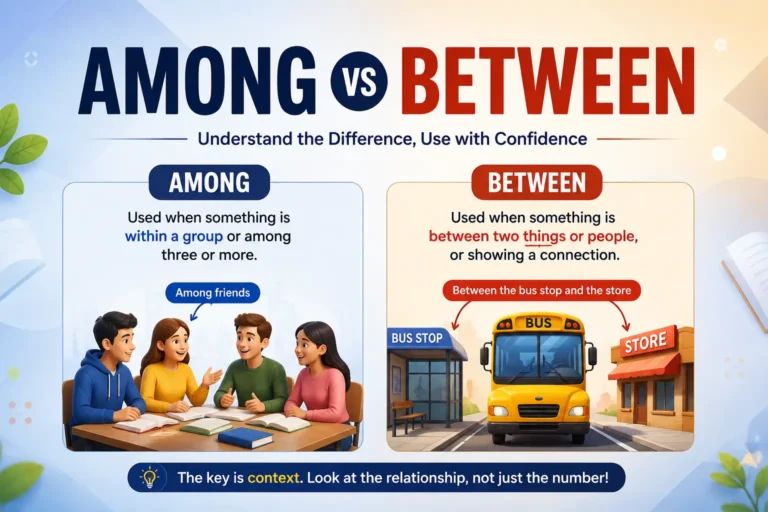
Among vs between grammar comparison showing how to use each word correctly

Among vs. between can be confusing because both words describe relationships involving people, things, places, and ideas. The key is simple: between usually highlights separate or clearly identified relationships, while among usually places someone or something within a group. Both words are prepositions, but they don’t always work in the same situations. The old rule … Read more

Mine as Well or Mind as Well: Which Is Correct?

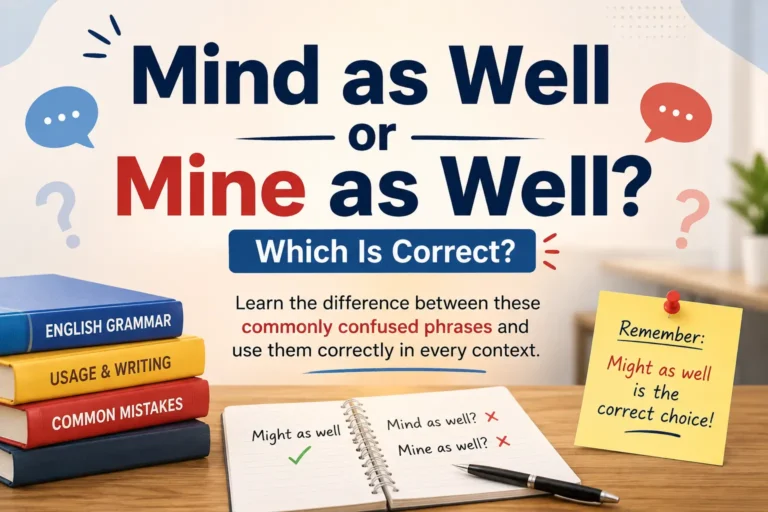
Mind as well or mine as well: learn why might as well is correct

Mind as well or mine as well are common spellings people use when they hear the phrase “might as well” in fast conversation. However, neither mind as well nor mine as well is the standard expression when you mean that something is a sensible choice because there’s little reason not to do it. The correct … Read more

Domino Affect or Effect: Which One Is Correct?

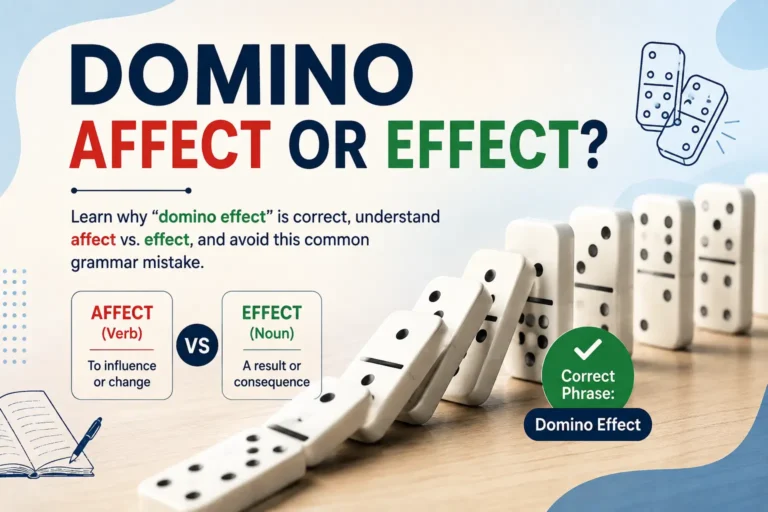
Domino affect or effect explained with the correct domino effect grammar usage

Domino affect or effect is a common grammar question, but the correct phrase is domino effect. Effect is a noun meaning a result or consequence, while affect is usually a verb meaning “to influence.” So, when one event triggers a chain of connected events, write domino effect, not “domino affect.” The confusion is understandable because … Read more

In Route vs En Route: Meaning, Correct Usage, and Examples

In route vs en route meaning and correct usage with a bus on the road

The in route vs en route difference is simple: use en route for “on the way,” while in-route may appear only in technical labels or route systems. En-route is the standard expression for movement toward a destination. It fits travel language, formal writing, professional English, and everyday English. For example, write, “The driver is en … Read more

Eventhough vs Even Though: Correct Spelling, Meaning, Grammar Rules, and Examples

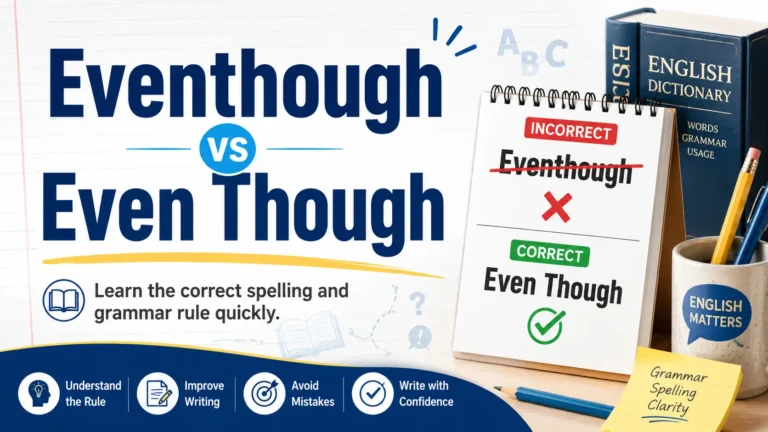
Eventhough vs Even Though comparison showing the incorrect and correct spelling with a simple English grammar guide.

Many English learners and native speakers confuse eventhough vs even though because both forms look similar while typing fast or writing in everyday usage. However, the correct spelling is always even though, which is a proper English phrase and a standard form in English. Eventhough is an incorrect spelling and a common spelling mistake that … Read more

Canvas vs Canvass: What Is the Difference and How Do You Use Them Correctly?

Canvas vs Canvass comparison showing the difference in meaning and correct English usage

Canvas vs Canvass is a common spelling and vocabulary confusion because both words look similar and sound similar, yet their meanings and uses are completely different. Canvas usually refers to a strong fabric or material used for paintings, bags, shoes, and other products. For example, an artist may paint on a canvas, while a company … Read more

Respond vs Response: Difference, Meaning, Grammar Rules, and Correct Usage

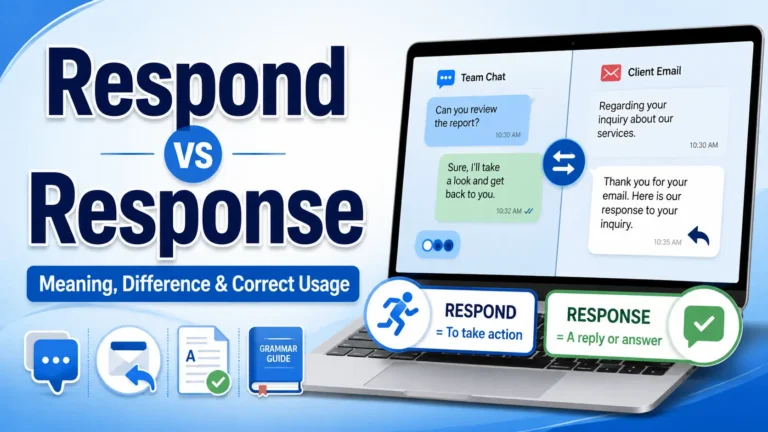
Respond vs response meaning, difference, grammar rules, and correct usage explained

Respond vs response becomes easy to understand once you know their grammar roles. Respond is a verb that means to answer, reply, or react. Response is a noun that means an answer, reaction, or result. Although these words look similar, they work differently in English. Knowing this difference improves writing, speaking, emails, and professional communication … Read more

Personal vs Personnel: What’s the Difference? Meaning, Usage, and Examples

Personal vs Personnel difference with private matters and company staff

Personal vs Personnel can be confusing because the two words look and sound similar but have very different meanings. Personal is usually an adjective that describes something related to one person, their private life, belongings, opinions, goals, or interests. Personnel, on the other hand, is a noun that refers to employees, staff, or people who … Read more