
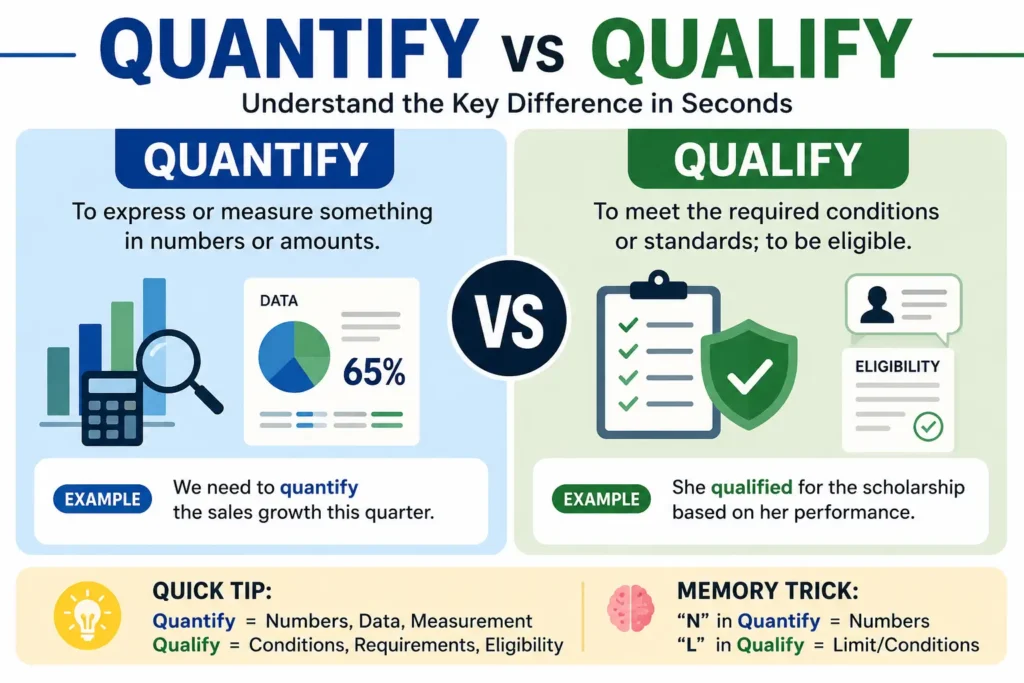
The words quantify and qualify look and sound similar, so it’s easy to mix them up. However, they do very different jobs in English. One word is about numbers, amounts, data, and measurement. The other is about requirements, limits, conditions, and added detail.
The difference matters in school essays, business emails, reports, resumes, research papers, and everyday conversation. If you write “qualify the cost” when you mean “measure the cost,” your sentence may sound confusing. If you write “quantify for a scholarship” when you mean “meet the requirements,” the word is simply wrong.
The simple rule is this: quantify connects to quantity, while qualify connects to qualification or conditions. Once you understand that connection, choosing the right word becomes much easier.
Quick Answer: Quantify vs Qualify
Quantify means to measure, count, or express something in numbers.
Qualify means to meet requirements, become eligible, or add limits and conditions to a statement.
| Word | Simple Meaning | Main Idea | Example |
| Quantify | To measure with numbers | Amount, quantity, data | “We need to quantify the results.” |
| Qualify | To meet requirements or add conditions | Eligibility, limits, context | “She qualified for the program.” |
Use quantify when you can ask, “How much?” or “How many?”
Use qualify when you can ask, “Does this meet the requirements?” or “What conditions should be added?”
Quick memory trick:
Quantify = quantity.
Qualify = qualification or condition.
Read this also: Courtesy vs Curtesy: Difference, Meaning, and Correct Usage
What Does Quantify Mean?
Quantify is a verb that means to measure something or express it as a number. When you quantify something, you make it more specific by using figures, amounts, percentages, scores, totals, or measurable data.
For example, “Sales improved” is a general statement. It tells the reader that sales got better, but it doesn’t say how much better.
“Sales increased by 18%” is quantified. It gives a clear number.
That’s the power of quantify. It turns vague information into measurable information.
Quantify Definition in Simple English
To quantify something means to answer questions like:
- How much?
- How many?
- How often?
- How large?
- How small?
- What percentage?
- What amount?
- What number?
Here are simple examples:
- “The company quantified its losses.”
- “The study quantified the effect of sleep on memory.”
- “Can you quantify the improvement?”
- “The report quantified the number of new customers.”
In each sentence, quantify points to measurement.
Part of Speech and Pronunciation
Quantify is a verb.
Pronunciation: KWAHN-tuh-fy
Common word forms include:
| Form | Example |
| quantify | “We need to quantify the cost.” |
| quantifies | “The chart quantifies the results.” |
| quantified | “The team quantified the damage.” |
| quantifying | “They are quantifying the risk.” |
| quantification | “The quantification of data takes time.” |
The noun quantification means the act or process of measuring something in numbers.
How to Use Quantify in a Sentence
The most common pattern is:
quantify + noun
Examples:
- “Please quantify the results.”
- “The survey quantifies customer satisfaction.”
- “The team quantified the cost of the delay.”
- “It’s difficult to quantify the emotional impact.”
You can quantify many things, especially when they can be counted, estimated, scored, or measured.
Common nouns used with quantify include:
- results
- cost
- damage
- impact
- risk
- progress
- growth
- improvement
- performance
- savings
- losses
- traffic
- revenue
- productivity
Correct Examples of Quantify
Correct: “We need to quantify the financial impact of the policy.”
This is correct because financial impact can be measured in dollars, percentages, or other figures.
Correct: “The teacher asked students to quantify the survey results.”
This works because survey results often include numbers, percentages, and totals.
Correct: “It’s hard to quantify how much stress the project caused.”
This sentence is also possible. Stress is not always easy to measure, but it can be quantified with surveys, scales, or ratings.
Why Quantify Is Useful
Quantify is especially useful in professional and academic writing because numbers make claims stronger.
Compare these two sentences:
| Vague Sentence | Quantified Sentence |
| “The campaign performed well.” | “The campaign increased website traffic by 42%.” |
| “She helped the company save money.” | “She reduced monthly expenses by $3,500.” |
| “The students improved.” | “The students’ average score rose from 72 to 86.” |
The quantified versions are clearer, stronger, and more believable.
That’s why resume writers, business professionals, researchers, and marketers often use quantify.
What Does Qualify Mean?
Qualify is also a verb, but it has a different meaning from quantify. The word qualify can mean to meet requirements, to become eligible, or to add limits and conditions to a statement.
This is why qualify can be confusing. It has more than one common use.
However, all major uses share one idea: qualify adds a condition, standard, or requirement.
Qualify Definition in Simple English
To qualify can mean:
- to meet the requirements for something
- to become eligible for something
- to add limits, conditions, or details to a statement
- to make a claim more careful or accurate
Examples:
- “She qualified for the scholarship.”
- “He qualified for the final round.”
- “The lawyer qualified the statement.”
- “The phrase ‘in most cases’ qualifies the rule.”
In the first two examples, qualify means to meet requirements. In the last two, it means to limit or add conditions.
Part of Speech and Pronunciation
Qualify is a verb.
Pronunciation: KWAH-luh-fy
Common word forms include:
| Form | Example |
| qualify | “You may qualify for a discount.” |
| qualifies | “This purchase qualifies for free shipping.” |
| qualified | “She qualified for the position.” |
| qualifying | “The team played a qualifying match.” |
| qualification | “A degree is one qualification for the job.” |
| qualifier | “The word ‘usually’ is a qualifier.” |
The noun qualification usually means a skill, credential, condition, or requirement.
The noun qualifier often means a word or phrase that limits or changes another word or statement.
Qualify Meaning: To Meet Requirements
One of the most common meanings of qualify is to meet the requirements for something.
You can qualify for:
- a job
- a loan
- a discount
- a scholarship
- a program
- a race
- a competition
- a benefit
- financial aid
- insurance coverage
Examples:
- “She qualified for the scholarship because of her grades.”
- “You may qualify for a lower interest rate.”
- “The team qualified for the playoffs.”
- “Only applicants with two years of experience qualify for the role.”
In this meaning, qualify is about eligibility. Someone or something meets a standard.
Correct Use with “For”
When qualify means “be eligible,” it is often followed by for.
Correct: “He qualified for the loan.”
Correct: “This order qualifies for free shipping.”
Correct: “She qualified for the state finals.”
Avoid using quantify in these sentences. You don’t measure for a scholarship or a discount. You meet the requirements.
Qualify Meaning: To Add Conditions or Limits
Qualify can also mean to add a condition, limit, or explanation to a statement. This use is common in writing, law, research, business communication, and careful speech.
For example:
Broad claim: “Remote work increases productivity.”
That sentence sounds absolute. It suggests remote work always increases productivity.
Qualified claim: “Remote work can increase productivity for some employees when they have a quiet workspace.”
The second sentence is more careful. It adds conditions: for some employees and when they have a quiet workspace.
That’s what it means to qualify a statement.
Examples of Qualifying a Statement
| Strong Claim | Qualified Claim |
| “This product is the best.” | “This product is one of the best options for small businesses.” |
| “Exercise prevents illness.” | “Regular exercise may reduce the risk of some illnesses.” |
| “Everyone liked the new policy.” | “Most employees responded positively to the new policy.” |
| “The results prove the theory.” | “The results support the theory under these conditions.” |
A qualified statement is often more accurate because it avoids overstatement.
Common Qualifying Words and Phrases
Qualifying words soften, limit, or narrow meaning.
Common qualifiers include:
- usually
- often
- sometimes
- may
- might
- can
- could
- likely
- probably
- generally
- somewhat
- nearly
- almost
- in most cases
- under certain conditions
- based on the available data
These words help writers sound more precise.
For example:
- “This method usually works.”
- “The results may suggest a pattern.”
- “The plan could reduce costs.”
- “In most cases, the rule applies.”
These sentences are careful. They don’t claim more than they can support.
Quantify vs Qualify: The Main Difference
The main difference between quantify vs qualify is simple:
Quantify is about numbers and measurement.
Qualify is about requirements, limits, and conditions.
| Feature | Quantify | Qualify |
| Main meaning | Measure with numbers | Meet requirements or add conditions |
| Main idea | Quantity | Qualification |
| Answers | How much? How many? | Under what conditions? Eligible for what? |
| Common in | Data, reports, analytics, resumes | Eligibility, careful writing, claims, feedback |
| Example | “Quantify the savings.” | “Qualify for a discount.” |
| Related words | quantity, quantitative | qualification, qualifier, qualitative |
The One-Question Test
Ask yourself this question:
Am I talking about numbers?
If yes, use quantify.
Example:
- “We need to quantify the cost.”
- “Can you quantify the results?”
- “The survey quantified customer opinions.”
Now ask:
Am I talking about eligibility, requirements, conditions, or limits?
If yes, use qualify.
Example:
- “She qualified for the award.”
- “The statement needs to be qualified.”
- “This purchase qualifies for a rebate.”
When to Use Quantify
Use quantify when you want to measure something. This word is especially useful when you need data, numbers, or proof.
Use Quantify for Data and Measurements
Quantify works naturally with research, analytics, surveys, and reports.
Examples:
- “The study quantified the relationship between sleep and test scores.”
- “The dashboard quantifies monthly website traffic.”
- “The survey helped quantify customer satisfaction.”
In each case, numbers help explain the result.
Use Quantify for Business Results
In business writing, quantify often means to turn performance into measurable results.
Examples:
- “The team quantified the return on investment.”
- “We need to quantify the cost of employee turnover.”
- “The report quantified a 12% drop in production time.”
This use is common in reports, presentations, project updates, and executive summaries.
Use Quantify on a Resume
Resume advice often tells job seekers to quantify achievements. That means adding numbers to show clear results.
Weak resume bullet:
- “Improved customer service.”
Stronger quantified bullet:
- “Improved customer satisfaction scores from 81% to 94% in six months.”
Weak resume bullet:
- “Managed a team.”
Stronger quantified bullet:
- “Managed a team of 12 employees across three departments.”
Numbers make achievements easier to understand.
When to Use Qualify
Use qualify when you’re talking about requirements, eligibility, or careful limits.
Use Qualify for Eligibility
This is the easiest use to understand.
Examples:
- “You may qualify for financial aid.”
- “The athlete qualified for the national competition.”
- “This purchase qualifies for free delivery.”
- “Applicants must qualify before they can join the program.”
Here, qualify means meet the necessary standard.
Use Qualify for Careful Claims
In academic and professional writing, you often need to qualify your claims. This means you avoid saying something too broad or too certain.
Too broad:
- “Social media harms teenagers.”
Qualified:
- “Heavy social media use may affect sleep and attention in some teenagers.”
The qualified version is more responsible. It gives room for context and evidence.
Use Qualify in Feedback
Qualify can also help soften feedback.
Direct:
- “Your report was unclear.”
Qualified:
- “Some sections of your report were unclear, especially the data analysis section.”
The second sentence is more specific and fair. It doesn’t attack the whole report.
Quantify vs Qualify in Real-Life English
The difference becomes clearer when you see both words in real contexts.
Business Example
A manager says:
“Before we approve the new plan, we need to quantify the cost and qualify the risks.”
This sentence uses both words correctly.
Quantify the cost means measure the cost in dollars.
Qualify the risks means explain the risks with conditions, limits, or context.
For example, a risk might depend on timing, budget, staffing, or market conditions.
Research Example
A researcher might write:
“The study quantified the increase in reading scores but qualified the findings because the sample size was small.”
Here, quantified means the increase was measured.
Qualified means the researcher added a limitation. The results may be useful, but they should be interpreted carefully.
Resume Example
A job seeker might say:
“I quantified my achievements to show measurable results, and I qualified for the role because of my project management experience.”
This sentence also uses both words correctly.
The person added numbers to achievements and met the job requirements.
Everyday Conversation Example
Imagine someone says:
“Can you quantify how much time we saved?”
That means: Can you give a number?
Maybe the answer is:
- “We saved two hours.”
- “We cut the process by 30%.”
- “We finished 45 minutes earlier than usual.”
Now compare:
“Do we qualify for the group discount?”
That means: Do we meet the requirements?
Maybe the requirement is ten people, a student ID, or an early booking.
Quantify vs Qualify Examples
Examples make the difference easier to remember.
Correct Examples with Quantify
- “Can you quantify the damage from the storm?”
- “The report quantified the company’s annual growth.”
- “The app quantifies your daily screen time.”
- “The teacher asked students to quantify the survey responses.”
- “It’s hard to quantify the value of a good mentor.”
- “The accountant quantified the savings from the new tax plan.”
Correct Examples with Qualify
- “She qualified for the final interview.”
- “The team qualified for the playoffs.”
- “This coupon qualifies for online purchases only.”
- “He qualified his answer by saying more research was needed.”
- “The word ‘usually’ qualifies the rule.”
- “The candidate is qualified for the position.”
Sentences Using Both Words
- “The report quantified the losses but qualified the conclusion because some records were missing.”
- “You should quantify your resume achievements and qualify broad claims with context.”
- “The survey quantified customer complaints, while the manager qualified the results by explaining seasonal delays.”
- “The analyst quantified the financial risk and qualified the recommendation with several conditions.”
These examples show that the words can appear in the same sentence, but they still have separate meanings.
Common Mistakes with Quantify and Qualify
Because the words look similar, writers often choose the wrong one. Here are the most common mistakes.
Using Qualify When You Mean Measure
Incorrect: “We need to qualify the cost of the project.”
Correct: “We need to quantify the cost of the project.”
Why? Cost is measured in numbers. You can estimate it in dollars, percentages, or totals. So quantify is the right word.
Using Quantify When You Mean Become Eligible
Incorrect: “She quantified for the scholarship.”
Correct: “She qualified for the scholarship.”
Why? A person does not “quantify for” a scholarship. A person qualifies for it by meeting requirements.
Using Quantify for Something That Has No Measurement
Weak: “Can you quantify how beautiful the painting is?”
This sounds awkward unless you have a scoring system.
Better:
- “Can you describe why the painting is beautiful?”
- “Can you rate the painting on a scale from 1 to 10?”
If you use a rating scale, then you can quantify the response.
Thinking Qualify Only Means “Meet Requirements”
Many learners know qualify from sentences like “qualify for a job.” However, the word also means to limit or add conditions.
Example:
- “The word ‘sometimes’ qualifies the statement.”
That means sometimes makes the statement less absolute.
Quantify vs Qualitative and Quantitative
The words quantify, qualify, qualitative, and quantitative are related, but they are not the same.
Quantify and Quantitative
Quantify is a verb. It means to measure something with numbers.
Quantitative is an adjective. It describes information based on numbers.
Examples of quantitative information include:
- percentages
- scores
- totals
- rankings
- dollar amounts
- measurements
- statistics
Example:
- “The team used quantitative data to quantify the results.”
That means the team used numerical data to measure the results.
Qualify and Qualitative
Qualify is a verb. It means to meet requirements or add conditions.
Qualitative is an adjective. It describes information based on qualities, descriptions, opinions, or observations.
Examples of qualitative information include:
- interview responses
- customer comments
- personal opinions
- written feedback
- classroom observations
- product reviews
Example:
- “The survey included qualitative feedback from customers.”
This means the feedback used words and descriptions, not just numbers.
Quantitative vs Qualitative Data
| Type of Data | Focus | Example |
| Quantitative data | Numbers and measurements | “82% of customers were satisfied.” |
| Qualitative data | Descriptions and qualities | “Customers said the service was friendly.” |
Both types of data are useful.
Quantitative data tells you how much or how many.
Qualitative data tells you why, how, or what kind.
Important Note
Don’t assume qualify and qualitative are interchangeable.
They are related by word family, but they do different jobs.
- Qualify is an action.
- Qualitative describes a type of information.
Correct:
- “The researcher qualified the claim.”
- “The researcher collected qualitative data.”
Incorrect:
- “The researcher qualitatived the claim.”
That form does not exist.
Quantify vs Quantitate
Another related word is quantitate.
Quantitate means to determine or measure the quantity of something. It is close in meaning to quantify, but it is much less common in everyday English.
Quantify Is Usually Better
In most general, business, academic, and everyday writing, quantify is the better choice.
Use:
- “The team quantified the results.”
- “The report quantified the increase.”
- “The survey quantified the change.”
These sound natural and clear.
When Quantitate May Appear
Quantitate is more likely to appear in technical, scientific, or laboratory contexts.
Example:
- “The lab quantitated the amount of protein in the sample.”
Even there, many readers will understand quantify more easily. So unless you’re writing for a technical audience that expects quantitate, choose quantify.
Grammar Notes: Quantifiers and Qualifiers
Understanding quantifiers and qualifiers can help you remember the difference between quantify vs qualify.
What Is a Quantifier?
A quantifier is a word that shows amount or number.
Common quantifiers include:
- many
- much
- several
- few
- a few
- some
- all
- most
- enough
- no
- each
- every
Examples:
- “Many students passed the test.”
- “Several employees joined the meeting.”
- “Most customers liked the update.”
- “Few people noticed the error.”
Quantifiers answer questions about amount.
What Is a Qualifier?
A qualifier is a word or phrase that limits, softens, or changes the strength of another word or statement.
Common qualifiers include:
- very
- fairly
- somewhat
- almost
- nearly
- usually
- probably
- maybe
- in some cases
- to some extent
Examples:
- “The movie was somewhat interesting.”
- “The answer is probably correct.”
- “The rule usually applies.”
- “The project is nearly finished.”
Qualifiers add nuance. They can make a statement less absolute or more precise.
Synonyms for Quantify and Qualify
Synonyms can help you understand the exact meaning of each word. However, not every synonym works in every sentence.
Synonyms for Quantify
Use these when you mean measure or express with numbers:
| Synonym | Best Use |
| measure | general use |
| count | number of items |
| calculate | math or figures |
| estimate | approximate amount |
| assess | evaluate, often with data |
| determine | find out clearly |
| evaluate | judge or measure value |
| express numerically | formal or technical writing |
Examples:
- “We need to measure the cost.”
- “The team calculated the total savings.”
- “The report expressed the results numerically.”
Synonyms for Qualify
Use these when you mean meet requirements, limit, or add conditions:
| Synonym | Best Use |
| be eligible | requirements |
| meet the requirements | applications or programs |
| certify | official approval |
| limit | narrow a statement |
| modify | change meaning |
| soften | make less direct |
| clarify | make clearer |
| add conditions | careful writing |
Examples:
- “She is eligible for the award.”
- “He softened his statement.”
- “The writer added conditions to the claim.”
Easy Memory Tricks for Quantify vs Qualify
Here are simple ways to remember the difference.
Think Quantity for Quantify
The word quantify contains the idea of quantity.
Quantity means amount.
So quantify means to express the amount.
Example:
- “Quantify the results” means give the numbers.
Think Qualification for Qualify
The word qualify connects to qualification.
A qualification is a requirement, skill, condition, or credential.
Example:
- “Qualify for the job” means meet the job requirements.
Use the Numbers-or-Conditions Test
Ask yourself:
Do I need a number?
Use quantify.
Do I need a condition, requirement, or limit?
Use qualify.
This test works in most sentences.
Practice: Quantify or Qualify?
Choose the correct word for each sentence.
| Sentence | Correct Word | Why |
| “Can you ___ the results?” | quantify | Results can be measured. |
| “She didn’t ___ for the loan.” | qualify | She didn’t meet the requirements. |
| “The word ‘usually’ ___ the rule.” | qualifies | It limits the rule. |
| “We need to ___ the financial risk.” | quantify | Risk can be estimated or measured. |
| “This order may ___ for free shipping.” | qualify | The order may meet the condition. |
| “The study ___ the effect of exercise on mood.” | quantified | The study measured the effect. |
| “He ___ his statement with more context.” | qualified | He added limits or explanation. |
| “The company wants to ___ its yearly savings.” | quantify | Savings can be shown in numbers. |
Real-Life Case Study: How One Wrong Word Changes Meaning
Imagine a business team is reviewing a new marketing campaign.
A manager writes:
“We need to qualify the campaign results before the meeting.”
This sentence is possible, but it may not say what the manager means.
If the manager means the team should measure sales, clicks, leads, and revenue, the correct word is quantify.
Better:
“We need to quantify the campaign results before the meeting.”
That means the team needs numbers.
However, if the manager means the team should explain the limits of the results, qualify may be correct.
Example:
“We need to qualify the campaign results because the test only ran for one week.”
That means the team should add context. The results may be useful, but they have limits.
This shows why context matters. Quantify gives numbers. Qualify gives conditions.
Quick Usage Tips for American English
In American English, both words sound natural in formal, academic, and professional settings. However, they are less common in casual conversation than simpler alternatives.
In Casual English
People may say:
- “Can you measure it?”
- “How much was it?”
- “Do I meet the requirements?”
- “Can you explain the limits?”
These are simpler than quantify or qualify.
In Professional English
Professionals often use quantify when discussing performance.
Examples:
- “Quantify the savings.”
- “Quantify the risk.”
- “Quantify the impact.”
They use qualify when discussing eligibility or careful claims.
Examples:
- “Does this client qualify?”
- “We should qualify that statement.”
- “The conclusion needs to be qualified.”
In Academic English
Academic writers often use both words.
Examples:
- “The study quantified the difference between the two groups.”
- “The author qualified the conclusion by noting several limitations.”
This use is common because academic writing values both evidence and caution.
Read this also: Unorganized vs Disorganized: Meaning, Difference, and Examples
FAQs About Quantify vs Qualify
Q1: Is quantify the same as qualify?
No. Quantify means to measure or express something in numbers. Qualify means to meet requirements or add conditions, limits, or details to a statement.
Example:
- “Quantify the cost” means measure the cost.
- “Qualify for the discount” means meet the requirements for the discount.
Q2: What is the easiest way to remember quantify vs qualify?
Connect quantify with quantity and qualify with qualification.
A quantity is an amount, so quantify means measure the amount.
A qualification is a requirement or condition, so qualify means meet a requirement or add a condition.
Q3: Can you quantify a person?
Usually, you don’t quantify a person directly. You quantify something about the person, such as performance, results, habits, scores, or achievements.
Better examples:
- “The coach quantified the athlete’s progress.”
- “The manager quantified the employee’s sales performance.”
- “The survey quantified voter preferences.”
Q4: Can you qualify a statement?
Yes. To qualify a statement means to make it more limited, careful, or accurate.
Example:
- “The treatment works” is broad.
- “The treatment may work for some patients” is qualified.
The second sentence is more careful because it adds a condition.
Q5: Is “quantify the results” correct?
Yes. Quantify the results is correct when you mean measure the results with numbers.
Example:
- “The report quantified the results using percentages and survey scores.”
This means the results were shown in measurable terms.
Q6: Is “qualify the results” correct?
It can be correct, but it means something different from quantify the results.
Qualify the results means to add context, limits, or conditions to the results.
Example:
- “The researcher qualified the results because the sample size was small.”
This means the researcher explained why the results should be understood carefully.
Q7: What does it mean to quantify a goal?
To quantify a goal means to make it measurable.
Vague goal:
- “Improve customer service.”
Quantified goal:
- “Increase customer satisfaction scores from 80% to 90% by December.”
The quantified goal is clearer because it includes a number and a deadline.
Q8: Should I use quantify or qualify on a resume?
Use quantify when adding numbers to achievements.
Example:
- “Increased monthly sales by 22%.”
Use qualify when explaining that you meet job requirements.
Example:
- “Qualified for the role through five years of management experience.”
In most resume bullet points, quantify is more useful because numbers make achievements stronger.
Q9: What is the difference between qualifying data and quantifying data?
Quantifying data means turning information into numbers.
Example:
- “The survey quantified customer satisfaction as 91% positive.”
Qualifying data means adding explanation, limits, or context.
Example:
- “The report qualified the data by noting that only 200 customers responded.”
Both actions can be useful in research and reporting.
Conclusion: Quantify vs Qualify
The difference between quantify vs qualify comes down to numbers versus conditions.
Use quantify when you mean measure, count, calculate, or express something with numbers. It’s the right word for data, results, costs, risks, growth, performance, and impact.
Use qualify when you mean meet requirements, become eligible, or add limits and conditions. It’s the right word for scholarships, jobs, loans, discounts, careful claims, and qualified statements.
Here’s the easiest way to remember it:
Quantify = quantity = numbers.
Qualify = qualification = requirements or conditions.
So, if your sentence needs a number, choose quantify. If your sentence needs a requirement, limit, or condition, choose qualify.
