
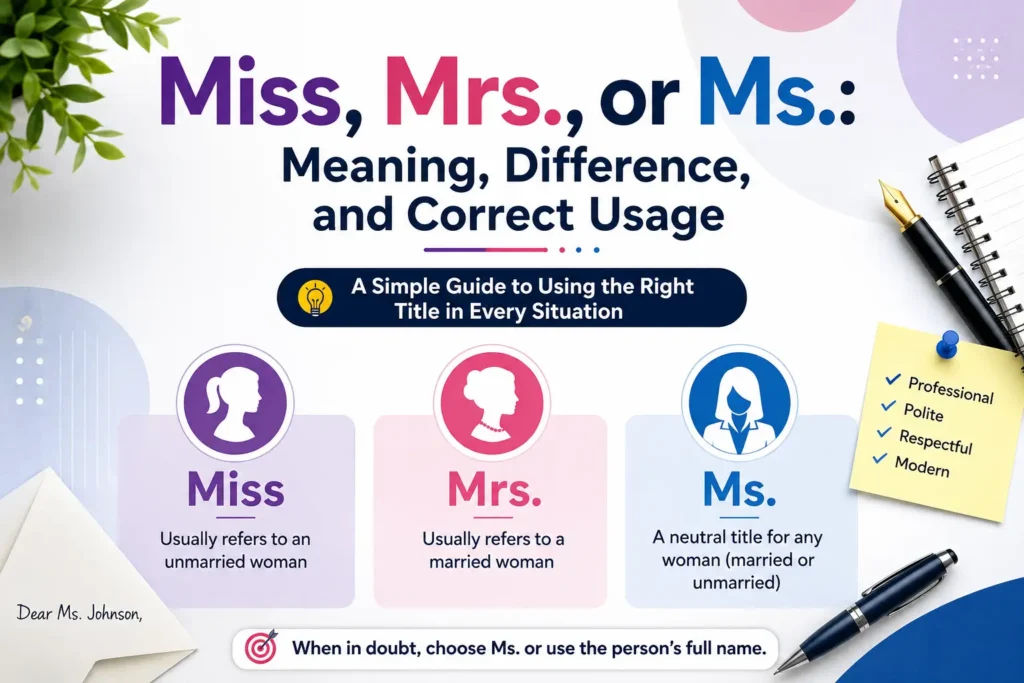
miss mrs or ms is a simple but important topic when you want to address a woman with the right title in a polite way. These female honorifics may seem small, but they can change the tone of your email etiquette, formal writing, business email, or wedding invitations. The goal is to help you understand when to use Miss, Mrs., or Ms. without guessing someone’s marital status.
In everyday use, Miss often means an unmarried woman, while Mrs. usually refers to a married woman. Ms. is different because it works as a neutral title and does not show whether a woman is married or unmarried.
Knowing the difference helps you write with respectful communication and confidence. Whether you’re sending a letter, filling out a form, or greeting someone professionally, the right choice makes your message sound clear, modern, and thoughtful.
Miss Mrs or Ms: Quick Answer
Use Ms. when you do not know whether a woman is married, unmarried, divorced, or widowed. It keeps the focus on the person instead of her relationship status.
Choose Mrs. when a woman uses that title herself.
Pick Miss for a girl, a young woman, or an unmarried woman who prefers that title.
| Title | Meaning | Marital Status | Best Use |
| Miss | A title for a girl or unmarried woman | Usually unmarried | Young girls, students, or women who prefer it |
| Mrs. | A title for a married woman | Usually married, though some divorced or widowed women use it | When the woman personally uses this title |
| Ms. | A neutral title for a woman | Not specified | Professional, formal, or unknown situations |
A simple rule works well in most cases: when in doubt, use Ms. or write the person’s full name without a title.
Read this also: Holistic or Wholistic: Meaning, Correct Spelling, and Usage Guide
What Does Ms. Mean?
Ms. is a title used before a woman’s name. It does not show whether she is married or unmarried.
Examples:
Ms. Parker
Ms. Emily Parker
Dear Ms. Parker,
This title gives you a polite way to address a woman without guessing anything about her personal life. That is why Ms. has become the standard choice in many workplaces, schools, customer service messages, legal letters, and formal emails.
Why Ms. Is the Modern Default
Ms. works well because it treats women more like Mr. treats men.
A man can be called Mr. whether he is single, married, divorced, or widowed. His title does not change based on his relationship status. Ms. gives women a similar option.
You can use Ms. in situations such as:
- Business emails
- Job applications
- Customer support messages
- School letters
- Professional introductions
- Formal forms
- Legal or administrative writing
Example:
Dear Ms. Johnson, thank you for your application.
This sounds respectful, professional, and neutral.
Is Ms. Married or Unmarried?
Ms. can be used for both married and unmarried women.
That is the whole point. It does not tell the reader anything about a woman’s marital status. A married woman may use Ms., and an unmarried woman may use Ms. too.
So, if someone asks, “Is Ms. for married or unmarried women?” the answer is simple:
Ms. is for any woman who uses it, regardless of marital status.
What Does Mrs. Mean?
Mrs. is a title traditionally used for a married woman.
Examples:
Mrs. Brown
Mrs. Olivia Brown
Dear Mrs. Brown,
Historically, Mrs. came from the word Mistress, which was once used as the female equivalent of Mister. Over time, the pronunciation changed, but the spelling kept the letter “r.”
That is why Mrs. has an “r,” even though people usually pronounce it like miss-iz.
When Should You Use Mrs.?
Use Mrs. when you know a woman prefers it or when the context clearly calls for it.
Common situations include:
- A married woman signs her name as Mrs.
- A formal invitation uses Mrs.
- A teacher or professional introduces herself as Mrs. Carter
- Someone directly says she prefers Mrs.
Example:
Thank you for your help, Mrs. Davis.
This works well when the person uses that title herself.
Mrs. After Divorce or Widowhood
Some divorced or widowed women continue using Mrs. Others choose Ms., return to Miss, or use no title at all.
There is no one-size-fits-all rule here. Personal preference matters most.
Examples:
Mrs. Helen Brooks may be used by a widow who keeps the title.
Ms. Helen Brooks may be preferred by a divorced woman.
Helen Brooks also works when the person chooses no title.
The polite move is simple: follow the title the person uses for herself.
What Does Miss Mean?
Miss is a title traditionally used for an unmarried woman or girl.
Examples:
Miss Adams
Miss Lily Adams
Dear Miss Adams,
Unlike Ms. and Mrs., Miss is not an abbreviation. That means it usually does not take a period in US English.
When Is Miss Still Used?
Miss still appears in many everyday situations.
You may hear or see it when addressing:
- Young girls
- School students
- Pageant contestants
- Young unmarried women who prefer it
- Teachers in some schools
- Formal or traditional settings
Example:
Good morning, Miss Taylor.
This may sound natural in a classroom. In a business email, though, Ms. Taylor often sounds more professional.
Can Miss Sound Outdated?
Yes, Miss can sound outdated in some settings.
In professional writing, Miss may feel old-fashioned because it points to marital status. It can also sound too young or informal for an adult woman.
Less professional:
Dear Miss Roberts, we reviewed your business proposal.
More polished:
Dear Ms. Roberts, we reviewed your business proposal.
That small change makes the sentence sound more modern and respectful.
Miss, Mrs., and Ms. Comparison Table
| Feature | Miss | Mrs. | Ms. |
| Refers to | Girl or unmarried woman | Married woman | Woman of any marital status |
| Shows marital status? | Yes, usually unmarried | Yes, usually married | No |
| Best for business writing | Sometimes, but less common | Only if preferred | Yes |
| Best when unsure | No | No | Yes |
| Takes a period in US English? | No | Yes | Yes |
| Example | Miss Green | Mrs. Green | Ms. Green |
| Tone | Traditional, youthful | Traditional, marital-status-based | Modern, neutral, professional |
For most uncertain situations, Ms. is the best choice. It avoids assumptions and keeps your tone clean.
Key Differences Between Miss, Mrs., and Ms.
The main difference between Miss, Mrs., and Ms. comes down to marital status and personal preference.
Miss Shows an Unmarried Status
Miss usually suggests that a woman or girl is unmarried.
Example:
Miss Emma Hill may suggest a young or unmarried woman.
However, do not use Miss for an adult woman unless you know she prefers it.
Mrs. Shows a Married Status
Mrs. traditionally means a woman is married.
Example:
Mrs. Emma Hill suggests a married woman.
Still, marriage alone does not decide the title. Some married women prefer Ms.
Ms. Does Not Show Marital Status
Ms. keeps marital status private.
Example:
Ms. Emma Hill works whether Emma is single, married, divorced, widowed, or simply does not want that detail shared.
That is why Ms. is usually best in modern communication.
How to Choose the Right Title
Choosing the right title depends on context. Think of it like choosing the right outfit. A tuxedo works at a gala, but not at a beach picnic.
The title should fit the situation.
Choose Ms. When You Do Not Know Her Preference
Ms. is the safest choice when you are unsure.
Example:
Dear Ms. Anderson,
Thank you for contacting our office.
This greeting sounds polite without making assumptions.
Go With Mrs. When She Uses Mrs.
When a woman introduces herself as Mrs. Lee, use Mrs. Lee.
Example:
It was lovely speaking with you, Mrs. Lee.
Personal preference always beats a general rule.
Pick Miss for Girls or Preferred Traditional Use
Miss works for girls or young students when the setting feels appropriate.
Example:
Miss Ava Wilson received the student award.
You may also use Miss when an adult woman clearly prefers it.
Use the Full Name When a Title Feels Risky
Sometimes the cleanest option is no title at all.
Example:
Dear Jordan Williams,
Thank you for your message.
This works well when:
- You do not know the person’s gender
- You do not know the preferred title
- The name could belong to any gender
- The setting allows a direct modern greeting
No guessing. No awkward assumption. No unnecessary mistake.
Correct Name Format with Miss, Mrs., and Ms.
Titles usually pair with a last name or full name.
Title + Last Name
This is the most common formal structure.
Examples:
Ms. Carter
Mrs. Bennett
Miss Morgan
This format works well in emails, letters, and formal speech.
Title + Full Name
This format is useful when you need clarity.
Examples:
Ms. Hannah Carter
Mrs. Laura Bennett
Miss Sophie Morgan
Use this when several people share the same last name or when introducing someone formally.
Title + First Name
This can sound unusual in formal US English.
Examples:
Ms. Hannah
Mrs. Laura
Miss Sophie
However, it may sound natural in classrooms, childcare settings, Southern US speech, or friendly community spaces.
For example, a preschool teacher may be called Miss Rachel. That is not wrong in the right setting. Still, in formal writing, use the last name.
Pronunciation Guide for Ms., Mrs., and Miss
These titles look similar, but they sound different.
| Title | Pronunciation | Sounds Like |
| Miss | miss | Rhymes with “kiss” |
| Mrs. | MISS-iz or MISS-uz | Sounds like “misses” |
| Ms. | miz | Sounds like “fizz” with an m |
How to Pronounce Ms.
Ms. is usually pronounced miz.
It does not sound exactly like Miss, and that difference matters in speech.
Miss = miss
Ms. = miz
Mrs. = miss-iz
Here is a quick memory trick:
Miss has the soft “s” sound. Ms. has the “z” sound.
Should You Use a Period After Ms., Mrs., and Miss?
In US English, use a period after abbreviated titles.
Correct US style:
Ms.
Mrs.
Mr.
Dr.
However, Miss usually does not need a period because it is not an abbreviation.
Correct:
Miss Taylor
Incorrect:
Miss. Taylor
US vs. UK Punctuation
US English usually uses periods with abbreviated titles. British English often leaves them out.
| Style | Correct Examples |
| US English | Mr., Mrs., Ms., Dr. |
| UK English | Mr, Mrs, Ms, Dr |
Since this article follows US English, the correct forms are Ms. and Mrs.
Plural Forms of Miss, Mrs., Ms., and Mr.
Plural titles can get clunky, so modern writing often avoids them. Still, they exist.
| Singular | Common Plural | Example |
| Miss | Misses | The Misses Carter |
| Mrs. | Mesdames or Mmes. | Mesdames Brown and Clark |
| Ms. | Mses. or Mss. | Mses. Brown and Clark |
| Mr. | Messrs. | Messrs. Brown and Clark |
In everyday writing, plural forms can look stiff.
Instead of writing:
Mses. Brown and Clark will attend.
You can write:
Ms. Brown and Ms. Clark will attend.
The second version sounds clearer and more natural.
Grammar Tips for Miss, Mrs., and Ms.
Small grammar details can make your writing look more polished.
Avoid a Title with Only a First Name in Formal Writing
Less formal:
Dear Ms. Emily,
Better:
Dear Ms. Stone,
Best when unsure:
Dear Emily Stone,
A title usually belongs with the last name in formal US English.
Do Not Guess Marital Status
Avoid calling someone Mrs. just because she looks older or uses a certain last name. That is risky and unnecessary.
Better:
Dear Ms. Patel,
Keep Punctuation Consistent
Do not mix styles in the same document.
Incorrect:
Ms Jones and Mrs. Smith attended the meeting.
Correct US style:
Ms. Jones and Mrs. Smith attended the meeting.
Avoid Miss in Serious Business Writing
For adult women in professional contexts, Ms. usually sounds better.
Less polished:
Dear Miss Edwards,
More polished:
Dear Ms. Edwards,
Real-Life Examples of Miss, Mrs., and Ms.
Examples make grammar easier to remember. Here are common situations.
Business Email Example
Best choice: Ms.
Dear Ms. Robinson,
Thank you for sending the updated contract. We’ll review it and respond by Friday.
Why it works: The email sounds professional and does not assume marital status.
School Example
Possible choice: Miss or Ms.
Miss Allen will lead the reading group today.
This may work for a young teacher or a teacher who uses Miss. However, Ms. Allen also works and often sounds more modern.
Wedding Invitation Example
Possible choice: Mrs., Ms., or full name.
Mrs. Grace Walker
This works if Grace uses Mrs. Many modern invitations use full names instead:
Grace Walker and Daniel Walker
That approach avoids title issues altogether.
Customer Service Example
Best choice: full name or Ms.
Hello, Maya Green,
Thank you for reaching out about your order.
This sounds warm and respectful. It also avoids guessing.
Formal Letter Example
Dear Ms. Mitchell,
We are pleased to confirm your appointment for Monday, March 12.
This is clear, polite, and business-friendly.
Common Mistakes with Miss, Mrs., and Ms.
Even strong writers slip on these titles. Watch for these common mistakes.
Mistake 1: Using Mrs. for Every Adult Woman
Wrong:
Dear Mrs. Cooper,
Better:
Dear Ms. Cooper,
Unless you know she prefers Mrs., use Ms.
Mistake 2: Thinking Ms. Means Divorced
Ms. does not mean divorced. It simply means marital status is not being stated.
A woman who uses Ms. may be single, married, divorced, widowed, or private about her personal status.
Mistake 3: Writing Miss. with a Period
Wrong:
Miss. Rivera
Correct:
Miss Rivera
Miss is not an abbreviation, so it does not need a period.
Mistake 4: Using Ms. and Miss as the Same Title
They are not the same.
Miss sounds like “miss” and often suggests unmarried status. Ms. sounds like “miz” and does not reveal marital status.
Mistake 5: Ignoring Someone’s Preference
This is more than a grammar mistake. It can feel disrespectful.
If someone says, “Please call me Mrs. Carter,” use Mrs. Carter.
When someone says, “I prefer Ms. Carter,” use Ms. Carter.
The best title is the one the person chooses.
Memory Tricks for Miss, Mrs., and Ms.
Need a quick way to remember the difference? Try these simple tricks.
Ms. Means Mystery
Think of Ms. as “mystery marital status.”
You do not know, and you do not need to know.
Ms. = marital status not shown
Mrs. Means Married
Mrs. usually points to marriage.
Mrs. = married title
Just remember that some divorced or widowed women may still prefer it.
Miss Means Younger or Unmarried
Miss often suggests a girl or unmarried woman.
Miss = traditionally unmarried
However, avoid using it for adult women unless you know it fits.
Full Name Means No Guessing
When the title feels uncertain, use the full name.
Dear Morgan Ellis,
That one move can avoid the whole issue.
Synonyms and Related Words
These titles belong to a larger group of polite address terms.
| Word | Meaning |
| Honorific | A respectful title used before a name |
| Courtesy title | A polite title such as Mr., Ms., or Dr. |
| Form of address | The way you address someone in speech or writing |
| Salutation | The greeting in a letter or email |
| Title | A word placed before a name to show respect, rank, or role |
| Ma’am | A polite spoken term for a woman |
| Madam | A formal term for a woman, often used in letters or service contexts |
| Mx. | A gender-neutral title used by some people |
Related Titles
You may also see:
- Mr. for men
- Dr. for medical doctors or people with doctorates
- Prof. for professors
- Mx. as a gender-neutral title
- Madam in very formal writing
- Ma’am in polite speech
When a professional title applies, use it instead of Miss, Mrs., or Ms.
Example:
Dear Dr. Harris,
This is better than guessing Ms. Harris or Mrs. Harris when the person’s professional title is known.
What About Mx.?
Mx. is a gender-neutral title.
Some people use Mx. when they do not identify with Mr., Miss, Mrs., or Ms. Others choose it because they prefer a title that does not suggest gender.
It is often pronounced mix, though pronunciation can vary.
Examples:
Mx. Jordan Avery
Dear Mx. Avery,
Use Mx. when someone has chosen it. Do not assign it randomly.
A respectful rule works here too: use the title a person gives you.
Miss, Mrs., or Ms. in Emails
Email is one of the most common places where people get stuck.
Here are the safest greetings:
| Situation | Best Greeting |
| You know her title is Ms. | Dear Ms. Adams, |
| You know her title is Mrs. | Dear Mrs. Adams, |
| You know she uses Miss | Dear Miss Adams, |
| You know her full name only | Dear Taylor Adams, |
| You do not know her gender | Dear Taylor Adams, |
| You know her job title | Dear Dr. Adams, |
Avoid old-fashioned greetings when possible, such as:
- Dear Sir or Madam
- To Whom It May Concern
- Dear Miss/Mrs. Adams
These can sound stiff. A full name often works better.
Miss, Mrs., or Ms. on Forms
Forms often ask for a title. Common choices include:
- Mr.
- Mrs.
- Miss
- Ms.
- Mx.
- Dr.
- Prof.
If you are filling out your own form, choose the title that feels right for you.
When creating a form, include neutral choices. Better yet, make the title field optional unless it is truly needed.
Titles can help with formality, but they can also create unnecessary friction. In many modern forms, a full name is enough.
Case Study: Choosing the Right Title in a Business Email
Imagine you need to email a new client named Rachel Bennett. Her LinkedIn profile shows her full name, but it does not show a title. You also do not know whether she is married.
You have three options:
| Option | Greeting | Problem |
| Miss Bennett | Dear Miss Bennett, | Assumes she is unmarried |
| Mrs. Bennett | Dear Mrs. Bennett, | Assumes she is married |
| Ms. Bennett | Dear Ms. Bennett, | Neutral and professional |
The best choice is:
Dear Ms. Bennett,
Why? It respects Rachel without asking for personal information. It also keeps your email professional.
Depending on the company’s tone, this may work even better:
Dear Rachel Bennett,
That version avoids titles completely while staying polished.
Case Study: Correcting the Wrong Title Politely
Now imagine someone writes:
Dear Mrs. Ahmed,
The recipient replies:
I prefer Ms. Ahmed.
A good response would be:
Thank you for letting me know, Ms. Ahmed. I’ll use that going forward.
That is enough. No long apology. No awkward explanation. Just a respectful correction.
Mistakes happen. How you respond matters more than the mistake itself.
Examples You Can Copy and Adapt
Formal Email
Dear Ms. Wilson,
Thank you for sharing the project details. I appreciate your time and look forward to reviewing the next steps.
Cover Letter
Dear Ms. Grant,
I’m excited to apply for the marketing coordinator position at your company.
School Note
Dear Miss Harper,
Thank you for helping Ava with her reading assignment this week.
Wedding Card
Dear Mrs. Collins,
Wishing you both a beautiful celebration and many happy years ahead.
Neutral Greeting
Dear Riley Morgan,
Thank you for your message. I’m happy to help with your request.
Better Alternatives When You Are Unsure
Sometimes the best title is no title.
Use these alternatives when you want to sound respectful without guessing:
- Dear Full Name
- Hello Full Name
- Good morning, Full Name
- Dear Hiring Manager
- Dear Admissions Team
- Dear Customer Support Team
- Hello Team
Examples:
Dear Avery Brooks,
Hello Jordan Lee,
Dear Hiring Manager,
These greetings feel natural and avoid unnecessary assumptions.
Frequently Asked Questions About Miss, Mrs., and Ms.
1. What is the difference between Miss, Mrs., and Ms.?
Miss is usually used for an unmarried woman. Mrs. is used for a married woman. Ms. is a neutral title that does not show whether a woman is married or unmarried.
2. When should I use Ms.?
Use Ms. when you do not know a woman’s marital status or when marital status is not important. It is often the safest choice in professional emails, formal letters, and modern communication.
3. Is Miss only for unmarried women?
Miss usually refers to an unmarried woman or girl. However, some adult women may still prefer this title, so it is best to follow personal preference when you know it.
4. Should I use Mrs. for every married woman?
No. Use Mrs. only when you know the woman prefers it. Many married women use Ms. because it keeps their marital status private.
5. Which title is safest if I am unsure?
Ms. is usually the safest title when you are unsure. It avoids guessing, sounds professional, and works well in most formal, social, and business situations.
Conclusion: Miss, Mrs., or Ms. Made Simple
Choosing between Miss, Mrs., and Ms. becomes much easier when you understand what each title means. Miss is commonly used for an unmarried woman, Mrs. is often used for a married woman, and Ms. is the best neutral title when you do not know or do not need to mention someone’s marital status.
The main purpose is not only correct grammar. It is also about respectful communication, good email etiquette, and modern formal writing. A small title before a woman’s name can show care, awareness, and professionalism.
When you’re unsure, use Ms. or write the person’s full name. That simple choice helps you avoid assumptions and keeps your message polite, clear, and respectful.

1 thought on “Miss, Mrs., or Ms.: Meaning, Difference, and Correct Usage”