
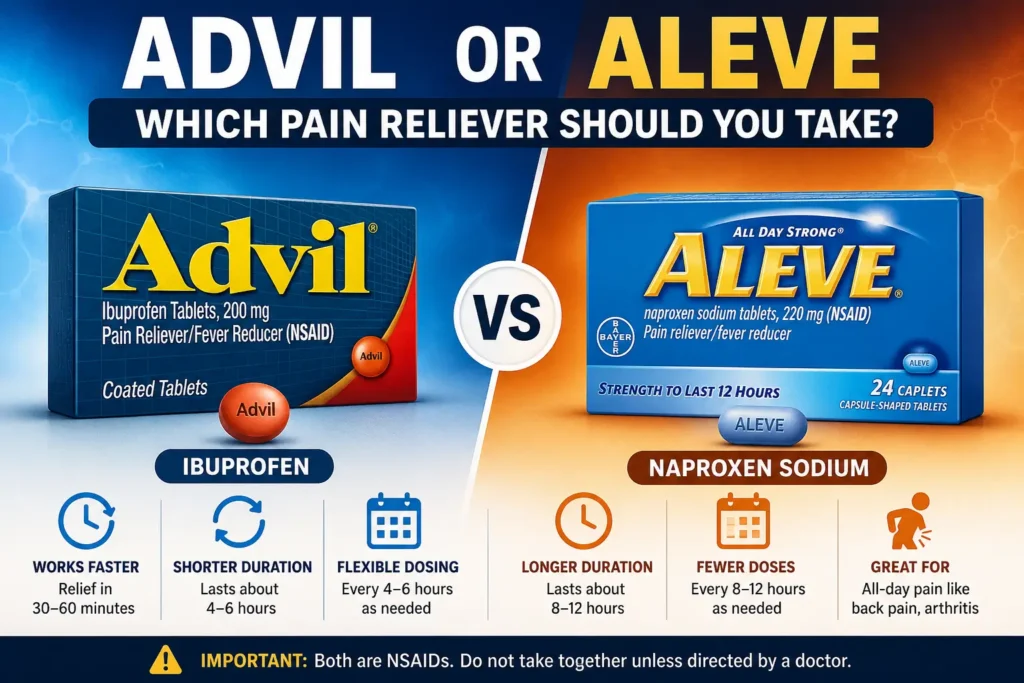
Advil or Aleve is a common choice people face when they need quick help for pain, fever, aches, cramps, or inflammation. Both are over-the-counter pain relievers, but they don’t work exactly the same. Advil contains Ibuprofen, while Aleve contains Naproxen, and that difference affects how long each medicine lasts and when it may be a better fit.
If you want shorter relief with flexible timing, Advil may make sense. If you want long-lasting relief, Aleve may be more useful. Still, the better option depends on your symptoms, health history, other medications, and possible side effects.
This guide explains the key similarities, differences, uses, risks, and safety tips in simple language. That way, you can understand how these NSAIDs work before choosing a pain reliever or fever reducer.
Quick Answer: Advil or Aleve?
Choose Advil when you want a shorter-acting pain reliever with flexible dosing. It may work well for headaches, fever, mild muscle aches, tooth pain, menstrual cramps, and short pain flare-ups.
Choose Aleve when you want longer-lasting relief and fewer doses per day. It may suit pain that hangs around for hours, such as back pain, arthritis-type aches, and steady muscle soreness.
Don’t take Advil and Aleve together unless your doctor or pharmacist tells you to. They’re both NSAIDs. Taking two NSAIDs at the same time usually adds risk without giving a guaranteed boost in relief.
| Best Fit | Advil | Aleve |
| Short-term headache | Good option | Good option |
| Fever | Common option | Possible option, label-dependent |
| Menstrual cramps | Good option | Good option |
| All-day back pain | Possible option | Often more convenient |
| Minor arthritis pain | Possible option | Often more convenient |
| Fewer daily doses | Less ideal | Better fit |
| Flexible repeat dosing | Better fit | Less flexible |
| Children under 12 | Use children’s ibuprofen products as directed | Ask a doctor |
Read this also: Laying Around or Lying Around? The Correct Phrase Explained With Clear Examples
What Is Advil?
Advil is a brand name for ibuprofen, an NSAID used to relieve pain, reduce fever, and lower inflammation.
People commonly use Advil for:
- Headaches
- Toothaches
- Back pain
- Muscle aches
- Menstrual cramps
- Minor arthritis pain
- Fever
- Cold and flu body aches
The usual over-the-counter Advil tablet or caplet contains 200 mg of ibuprofen. Adult label directions commonly apply to adults and children 12 years and older.
Ibuprofen doesn’t cure the cause of pain. It turns down the chemical signals involved in pain and inflammation. Think of it as lowering the volume on your body’s alarm system. Useful? Yes. A complete fix? Not always.
What Is Aleve?
Aleve is a brand name for naproxen sodium, another NSAID used for pain, fever, and inflammation.
People commonly use Aleve for:
- Back pain
- Muscle aches
- Menstrual cramps
- Minor arthritis pain
- Headaches
- Toothaches
- Body aches
- Pain that lasts through the day
The usual over-the-counter Aleve tablet or caplet contains 220 mg of naproxen sodium. Its biggest practical advantage is duration. Aleve usually lasts longer than Advil, so many people prefer it when they want fewer doses during the day.
However, longer-lasting relief cuts both ways. Since naproxen stays active longer, it may not suit everyone, especially people with kidney issues, stomach bleeding risk, heart disease, or medication interactions.
Advil vs Aleve Comparison Table
This table gives you the clean version before we get into the details.
| Feature | Advil | Aleve |
| Active ingredient | Ibuprofen | Naproxen sodium |
| Drug class | NSAID | NSAID |
| Common OTC strength | 200 mg | 220 mg |
| Main use | Pain, fever, inflammation | Pain, fever, inflammation |
| Typical adult timing | Every 4–6 hours as needed | Every 8–12 hours as needed |
| Daily OTC limit | Usually 6 tablets/caplets in 24 hours unless directed | Usually 3 tablets/caplets in 24 hours |
| Duration | Shorter | Longer |
| Best practical advantage | Flexible dosing | Longer relief |
| Can you take with the other? | No, unless directed | No, unless directed |
| Children under 12 | Ask doctor for adult tablets; children’s ibuprofen products exist | Ask a doctor |
| Main risks | Stomach bleeding, kidney strain, heart risk, interactions | Stomach bleeding, kidney strain, heart risk, interactions |
The Key Difference Between Advil and Aleve
The key difference between Advil and Aleve is the active ingredient.
Advil = ibuprofen
Aleve = naproxen sodium
Both belong to the same medicine family, but your body handles them differently.
Ibuprofen usually works for a shorter window. That can help when pain comes and goes. Naproxen sodium usually lasts longer. That can help when pain stays with you through the day.
So the better question isn’t, “Which brand is stronger?” The better question is:
Which active ingredient fits this pain, this body, and this situation?
That question leads to safer choices.
How Advil and Aleve Work in the Body
Both Advil and Aleve block enzymes involved in making prostaglandins. Prostaglandins are chemicals your body releases when tissue gets irritated, injured, inflamed, or infected.
Prostaglandins can:
- Increase pain sensitivity
- Trigger inflammation
- Raise fever
- Contribute to menstrual cramps
- Protect the stomach lining
- Support kidney blood flow
That last part matters. NSAIDs help because they reduce prostaglandins. They can also cause problems because prostaglandins do useful work in the stomach, kidneys, and blood vessels.
That’s why NSAIDs can ease a sore knee and upset your stomach in the same afternoon. Same mechanism. Different body system.
Which Works Faster: Advil or Aleve?
Many people want the fastest option. Fair enough. Pain makes patience disappear.
In real life, the speed of relief depends on several things:
- The product form
- Whether you took it with food
- Your metabolism
- The type of pain
- Your hydration level
- Whether inflammation drives the pain
- How long you waited before taking medicine
Advil may feel more flexible for short-term pain because you can usually repeat it sooner according to label directions.
Aleve may feel more useful when you want longer relief from one dose.
For example, if you wake up with a mild headache before work, Advil may be enough. If your lower back aches from morning to evening, Aleve may be more convenient because it lasts longer.
Neither one wins every time. Pain isn’t a one-size-fits-all problem.
Which Lasts Longer: Advil or Aleve?
Aleve usually lasts longer than Advil.
That’s the main reason many people choose Aleve for persistent pain. Its dosing window is usually 8 to 12 hours, while Advil’s dosing window is usually 4 to 6 hours.
Here’s the practical difference:
| Situation | Better Practical Fit |
| Pain that comes and goes | Advil may fit better |
| Pain that lasts most of the day | Aleve may fit better |
| Need fewer doses | Aleve |
| Need flexible timing | Advil |
| Want overnight relief | Aleve may be more convenient |
| Unsure about health risks | Ask a doctor or pharmacist first |
However, longer-lasting doesn’t automatically mean safer or stronger. It just means the medicine stays active longer. For some people, that’s helpful. For others, it increases concern.
Advil or Aleve for Headache
Both Advil and Aleve can help some headaches, especially tension-type headaches or headaches linked to muscle tightness, inflammation, or general body aches.
Advil may be a good fit when:
- The headache is mild to moderate
- You want shorter-acting relief
- You don’t need all-day coverage
- Ibuprofen is safe for your health history
Aleve may be a good fit when:
- The headache tends to linger
- You want fewer doses
- You’ve tolerated naproxen before
- You don’t have NSAID risk factors
However, don’t keep treating frequent headaches with OTC pain relievers. That can backfire. Overuse of pain medicine can lead to rebound headaches in some people.
Call a healthcare professional if headaches are sudden, severe, new, recurring, or linked with vision changes, confusion, weakness, fever, stiff neck, or head injury.
Advil or Aleve for Back Pain
Back pain is one of the most common reasons people compare Advil vs Aleve.
If the pain is short-lived, such as soreness after lifting boxes, Advil may work well. If the pain lasts all day, Aleve may offer more convenient coverage because it lasts longer.
Still, back pain isn’t always “just muscle pain.” Pain that travels down one leg, causes numbness, affects bladder or bowel control, or follows a fall needs medical attention.
Real-Life Example: The Weekend Yard Work Problem
Mark spends Saturday clearing branches, hauling bags, and pretending he’s still 22. By Sunday morning, his lower back feels tight and sore.
If he needs short relief to move around, Advil may help. If the ache stays steady through the day, Aleve may make more sense.
However, if Mark feels pain shooting down his leg, numbness in his foot, or weakness, pain relievers aren’t the main issue anymore. He needs evaluation.
That’s the part many people miss. Medicine can quiet the symptom while the cause keeps waving a red flag.
Advil or Aleve for Muscle Pain
Both medicines can help with muscle pain, especially when inflammation contributes to soreness.
Advil may suit:
- Mild workout soreness
- Short flare-ups
- Minor strains
- Pain that improves with rest
Aleve may suit:
- Longer-lasting soreness
- All-day aches
- Pain that needs fewer doses
- Minor inflammatory pain
But don’t use pain medicine to bulldoze through an injury. That’s how a small strain becomes a bigger problem.
Use NSAIDs as one part of care, not the whole plan. Rest, gentle movement, hydration, sleep, and ice or heat often matter just as much.
Advil or Aleve for Menstrual Cramps
NSAIDs can work well for menstrual cramps because prostaglandins play a major role in uterine cramping. When prostaglandin levels rise, cramps can feel sharper and more intense.
Advil may work well when:
- Cramps come in waves
- You want flexible timing
- You need relief for a shorter period
Aleve may work well when:
- Cramps last for hours
- You want fewer doses
- You need longer coverage
Some people get better results when they take an NSAID early, before cramps peak. However, you still need to follow the label.
Severe cramps, sudden pelvic pain, heavy bleeding, pain after sex, or cramps that disrupt life every month deserve medical attention. Don’t normalize misery just because it’s common.
Advil or Aleve for Tooth Pain
Tooth pain needs a different mindset.
Yes, Advil or Aleve may reduce pain temporarily. However, tooth pain often comes from a problem that medicine can’t fix, such as:
- A cavity
- Gum infection
- Cracked tooth
- Abscess
- Nerve inflammation
- Impacted wisdom tooth
If pain throbs, swelling appears, fever develops, or chewing becomes difficult, call a dentist. Pain pills may buy time, but they don’t drain an abscess or repair a tooth.
That’s not dramatic. That’s basic dentistry.
Advil or Aleve for Arthritis Pain
Many people choose Aleve for minor arthritis pain because it lasts longer. That can make it convenient for morning stiffness or pain that lingers during daily tasks.
Advil can also help minor arthritis pain, especially when symptoms flare and then settle.
However, regular arthritis pain needs a safer long-term plan. Daily NSAID use can raise the risk of stomach bleeding, kidney problems, fluid retention, and cardiovascular issues.
If you need Advil or Aleve several days a week, speak with a clinician. You may need a diagnosis, topical treatment, physical therapy, weight-bearing exercise, joint protection strategies, or a different pain plan.
Advil or Aleve for Fever
Advil is commonly used to reduce fever. Aleve can also reduce fever, but people often reach for ibuprofen or acetaminophen first, especially for children.
For adults, follow the label exactly. For children, don’t guess. Adult Advil and adult Aleve labels are not child dosing guides.
A fever can be useful because it shows your immune system is responding. But high fever, fever lasting more than three days, fever in an infant, fever with stiff neck, confusion, dehydration, breathing problems, or severe pain needs medical care.
Advil Dosage: What the OTC Label Usually Says
For common OTC Advil 200 mg tablets or caplets, adult directions typically apply to adults and children 12 years and older.
Common label directions:
- Take 1 tablet or caplet every 4 to 6 hours while symptoms persist.
- If pain or fever doesn’t respond to 1 tablet, 2 tablets may be used.
- Don’t exceed 6 tablets or caplets in 24 hours unless directed by a doctor.
- Children under 12 should use appropriate pediatric guidance or ask a doctor.
The key phrase is “smallest effective dose.” More isn’t automatically better. More often means more side effect risk.
Aleve Dosage: What the OTC Label Usually Says
For common OTC Aleve 220 mg tablets or caplets, adult directions typically apply to adults and children 12 years and older.
Common label directions:
- Take 1 tablet or caplet every 8 to 12 hours while symptoms last.
- For the first dose, 2 tablets or caplets may be taken within the first hour.
- Don’t exceed 2 tablets or caplets in any 8- to 12-hour period.
- Don’t exceed 3 tablets or caplets in 24 hours.
- Children under 12 should ask a doctor.
Aleve also commonly advises drinking a full glass of water with each dose.
Again, the goal isn’t to “feel powerful.” The goal is to relieve symptoms while keeping risk as low as possible.
Can You Take Advil and Aleve Together?
No. You should not take Advil and Aleve together unless a healthcare professional specifically tells you to.
This is one of the biggest mistakes people make.
Advil and Aleve are both NSAIDs. Taking them together can increase the chance of:
- Stomach pain
- Heartburn
- Stomach bleeding
- Kidney strain
- Fluid retention
- Higher blood pressure
- Drug interactions
- Serious allergic reactions in sensitive people
Mixing two NSAIDs is like using two umbrellas in a thunderstorm. It may feel like extra protection, but it doesn’t fix the real problem and can create new trouble.
If one NSAID doesn’t help, don’t stack another one on top. Ask a pharmacist or clinician what makes sense next.
Can You Take Tylenol With Advil or Aleve?
Tylenol is different. Tylenol contains acetaminophen, not an NSAID.
That means Tylenol doesn’t carry the same NSAID stomach bleeding risk. It also doesn’t reduce inflammation the same way Advil or Aleve does.
Some people can take acetaminophen with an NSAID, but you still need to be careful. Acetaminophen has its own serious risk: liver damage, especially when you take too much or combine several products that contain it.
Common products that may contain acetaminophen include:
- Cold medicines
- Flu medicines
- Sinus medicines
- Sleep aids
- Prescription pain medicines
- Combination headache products
Don’t assume “different box” means “different active ingredient.” Always check the active ingredient panel.
Side Effects of Advil and Aleve
Both Advil and Aleve can cause side effects. Some are mild. Others are urgent.
Common Side Effects
Possible side effects include:
- Upset stomach
- Heartburn
- Nausea
- Dizziness
- Bloating
- Mild fluid retention
- Stomach discomfort
Taking NSAIDs with food may reduce stomach upset for some people. However, food does not remove the risk of serious stomach bleeding.
Serious Side Effects
Stop taking the medicine and get medical help if you notice:
- Vomiting blood
- Bloody or black stools
- Chest pain
- Trouble breathing
- Weakness on one side of the body
- Slurred speech
- Facial swelling
- Hives
- Wheezing
- Severe rash
- Leg swelling
- Severe stomach pain that doesn’t improve
Those aren’t “wait and see” symptoms. Treat them seriously.
Is Advil or Aleve Safer?
Neither one is universally safer.
The safer choice depends on:
- Your age
- Your dose
- How many days you use it
- Your stomach history
- Your kidney health
- Your heart health
- Your blood pressure
- Your pregnancy status
- Your other medications
- Your alcohol use
Advil may be a better fit for one person. Aleve may be a better fit for another. For some people, both are poor choices.
Ask a doctor or pharmacist before taking either medicine if you have:
- A history of stomach ulcers
- Previous stomach bleeding
- Kidney disease
- Heart disease
- High blood pressure
- Heart failure
- Liver disease
- Asthma triggered by aspirin or NSAIDs
- Stroke history
- Bleeding disorders
- Heavy alcohol use
- Current blood thinner use
- Current steroid use
- Pregnancy
This is where smart self-care beats guesswork.
Advil, Aleve, and Heart Risk
NSAIDs, except aspirin, can increase the risk of heart attack, heart failure, and stroke. That risk may rise when people take more than directed or use NSAIDs longer than directed.
This doesn’t mean every healthy adult who takes one dose is in danger. It means the risk matters more for people with heart disease, high blood pressure, stroke history, heart failure, kidney disease, or multiple cardiovascular risk factors.
If you already take heart medication, blood pressure medicine, aspirin, or blood thinners, don’t treat NSAIDs casually.
A good question for your doctor or pharmacist is:
“Given my heart history and medications, is ibuprofen or naproxen safer for me, or should I avoid both?”
That question is much better than picking the box with the boldest promise.
Advil, Aleve, and Stomach Bleeding
Both Advil and Aleve can raise the risk of stomach bleeding. The risk goes up if you:
- Are 60 or older
- Have had stomach ulcers
- Have had bleeding problems
- Take blood thinners
- Take steroid drugs
- Take other NSAIDs
- Drink three or more alcoholic drinks daily
- Take more than directed
- Use NSAIDs longer than directed
Warning signs can include black stools, bloody stools, vomiting blood, feeling faint, or stomach pain that doesn’t improve.
Don’t ignore black stools. People sometimes brush them off as food-related. That can be dangerous.
Advil, Aleve, and Kidney Risk
NSAIDs can reduce blood flow through the kidneys. Healthy kidneys may handle occasional NSAID use without trouble. Vulnerable kidneys may not.
Be extra cautious if you:
- Have kidney disease
- Are dehydrated
- Take diuretics
- Take ACE inhibitors or ARBs for blood pressure
- Have heart failure
- Are older
- Have vomiting or diarrhea
- Use NSAIDs often
A simple practical tip: avoid NSAIDs when you’re dehydrated unless a clinician tells you otherwise. Your kidneys already work harder when fluid levels drop.
Advil, Aleve, and Pregnancy
Pregnancy changes the rules.
NSAIDs such as ibuprofen and naproxen need medical guidance during pregnancy. Health authorities warn against NSAID use around 20 weeks or later unless a healthcare professional recommends it because NSAIDs may affect fetal kidney function and amniotic fluid levels.
Many OTC labels also warn against NSAID use during the last three months of pregnancy unless directed by a doctor.
If you’re pregnant, trying to become pregnant, or breastfeeding, don’t freestyle with pain relievers. Ask your OB-GYN, doctor, or pharmacist.
Advil, Aleve, and Low-Dose Aspirin
This is a safety trap.
Some people take low-dose aspirin because a clinician told them it helps reduce the risk of heart attack or stroke. Ibuprofen can interfere with aspirin’s antiplatelet effect when taken at the wrong time.
That doesn’t mean everyone on aspirin must panic. It means timing and medical guidance matter.
If you take aspirin for heart protection, ask a healthcare professional before using Advil, Aleve, or any NSAID. Don’t guess your way through this one.
Which Is Better for Children: Advil or Aleve?
For children, the answer changes.
Children’s ibuprofen products exist, but dosing depends on the child’s age, weight, and product strength. Adult Advil tablets are not a substitute for pediatric dosing instructions.
Aleve is usually labeled for adults and children 12 years and older, while children under 12 should ask a doctor.
Never dose a child like a small adult. That’s lazy and risky.
Use:
- The correct child-specific product
- The correct measuring device
- Weight-based instructions when provided
- A pediatrician’s guidance for young children or complex cases
Call a doctor quickly for fever in infants, dehydration, breathing trouble, severe pain, stiff neck, unusual sleepiness, or symptoms that worry you.
Common Mistakes People Make With Advil or Aleve
People don’t usually get into trouble because they read the label too carefully. They get into trouble because they assume.
Avoid these mistakes:
- Taking Advil and Aleve together
- Taking more than the label allows
- Taking doses too close together
- Using NSAIDs daily without medical guidance
- Taking NSAIDs with blood thinners without asking a doctor
- Mixing NSAIDs with heavy alcohol use
- Using adult dosing for children
- Taking NSAIDs late in pregnancy without medical guidance
- Ignoring stomach pain or black stools
- Forgetting that cold and flu products may contain pain relievers
One box. One active ingredient. One label. Read it every time.
Label-Reading Tips: The “Grammar Tips” That Actually Matter
This topic doesn’t need grammar trivia. It needs wording clarity. Medication labels use specific phrases, and misunderstanding them can cause real harm.
“Active Ingredient” Means the Drug That Does the Work
Look for ibuprofen or naproxen sodium. Brand names matter less than active ingredients.
“NSAID” Means You Should Check for Overlap
If two products both contain NSAIDs, don’t combine them unless a healthcare professional tells you to.
“Every 4 to 6 Hours” Doesn’t Mean “Whenever Pain Returns”
It means you must respect the minimum spacing and daily limit.
“As Directed” Doesn’t Mean “As Much as Needed”
It means follow the label or your clinician’s instructions.
“Ask a Doctor” Is Not Decorative Text
It usually appears because certain people face higher risk. Take it seriously.
Memory Tricks for Advil vs Aleve
Use these simple memory hooks:
- Advil = Ibuprofen = shorter interval
- Aleve = Naproxen = longer relief
- A in Aleve = All-day-ish relief
- I in Ibuprofen = Interval dosing
- Two NSAIDs together = too much risk
Here’s the easiest one:
Advil is more flexible. Aleve lasts longer. Don’t mix them.
That sentence does most of the work.
Synonyms and Related Words
Readers often search for the same topic using different names. These terms usually point to the same comparison.
Advil Related Words
- Ibuprofen
- Motrin
- NSAID
- Pain reliever
- Fever reducer
- Anti-inflammatory medicine
Aleve Related Words
- Naproxen
- Naproxen sodium
- NSAID
- Long-lasting pain reliever
- Anti-inflammatory medicine
Related Search Phrases
- Advil vs Aleve
- Aleve vs Advil
- Ibuprofen vs naproxen
- Naproxen vs ibuprofen
- Can I take Advil and Aleve together?
- Which lasts longer, Advil or Aleve?
- Advil or Aleve for back pain
- Advil or Aleve for cramps
- Advil or Aleve for tooth pain
- Advil or Aleve for arthritis
Case Study: Choosing Advil or Aleve in Real Life
Scenario: The All-Day Back Ache
Jenna works at a desk and wakes up with a stiff lower back. She has no kidney disease, no stomach ulcer history, no blood thinners, and no pregnancy concerns. She wants relief that lasts through meetings.
Aleve may be convenient because it lasts longer and requires fewer doses.
Scenario: The Evening Headache
Carlos gets a mild headache after skipping lunch. He wants short-term relief before dinner. He doesn’t need all-day coverage.
Advil may be a practical choice because it works in a shorter dosing window.
Scenario: The Risky Mix
Dana takes low-dose aspirin every morning because her doctor recommended it. She also has high blood pressure. Her knee starts hurting, so she reaches for Advil.
This is where she should pause. Ibuprofen can interfere with aspirin’s heart-protective effect depending on timing. NSAIDs can also affect blood pressure. Dana should ask a pharmacist or doctor before taking it.
The lesson is simple: the “best” pain reliever changes when your health history changes.
Advil or Aleve Decision Guide
Use this quick guide when you’re trying to decide.
| If You Need… | Consider… | Why |
| Shorter relief window | Advil | More flexible timing |
| Longer relief | Aleve | Longer dosing interval |
| Fewer doses | Aleve | Usually taken less often |
| Fever relief | Advil | Common fever option |
| Menstrual cramp relief | Advil or Aleve | Both may help prostaglandin-driven cramps |
| All-day minor arthritis pain | Aleve | Longer duration may help |
| Pain with high stomach risk | Ask a doctor | Both can cause bleeding |
| Pain with kidney disease | Ask a doctor | Both can strain kidneys |
| Pain while pregnant | Ask a doctor | NSAID rules change in pregnancy |
| Pain while taking blood thinners | Ask a doctor | Bleeding risk may rise |
When You Should Avoid Both Advil and Aleve
Avoid Advil and Aleve, or ask a healthcare professional first, if you:
- Have had an allergic reaction to aspirin or NSAIDs
- Have had stomach bleeding
- Have active stomach ulcers
- Take blood thinners
- Take steroid medication
- Have kidney disease
- Have heart failure
- Have uncontrolled high blood pressure
- Had a recent heart surgery
- Are pregnant, especially around 20 weeks or later
- Drink heavily
- Need pain medicine every day
- Already took another NSAID
Don’t try to outsmart the warning label. It has seen more bad decisions than you have.
When to Stop and Get Medical Help
Stop taking Advil or Aleve and get medical help if you have:
- Chest pain
- Shortness of breath
- Weakness on one side
- Slurred speech
- Facial swelling
- Hives
- Wheezing
- Vomiting blood
- Black or bloody stools
- Severe stomach pain
- Severe rash
- Leg swelling
- Pain that gets worse
- Fever that lasts more than three days
- Pain that lasts more than ten days
Also get care for severe tooth pain, serious injury, intense abdominal pain, sudden severe headache, or back pain with weakness or numbness.
Pain relievers help symptoms. They don’t diagnose the cause.
FAQs About Advil or Aleve
Q1: Can I take Advil and Aleve together?
No, you shouldn’t take Advil and Aleve together unless a doctor tells you to. Both are NSAIDs, and mixing them can increase the risk of stomach bleeding, kidney problems, and other side effects.
Q2: Which lasts longer, Advil or Aleve?
Aleve usually lasts longer than Advil. That’s because Naproxen stays active in the body longer than Ibuprofen, making Aleve useful for longer-lasting aches, arthritis pain, or steady inflammation-related pain.
Q3: Is Advil or Aleve better for fever?
Advil is commonly used as a fever reducer, but Aleve may also reduce fever in some cases. Always follow the product label, especially for children, older adults, or anyone taking other medications.
Q4: Which is better for back pain, Advil or Aleve?
For short back pain flare-ups, Advil may work well. For pain that lasts through the day, Aleve may be more convenient because it gives long-lasting relief. Severe or ongoing back pain should be checked by a healthcare professional.
Q5: Is Aleve safer than Advil?
Not always. Neither Aleve nor Advil is safer for everyone. The safer choice depends on your age, health history, stomach risk, heart health, kidney health, and other medications you take.
Conclusion: Advil or Aleve?
Choosing Advil or Aleve should come down to your pain type, timing needs, and safety risks. Advil, made with Ibuprofen, often works well for short-term pain relief, headache, fever, body ache, and mild pain that comes and goes. Aleve, made with Naproxen, usually lasts longer, so it may help more with steady inflammatory pain, arthritis, cramps, or all-day aches.
However, both medicines are NSAIDs, so you shouldn’t treat them like harmless everyday pills. They can cause side effects, stomach problems, kidney strain, and other safety concerns, especially if you take too much or mix them with other medications.
The safest choice is simple: read the label, use the lowest helpful dose, avoid taking Advil and Aleve together, and ask a doctor or pharmacist if you have health conditions, take other drugs, or feel unsure.
