
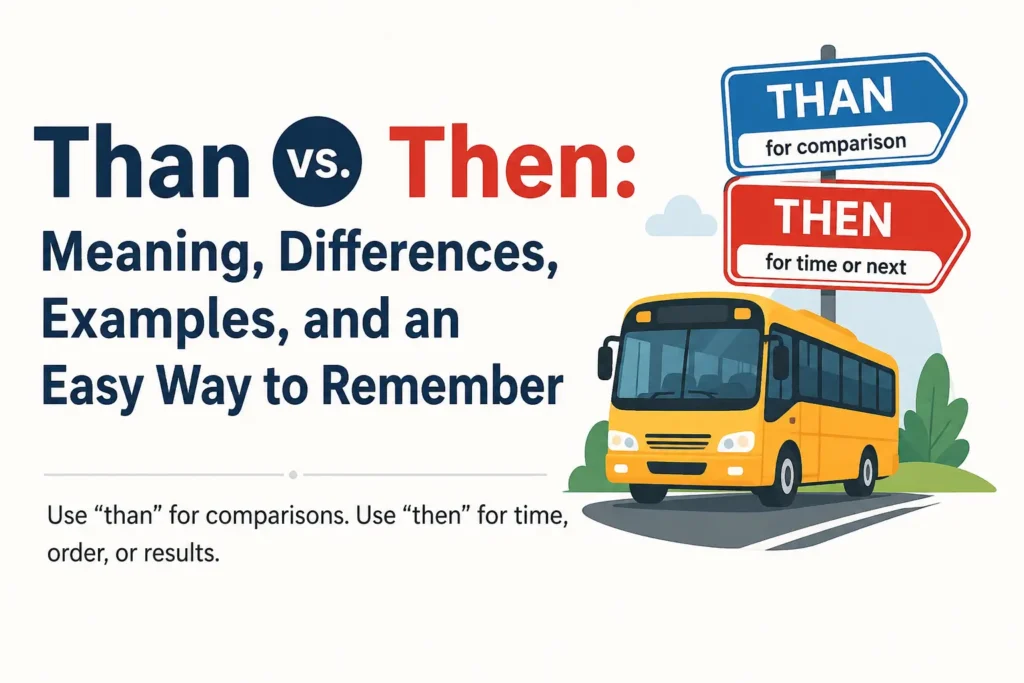
Than vs then is a common grammar problem, but the difference is simple. Use than when making a comparison, and use then when discussing time, sequence, or a result. For example, “This book is better than that one” compares two books. “Finish the book, then write the review” shows what happens next.
These commonly confused words often cause mistakes because they have similar spellings and may sound alike in fast spoken English. However, their meanings and grammar roles are different. Than usually follows comparative words such as better, more, less, faster, and taller. In contrast, then can mean next, at that time, or in that case.
Learning the correct word usage will make your emails, school assignments, reports, and everyday messages clearer. The examples and memory tips below will help you choose the correct word without guessing.
Quick Answer: What Is the Difference Between Than and Then?
Use “than” for comparisons. Use “then” for time, order, or results.
Than commonly appears after comparative words such as better, taller, faster, more, less, and different.
- This laptop is cheaper than that one.
- He runs faster than his brother.
- We received more applications than expected.
In contrast, then tells you when something happened, what happened next, or what will happen as a result.
- I lived in Boston back then.
- Finish your report, then send it to me.
- If the weather improves, then we’ll leave.
Than vs. Then Comparison Table
| Feature | Than | Then |
| Main meaning | Introduces a comparison | Refers to time, sequence, or a result |
| Common grammar role | Conjunction or preposition | Adverb, adjective, or noun |
| Common clue words | better, more, less, taller, rather | next, afterward, at that time, if |
| Example | This road is shorter than the other one. | Turn left, then continue straight. |
| Memory clue | Than = comparison | Then = time or next event |
What Does “Than” Mean?
Than introduces the second part of a comparison. It shows how one person, object, action, quality, or amount relates to another.
Consider this sentence:
- Jordan is older than Casey.
The word older creates the comparison. The word than introduces the person Jordan is being compared with.
In grammar, than can act as a conjunction or a preposition. You don’t need to memorize those labels to use the word correctly. Instead, look for a comparison.
When to Use “Than”
Use Than After Comparative Adjectives
A comparative adjective compares two people or things. Many short adjectives form comparisons by adding -er.
Common examples include:
- taller than
- shorter than
- older than
- younger than
- faster than
- colder than
- stronger than
Examples:
- This building is taller than the library.
- My new phone is lighter than my old one.
- Today feels colder than yesterday.
- Elena is younger than her supervisor.
Longer adjectives usually form comparisons with more or less.
- This explanation is more helpful than the first one.
- The afternoon meeting was less productive than the morning meeting.
- Online registration is more convenient than mailing a form.
Some adjectives have irregular comparative forms.
| Basic form | Comparative form | Example |
| good | better | This plan is better than the original. |
| bad | worse | Traffic was worse than usual. |
| far | farther/further | The hotel is farther away than we thought. |
| little | less | We have less time than expected. |
| many/much | more | She has more experience than I do. |
Use Than After Comparative Adverbs
Adverbs describe actions. When two actions are compared, than introduces the second action or person.
- Daniel speaks more clearly than I do.
- She completed the test faster than the other students.
- Our team worked more efficiently than last month.
- He arrived earlier than expected.
The comparison may be shortened when the missing words are obvious.
- She types faster than me.
This wording is common in everyday American English. A more formal version would be:
- She types faster than I do.
Both versions are widely used. However, the complete version may sound clearer in formal, academic, or professional writing.
Use Than to Compare Amounts and Numbers
Than also appears in comparisons involving quantity, age, time, distance, price, and measurement.
- The concert lasted more than three hours.
- Fewer than 20 students attended.
- The repair cost less than $100.
- My commute takes longer than yours.
- Children younger than 12 need an adult.
- The store is less than a mile away.
Notice that more than, less than, and fewer than are comparisons. Therefore, they always require than, not then.
Use Than to Compare Choices or Preferences
The expression would rather … than … shows that you prefer one action or option over another.
- I’d rather call than send a long email.
- We’d rather wait than make a rushed decision.
- She would rather study at home than work in a noisy café.
The first action is preferred. The action after than is the less desirable choice.
You can also use rather than to mean instead of.
- Take the train rather than driving.
- He apologized rather than making excuses.
- The company repaired the product rather than replacing it.
Use Than After “Different”
In American English, different from is often the safest choice in formal writing.
- My answer is different from yours.
However, different than is also common, especially when a full clause follows.
- The event was different than I expected.
- Her new role is different than what she described.
In these sentences, replacing than with from may sound awkward:
- The event was different from I expected.
This construction is incorrect.
You would need to rewrite it:
- The event was different from what I expected.
Therefore, different than can be useful before a clause, while different from works well before a noun or pronoun.
Common Expressions with “Than”
More Than
More than compares numbers, amounts, or degrees.
- More than 500 people attended the festival.
- The project took more than a week.
- She was more than prepared for the interview.
In the last example, more than prepared adds emphasis. It means she was completely or extremely prepared.
Less Than
Less than refers to a smaller amount, degree, or quantity.
- The trip took less than two hours.
- He has worked here for less than a year.
- Her response was less than helpful.
The final sentence is a polite but critical way of saying that the response was unhelpful.
Fewer Than
Use fewer than with countable items.
- Fewer than ten employees applied.
- The essay contains fewer than 1,000 words.
- We received fewer complaints than last month.
Use less than with uncountable amounts.
- less than ten minutes
- less than a gallon of water
- less than enough time
Better Than and Worse Than
Because better and worse are comparative forms, they require than.
- This solution is better than the previous one.
- The second movie was worse than the first.
- Sleeping for five hours is better than not sleeping at all.
Other Than
Other than usually means except for, besides, or apart from.
- Other than one spelling error, your report looks excellent.
- I don’t know anyone here other than Marcus.
- Is there anything else you need other than a receipt?
Writing other then would be incorrect in these examples because no time or sequence is involved.
Rather Than
Rather than presents an alternative or preference.
- Let’s solve the problem rather than blame each other.
- She chose tea rather than coffee.
- Rather than canceling the meeting, we moved it online.
No Sooner Than
The fixed expression is no sooner … than, not no sooner … then.
- No sooner had I sat down than the phone rang.
- No sooner did the meeting begin than the fire alarm went off.
This formal structure means that one event happened immediately after another.
Than with Pronouns: “Than Me” or “Than I”?
Both than me and than I appear in American English, but the best choice depends on the sentence and level of formality.
Than Me
Than me is natural and common in everyday conversation.
- She is taller than me.
- Ben arrived earlier than me.
- They have more experience than us.
Here, than functions much like a preposition, followed by an object pronoun.
Than I Am
A complete comparison may sound more formal or precise.
- She is taller than I am.
- Ben arrived earlier than I did.
- They have more experience than we do.
Avoid writing only than I when the missing verb would make the sentence sound stiff or incomplete.
- She is taller than I.
Grammatically defensible, but unnatural in most modern contexts. - She is taller than I am.
Clear and natural.
Complete the Comparison to Avoid Ambiguity
Sometimes, a shortened comparison can have two meanings.
- Noah likes Emma more than me.
This sentence may mean:
- Noah likes Emma more than Noah likes me.
- Noah likes Emma more than I like Emma.
To remove the confusion, complete the clause:
- Noah likes Emma more than he likes me.
- Noah likes Emma more than I do.
This small change improves clarity, especially in formal or professional writing.
What Does “Then” Mean?
Then most often relates to time. It can mean at that time, next, afterward, or in that case.
- I was living in Seattle then.
- We ate lunch and then returned to work.
- If the payment arrives, then we can ship the order.
Unlike than, the word then does not introduce a comparison.
When to Use “Then”
Use Then for the Next Step
Use then when one action follows another.
- Wash your hands, then prepare the food.
- Click “Save,” then close the document.
- We checked into the hotel and then went out for dinner.
- First, review the instructions. Then, begin the test.
This use often appears in recipes, directions, tutorials, workplace instructions, and stories.
Use Then to Mean “At That Time”
Then can refer to a specific point in the past or future.
- I didn’t understand the problem then.
- Gas prices were lower back then.
- The office opens at nine. I’ll meet you then.
- By then, the roads should be clear.
The exact time may appear earlier in the sentence or conversation.
- The appointment is scheduled for Tuesday. I’ll bring the documents then.
Here, then means on Tuesday.
Use Then to Show a Result
In an if-then statement, if introduces a condition, and then introduces the result.
- If you finish early, then you can leave.
- If the password is incorrect, then reset it.
- If demand increases, then prices may rise.
However, then is often optional.
- If you finish early, you can leave.
- If demand increases, prices may rise.
Both versions are correct. Including then places more emphasis on the result.
Use Then to Mean “In That Case”
In conversation, then can respond to new information.
- “The restaurant is closed.”
“Let’s go somewhere else, then.” - “I can’t meet on Friday.”
“How about Monday, then?”
Here, then means in that case or because of what you just said.
Use Then to Add Another Point
Sometimes, then introduces another factor or idea.
- The rent is high. Then there’s the cost of parking.
- The job requires travel, and then there are weekend shifts to consider.
- We need to fix the roof. Then we can discuss repainting the house.
In these examples, then helps organize related points.
Less Common Grammar Roles of “Then”
Then as an Adjective
Then can describe a person’s position or status at a particular time.
- The then president addressed the nation.
- She contacted her then employer.
- The policy was approved by the then board of directors.
The phrase then president means the person who was president at that time but may not hold the position now.
In formal writing, you may also see a hyphen:
- the then-president
Both styles appear, though many writers leave the phrase open unless a style guide requires the hyphen.
Then as a Noun
Then can function like a noun in expressions involving a point in time.
- I haven’t seen her since then.
- We need the final decision before then.
- Until then, continue using the current system.
- From then on, he kept detailed records.
These expressions all point to a previously mentioned time.
Key Differences Between Than and Then
| Meaning or function | Use than | Use then |
| Comparing two things | Yes | No |
| Showing what happens next | No | Yes |
| Referring to a past time | No | Yes |
| Comparing amounts | Yes | No |
| Introducing a consequence | No | Yes |
| Showing a preference | Yes | No |
| Used after “better” or “more” | Yes | No |
| Used in “if … then” | No | Yes |
Than vs. Then in Commonly Confused Phrases
More Than or More Then?
The correct phrase is more than because it expresses a comparison.
- Correct: The class has more than 30 students.
- Incorrect: The class has more then 30 students.
However, more, then may appear when then begins the next idea.
- We need more information. Then we can decide.
Better Than or Better Then?
The correct expression is better than.
- Correct: Your second draft is better than the first.
- Incorrect: Your second draft is better then the first.
The word better compares two drafts, so it requires than.
Rather Than or Rather Then?
Use rather than when presenting a choice or alternative.
- Correct: I’d walk rather than wait for the bus.
- Incorrect: I’d walk rather then wait for the bus.
A sentence may contain rather and then separately, but the meaning changes.
- I’d rather finish the report now, then relax tonight.
Here, rather expresses preference, while then shows sequence.
Other Than or Other Then?
Use other than to mean except for or besides.
- Correct: Other than the weather, the trip was perfect.
- Incorrect: Other then the weather, the trip was perfect.
Earlier Than or Earlier Then?
Use earlier than for comparison.
- The train arrived earlier than scheduled.
- She woke up earlier than I did.
Use then when describing the next event.
- She arrived early and then prepared the room.
Later Than or Later Then?
Use later than to compare times.
- The meeting ended later than expected.
- He arrived later than everyone else.
Use then to show what happened afterward.
- We’ll eat dinner later, then watch the game.
If Then or If Than?
Use then to introduce the result of a condition.
- If the client approves the design, then production can begin.
- If you’re ready, then let’s start.
Use than only if the sentence contains a comparison.
- If this model is cheaper than that one, then we should buy it.
Sentences That Use Both Than and Then
A sentence can correctly contain both words because each one performs a different job.
- If this route is shorter than the highway, then we should take it.
- The meeting ended earlier than expected, so we left then.
- She completed the task faster than I did and then helped her coworker.
- If your score is higher than 80, then you’ll move to the next level.
- The red jacket costs less than the blue one, but I liked the blue one better then.
The final sentence is incorrect because then should be than. The sentence compares how much the speaker liked the jackets.
Correct version:
- The red jacket costs less than the blue one, but I liked the blue one better than the red one.
Pronunciation of Than and Then
In American English, the two words have different standard pronunciations.
- Than: /ðæn/
- Then: /ðɛn/
The vowel in than sounds like the vowel in cat. The vowel in then sounds like the vowel in bed.
However, unstressed than is often reduced in natural speech. It may sound closer to thun:
- bigger than mine
- faster than expected
- more than enough
Because of this reduced pronunciation, you shouldn’t rely only on sound. Instead, check the word’s purpose.
- Comparison = than
- Time, order, or result = then
Why Are Than and Then So Often Confused?
Several factors cause this common error.
- The words differ by only one letter.
- They may sound similar during fast conversation.
- Both words often appear in the middle of sentences.
- Autocorrect may replace one with the other.
- A basic spell-checker may not flag the mistake because both are real words.
- Writers sometimes type from memory without checking the sentence’s meaning.
The confusion is understandable. Still, using the wrong word can weaken an otherwise clear email, essay, report, or social media post.
Common Than and Then Mistakes
Using Then in a Comparison
- Incorrect: My apartment is smaller then yours.
- Correct: My apartment is smaller than yours.
The adjective smaller compares two apartments.
Using Than for the Next Action
- Incorrect: Read the instructions, than answer the questions.
- Correct: Read the instructions, then answer the questions.
The sentence gives two steps in order.
Writing “And Than” for a Sequence
- Incorrect: We packed the car and than left.
- Correct: We packed the car and then left.
The word then shows what happened after the car was packed.
However, and than can occasionally occur when than belongs to a comparison:
- The job requires more patience and attention than I expected.
Using Than After If
- Incorrect: If you need help, than call me.
- Correct: If you need help, then call me.
The phone call is the result of the condition.
Using Then After Comparative Words
- Incorrect: The new software is faster then the old version.
- Correct: The new software is faster than the old version.
Words such as faster, slower, bigger, smaller, better, worse, more, and less usually signal a comparison.
Creating an Incomplete or Unclear Comparison
- Unclear: Taylor likes the manager more than me.
Does Taylor like the manager more than Taylor likes me? Or does Taylor like the manager more than I like the manager?
Clear alternatives:
- Taylor likes the manager more than she likes me.
- Taylor likes the manager more than I do.
Easy Memory Tricks for Than vs. Then
Remember the “A” in Than
The word than contains the letter a, and the word comparison also contains an a.
Think:
ThAn = compArison
This isn’t a grammar rule, but it can help you remember which spelling to choose.
Connect Then with Time
Both then and time contain the letter e sound in common memory phrases such as next event.
Think:
Then = what happened next
Replace the Word
Try replacing the word with a simple phrase.
Replace then with:
- next
- afterward
- at that time
- in that case
If the sentence still makes sense, use then.
- Finish the call, then email me.
- Finish the call, afterward email me.
Replace than with a comparison phrase such as:
- compared with
- in comparison with
- This chair is more comfortable than that one.
- This chair is more comfortable compared with that one.
Look for Signal Words
Words that often signal than include:
- better
- worse
- more
- less
- fewer
- taller
- shorter
- older
- younger
- rather
- other
Words or structures that often signal then include:
- first
- next
- after
- before
- back
- if
- until
- since
These clues are useful, but meaning should always guide your final choice.
Real-Life Examples in American English
At School
- This chapter is easier than the last one.
- Finish the quiz, then turn in your paper.
- If you miss more than three classes, then contact your instructor.
- Maya scored higher than I did.
At Work
- The updated plan costs less than the original proposal.
- Review the contract, then send your comments.
- If the client agrees, then we can schedule the launch.
- The afternoon shift is busier than the morning shift.
In Emails
- The file is larger than the email system allows.
- Please sign the form and then return it to HR.
- If Thursday works better than Friday, then I’ll update the invitation.
- We received fewer responses than expected.
In Text Messages
- I’ll finish work and then call you.
- This place is farther away than I thought.
- If you’re already there, then save us a table.
- I’d rather meet at six than seven.
On Social Media
- The concert was even better than last year.
- We grabbed coffee and then walked around downtown.
- This recipe was easier than it looked.
- Back then, I posted everything without editing it.
Practical Usage Scenarios
Scenario: Comparing Two Job Offers
Suppose you’re deciding between two positions.
- Job A pays more than Job B.
- Job B is closer to home than Job A.
- First, compare the benefits. Then, review the work schedule.
- If flexibility matters more than salary, then Job B may be the better choice.
In this situation, than handles each comparison. Meanwhile, then organizes the decision-making process.
Scenario: Giving Technical Instructions
Imagine you’re explaining how to reset an account password.
- Open the login page, then select “Forgot Password.”
- Enter the email address connected to your account.
- If the address is correct, then you’ll receive a reset message.
- The link should arrive in less than five minutes.
Again, then shows sequence and results. Than compares the delivery time with five minutes.
Scenario: Editing a Professional Email
Original sentence:
- If the new price is lower then the current rate, than approve the purchase.
Corrected sentence:
- If the new price is lower than the current rate, then approve the purchase.
The first blank requires than because it compares two prices. The second requires then because approval is the result of the condition.
Synonyms and Alternatives
Neither than nor then has one perfect synonym that works in every sentence. However, you can often replace each word with a phrase that expresses a similar meaning.
Alternatives for Than
| Expression | Possible alternative |
| taller than | taller compared with |
| rather than | instead of |
| other than | except for |
| more than | over |
| less than | under |
| different than | different from |
Be careful with over and under. They work well with numbers in many contexts.
- More than 100 people attended.
- Over 100 people attended.
However, you cannot replace than with over in every comparison.
- She is taller over her brother.
Incorrect.
Alternatives for Then
| Meaning of then | Possible alternative |
| what happened next | next, afterward |
| at that time | back then, at the time |
| in that case | therefore, in that case |
| by then | by that time |
| since then | since that time |
| until then | until that time |
Examples:
- We ate and then left.
- We ate and afterward left.
- I didn’t know her then.
- I didn’t know her at that time.
These substitutions can help you test whether then fits the sentence.
Related Words and Phrases
Understanding nearby grammar patterns can make the distinction even clearer.
Compared With and Compared To
Both phrases introduce comparisons.
- This year’s sales increased compared with last year’s.
- The speaker compared the city to a living organism.
Because these phrases already express comparison, they can sometimes replace a structure using than. However, they often require a rewritten sentence.
Afterward and Next
These words can replace then when it shows order.
- We finished dinner and then left.
- We finished dinner and afterward left.
Therefore and As a Result
These expressions may replace then when it introduces a consequence.
- If demand rises, then prices may increase.
- Demand may rise. Therefore, prices may increase.
The structure changes slightly, but the cause-and-effect relationship remains.
Quick Editing Checklist
Before submitting an essay, email, report, or post, check each use of than and then.
- Is the sentence comparing two things? Use than.
- Does the word follow better, worse, more, less, or another comparative? Use than.
- Does the sentence describe what happened next? Use then.
- Does it refer to a particular time? Use then.
- Does it introduce the result of an if condition? Use then.
- Is the phrase rather than, other than, or more than? Use than.
- Could a shortened comparison create two meanings? Complete the clause.
- Don’t trust spell-check alone. Review the sentence’s meaning.
Practice: Choose Than or Then
Fill in each blank with than or then.
- This assignment is easier ___ the previous one.
- Finish your lunch, and ___ clean the table.
- We had fewer customers ___ expected.
- If you’re available tomorrow, ___ let’s meet at noon.
- I’d rather walk ___ wait another hour.
- She worked in California back ___.
- The package arrived later ___ promised.
- Check the address, ___ mail the letter.
- Other ___ one small issue, the system works well.
- If this plan is more affordable ___ the other one, ___ we should approve it.
Answer Key
- Than — The sentence compares two assignments.
- Then — Cleaning happens after lunch.
- Than — The sentence compares the actual number with the expected number.
- Then — Meeting is the result of being available.
- Than — The structure is rather … than.
- Then — The phrase refers to a past time.
- Than — The sentence compares the arrival time with the promised time.
- Then — Mailing is the next action.
- Than — The fixed phrase is other than.
- Than, then — The first word compares two plans. The second introduces the result.
Frequently Asked Questions
Q1. What is the main difference between than and then?
Than introduces a comparison, while then refers to time, the next step, or a consequence.
- My car is newer than yours.
- We ate dinner and then watched a movie.
Q2. Is it “better than” or “better then”?
The correct phrase is better than because better compares two people, objects, or situations.
Correct: This option is better than the first one.
Incorrect: This option is better then the first one.
Q3. Is it “more than” or “more then”?
Use more than when comparing amounts, numbers, or degrees.
- More than 50 people attended.
- The repair took more than two hours.
However, more and then can appear separately when then shows sequence:
- Add more water, then stir the mixture.
Q4. Can then be used after if?
Yes. Then can introduce the result of an if condition.
- If you finish your work, then you can leave.
However, then is often optional:
- If you finish your work, you can leave.
Both sentences are correct, but adding then emphasizes the result.
Q5. What is an easy way to remember than vs then?
Ask what the sentence expresses. If it makes a comparison, use than. If it refers to time, order, or what happens next, use then.
You can also replace then with “next” or “at that time.” Replace than with “in comparison to.” If the replacement makes sense, you have chosen the right word.
Conclusion
The than vs then difference depends on the purpose of the sentence. Use than for a comparison, especially after words such as better, more, less, older, and faster. Use then for time, sequence, or a result.
Remember this simple rule: than compares, while then tells when or what happens next. Check the meaning of the sentence instead of relying only on pronunciation. With regular practice, these commonly confused words will become much easier to use correctly.
