
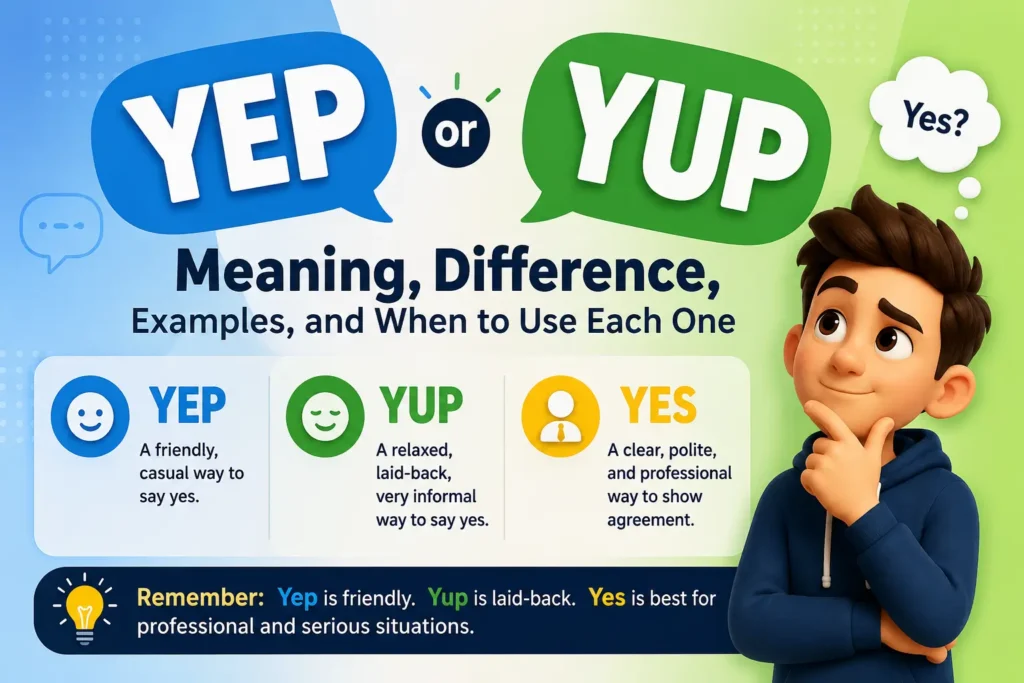
For Yep or Yup, focus on tone, context, and communication style, not only spelling, because both words mean yes. In simple English, yep and yup share the same meaning as a yes variation, synonym of yes, casual yes, and informal yes. Still, yep meaning feels friendly, quick, and clear, while yup meaning sounds more relaxed, playful, or slightly uninterested in certain contexts.
The clear difference comes from usage context, not strict grammar rules. These are colloquial words, common words, and informal words, not formal words. Use them in spoken English, text messages, chats, social media, online communication, conversation, and everyday speech. In written English or a serious situation, choose yes.
When choosing words, look at the agreement, confirmation, reply, and somebody receiving it. The difference explained is simple: yep is the safer casual reply, while yup is more laid-back.
Quick Answer: Yep or Yup?
Use yep when you want to say yes in a casual but friendly way.
Use yup when you want to sound more relaxed, laid-back, playful, or very informal.
Use yes when you want to sound clear, polite, professional, or serious.
Here’s the simplest way to remember it:
| Word | Meaning | Tone | Best Use |
| Yes | Agreement or confirmation | Neutral, polite, formal | Work, school, serious replies |
| Yep | Informal yes | Friendly, casual, clear | Texts, casual chats, friendly replies |
| Yup | Informal yes | Relaxed, playful, sometimes blunt | Close friends, jokes, quick replies |
So, which one should you choose?
Most of the time, yep is the safer casual choice. It sounds friendly without feeling too dry. Yup also works, but it can sound a bit short if the other person expects warmth or respect.
Read this also: Up to Date or Up-to-Date: Meaning, Difference, Examples, and Grammar Rule
What Does Yep Mean?
Yep means yes. It’s an informal word people use in everyday speech and casual writing.
You can use yep when you agree with someone, confirm something, answer a question, or show that you understood a message.
For example:
- “Yep, I’ll be there.”
- “Yep, that works for me.”
- “Yep, I saw your email.”
- “Yep, we can talk later.”
- “Yep, you’re right.”
In these examples, yep feels simple and natural. It doesn’t sound stiff. It doesn’t sound overly formal. It gives the other person a quick answer without making the conversation feel cold.
When Should You Use Yep?
Use yep when the setting is casual and the relationship feels comfortable.
Good situations for yep include:
- Texting a friend
- Replying to a classmate
- Answering a quick family question
- Chatting with a coworker you know well
- Confirming simple plans
- Responding in casual online conversations
Here’s a real-life example:
Your friend texts:
“Are you still coming tonight?”
You reply:
“Yep, I’ll be there around 7.”
That sounds natural. It gives the answer and adds a little context. Even better, it doesn’t feel like a cold one-word reply.
What Does Yup Mean?
Yup also means yes. Like yep, it’s informal. However, yup often sounds more relaxed, more casual, and sometimes more playful.
For example:
- “Yup, that’s the one.”
- “Yup, I knew it.”
- “Yup, we’re still going.”
- “Yup, sounds good.”
- “Yup, no problem.”
In friendly conversations, yup can sound easygoing. It has a “no big deal” feeling. However, that same relaxed tone can sometimes come across as bored, blunt, or dismissive.
That’s the tricky part.
Yup is not rude by itself. Still, tone matters. A lot.
When Should You Use Yup?
Use yup when the conversation is very casual.
It works best when you’re talking to:
- Close friends
- Siblings
- People your age
- Online communities
- Someone who already understands your tone
For example:
Friend: “Did you already eat the last slice of pizza?”
You: “Yup. No regrets.”
That sounds funny and playful. The word yup fits because the moment is light.
Now compare this:
Manager: “Did you complete the client report?”
You: “Yup.”
That might sound too casual. It could also sound careless. A better reply would be:
“Yes, I completed it this morning.”
Same meaning. Better tone.
Yep or Yup: The Main Difference
The main difference between yep and yup is not grammar. It’s tone.
Both words mean yes, but they create slightly different feelings.
| Feature | Yep | Yup |
| Meaning | Yes | Yes |
| Formality | Informal | Very informal |
| Tone | Friendly, casual, clear | Relaxed, playful, dry, blunt |
| Best for | Everyday casual replies | Close friends and very relaxed chats |
| Risk | Low | Can sound too short |
| Professional use | Sometimes okay in casual work chats | Usually less safe |
| Formal writing | Avoid it | Avoid it |
In simple terms, yep sounds a little warmer. Yup sounds more laid-back.
That doesn’t mean yup is bad. It just needs the right setting. Like hot sauce, it works better when you don’t pour it on everything.
Are Yep and Yup Real Words?
Yes, yep and yup are real words.
They are informal words, but informal doesn’t mean incorrect. English has many informal words that native speakers use every day. Words like yeah, okay, sure, nope, thanks, and bye all belong to regular conversation.
The important point is this:
Yep and yup are correct in casual English, but they are not ideal for formal English.
You can use them in a text message. You can use them in a friendly chat. You can use them in dialogue if you’re writing a story. However, you should avoid them in:
- Academic essays
- Research papers
- Job applications
- Formal emails
- Business contracts
- Professional reports
- Serious apologies
- Official statements
For those situations, choose yes.
Do Yep and Yup Mean the Same as Yes?
Yes, yep and yup have the same basic meaning as yes.
However, meaning and tone are not always the same thing.
Look at these three replies:
- “Yes, I understand.”
- “Yep, I understand.”
- “Yup, I understand.”
All three confirm understanding. Still, they don’t feel exactly alike.
Yes sounds direct and respectful.
Yep sounds casual and friendly.
Yup sounds relaxed and informal.
That difference matters when you’re talking to teachers, clients, managers, strangers, or anyone who expects a respectful tone.
Yes vs Yep vs Yup
| Word | Best Meaning | Tone | Example |
| Yes | Standard agreement | Polite, clear, serious | “Yes, I can attend the meeting.” |
| Yep | Casual agreement | Friendly and quick | “Yep, I can make it.” |
| Yup | Relaxed agreement | Very casual or playful | “Yup, I’m in.” |
If you’re ever unsure, use yes. It’s the safest choice.
Is It Rude to Say Yep or Yup?
Usually, no. Yep and yup are not rude by themselves.
However, they can sound rude in the wrong context.
A one-word reply can feel cold when the other person expects more effort. This happens often in texting because the reader can’t hear your voice, see your face, or read your body language.
For example:
Person: “I spent a lot of time fixing that issue. Did it help?”
Reply: “Yup.”
That reply may feel flat. The person might think you don’t care. A warmer answer would be:
“Yep, it helped a lot. Thank you.”
Small change. Big difference.
When Yep Can Sound Rude
Yep can sound rude when:
- You use it as a one-word answer in a serious conversation.
- The other person expects a more respectful reply.
- You use a period that makes it feel final or cold.
- You don’t add any detail after someone asks an important question.
Example:
Teacher: “Do you understand why this assignment is late?”
Student: “Yep.”
That sounds too casual. A better answer would be:
“Yes, I understand. I’ll submit it today.”
When Yup Can Sound Rude
Yup has a higher chance of sounding blunt because it already feels very casual.
Example:
Client: “Can you confirm that the invoice was corrected?”
Bad reply: “Yup.”
Better reply:
“Yes, I corrected the invoice and sent the updated version.”
The better answer sounds professional because it gives confirmation and detail.
How Punctuation Changes Yep and Yup
Punctuation can change the feeling of yep and yup. This is especially true in texting.
| Reply | Possible Tone |
| Yep | Neutral, quick |
| Yep! | Friendly, cheerful |
| Yep 🙂 | Warm and casual |
| Yep, sure | Helpful |
| Yup | Relaxed, simple |
| Yup! | Playful, upbeat |
| Yup. | Cold, dry, possibly annoyed |
| Yup lol | Very casual, joking |
That little period can be dangerous. “Yup.” may look like a door closing.
Of course, context matters. Some people always text with periods. Others never do. Still, if you want your reply to feel warm, add a few words.
Instead of:
“Yup.”
Try:
“Yup, that sounds good!”
Or:
“Yep, I’m good with that.”
Should You Use Yep or Yup in Professional Writing?
You should avoid yep and yup in formal professional writing.
That doesn’t mean you can never use them at work. Many workplaces have casual chat tools where people write quick replies. In those spaces, yep can feel normal.
For example:
Coworker: “Can you join the call at 2?”
You: “Yep, see you then.”
That sounds fine if your team has a casual culture.
However, in a formal email, yes works better.
Bad formal email example:
“Yep, I approve the final version.”
Better:
“Yes, I approve the final version.”
Even better:
“Yes, I approve the final version. Thank you for making the updates.”
Professional writing rewards clarity. It also rewards tone. When money, deadlines, grades, or trust are involved, choose the word that leaves no room for doubt.
Better Professional Alternatives
| Casual Word | Better Professional Option |
| Yep | Yes |
| Yup | Yes |
| Yep, sure | Certainly |
| Yup, got it | I understand |
| Yep, works | That works for me |
| Yup, done | I’ve completed it |
| Yep, okay | Yes, that’s fine |
Use yes when you want to sound polished. Use certainly when you want to sound helpful. Use absolutely when you want to sound confident and warm.
Which Is More Common: Yep or Yup?
Both yep and yup are common in modern English. You’ll hear them in American English, online conversations, movies, casual speech, and texting.
In general, yep often feels more neutral and widely usable. Yup feels more relaxed or expressive.
That said, usage depends on the speaker. Some people say yep all the time. Others prefer yup because it sounds funnier, shorter, or more casual.
Region, age, personality, and platform can also affect the choice.
For example:
- A coworker may type yep in Slack.
- A friend may text yup after a joke.
- A parent may say yes in a serious talk.
- A teenager may use yup online without thinking twice.
So, the better question isn’t only “Which is more common?” The better question is “Which one fits this moment?”
British English vs American English Usage
In American English, both yep and yup sound natural. People use them in speech, texting, and casual online writing.
In British English, people also understand both words. However, other casual forms like yeah, yea, aye, or simply yes may feel more common depending on the region and context.
In global English, yes remains the safest option. It works everywhere. It doesn’t depend as much on tone, culture, or personal style.
If you’re writing for an international audience, use yes when clarity matters. Use yep or yup only when the tone is clearly casual.
Yep or Yup in Text Messages
Texting gives yep and yup most of their daily mileage. They’re short, fast, and easy to understand.
Still, short replies can feel colder than you intend. That’s why it helps to add a little warmth.
Text Message Examples
| Situation | Better Reply | Why It Works |
| Friend asks if you’re coming | “Yep, I’ll be there!” | Friendly and clear |
| Someone confirms a plan | “Yep, that works for me.” | Casual but helpful |
| Friend asks a funny question | “Yup, guilty.” | Playful |
| Classmate asks if you finished | “Yep, just finished it.” | Gives useful detail |
| Coworker asks for confirmation | “Yep, I’ll handle it.” | Clear and responsible |
Notice something important. The best replies usually don’t stop at yep or yup. They add one small detail.
That tiny detail makes your answer feel human.
Real-Life Examples of Yep, Yup, and Yes
Sometimes the easiest way to understand tone is to see the words in real situations.
Casual Conversation
Friend: “Are we still watching the movie tonight?”
You: “Yep, I already bought snacks.”
This feels friendly. It confirms the plan and adds personality.
Very Casual Conversation
Friend: “Did you really wear pajamas to the store?”
You: “Yup. Fashion is pain.”
Here, yup works because the tone is silly and relaxed.
Work Chat
Coworker: “Can you check the file before lunch?”
You: “Yep, I’ll review it now.”
This sounds casual but still responsible.
Formal Email
Manager: “Can you confirm your attendance?”
You: “Yes, I’ll attend the meeting.”
This sounds better than yep or yup because the context is formal.
Serious Conversation
Parent: “Do you understand why this matters?”
You: “Yes, I understand.”
Here, yes carries more respect. Yep might feel too casual. Yup might feel dismissive.
Common Mistakes with Yep and Yup
Even simple words can cause problems. The trouble usually comes from tone, not grammar.
Thinking One Word Is Wrong
Some people think yup is wrong and yep is correct. That’s not true.
Both words are correct informal versions of yes. The difference sits in tone and usage.
Using Them in Formal Writing
This is the biggest mistake.
Don’t write yep or yup in formal essays, applications, reports, or professional documents. They can make your writing look too casual.
Use yes, certainly, correct, or I agree instead.
Ignoring the Relationship
You can say yup to a close friend. You probably shouldn’t say it to a client.
Language changes depending on the relationship. That’s not fake. That’s communication.
You wouldn’t wear flip-flops to a courtroom. In the same way, you shouldn’t use ultra-casual words in formal settings.
Forgetting That Text Has No Voice
In person, your smile can soften a short reply. In texting, the other person only sees the word.
“Yup.”
That might sound annoyed.
“Yup, no problem!”
That sounds friendly.
Same word. Different feeling.
Grammar Tips for Yep and Yup
Yep and yup are easy to use, but a few grammar tips can help you avoid awkward writing.
Capitalize Them at the Start of a Sentence
Correct:
- “Yep, I agree.”
- “Yup, that’s right.”
Incorrect:
- “yep, I agree.”
- “yup, that’s right.”
In casual texting, people often ignore capitalization. In polished writing, capitalize the first word.
Use a Comma After Yep or Yup When a Sentence Continues
When yep or yup starts a sentence and the sentence continues, use a comma after it.
Examples:
- “Yep, I can help.”
- “Yup, that was me.”
- “Yep, we’re ready.”
The comma creates a natural pause. It helps the sentence read smoothly.
Avoid Yep and Yup in Academic Writing
Academic writing needs standard language. Yep and yup sound conversational, not scholarly.
Instead of:
“Yep, the results support the claim.”
Write:
“Yes, the results support the claim.”
Better yet:
“The results support the claim.”
That sounds cleaner and more academic.
Don’t Overuse Them
Repeating yep or yup too often can make dialogue sound lazy.
Example:
“Yep.”
“Yep.”
“Yup.”
“Yep.”
That gets dull fast. Mix in other replies like:
- “Sure.”
- “Of course.”
- “That works.”
- “Sounds good.”
- “Absolutely.”
- “I agree.”
Good writing has rhythm. Repetition kills rhythm when it adds nothing.
Memory Tricks: How to Remember Yep vs Yup
Need a quick trick? Try this:
Yep = friendly yes.
Yup = ultra-casual yes.
Yes = safe yes.
Here’s another one:
Yep has an e, like easy and everyday. Use it for easy everyday replies.
Yup has a u, like ultra-casual. Use it when the conversation feels very relaxed.
Still unsure? Choose yep in casual settings. Choose yes in formal settings.
That rule will save you from most tone problems.
Yep and Yup Synonyms
Sometimes yep and yup work well. Other times, a different word sounds better.
Casual Synonyms
Use these with friends, family, classmates, or casual coworkers:
- Yeah
- Sure
- Okay
- Alright
- For sure
- Totally
- Sounds good
- You bet
- No problem
- Definitely
Examples:
- “Sure, I can help.”
- “For sure, let’s do it.”
- “Sounds good to me.”
- “Totally, I agree.”
Professional Synonyms
Use these in formal or work-related communication:
- Yes
- Certainly
- Absolutely
- Correct
- I agree
- I understand
- That is correct
- I can confirm
- That works for me
- I’d be happy to
Examples:
- “Yes, I can attend.”
- “Certainly, I’ll send it today.”
- “I can confirm the update.”
- “That works for me.”
Synonym Table by Tone
| Tone You Want | Best Choices |
| Friendly | Yep, sure, sounds good |
| Playful | Yup, totally, you bet |
| Polite | Yes, of course, certainly |
| Professional | Yes, I can confirm, absolutely |
| Serious | Yes, I understand |
| Warm | Absolutely, no problem, happy to help |
| Quick | Yep, sure, okay |
Choose the word that matches the moment. That’s the secret.
Related Words: Yeah, Yea, Yay, Nope, and Nah
English has several short casual words that look simple but cause confusion.
Yep vs Yeah
Yeah also means yes. It’s very common in casual speech.
- “Yeah, I like it.”
- “Yep, I like it.”
Both work. However, yeah can sound a little more conversational. Yep can sound more like a quick confirmation.
Yup vs Yeah
Yup sounds more clipped and relaxed than yeah.
Compare:
- “Yeah, I get it.”
- “Yup, I get it.”
The second one may sound more casual. Depending on tone, it may also sound less emotional.
Yea vs Yeah
Yea is not the same as yeah in most modern everyday writing.
Yea often appears in voting or formal approval contexts, as in “yea or nay.”
Yeah is the casual form of yes.
If you’re texting someone, you probably want yeah, not yea.
Yay
Yay shows excitement. It does not simply mean yes.
Example:
- “Yay! We won!”
Don’t use yay when you only mean yes.
Nope and Nah
Nope and nah are casual ways to say no.
| Word | Meaning | Tone |
| No | Standard negative answer | Neutral |
| Nope | Informal no | Casual, clear |
| Nah | Informal no | Very casual, relaxed |
Examples:
- “Nope, I haven’t seen it.”
- “Nah, I’m staying home.”
Just like yep and yup, these words depend on context.
Yep or Yup in Dialogue Writing
If you write stories, scripts, captions, or social posts, yep and yup can help characters sound natural.
A serious character might say:
“Yes, I understand.”
A friendly character might say:
“Yep, I’m ready.”
A sarcastic or relaxed character might say:
“Yup, that went terribly.”
These small choices reveal personality. They also make dialogue sound less robotic.
However, don’t force them. If every character says yup, they’ll start sounding like the same person wearing different hats.
Use word choice to show voice.
Mini Case Study: How One Word Changes Tone
Imagine someone texts you:
“Did you forget my birthday?”
Now compare these replies:
| Reply | How It Feels |
| “Yes.” | Honest but serious |
| “Yep.” | Too casual for the situation |
| “Yup.” | Almost careless or joking |
| “Yes, and I’m really sorry.” | Responsible and respectful |
| “I did, and I feel terrible about it.” | Human and sincere |
This shows why yep or yup is not only a grammar question. It’s a tone question.
Words carry mood. Short words carry even more mood because they leave space for the reader to guess.
And when people guess tone, they often guess wrong.
Best Rule for Choosing Yep or Yup
Here’s the easiest rule:
Use yep when you want casual and friendly.
Use yup when you want casual and relaxed.
Use yes when you want respectful and clear.
If the person matters, the situation feels serious, or the message could be misunderstood, don’t gamble. Use yes and add a little detail.
For example:
Instead of:
“Yup.”
Write:
“Yes, I’ll take care of it today.”
Instead of:
“Yep.”
Write:
“Yep, I’ll send it over in a few minutes.”
Better communication doesn’t always need bigger words. Sometimes it only needs one extra sentence.
FAQs About Yep or Yup
Q1: Is yep or yup correct?
Both yep and yup are correct informal words. They both mean yes, but yep usually sounds friendlier, while yup sounds more relaxed or casual.
Q2: What is the difference between yep and yup?
The main difference between yep and yup is tone. Yep feels warmer and more polite in casual replies. Yup feels more laid-back, playful, or sometimes slightly uninterested.
Q3: Is yup rude to say?
Yup is not rude by itself. However, it can sound blunt if you use it in a serious conversation, formal message, or one-word reply like “Yup.” Adding more words can make it sound friendlier.
Q4: Can I use yep in professional emails?
You should avoid yep in formal professional emails. Use yes, certainly, or that works for me instead. In casual team chats, yep may be fine if your workplace tone is relaxed.
Q5: Which is better: yep or yup?
Yep is usually the better choice because it sounds casual, friendly, and clear. Yup works best with close friends, playful messages, and very informal conversations.
Conclusion: Yep or Yup?
Choosing between yep or yup is simple once you understand the tone behind each word. Both yep and yup mean yes, and both work well in casual English. However, they don’t always feel the same in real conversation. Yep sounds more friendly, clear, and easygoing, while yup feels more relaxed, playful, or sometimes a little blunt.
The safest rule is easy to remember: use yep when you want a warm casual reply, use yup when you’re speaking with close friends, and use yes when the situation is formal or serious. In text messages, chats, social media, and everyday speech, both words are widely understood. Still, context matters. A small word can change the whole mood of your reply, so choose the one that fits your tone, audience, and situation.

1 thought on “Yep or Yup: Meaning, Difference, Examples, and When to Use Each One”