
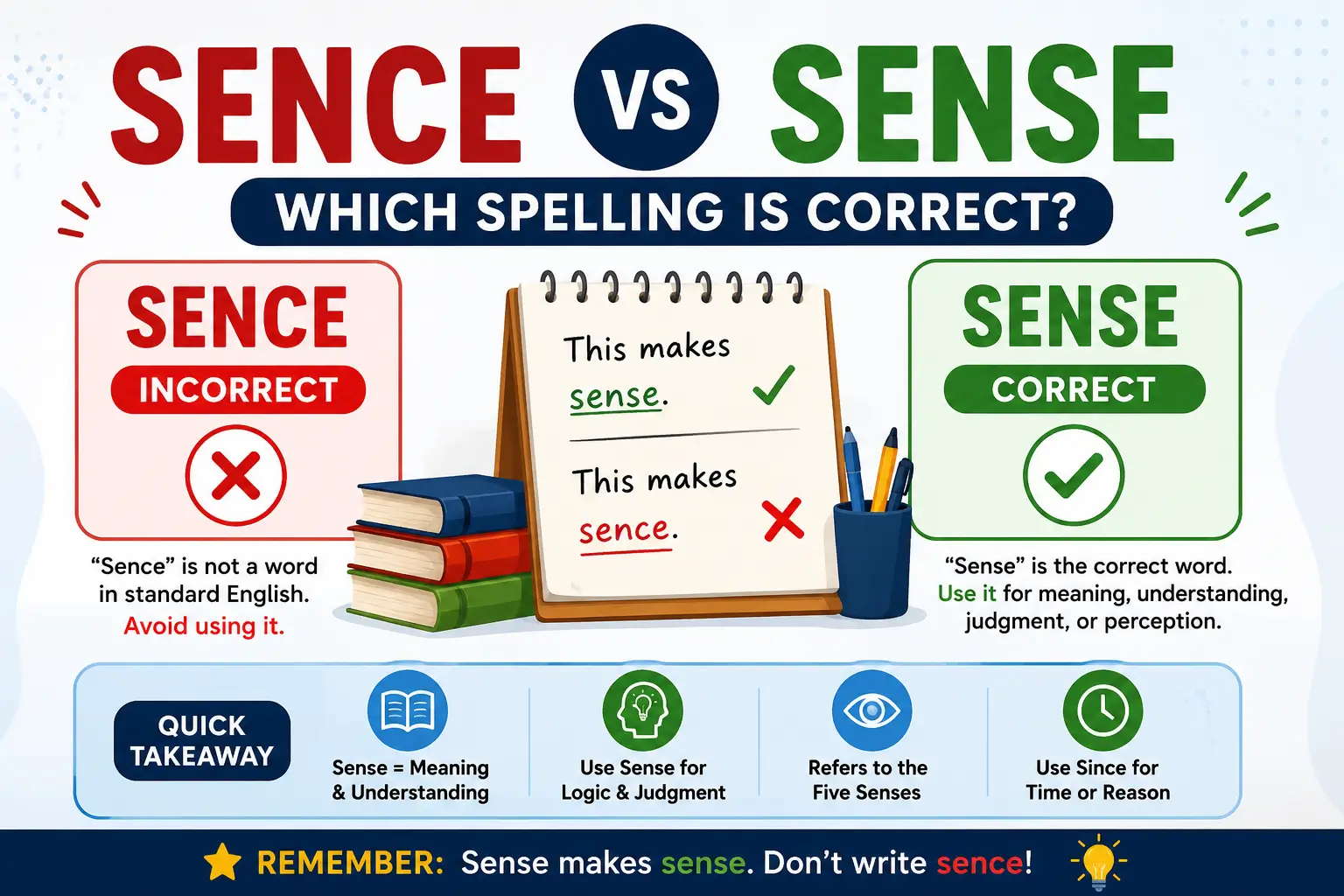
Sence vs sense is a common English spelling confusion, but the answer is simple: sense is the correct word, and sence is a spelling mistake. Many students, writers, bloggers, and professionals mix these words because they sound the same when spoken.
However, only sense is accepted in standard English. You use it when talking about meaning, understanding, judgment, awareness, or the five physical senses. For example, “This sentence makes sense” is correct, while “This sentence makes sence” is incorrect.
This guide explains the correct spelling, sense meaning, common examples, and the difference between sense and since. You’ll also learn how to avoid this mistake in emails, schoolwork, blog posts, and professional writing. By the end, you’ll know exactly when to use sense, why sence is wrong, and how to write with more confidence.
Quick Answer: Sence or Sense?
Sense is correct.
Sence is a spelling mistake.
| Word | Correct? | Meaning | Example |
| Sense | Yes | Meaning, judgment, awareness, or perception | This idea makes sense. |
| Sence | No | Incorrect spelling of sense | This idea makes sence. |
Here is the easiest rule:
Use sense when you mean:
- meaning
- understanding
- good judgment
- feeling
- awareness
- physical perception
Correct examples:
- That doesn’t make sense.
- She has a strong sense of responsibility.
- I could sense something was wrong.
- Touch is one of the five senses.
- His answer showed common sense.
Incorrect examples:
- That doesn’t make sence.
- She has a strong sence of responsibility.
- I could sence something was wrong.
- Touch is one of the five sences.
- His answer showed common sence.
Read this also: Advil or Aleve: Which Pain Reliever Should You Take?
What Does Sense Mean?
Sense is a real English word. It can work as both a noun and a verb.
As a noun, sense can mean meaning, judgment, feeling, awareness, or one of the body’s physical abilities.
As a verb, sense means to feel, notice, detect, or become aware of something.
For example:
- This paragraph makes sense.
- She has a good sense of humor.
- Dogs have a strong sense of smell.
- I can sense that something is wrong.
The exact meaning depends on the sentence, but the word always connects to understanding, feeling, noticing, or judging something.
Sense as Meaning or Understanding
The most common use of sense appears in the phrase make sense.
When something makes sense, it is clear, logical, or easy to understand.
Examples:
- Your explanation finally makes sense.
- This answer doesn’t make sense.
- Does this schedule make sense to you?
- The rule makes perfect sense now.
In this use, sense means clear meaning or reasonable logic.
For example, if someone explains a difficult topic and you finally understand it, you can say:
Now it makes sense.
Sense as Good Judgment
Sense can also mean practical judgment. This meaning appears in phrases like common sense, good sense, and business sense.
Examples:
- Wearing a seat belt is common sense.
- She showed good sense by checking the contract first.
- That decision makes financial sense.
- He has strong business sense.
In these examples, sense means the ability to make smart and practical choices.
Sense as Physical Perception
You also use sense when talking about the body’s ability to notice the world.
The five basic senses are:
- sight
- hearing
- smell
- taste
- touch
Examples:
- Dogs have an excellent sense of smell.
- He lost his sense of taste during the illness.
- Touch is an important sense.
- The baby’s sense of hearing develops early.
In this meaning, sense connects to physical perception. Your senses help you experience what happens around you.
Sense as a Feeling or Awareness
Sometimes sense means a feeling, instinct, or awareness that something exists or may happen.
Examples:
- I had a strange sense that someone was watching.
- She felt a deep sense of peace.
- There was a strong sense of excitement in the room.
- He had a clear sense of danger.
This use does not always depend on logic. It can come from emotion, instinct, or atmosphere.
For example, when you enter a quiet room after an argument, you might sense tension even if no one says anything.
Is Sence a Word?
Sence is not a correct word in standard English. In most cases, it is simply a misspelling of sense.
You may see sence in text messages, social media comments, or rushed writing, but you should avoid it in formal and professional writing.
Correct:
- This idea makes sense.
Incorrect:
- This idea makes sence.
Using sence in schoolwork, emails, resumes, reports, blogs, or business writing can make your sentence look careless. Even one small spelling mistake can distract the reader from your message.
Why Do People Confuse Sence and Sense?
People confuse sence and sense because the pronunciation gives almost no clue. The incorrect spelling sence looks possible because many English words end with -ence.
Examples:
- fence
- hence
- sentence
- difference
- presence
Because these words look normal, sence may seem believable. However, sense belongs to a different spelling pattern.
Related words include:
- sensation
- sensitive
- sensible
- sensory
- senseless
Notice the pattern. These words begin with sens-, not senc-. That spelling family can help you remember the correct form.
Sence vs Sense: Main Difference
The difference between sence and sense is simple: sense is correct, and sence is incorrect.
| Feature | Sense | Sence |
| Correct spelling | Yes | No |
| Standard English word | Yes | No |
| Can be used as a noun | Yes | No |
| Can be used as a verb | Yes | No |
| Means understanding | Yes | No |
| Means perception | Yes | No |
| Suitable for formal writing | Yes | No |
So, when you are choosing between sence or sense, choose sense every time.
How to Use Sense Correctly
You can use sense as both a noun and a verb.
Sense as a Noun
As a noun, sense names an idea, ability, feeling, or type of perception.
Examples:
- She has a great sense of humor.
- He has no sense of direction.
- This plan makes sense.
- There was a sense of sadness in the room.
- Smell is one of the five senses.
Common phrases with sense include:
| Phrase | Meaning | Example |
| common sense | practical judgment | Use common sense online. |
| sense of humor | ability to enjoy jokes | He has a dry sense of humor. |
| sense of direction | ability to navigate | I have a poor sense of direction. |
| sense of purpose | feeling of meaning or goal | Her work gives her a sense of purpose. |
| sense of responsibility | awareness of duty | He has a strong sense of responsibility. |
Sense as a Verb
As a verb, sense means to feel, notice, detect, or become aware of something.
Examples:
- I can sense a problem.
- She sensed that he was upset.
- The camera can sense movement.
- Animals can often sense danger before humans do.
- He senses a change in the market.
A useful trick is to replace sense with notice, feel, or detect. If the sentence still works, sense is probably correct.
Example:
- I can sense tension.
- I can feel tension.
- I can detect tension.
All three sentences work.
Word Forms of Sense
Here are the most common word forms related to sense:
| Word | Part of Speech | Example |
| sense | noun or verb | This makes sense. |
| senses | plural noun or verb | The body has five senses. |
| sensed | past tense verb | She sensed danger. |
| sensing | present participle | The device is sensing motion. |
| sensible | adjective | That’s a sensible choice. |
| senseless | adjective | It was a senseless mistake. |
| sensitive | adjective | His skin is sensitive. |
| sensory | adjective | The activity supports sensory learning. |
| sensation | noun | The cold water caused a sharp sensation. |
These related words make the spelling easier to remember. If the meaning connects to feeling, perception, awareness, or judgment, the spelling usually starts with sens-.
Sence vs Sense vs Since
Many people also confuse sense with since because the two words sound similar in casual speech. However, they have different meanings.
| Word | Meaning | Example |
| Sense | meaning, judgment, feeling, or perception | Your answer makes sense. |
| Since | from a time in the past | I’ve lived here since 2020. |
| Since | because | Since you asked, I’ll explain. |
| Sence | incorrect spelling | Do not use sence. |
When to Use Since
Use since when you talk about time.
Examples:
- I’ve known her since college.
- He has worked here since Monday.
- They’ve lived in Chicago since 2018.
You can also use since to mean because.
Examples:
- Since you’re here, let’s start.
- Since it’s late, we should leave.
- Since the file is ready, send it today.
When to Use Sense
Use sense when you talk about meaning, understanding, judgment, feeling, or perception.
Examples:
- That answer makes sense.
- She has a strong sense of style.
- I can sense your frustration.
- He has no sense of timing.
- The idea makes business sense.
When Not to Use Sence
Never use sence in standard English.
Incorrect:
- I haven’t seen him sence Friday.
- This doesn’t make sence.
- She has a good sence of humor.
Correct:
- I haven’t seen him since Friday.
- This doesn’t make sense.
- She has a good sense of humor.
Correct and Incorrect Examples
| Incorrect | Correct | Why |
| This doesn’t make sence. | This doesn’t make sense. | Sense is the correct spelling. |
| She has a good sence of humor. | She has a good sense of humor. | The phrase is sense of humor. |
| I could sence danger. | I could sense danger. | Sense can be a verb. |
| He has no common sence. | He has no common sense. | The correct phrase is common sense. |
| I’ve waited sense morning. | I’ve waited since morning. | Use since for time. |
| That was a sense decision. | That was a sensible decision. | Use sensible as the adjective. |
Common Mistakes with Sence and Sense
1. Writing Sence Instead of Sense
This is the most common mistake.
Incorrect:
- This sentence doesn’t make sence.
Correct:
- This sentence doesn’t make sense.
To remember the correct spelling, connect sense with sensation. Both start with sens-.
2. Confusing Sense and Since
This mistake happens because the words sound similar.
Incorrect:
- I’ve lived here sense 2021.
Correct:
- I’ve lived here since 2021.
Use since for time or reason. Use sense for meaning, awareness, or judgment.
3. Writing Common Sence
The correct phrase is common sense, not common sence.
Incorrect:
- That is just common sence.
Correct:
- That is just common sense.
Common sense means practical judgment or the ability to make reasonable decisions.
4. Using Sense Instead of Sensible
Sense is usually a noun or verb. Sensible is an adjective.
Incorrect:
- That was a sense decision.
Correct:
- That was a sensible decision.
More examples:
- She made a sensible choice.
- His answer made sense.
- It makes sense to save money.
- Saving money is sensible.
Memory Tricks for Sence vs Sense
The Five Senses Trick
You probably already know the phrase five senses. Use that spelling as your anchor.
Correct:
- five senses
- common sense
- make sense
Incorrect:
- five sences
- common sence
- make sence
The Sensation Trick
Sense and sensation both relate to feeling or perception.
Examples:
- sense
- sensation
- sensory
- sensitive
- sensible
They all begin with sens-. That pattern can help you avoid the wrong spelling.
The Since Test
Ask yourself this question:
Am I talking about time or reason?
If yes, use since.
Examples:
- since Monday
- since 2020
- since you asked
- since it rained
If no, you probably need sense.
Examples:
- make sense
- common sense
- sense of humor
- sense danger
Synonyms for Sense
The best synonym depends on the meaning of sense in the sentence.
| Meaning of Sense | Possible Synonyms | Example |
| Understanding | meaning, logic, clarity | This idea has clear logic. |
| Judgment | wisdom, reason, practicality | She showed great wisdom. |
| Physical perception | perception, awareness, feeling | Smell is a type of perception. |
| Emotional awareness | feeling, instinct, intuition | I had a strong instinct. |
| Detect as a verb | notice, feel, detect, perceive | I can detect a problem. |
Examples:
- “This makes sense” can mean “This is logical.”
- “He has common sense” can mean “He has practical judgment.”
- “I can sense danger” can mean “I can feel or detect danger.”
FAQs About Sence vs Sense
Q1. Is sence a word?
No, sence is not a correct word in standard English. It is a common spelling mistake. The correct spelling is sense.
Q2. Which is correct: sence or sense?
Sense is correct, and sence is incorrect. For example, write “This makes sense,” not “This makes sence.”
Q3. What does sense mean?
Sense can mean meaning, understanding, judgment, awareness, or physical perception. For example, “She has common sense” means she has practical judgment.
Q4. What is the difference between sense and since?
Sense means meaning, judgment, awareness, or perception. Since refers to time or reason. For example, “This makes sense” and “I’ve lived here since 2020.”
Q5. Why do people write sence instead of sense?
People write sence by mistake because it sounds like sense and looks similar to words ending in “-ence,” such as fence, sentence, and difference. However, the correct spelling is always sense.
Conclusion
The difference between sence vs sense is easy to remember: sense is the correct spelling, and sence is an incorrect form. Use sense when you mean meaning, understanding, awareness, judgment, or physical perception. Common phrases like make sense, common sense, sense of humor, and sense of direction always use the spelling with “s.” You should also remember that sense and since are different words.
Use since for time or reason, such as “since Monday” or “since you asked.” If you connect sense meaning with related words like sensible, sensory, and sensation, the spelling becomes easier to remember. Avoiding this simple spelling mistake can make your writing clearer, more polished, and more professional.