
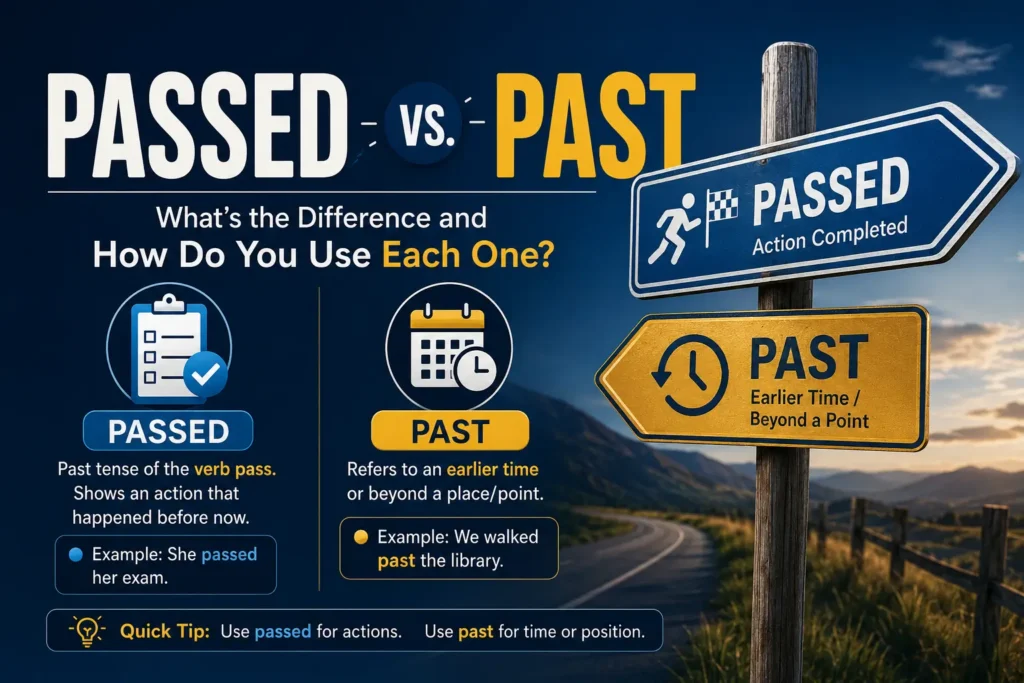
Confused about passed vs past? You’re not alone. These words sound alike, but they have different meanings and uses. Passed is the past tense of the verb pass, while past can describe an earlier time or something beyond a place or point. For example, you passed your test, but you walked past the school. Learning this simple difference can help you avoid common spelling and grammar mistakes in school, work, emails, and everyday writing.
The easiest way to choose the right word is to look at its role in the sentence. Use passed for an action that happened before now, such as passed the exam or passed the car. Use past when you mean an earlier time, as in the past year, or movement beyond something, as in walked past the store.
Once you understand how each word works, passed and past become much easier to use correctly. A quick check of the sentence’s main verb can often tell you which word belongs there.
Quick Answer: Passed vs. Past
Use passed when you’re using the verb pass in the past tense. It can mean succeeded, moved beyond something, handed something to someone, or went by.
- I passed my exam.
- The car passed us.
- She passed me the phone.
- Three hours passed quickly.
Use past when you mean an earlier time, a previous period, or movement beyond a particular point.
- We can’t change the past.
- He learned from his past mistakes.
- We walked past the library.
- It was past midnight.
The easiest memory trick
Passed = an action performed in the past.
Past = before now or beyond a point.
This isn’t a rule that covers every possible sentence, but it’s a reliable shortcut for most everyday uses.
Passed vs. Past: The Main Difference
The biggest difference between passed and past is their grammatical function.
Passed is a form of the verb pass. It describes an action that happened in the past.
Past has several grammatical roles. It can be a noun, adjective, preposition, or adverb. Its meaning often relates to previous time or something located beyond a particular point.
| Word | Grammatical Role | Main Meaning | Example |
| Passed | Verb | Completed an action involving “pass” | She passed the test. |
| Past | Noun | Time before now | We can’t change the past. |
| Past | Adjective | Previous or former | He learned from his past mistakes. |
| Past | Preposition | Beyond a place or point | We walked past the store. |
| Past | Adverb | Beyond a particular point | The car drove past. |
The pronunciation causes much of the confusion. In most American English accents, passed and past sound the same or very similar. However, their spelling and grammatical functions are different.
Therefore, you shouldn’t choose between them based on sound alone. Instead, look at the sentence and ask what the word is doing.
What Does “Passed” Mean?
Passed is the simple past tense and past participle of the verb pass.
The verb pass has several meanings, so passed can appear in many different situations. However, it always functions as a verb form.
“Passed” Means Successfully Completed Something
One of the most common uses of passed is to say that someone successfully completed a test, exam, course, or requirement.
- I passed my English exam.
- Maria passed her driving test.
- He passed the final.
- The students passed the course.
In each sentence, passed means that the person achieved the required result.
Compare these two sentences:
I passed my driver’s test.
I failed my driver’s test.
Here, passed and failed are opposite outcomes.
You wouldn’t write:
I past my driver’s test.
That’s incorrect because the sentence needs a verb. The correct past-tense form of pass is passed.
“Passed” Means Moved Beyond Something
Passed can also describe movement beyond a person, vehicle, building, or other object.
- The truck passed my car.
- A runner passed two competitors.
- We passed several restaurants on the way downtown.
- The train passed the station without stopping.
In these examples, passed is the main verb.
This is an important distinction because you can describe similar movement using past.
Compare:
The car passed the house.
The car drove past the house.
Both sentences describe the car moving beyond the house. However, the grammar is different.
In the first sentence, passed is the verb.
In the second sentence, drove is the verb, and past is a preposition that indicates the car’s position relative to the house.
“Passed” Means Handed Something to Someone
The verb pass can also mean to give or transfer something from one person to another. In the past tense, you use passed.
- She passed me the salt.
- He passed the phone to his sister.
- The teacher passed the papers around the classroom.
- Please pass the remote. (Present tense)
Notice the difference between pass and passed:
Please pass the salt.
This describes a present request.
She passed me the salt.
This describes an action that already happened.
Therefore, passed is the correct choice when the action occurred in the past.
“Passed” Means Time Went By
Another common use occurs when passed means that time went by or elapsed.
- Two hours passed before the meeting ended.
- Several years passed quickly.
- As time passed, she became more confident.
- A week passed without any response.
You can often replace passed with went by without changing the basic meaning.
Three days passed.
Three days went by.
This is a useful test when you’re unsure whether passed is correct.
“Passed” in Government and Legal Contexts
In news reports, government discussions, and formal writing, passed can mean that lawmakers officially approved a bill or law.
- Congress passed the bill.
- The state legislature passed a new law.
- The city council passed the measure.
Here, passed is still the past tense of pass, but the action involves formal approval rather than physical movement.
What Does “Past” Mean?
Unlike passed, the word past isn’t the past-tense form of pass. It has several different grammatical functions.
You can use past as a noun, adjective, preposition, or adverb.
“Past” as a Noun
As a noun, past refers to a time or period that has already happened.
- We can’t change the past.
- She doesn’t like talking about her past.
- His past shaped his future.
- We should learn from the past.
In these sentences, past refers to previous events, experiences, or periods.
Common expressions include:
- in the past
- from the past
- the recent past
- the distant past
- learn from the past
For example:
People in the past didn’t have smartphones.
The word past refers to an earlier period.
“Past” as an Adjective
As an adjective, past describes something that happened earlier or belonged to a previous period.
- my past experiences
- past mistakes
- a past president
- a past employer
- past relationships
For example:
My past experience helped me get the job.
Here, past means previous or earlier.
Similarly:
She learned from her past mistakes.
The mistakes happened before now, so past correctly describes them.
“Past” as a Preposition
As a preposition, past often shows movement beyond a specific place, person, or point.
- We walked past the library.
- She drove past my house.
- The dog ran past the fence.
- He hurried past me.
The key point is that another verb already expresses the action.
For example:
She walked past the store.
The action is walked. The word past tells us where she moved in relation to the store.
This is why you shouldn’t write:
She walked passed the store.
The correct version is:
She walked past the store.
“Past” as an Adverb
Past can also work as an adverb when it means beyond a particular point or place.
- The car drove past.
- The runner sped past.
- She walked past without noticing me.
In these examples, the specific object or location may be understood from the context.
“Past” When Talking About Time
You can use past to describe a time that is later than a particular hour.
- It’s ten minutes past three.
- We arrived past noon.
- It was past midnight.
- She stayed up past her usual bedtime.
American English also commonly uses after in this context.
- It’s ten minutes past three.
- It’s ten minutes after three.
Both are understandable and commonly used in American English. In everyday conversation, many US speakers naturally use after, while past is also standard.
Passed vs. Past: A Grammar Comparison
Understanding the grammatical role of each word is the best way to avoid confusion.
Passed
Passed is the past tense and past participle of pass.
The basic verb forms are:
- pass — base or present form
- passed — simple past
- passed — past participle
Examples:
I hope I pass the exam.
I passed the exam yesterday.
I have passed the exam.
In all three sentences, the word belongs to the verb pass.
Past
Past isn’t the past tense of pass.
Instead, it can function in several ways:
- Noun: The past is behind us.
- Adjective: She has past experience.
- Preposition: We walked past the store.
- Adverb: The car drove past.
This distinction explains why the following sentence is incorrect:
I past the exam.
The sentence needs the verb pass in the past tense:
I passed the exam.
Passed vs. Past: Examples in Everyday English
The difference becomes clearer when you see the words used in familiar situations.
At School
I passed my science test.
Passed is correct because the student successfully completed the test.
We talked about our past school experiences.
Past is correct because the sentence refers to earlier experiences.
At Work
She passed the certification exam.
The action of successfully completing the exam happened in the past.
His past work experience made him a strong candidate.
Here, past means previous.
While Driving
The truck passed my car.
Passed is the verb describing the truck’s movement.
We drove past the gas station.
Drove is the verb. Past indicates movement beyond the gas station.
Talking About Time
Three hours passed before we heard from them.
The word passed means that three hours went by.
It was past midnight when we arrived.
The word past means later than midnight.
In Daily Conversation
I passed your house yesterday.
I walked past your house yesterday.
Both can be correct. The first uses passed as the main verb. The second uses walked as the main verb and past as a preposition.
Passed vs. Past: Similar Sentences That Confuse Readers
Some of the hardest examples are sentences where both words seem to express almost the same idea.
“I Passed the Store” vs. “I Walked Past the Store”
Both sentences describe movement beyond a store.
I passed the store.
Here, passed is the verb.
I walked past the store.
Here, walked is the verb, while past shows the relationship between the walking and the store.
The difference is grammatical rather than a major difference in the overall situation.
“The Car Passed Me” vs. “The Car Went Past Me”
Again, the meanings are closely related.
The car passed me.
Passed is the main verb.
The car went past me.
Went is the main verb, and past indicates movement beyond you.
“Time Passed” vs. “Past Time”
These expressions aren’t interchangeable.
Time passed quickly.
This means time went by.
It was past time to leave.
This means the appropriate time for leaving had already gone by.
The words may appear together in related contexts, but their grammatical roles remain different.
Common Mistakes With Passed and Past
Because these words sound alike, spelling mistakes are common. Here are the errors you’re most likely to encounter.
Mistake: “I Past the Test”
❌ I past the test.
✅ I passed the test.
The sentence needs the past-tense verb passed.
Mistake: “We Drove Passed the School”
❌ We drove passed the school.
✅ We drove past the school.
The verb is drove. The word past shows movement beyond the school.
Mistake: “It’s Passed Midnight”
❌ It’s passed midnight.
✅ It’s past midnight.
The phrase past midnight means later than midnight.
Mistake: “In the Passed”
❌ In the passed, people communicated differently.
✅ In the past, people communicated differently.
The standard expression is in the past.
Mistake: “She Walked Passed Me”
❌ She walked passed me.
✅ She walked past me.
The verb walked already describes the action. Past indicates that she moved beyond your position.
Mistake: “Passed Due”
❌ Your payment is passed due.
✅ Your payment is past due.
Past due means something was due earlier but hasn’t been paid or completed.
You can use this phrase for:
- bills
- invoices
- payments
- library books
- assignments
For example:
My electricity bill is past due.
When Passed and Past Appear Together
It’s completely possible to use passed and past in the same sentence.
Consider:
She passed the time by walking past the shops.
The two words have different jobs.
- Passed = the verb meaning time went by
- Past = a preposition showing movement beyond the shops
Another example is:
The car passed us and continued past the exit.
Here:
- passed describes the car moving beyond us
- past describes the car’s continued movement beyond the exit
This is a good reminder that similar pronunciation doesn’t make two words interchangeable.
How to Choose Between Passed and Past
When you’re unsure which spelling to use, follow this simple process.
Ask: Is “Pass” the Verb?
If the sentence needs the past tense of pass, use passed.
I passed the exam.
The bus passed our house.
She passed me the phone.
Ask: Am I Talking About Earlier Time?
If you’re referring to a previous period, use past.
We discussed the past.
He has past experience.
She regrets her past decisions.
Ask: Am I Describing Movement Beyond Something?
If another verb already describes the movement, use past.
We walked past the school.
She ran past me.
They drove past the restaurant.
Ask: Am I Saying That Time Went By?
If you can replace the word with went by, use passed.
Several months passed.
Several months went by.
This test works well because passed is acting as a verb.
Common Expressions With Passed
The word passed appears in several familiar expressions.
Passed Away
Passed away is a polite way to say that someone died.
Her grandfather passed away last year.
The expression is common in everyday conversation, condolences, obituaries, and other sensitive contexts.
Passed By
Passed by means went past or moved beyond.
I passed by your office yesterday.
It can also refer to time:
The years passed by quickly.
Passed Down
Passed down means transferred from one generation or person to another.
The recipe was passed down through the family.
The watch was passed down from his grandfather.
Passed Through
Passed through means traveled through a place or area.
We passed through several small towns.
It can also be used more figuratively, depending on context.
Common Expressions With Past
In the Past
This means at an earlier time.
People communicated differently in the past.
Past Experience
This means experience gained from previous situations.
Her past experience helped her succeed in the new role.
Past Mistakes
This refers to mistakes that happened earlier.
We can learn from our past mistakes.
Past Midnight
This means later than midnight.
We didn’t get home until past midnight.
Past Due
This means something was due earlier but hasn’t been paid, completed, or returned.
The library book is past due.
Walk Past or Drive Past
These phrases describe movement beyond a place.
We walked past the coffee shop.
I drove past the school this morning.
Passed vs. Past in American English
In standard American English, passed and past are both common words, but they aren’t interchangeable.
The main challenge is pronunciation. In many US accents, the two words sound alike or nearly alike. Therefore, spelling becomes especially important in writing.
American English commonly uses both past and after when telling time.
It’s five minutes past two.
It’s five minutes after two.
Both are standard and understandable.
The more important distinction is grammatical. American English speakers still use passed for the past tense of pass and past for previous time, position, or movement beyond a point.
A Simple Memory Trick for Passed vs. Past
Use this sentence as your main reminder:
You passed the test, but you walked past the school.
Why does this work?
- Passed is the action of successfully completing the test.
- Past follows walked and shows movement beyond the school.
You can also remember:
Passed = pass + ed
If you can replace the word with the past tense of pass, use passed.
I passed the exam.
If the meaning is before now or beyond a point, use past.
My past is important to me.
We walked past the store.
Passed vs. Past: Quick Practice Quiz
Choose passed or past for each sentence.
- I ___ my driving test yesterday.
- We walked ___ the bank.
- The ___ year was challenging.
- Three hours ___ before the meeting ended.
- The bill is ___ due.
- She ___ me the phone.
- It’s ___ midnight.
- We can’t change the ___.
- The car ___ us on the highway.
- He drove ___ the exit.
Answers
- passed — I passed my driving test yesterday.
- past — We walked past the bank.
- past — The past year was challenging.
- passed — Three hours passed before the meeting ended.
- past — The bill is past due.
- passed — She passed me the phone.
- past — It’s past midnight.
- past — We can’t change the past.
- passed — The car passed us on the highway.
- past — He drove past the exit.
The fastest way to solve these questions is to identify the main verb. If pass is the verb in the past tense, choose passed. If the word refers to earlier time or movement beyond something, choose past.
Related Words: Pass, Passed, Past, and Passing
These words are related, but they don’t have the same grammatical function.
| Word | Meaning or Function | Example |
| Pass | Base verb | I hope I pass the test. |
| Passed | Past tense of pass | I passed the test. |
| Past | Earlier time or beyond a point | We walked past the school. |
| Passing | Present participle or adjective | The passing cars were noisy. |
Understanding this word family can help you recognize the correct form more quickly.
For example:
I hope I pass.
I passed yesterday.
I am passing the school now.
I walked past the school yesterday.
Each word has a distinct role, even though pass, passed, and past are closely related in meaning or sound.
Conclusion
Understanding passed vs. past is easier when you focus on the meaning and grammatical role of each word. Passed is the past tense of the verb pass, so you use it for actions such as passing a test, moving beyond something, handing something to someone, or describing time going by. Past, however, can refer to an earlier time, a previous experience, or movement beyond a particular place or point.
A simple memory trick can help: passed = pass + ed, while past = before or beyond. You passed the exam, but you walked past the school. When you’re unsure, look for the main verb and ask what the sentence means. This quick check will help you choose between passed and past with confidence.
Frequently Asked Questions About Passed vs. Past
Q:1. What is the main difference between passed and past?
Passed is the past tense of the verb pass. Past usually refers to an earlier time, a previous situation, or movement beyond a particular place or point.
Q:2. Is it “I passed the test” or “I past the test”?
The correct sentence is “I passed the test.” The word passed is the past tense of pass, meaning you successfully completed the test.
Q:3. Is it “walked past” or “walked passed”?
The correct phrase is “walked past.” The verb is walked, while past shows movement beyond a person, place, or object.
Q:4. Is it “past due” or “passed due”?
The correct expression is past due. It means something was supposed to be paid, completed, or returned earlier.
Your payment is past due.
Q:5. Is it “past midnight” or “passed midnight”?
The standard expression is past midnight when you mean a time later than midnight.
We arrived home past midnight.
However, passed can be correct when it functions as the verb pass.
Midnight passed while we were driving.
Q:6. Is passed always a verb?
Yes. Passed is the past tense and past participle of the verb pass. It can mean successfully completing something, moving beyond something, handing something over, or going by.
Q:7. Can past be a verb?
In standard modern English, past isn’t normally used as the verb pass. When you need the past tense of pass, use passed.
Q:8. How can I easily remember passed vs. past?
Remember this simple rule: passed = an action, while past = before or beyond. You passed your exam, but you walked past the school.
Q:9. Why do passed and past sound so similar?
In many varieties of American English, passed and past have the same or nearly the same pronunciation. However, their meanings, spellings, and grammatical functions are different.
Q:10. Can passed and past be used in the same sentence?
Yes. For example:
She passed the time by walking past the shops.
Here, passed is the verb meaning time went by, while past shows movement beyond the shops.
