
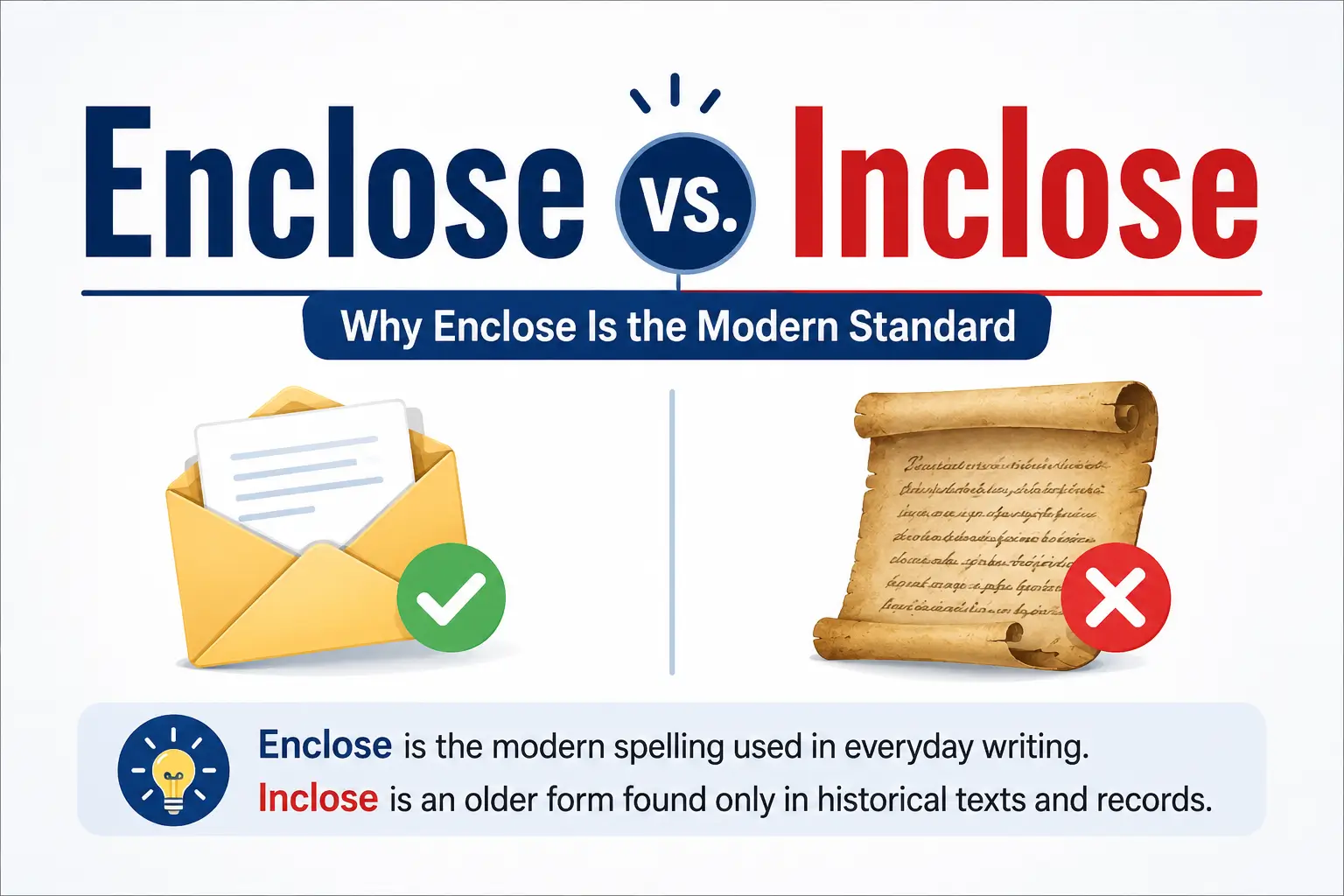
The enclose vs. inclose choice is simple: enclose is the modern spelling, while inclose survives mainly in older historical records and texts. Both words once meant to surround, shut in, or place something inside a container, boundary, or envelope.
Today, enclose is the accepted verb in modern English. Its related forms are enclosed, enclosing, and enclosure. You can enclose a yard with a fence, enclose a document in a letter, or describe an enclosed space. This spelling fits school, business, and formal writing.
Use inclose only when quoting an old source or naming something historical, such as the Inclosure Acts. Older forms like inclosed, inclosing, and inclosure may appear in legal records or classic literature. In new writing, they can look like misspellings. A simple rule helps: use enclose for current writing and keep inclose only when historical accuracy requires it.
Quick Answer: Is It Inclosed or Enclosed?
Use enclosed in modern English.
The word enclosed can mean:
- Surrounded by a physical boundary
- Placed inside a letter, envelope, or package
- Included as part of a physical delivery
- Closed off from an open area
Examples:
- The yard is enclosed by a wooden fence.
- The payment is enclosed with this letter.
- The animals stayed in an enclosed area.
- A copy of the receipt is enclosed.
Inclosed is a historical spelling of the same word. It may be preserved in old legal records, books, maps, or direct quotations. However, it is not the recommended form for normal school, business, academic, or professional writing.
Simple rule: Use enclosed unless you are quoting an older source that originally uses inclosed.
Inclosed vs. Enclosed at a Glance
| Word | Modern status | Meaning | Recommended use | Example |
| enclosed | Standard | Surrounded, contained, or included inside something | Use in modern writing | The form is enclosed. |
| inclosed | Archaic or historical | Older variant of enclosed | Use only in quotations or historical discussion | The original deed says “inclosed land.” |
| enclose | Standard base verb | To surround or place inside | Use for present or future actions | Please enclose the receipt. |
| enclosure | Standard noun | An enclosed area or an item included with a letter | Use in modern writing | The animals entered the enclosure. |
The two spellings do not represent two different modern meanings. Instead, enclosed became the accepted standard form.
What Does Enclosed Mean?
Enclosed is the simple past and past participle form of the verb enclose. It can also work as an adjective.
The verb enclose means to surround, contain, or place something inside another object.
For example:
- The fence enclosed the garden.
- She enclosed a check with the application.
The form enclosed may describe a completed action:
- They enclosed the porch last year.
It may also describe the condition of something:
- The porch is fully enclosed.
Therefore, the exact meaning depends on the sentence.
Enclosed Meaning “Surrounded or Contained”
One common meaning of enclosed is surrounded by a physical boundary.
The boundary may be made of:
- Walls
- Fences
- Glass
- Metal
- Fabric
- Hedges
- Barriers
- A container
Examples:
- The playground is enclosed by a high fence.
- We sat in an enclosed courtyard.
- The equipment must remain in an enclosed cabinet.
- The balcony is fully enclosed with glass.
- The dog stayed in an enclosed yard.
In these examples, the enclosed place has clear limits around it.
However, enclosed does not always mean airtight or completely sealed. A fenced yard may be enclosed even if it has an open gate. An enclosed porch may have windows that can open.
The word focuses on the surrounding boundary, not necessarily on complete closure.
Enclosed Meaning “Included Inside Something”
The second major meaning appears in letters, packages, applications, and business communication.
When an item is enclosed, it has been placed inside another physical item.
Examples:
- I have enclosed the signed agreement.
- The receipt is enclosed with your order.
- Please review the enclosed documents.
- A return label is enclosed in the package.
- The application includes an enclosed payment form.
This usage was especially common when businesses sent most documents by mail.
Today, it still applies to physical letters and packages. However, attached is usually the better word for digital files sent by email.
Is Inclosed a Real Word?
Yes, inclosed has existed in English. However, that does not make it the best spelling for modern writing.
Historically, inclosed appeared as a variant of enclosed. Older writers did not always follow the same spelling standards used today. As a result, several words appeared in more than one form.
You may find inclosed in:
- Historical property documents
- Old court records
- Early dictionaries
- Older books and letters
- Land surveys
- Legal quotations
- Preserved place names
- Transcriptions of original sources
For example, an old deed might describe “inclosed land.” When quoting the deed exactly, you should preserve its original spelling.
However, when explaining the same information in modern English, write:
- The deed describes enclosed land.
This keeps the quotation accurate while making your explanation clear.
Why Did Inclosed and Enclosed Both Exist?
The spellings developed during a period when English spelling was less fixed than it is today.
The prefixes in- and en- can both carry the idea of putting something into a state or place. English borrowed and developed words from several languages, including French and Latin. As spelling conventions changed, some forms became more common than others.
Over time, enclose became the standard verb. Therefore, its related forms also became standard:
- enclose
- encloses
- enclosed
- enclosing
- enclosure
The older form inclose remained visible in some records, but it gradually became rare.
For modern writers, the language history is less important than the practical result: enclosed is the expected spelling today.
The Main Difference Between Inclosed and Enclosed
The clearest difference is their status in modern English.
Enclosed Is the Modern Standard
Use enclosed in:
- School assignments
- Business letters
- Reports
- Articles
- Contracts written today
- Product instructions
- Property descriptions
- Emails discussing physical documents
- Everyday conversation
Example:
- The pool is enclosed by a safety fence.
This spelling looks natural and professional to modern readers.
Inclosed Is a Historical Variant
Use inclosed only when:
- Quoting an old source exactly
- Discussing historical spelling
- Preserving an official old title
- Referring to a proper name that uses that spelling
Example:
- The 1798 record uses the phrase “inclosed meadow.”
In this sentence, the older spelling is appropriate because it is part of a quotation.
Reader Expectations Matter
Even when readers can understand inclosed, many will assume it is a typo. That reaction can weaken confidence in the writing.
Compare:
- The documents are inclosed.
- The documents are enclosed.
The second version is clearer because it matches current spelling standards.
Enclosed as a Verb Form
The word enclosed can function as a verb in the past tense or as a past participle.
Enclosed in the Simple Past
Use the simple past when describing a completed action.
Examples:
- The builder enclosed the porch last summer.
- She enclosed a copy of her identification.
- The company enclosed the equipment in a protective case.
- We enclosed the garden with a metal fence.
In each example, the action happened and ended in the past.
Enclosed as a Past Participle
Use enclosed after helping verbs such as has, have, had, is, was, were, or been.
Examples:
- The contractor has enclosed the patio.
- I have enclosed the requested documents.
- The area was enclosed for safety.
- The receipt is enclosed with the letter.
- The animals had been enclosed before the storm arrived.
The helping verb shows tense or voice, while enclosed carries the main meaning.
Enclosed as an Adjective
Enclosed can also describe a noun.
Common adjective phrases include:
- an enclosed space
- an enclosed porch
- an enclosed garden
- an enclosed trailer
- the enclosed document
- the enclosed receipt
- an enclosed courtyard
- an enclosed staircase
The meaning depends on the noun.
For example:
- an enclosed patio means a patio surrounded by walls, screens, or glass.
- the enclosed invoice means an invoice placed inside a letter or package.
Context usually makes the meaning clear.
Enclosed in Letters and Business Writing
The word enclosed has a long history in formal correspondence.
A traditional business letter might say:
- Please find enclosed the signed agreement.
- Enclosed is a copy of the invoice.
- I have enclosed the requested payment.
All three examples are grammatically correct. However, they differ in tone.
Is “Please Find Enclosed” Correct?
Yes, please find enclosed is grammatically acceptable. However, it can sound formal, stiff, or old-fashioned.
For example:
- Please find enclosed the completed application.
A more direct version is:
- I have enclosed the completed application.
Another clear option is:
- The completed application is enclosed.
The best choice depends on your audience. A traditional legal or financial letter may still use please find enclosed. A modern business letter often benefits from simpler wording.
Enclosed vs. Attached in Email
Writers often use enclosed and attached as though they mean the same thing. However, the two words describe different situations.
Use enclosed when an item is placed inside a physical letter, envelope, or package.
Use attached when a digital file is added to an email.
| Situation | Preferred word | Example |
| Paper inside an envelope | enclosed | The signed form is enclosed. |
| Receipt inside a package | enclosed | A receipt is enclosed with your order. |
| PDF added to an email | attached | The invoice is attached. |
| File uploaded with a message | attached | Please review the attached report. |
| Document physically fastened to another item | attached | The label is attached to the box. |
Therefore, avoid writing:
- I enclosed the PDF in this email.
A clearer version is:
- I attached the PDF to this email.
Although some people may understand the first sentence, attached matches modern digital communication more accurately.
Enclosed in Physical Spaces
The word enclosed commonly describes spaces with boundaries.
Examples include:
- an enclosed room
- an enclosed balcony
- an enclosed garden
- an enclosed parking area
- an enclosed trailer
- an enclosed playground
- an enclosed stairway
- an enclosed swimming pool
The word may also appear in safety instructions.
For example:
- Do not operate the machine in an enclosed space.
Here, the phrase may refer to a place with limited airflow. The meaning is more specific because safety concerns depend on ventilation.
Therefore, always read the surrounding context. An enclosed space may simply be surrounded, or it may also have poor airflow.
Enclosed in Legal and Property Writing
Property descriptions often use enclosed to explain how land or buildings are divided.
Examples:
- The rear yard is enclosed by a brick wall.
- The property includes an enclosed garage.
- The field is enclosed by fencing on three sides.
- The tenant may use the enclosed courtyard.
Older property records may use inclosed, especially in quotations or transcriptions.
Suppose an 18th-century deed says:
“A parcel of inclosed ground adjoining the road.”
When quoting the record, preserve inclosed. However, a modern explanation should use enclosed:
- The deed refers to a parcel of enclosed land beside the road.
This approach respects the original source without carrying outdated spelling into new writing.
Pronunciation and Part of Speech
The base verb enclose is commonly pronounced with a final z sound.
The related forms are:
| Form | Part of speech | Example |
| enclose | Base verb | Please enclose the receipt. |
| encloses | Third-person singular verb | The wall encloses the garden. |
| enclosed | Past tense, past participle, or adjective | The enclosed form is complete. |
| enclosing | Present participle or gerund | They are enclosing the patio. |
| enclosure | Noun | The tiger entered the enclosure. |
The historical form inclosed was generally intended to carry the same meaning as enclosed. The difference is spelling and modern acceptance, not a major difference in pronunciation or definition.
Common Mistakes With Inclosed and Enclosed
Using Inclosed in Modern Writing
Incorrect in normal modern use:
- The signed agreement is inclosed.
Correct:
- The signed agreement is enclosed.
The first version may be understood, but it looks outdated.
Using Enclose After “Is” or “Was”
Incorrect:
- The receipt is enclose.
- The yard was enclose by a fence.
Correct:
- The receipt is enclosed.
- The yard was enclosed by a fence.
After is or was, you need the past participle enclosed.
Confusing Enclosed With Attached
Less accurate for email:
- The spreadsheet is enclosed in this email.
Better:
- The spreadsheet is attached to this email.
Use enclosed for a physical item inside something. Use attached for a digital file.
Confusing Enclosed With Included
The word included is broader than enclosed.
For example:
- Breakfast is included in the room price.
- A return label is enclosed in the package.
Breakfast is part of the service, but it is not physically placed inside the price. The label, however, is physically inside the package.
Using Enclosure When Enclosed Is Needed
Incorrect:
- The enclosure garden is private.
Correct:
- The enclosed garden is private.
Enclosed describes the garden. Enclosure is a noun.
Misspelling Enclosure
The standard noun is enclosure.
Correct:
- The animals are inside the enclosure.
Avoid inclosure in ordinary modern writing unless you are discussing a historical spelling.
Enclosed Compared With Related Words
Understanding nearby terms helps you choose the most accurate word.
Enclosed vs. Attached
Enclosed means placed inside or surrounded.
Attached means joined, fastened, or added to something.
Examples:
- The check is enclosed in the envelope.
- The file is attached to the email.
- The tag is attached to the suitcase.
Enclosed vs. Included
Included means something forms part of a group, package, service, or total.
Enclosed usually suggests physical placement inside something or physical boundaries.
Examples:
- Taxes are included in the total.
- Instructions are enclosed in the box.
Enclosed vs. Closed
Closed means not open.
Enclosed means surrounded or contained.
Examples:
- The door is closed.
- The courtyard is enclosed by walls.
A room may be enclosed even when its door is open. Likewise, a box may be closed without being described as an enclosed space.
Enclosed vs. Sealed
Sealed emphasizes secure closure.
Enclosed emphasizes containment or surrounding boundaries.
Examples:
- The medicine is stored in a sealed container.
- The equipment is stored in an enclosed cabinet.
A sealed container is usually closed tightly. An enclosed cabinet may still be opened normally.
Enclosed vs. Fenced
Fenced specifically means surrounded by a fence.
Enclosed is broader. The boundary could be a fence, wall, hedge, railing, glass panel, or container.
Examples:
- The field is fenced.
- The field is enclosed by stone walls.
Synonyms for Enclosed
The best synonym depends on the intended meaning.
Synonyms Meaning Surrounded
Possible alternatives include:
- surrounded
- contained
- bounded
- fenced
- walled
- closed in
- covered
- confined
Example:
- The yard is enclosed by a fence.
- The yard is surrounded by a fence.
Synonyms Meaning Included Inside
Possible alternatives include:
- included
- inserted
- placed inside
- packed
- contained
- provided
- added
Example:
- A receipt is enclosed.
- A receipt is included in the package.
These alternatives are not always exact replacements. Choose the word that matches the physical situation.
Related Forms of Enclose
Enclose
The base verb means to surround or place inside.
- Please enclose a copy of your receipt.
Encloses
This is the third-person singular present form.
- A stone wall encloses the property.
Enclosed
This is the past form, past participle, and adjective.
- The enclosed courtyard is quiet.
Enclosing
This form describes an ongoing action or the act itself.
- The workers are enclosing the balcony.
Enclosure
This noun may refer to a surrounded area or an item included with a letter.
- The birds live in a large enclosure.
- Please review the enclosure with this letter.
The second meaning is formal and less common in everyday communication.
A Real-World Business Example
Consider this sentence in an email:
Please find inclosed the contract you requested.
It contains two problems.
First, inclosed is outdated. Second, a digital contract is normally attached, not enclosed.
A better version is:
Please find the requested contract attached.
A more natural version is:
I’ve attached the contract you requested.
Now consider a printed letter containing a paper contract:
I have enclosed the contract you requested.
In that case, enclosed is accurate because the document is physically inside the envelope.
This example shows why correct word choice depends on both spelling and context.
How to Remember Enclosed
The easiest memory trick is to connect enclosed with enclosure.
An enclosure is enclosed.
Both standard words begin with en-.
You can also ask three questions:
- Is something surrounded by a boundary?
- Is a physical item placed inside a letter or package?
- Am I writing in modern English?
If the answer is yes, use enclosed.
For email files, ask one more question:
- Is the item digital?
If it is, attached is usually better.
Quick Usage Checklist
Before choosing the word, check the situation:
- Use enclosed in modern English.
- Use inclosed only in historical quotations or preserved names.
- Use enclosed for an item inside a physical letter or package.
- Use attached for a digital email file.
- Use enclosed after is, was, has, or have.
- Use enclosed for a space surrounded by boundaries.
- Use enclose for the base form of the verb.
- Use enclosure for the related noun.
Practice: Choose the Correct Word
Fill in each blank with enclosed, inclosed, attached, enclose, or enclosure.
- The signed agreement is ______ with this letter.
- Please ______ a copy of your identification.
- The animals remained inside the secure ______.
- I have ______ the invoice to this email.
- The old record uses the spelling ______.
- The balcony was fully ______ last year.
Answers
- enclosed
- enclose
- enclosure
- attached
- inclosed
- enclosed
Conclusion
The difference between enclose vs. inclose is simple. Enclose is the correct modern spelling, while inclose is an old variant that mainly appears in historical writing.
Use enclose when something is placed inside an envelope, package, or container. You can also use it when a fence, wall, or other boundary surrounds an area. The related modern forms are enclosed, enclosing, and enclosure.
Use inclose only when quoting an old document, legal record, or official historical name such as the Inclosure Acts. In all normal school, business, and professional writing, enclose is the safer and accepted choice.
Frequently Asked Questions
Q1: Is “inclose” a correct English word?
Inclose is a historical spelling of enclose. It was once accepted, but it is now considered archaic and may look like a spelling mistake in modern writing.
Q2: What is the difference between enclose and inclose?
Both words originally had the same meaning: to surround something or place it inside another object. However, enclose is the modern standard, while inclose is an outdated variant.
Q3: Should I use enclosed or inclosed?
Use enclosed in modern English.
Correct:
- The signed form is enclosed.
- The garden is enclosed by a fence.
Use inclosed only when preserving the spelling of an old source.
Q4:Is it enclosed or attached in an email?
Use attached for a digital file sent by email. Use enclosed for a physical document placed inside a letter, envelope, or package.
- The PDF is attached to this email.
- The receipt is enclosed in the package.
Q5: What is the noun form of enclose?
The standard noun is enclosure. It can refer to a surrounding area or an item included with a formal letter.
- The animals stayed inside the enclosure.
- Please review the enclosure included with this letter.