
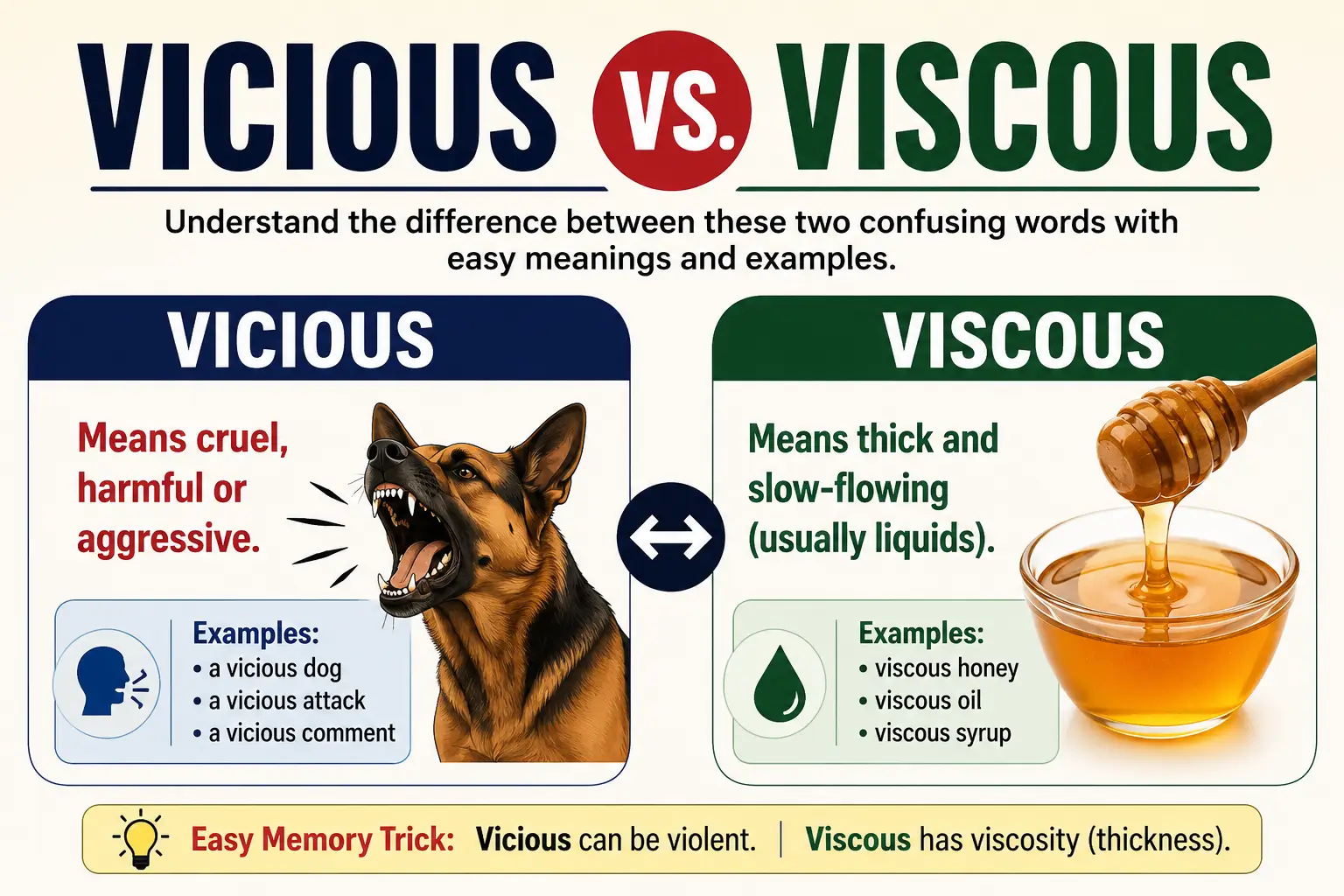
Vicious vs. Viscous becomes clear when you remember that vicious describes cruel behavior, while viscous describes a thick liquid that flows slowly. Both words are adjectives, but their close spelling hides very different meanings. Vicious can describe an evil, malicious, aggressive, violent, or severe person, action, remark, storm, or attack.
Viscous refers to thickness and resistance to flow. Water has low viscosity, while honey, molasses, mud, glue, and industrial sludge have higher viscosity. A viscous mixture may feel sticky, gummy, or gluey, and it usually flows down an incline more slowly than water.
A simple memory rule prevents confusion: vicious behavior can hurt someone, but a viscous substance is difficult to pour or stir. Use vicious for a cruel dog, fierce assault, spiteful comment, or intense dispute. Use viscous for thick oil, honey, tree sap, or another slow-flowing liquid. This distinction keeps your writing clear and accurate.
Quick Answer: What Is the Difference Between Vicious and Viscous?
Vicious means cruel, violent, aggressive, dangerous, or extremely unpleasant.
Viscous means thick, sticky, and resistant to flowing.
Quick rule: Use vicious for cruelty or severity. Use viscous for thick liquids.
Consider these examples:
- The dog became vicious when the stranger approached.
- The sauce was too viscous to pour easily.
- A vicious rumor damaged his reputation.
- Motor oil becomes more viscous in cold weather.
Although both words are adjectives, they don’t have interchangeable meanings.
Vicious vs. Viscous at a Glance
| Feature | Vicious | Viscous |
| Basic meaning | Cruel, violent, dangerous, or severe | Thick and slow-flowing |
| Part of speech | Adjective | Adjective |
| Pronunciation | VISH-us | VIS-kus |
| Common use | People, animals, attacks, remarks, weather, cycles | Liquids, oils, sauces, fluids, mixtures |
| Related noun | Viciousness | Viscosity |
| Example | The article received vicious criticism. | The mixture became viscous. |
| Memory clue | Vicious can be violent. | Viscous relates to viscosity. |
The main distinction is simple. Vicious describes behavior, actions, or conditions that cause harm. Viscous, however, describes how easily a liquid flows.
What Does Vicious Mean?
Vicious is an adjective that describes someone or something cruel, violent, dangerous, harmful, or extremely severe.
The word often carries a strong negative meaning. For example, a vicious person may deliberately hurt others. Likewise, a vicious attack may involve serious physical or verbal harm.
However, vicious doesn’t always describe physical violence. It can also describe harsh criticism, severe weather, damaging rumors, or a repeating harmful pattern.
Vicious Meaning Cruel or Violent
The most common meaning of vicious is cruel, savage, or deliberately harmful.
Examples include:
- a vicious criminal
- a vicious attack
- a vicious animal
- a vicious bully
- a vicious argument
In these examples, the word suggests more than ordinary anger. It implies serious aggression, cruelty, or a desire to cause harm.
Example:
The victim suffered injuries during a vicious attack.
The word vicious is correct because the attack was violent and severe.
Vicious Meaning Aggressive or Dangerous
People often use vicious to describe animals that attack or behave aggressively.
For example:
- The shelter warned visitors that the dog could become vicious.
- A vicious animal escaped from the enclosure.
- The cat gave a vicious swipe at the veterinarian.
However, avoid labeling an animal as vicious simply because it feels afraid or defensive. In professional animal-care contexts, words such as aggressive, reactive, or defensive may provide greater accuracy.
Vicious Meaning Harsh or Spiteful
Vicious can also describe cruel language, rumors, criticism, or social behavior.
Examples:
- She posted a vicious comment about her coworker.
- The candidate faced a vicious online campaign.
- Someone spread a vicious rumor at school.
- The review contained several vicious personal attacks.
In these sentences, no physical violence occurs. Nevertheless, the words or actions are intentionally harmful.
Vicious Meaning Severe or Intense
Sometimes, vicious describes something extremely unpleasant or intense.
For example:
- A vicious winter storm closed several highways.
- He developed a vicious headache during the meeting.
- The companies were involved in vicious competition.
- The team faced a vicious schedule during the final month.
This use is often figurative. The storm, headache, or schedule isn’t cruel in a literal sense. Instead, the adjective emphasizes severity.
How to Pronounce Vicious
Vicious is pronounced:
VISH-us
Its phonetic pronunciation is approximately:
/ˈvɪʃ.əs/
The first syllable sounds like “vish.” The second sounds like “us.”
The letters ci create a “sh” sound in this word. Therefore, you should not pronounce it as “vis-see-us” or “vik-us.”
Say it in two parts:
- vish
- us
Then combine them:
VISH-us
Vicious as an Adjective
Vicious functions as an adjective. That means it modifies or describes a noun.
In the phrase vicious attack, the adjective vicious describes the noun attack.
More examples include:
- a vicious dog
- a vicious lie
- a vicious storm
- a vicious debate
- a vicious insult
- a vicious cycle
You can also use it after a linking verb:
- The dog became vicious.
- Her comments were vicious.
- The competition turned vicious.
- The attack was particularly vicious.
In each sentence, vicious describes the subject.
What Is a Vicious Cycle?
A vicious cycle is a repeating chain of negative events. One problem causes another problem, which then makes the first problem worse.
For example:
- You feel stressed.
- Stress prevents you from sleeping.
- Poor sleep makes you more stressed.
- Increased stress makes sleep even harder.
This pattern creates a vicious cycle.
The phrase appears often in health, business, education, finance, and everyday conversation.
Examples:
- Debt and high interest can create a vicious cycle.
- Anxiety and poor sleep may form a vicious cycle.
- Low sales forced the company to cut advertising, creating a vicious cycle.
- Skipping class can lead to confusion, which creates a vicious cycle of falling behind.
Vicious circle has nearly the same meaning. Both expressions describe a harmful pattern that keeps repeating.
Examples of Vicious in Sentences
Everyday Conversation
- That mosquito bite caused a vicious itch.
- Their friendly debate suddenly turned vicious.
- The dog looked calm but became vicious around strangers.
- She received a vicious message after posting her opinion.
School and Academic Contexts
- The student wrote about the vicious effects of online bullying.
- A vicious rumor spread throughout the school.
- The historian described the battle as unusually vicious.
- The professor warned against using vicious personal attacks in debates.
Workplace and Professional Contexts
- The company faced vicious competition from larger brands.
- A vicious email exchange damaged the team’s trust.
- The manager stopped the discussion before it became vicious.
- Employees complained about a vicious cycle of overtime and exhaustion.
News and Formal Writing
- Officials condemned the vicious assault.
- The region experienced a vicious winter storm.
- The journalist received vicious threats online.
- Investigators described the crime as deliberate and vicious.
What Does Viscous Mean?
Viscous is an adjective that describes a liquid or semi-liquid substance that is thick and doesn’t flow easily.
Honey, syrup, glue, and heavy oil are common examples of viscous substances. They move more slowly than water because they resist flowing.
For example, water pours quickly from a glass. Honey moves much more slowly. Therefore, honey is more viscous than water.
Viscous Meaning Thick and Slow-Flowing
A viscous liquid has a thick consistency and strong resistance to movement.
Common examples include:
- honey
- maple syrup
- molasses
- motor oil
- shampoo
- liquid glue
- melted chocolate
- thick sauces
- lava
However, viscosity exists on a scale. A liquid can be slightly viscous, moderately viscous, or highly viscous.
Water has relatively low viscosity. In contrast, honey has much higher viscosity.
What Is Viscosity?
Viscosity is the noun related to viscous. It refers to a fluid’s resistance to flowing.
A liquid with high viscosity flows slowly. Meanwhile, a liquid with low viscosity flows more easily.
| Substance | Relative Viscosity | How It Flows |
| Water | Low | Quickly |
| Milk | Low to moderate | Easily |
| Cooking oil | Moderate | More slowly than water |
| Syrup | High | Slowly |
| Honey | High | Very slowly |
| Thick glue | Very high | With difficulty |
Temperature can also affect viscosity. For instance, warm honey usually flows faster than cold honey. Similarly, many oils become thicker in cold conditions.
Viscous in Science and Technical Writing
The word viscous appears frequently in chemistry, physics, medicine, engineering, manufacturing, and food science.
Examples include:
- Engineers measured the viscous resistance of the fluid.
- The laboratory sample formed a dark, viscous substance.
- The technician selected an oil with the correct viscosity.
- The chef reduced the sauce until it became more viscous.
In technical writing, viscous is often more precise than simply saying thick.
How to Pronounce Viscous
Viscous is pronounced:
VIS-kus
Its phonetic pronunciation is approximately:
/ˈvɪs.kəs/
The first syllable sounds like “vis.” The second sounds like “kus.”
Say it in two parts:
- vis
- kus
Then combine them:
VIS-kus
The sc keeps a clear “sk” sound. This feature separates its pronunciation from vicious, which contains a “sh” sound.
Viscous as an Adjective
Like vicious, viscous is an adjective. It describes a noun, usually a liquid, fluid, mixture, or substance.
Examples include:
- a viscous liquid
- a viscous fluid
- a viscous sauce
- a viscous mixture
- a viscous oil
- a viscous substance
It can also appear after a linking verb:
- The syrup is viscous.
- The mixture became viscous.
- The oil feels unusually viscous.
- The sauce remained too viscous to pour.
Because viscous substances can flow, the adjective usually applies to liquids or semi-liquids. It doesn’t normally describe solid objects.
Examples of Viscous in Sentences
Cooking and Food
- The sauce became more viscous as it cooled.
- Honey is more viscous than water.
- The melted chocolate formed a smooth, viscous coating.
- Add a little milk if the mixture becomes too viscous.
Science and School
- The students compared water with a more viscous liquid.
- The experiment measured how quickly each viscous fluid moved.
- The sample changed into a sticky, viscous material.
- Temperature affected the liquid’s viscosity.
Automotive and Mechanical Use
- Cold engine oil may become more viscous.
- The mechanic inspected the dark, viscous fluid.
- A lubricant must have the correct viscosity for the machine.
- The pump struggled to move the highly viscous oil.
Medical and Biological Contexts
- The sample contained a thick, viscous substance.
- Dehydration can make certain bodily fluids more concentrated and viscous.
- The researcher studied the movement of a viscous biological fluid.
- The gel formed a viscous barrier over the surface.
Medical descriptions require care. Therefore, writers should use the term only when it accurately describes consistency or flow.
Vicious vs. Viscous: Key Differences
The clearest way to understand vicious vs. viscous is to compare meaning, sound, and context.
Difference in Meaning
Vicious relates to cruelty, violence, danger, severity, or harmful patterns.
Viscous relates to the thickness and flow of liquids.
Examples:
- a vicious attack
- a viscous fluid
An attack can be cruel or violent. A fluid, however, can be thick and slow-moving.
Difference in Pronunciation
| Word | Pronunciation | Key Sound |
| Vicious | VISH-us | “sh” |
| Viscous | VIS-kus | “sk” |
The pronunciation difference is important. Although the spellings are similar, the words don’t sound the same.
Difference in Context
Use vicious with nouns related to:
- violence
- cruelty
- aggression
- criticism
- rumors
- attacks
- competition
- storms
- cycles
Use viscous with nouns related to:
- liquids
- fluids
- oil
- syrup
- glue
- sauces
- chemicals
- mixtures
- lava
Side-by-Side Examples
| Vicious | Viscous |
| The dog became vicious. | The liquid became viscous. |
| He launched a vicious attack. | She poured a viscous sauce. |
| The rumor was vicious. | The oil was viscous. |
| They entered a vicious cycle. | The mixture had a viscous texture. |
| The criticism sounded vicious. | The sample looked dark and viscous. |
Why Are Vicious and Viscous Commonly Confused?
These words cause confusion for several reasons.
First, they share most of the same letters. Vicious contains “ici,” while viscous contains “isco.” A fast reader may overlook the difference.
Second, both words function as adjectives. Therefore, they often appear before nouns and occupy the same grammatical position.
Third, some speakers mispronounce them. Once the pronunciation becomes unclear, the spelling also becomes harder to remember.
Finally, viscous appears less often in everyday conversation. Many people know the word vicious better, so they accidentally use it when describing a thick liquid.
How to Remember Vicious vs. Viscous
A simple memory trick can prevent most mistakes.
Memory Trick for Vicious
Connect vicious with violent.
Both words:
- begin with vi
- describe harmful situations
- may involve aggression or cruelty
Think:
Vicious can be violent.
Examples:
- vicious attack
- vicious dog
- vicious insult
Memory Trick for Viscous
Connect viscous with viscosity.
Both words refer to how thickly or slowly a liquid flows.
Think:
Viscous liquids have viscosity.
Examples:
- viscous honey
- viscous oil
- viscous glue
Visual Memory Trick
Imagine two pictures:
- A barking dog represents vicious.
- A jar of slowly pouring honey represents viscous.
The mental image helps separate cruelty from liquid thickness.
Common Mistakes with Vicious and Viscous
Using Vicious for a Thick Liquid
Incorrect: The honey is very vicious.
Correct: The honey is very viscous.
Honey isn’t cruel or violent. Instead, it is thick and flows slowly. Therefore, viscous is the correct choice.
Using Viscous for Cruel Behavior
Incorrect: She made a viscous comment.
Correct: She made a vicious comment.
A cruel or spiteful comment is vicious. The word viscous would incorrectly suggest that the comment has the physical consistency of a thick liquid.
Confusing Vicious Cycle with Viscous Cycle
Incorrect: Poor sleep created a viscous cycle.
Correct: Poor sleep created a vicious cycle.
A repeating harmful pattern is a vicious cycle. Although “viscous cycle” could appear in a highly specialized scientific description, it isn’t the standard expression for a repeating problem.
Calling Every Thick Object Viscous
Incorrect: The wooden table is viscous.
Correct: The wooden table is thick.
Viscous generally describes substances that can flow. A solid table may be thick, heavy, wide, or dense, but it isn’t normally viscous.
Pronouncing Both Words the Same Way
Incorrect pronunciation often leads to incorrect spelling.
Remember:
- Vicious: VISH-us
- Viscous: VIS-kus
The “sh” sound belongs to vicious. The “sk” sound belongs to viscous.
Correct and Incorrect Examples
Vicious Examples
Correct: The dog made a vicious attempt to bite the mail carrier.
The adjective describes aggressive behavior.
Incorrect: The dog’s water was vicious.
Water can’t normally be cruel or aggressive. If the sentence refers to thick fluid, viscous may fit, although normal water isn’t highly viscous.
Correct: The debate turned vicious after several personal insults.
Here, vicious describes cruel and hostile communication.
Incorrect: The debate turned viscous.
A debate doesn’t have liquid resistance. Therefore, viscous is incorrect.
Viscous Examples
Correct: The syrup became viscous after sitting in the refrigerator.
The cold syrup became thicker and flowed more slowly.
Incorrect: The syrup became vicious after sitting in the refrigerator.
Syrup can’t become cruel or violent.
Correct: The scientist added water to the viscous solution.
The adjective accurately describes the solution’s thick consistency.
Incorrect: The scientist added water to the vicious solution.
Unless the sentence uses humor or personification, a solution can’t be vicious.
Real-Life Examples of Vicious and Viscous
Workplace Example
A manager receives an email containing personal insults and threats.
The manager might say:
“The message was unnecessarily vicious.”
The email is harmful and aggressive. Therefore, vicious fits the context.
Now imagine a technician checking oil inside a machine.
The technician might say:
“The fluid is too viscous for this pump.”
The oil is too thick to move properly. Therefore, viscous is correct.
School Example
A student spreads a cruel rumor about a classmate.
The teacher might describe it as a vicious rumor because it was intended to cause harm.
Meanwhile, students in a science class compare water and corn syrup. They observe that corn syrup is more viscous because it flows more slowly.
Cooking Example
A cook reduces a sauce over heat. As water evaporates, the sauce becomes thicker.
The cook may describe the finished sauce as viscous, although everyday speakers would more often say thick.
However, if a food critic writes a cruel personal review, the chef might call the review vicious.
Grammar Tips for Using Vicious and Viscous
Check the Noun Being Described
Look at the noun after the adjective.
Ask yourself:
- Is it a person, animal, attack, insult, storm, rumor, or harmful pattern?
- Is it a liquid, oil, sauce, fluid, glue, or mixture?
Use vicious for the first group. Use viscous for the second.
Replace the Word with a Simple Synonym
Try replacing the word with cruel or thick.
- If cruel makes sense, choose vicious.
- If thick and slow-flowing makes sense, choose viscous.
Example:
“The criticism was _____.”
“Cruel criticism” makes sense. Therefore, use vicious.
“The oil was _____.”
“Thick oil” makes sense. Therefore, use viscous.
Listen for the Key Sound
When speaking, listen for the middle consonant sound.
- Vicious contains a “sh” sound.
- Viscous contains a “sk” sound.
This sound difference can guide the spelling.
Consider the Level of Formality
Vicious appears in both casual and formal English.
For example:
- “That comment was vicious.”
- “Officials condemned the vicious assault.”
Viscous sounds more technical. In everyday conversation, people often say thick instead.
For example:
- Casual: “This syrup is really thick.”
- Technical: “This syrup is highly viscous.”
Formal, Informal, and Professional Usage
Vicious in Casual English
In casual speech, vicious may describe anything extremely harsh or unpleasant.
Examples:
- That was a vicious comeback.
- She has a vicious headache.
- The comments section became vicious.
- We got caught in a vicious storm.
Although these uses are common, the word carries strong emotional force.
Vicious in Formal Writing
Formal writers use vicious for severe attacks, harmful behavior, or destructive patterns.
Examples:
- The report documented a vicious campaign of harassment.
- Rising costs created a vicious cycle of debt.
- Witnesses described the assault as vicious.
In legal, academic, or journalistic writing, choose the word carefully. More specific terms such as violent, malicious, severe, or aggressive may sometimes provide greater precision.
Viscous in Casual English
Viscous is correct in casual English, but it may sound scientific.
For example:
- The smoothie became surprisingly viscous.
- This glue is too viscous to spread.
However, many speakers would simply use thick or sticky.
Viscous in Technical Writing
Technical fields use viscous because it has a precise meaning.
Examples:
- The pump can’t process highly viscous fluids.
- The substance formed a viscous gel.
- The engineer recorded the fluid’s viscosity.
- The sample became less viscous as the temperature increased.
In these contexts, thick may sound too general.
Synonyms for Vicious
Possible synonyms depend on the context.
| Meaning | Possible Synonyms |
| Cruel | heartless, merciless, brutal |
| Violent | savage, fierce, aggressive |
| Spiteful | malicious, hateful, mean |
| Severe | intense, harsh, extreme |
| Dangerous | threatening, hostile, harmful |
Examples:
- a vicious attack → a brutal attack
- a vicious remark → a malicious remark
- a vicious storm → a severe storm
- a vicious dog → an aggressive dog
However, these words aren’t always interchangeable. Vicious often combines cruelty, aggression, and severity in a single strong description.
Synonyms for Viscous
Common synonyms and related descriptions include:
- thick
- sticky
- syrupy
- gummy
- glue-like
- gelatinous
- slow-flowing
Examples:
- a viscous syrup → a thick syrup
- a viscous gel → a sticky gel
- a viscous liquid → a slow-flowing liquid
Still, viscous has a more exact technical meaning. A substance may feel sticky without having especially high viscosity. Likewise, a liquid may be viscous without sticking strongly to surfaces.
Related Words and Word Forms
Words Related to Vicious
Viciously is the adverb form.
- The dog barked viciously.
- The two candidates attacked each other viciously.
- She was viciously criticized online.
Viciousness is the noun form.
- The viciousness of the attack shocked investigators.
- He apologized for the viciousness of his remarks.
Common phrases include:
- vicious attack
- vicious dog
- vicious rumor
- vicious criticism
- vicious cycle
- vicious circle
- vicious competition
Words Related to Viscous
Viscosity is the main noun form.
- The oil has a high viscosity.
- Heat reduced the liquid’s viscosity.
- The technician measured its viscosity.
Viscously is the adverb form, although it is uncommon outside technical descriptions.
- The material flowed viscously through the tube.
Common phrases include:
- viscous fluid
- viscous liquid
- viscous oil
- highly viscous
- low viscosity
- high viscosity
- viscous mixture
Practice: Choose Vicious or Viscous
Choose the correct word for each sentence.
- The mechanic examined the dark, ______ fluid.
- The celebrity received a ______ message online.
- The sauce became more ______ as it cooled.
- Poor sleep can begin a ______ cycle.
- The animal showed ______ behavior.
- The laboratory sample was thick and ______.
- The newspaper published a ______ personal attack.
- Cold temperatures made the oil more ______.
- The argument became increasingly ______.
- Honey is more ______ than water.
Answer Key
- Viscous — The sentence describes a thick fluid.
- Vicious — The message was cruel or harmful.
- Viscous — The sauce became thicker.
- Vicious — “Vicious cycle” is the correct expression.
- Vicious — The animal behaved aggressively.
- Viscous — The sample had a thick consistency.
- Vicious — The attack involved harmful language.
- Viscous — Cold oil often flows more slowly.
- Vicious — The argument became cruel or hostile.
- Viscous — Honey has greater resistance to flow.
Conclusion
The difference between vicious vs. viscous is simple once you connect each word with its meaning. Vicious describes something cruel, violent, harmful, severe, or aggressive. Viscous, however, describes a thick liquid or substance that flows slowly.
Remember this easy rule: vicious can be violent, while viscous relates to viscosity. Use vicious for an attack, rumor, dog, comment, storm, or harmful cycle. Use viscous for honey, oil, glue, syrup, mud, or another thick fluid. Checking the noun and pronunciation will help you choose the correct word every time.
Frequently Asked Questions
Q1:What is the main difference between vicious and viscous?
Vicious means cruel, violent, dangerous, or severe. Viscous means thick and resistant to flowing. For example, a dog may be vicious, while honey is viscous.
Q2:Are vicious and viscous pronounced the same?
No. Vicious is pronounced VISH-us, while viscous is pronounced VIS-kus. The “sh” sound belongs to vicious, and the “sk” sound belongs to viscous.
Q3:Is honey vicious or viscous?
Honey is viscous because it is thick and flows slowly. It cannot normally be described as vicious because vicious refers to cruelty, violence, or harmful behavior.
Q4:Is “vicious cycle” the correct phrase?
Yes, vicious cycle is the correct phrase. It describes a harmful pattern in which one problem causes another and makes the first problem worse. Viscous cycle is incorrect in this context.
Q5:Can viscous describe a person?
Normally, no. Viscous describes liquids, fluids, and substances that resist flowing. A cruel or aggressive person may be described as vicious, not viscous.