
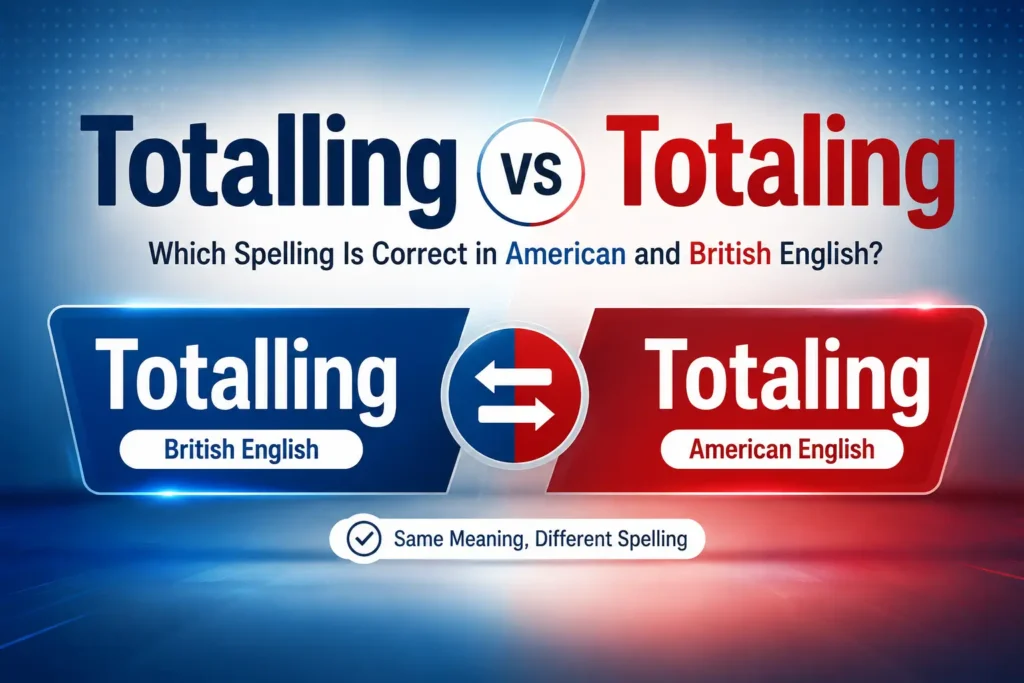
When writing about totalling vs totaling, many English writers face spelling confusion because English spelling rules change between regions. Both forms are correct spelling choices, but American English usually uses totaling with one L, while British English prefers totalling with two Ls. The meaning stays the same: both describe adding numbers to find a complete sum or final amount.
The difference comes from regional grammar rules and spelling patterns. In British English, writers often follow the double l rule, so total becomes totalling when adding -ing. In American English, writers usually keep a single l, creating totaling. This same pattern appears in words like travelling and traveling. Understanding these language conventions helps writers choose the right spelling style for their audience, whether they are creating an email, article, report, or other form of professional writing.
For clear English writing, consistency matters more than choosing one version. A writer preparing business documents, an expense report, or online content should consider the reader’s location, follow suitable writing standards, and use reliable editing tools such as Grammarly or Microsoft Word for proofreading. These tools can improve spelling clarity, but knowing the grammar patterns, usage rules, and correct form behind words like totaling, totalling, totaled, and totalled creates stronger writing. Whether you write for the United States, UK, or a global English audience, choosing one style improves professionalism, audience understanding, and overall writing confidence.
Quick Answer: Is It Totalling or Totaling?
Both totalling and totaling are correct spellings.
The difference depends on the variety of English you are using.
| Spelling | Commonly Used In | Example |
| Totaling | American English | The repairs are totaling $2,000. |
| Totalling | British English | The repairs are totalling £2,000. |
If you are writing for a US audience, use totaling with one L.
If you are writing for a UK audience, use totalling with two Ls.
The meaning does not change. Only the spelling varies.
What Do Totalling and Totaling Mean?
The words totalling and totaling come from the verb total.
They describe the process of adding separate amounts together to find a final number.
To total = to add things together and find the complete amount.
Examples:
- The three invoices total $1,500.
- The expenses are totaling more than expected.
- The donations are totalling over £10,000.
The verb can also describe something reaching a particular final amount.
The company’s losses are totaling millions of dollars.
This means the combined losses have reached millions of dollars.
Understanding the Word “Total” in English
Before comparing totalling vs totaling, it helps to understand how the root word total works.
Total can function as a noun, verb, or adjective.
Total as a Noun
As a noun, total means the complete amount after everything has been added together.
Examples:
- The total on the receipt was $45.
- The final total includes taxes and shipping.
- The teacher calculated the students’ total scores.
In these sentences, total refers to the final result.
Total as a Verb
As a verb, total means to add things together or reach a particular amount.
Examples:
- The bills total $800.
- The costs are totaling more than last year.
- The expenses totalled £3,000.
The regional spelling difference becomes noticeable when endings such as -ing and -ed are added.
Total as an Adjective
As an adjective, total means complete, entire, or absolute.
Examples:
- It was a total surprise.
- The project was a total success.
- She showed total confidence during the presentation.
This use does not involve the totalling vs totaling spelling difference because no ending is added.
Totalling vs Totaling: The Main Difference
The main difference between totalling and totaling is regional spelling.
Their meaning is the same.
Totaling in American English
American English normally uses:
total → totaling
Examples of similar American spellings include:
- total → totaling
- travel → traveling
- cancel → canceling
- label → labeling
So, if your audience is primarily in the United States, totaling is normally the appropriate spelling.
Totalling in British English
British English normally uses:
total → totalling
Examples include:
- total → totalling
- travel → travelling
- cancel → cancelling
- label → labelling
If you are writing for British readers or following British spelling conventions, totalling is the preferred form.
Totalling vs Totaling Comparison Table
Here is the difference at a glance:
| Feature | Totaling | Totalling |
| English variety | American English | British English |
| Number of Ls | One L | Two Ls |
| Meaning | Adding amounts together | Adding amounts together |
| Common audience | United States | United Kingdom and British-style English audiences |
| Formal writing | Correct | Correct |
| Best for US readers | Yes | Less common |
| Best for UK readers | Less common | Yes |
The important point is that neither spelling changes the meaning.
Why Does British English Use “Totalling” With Two Ls?
British English commonly doubles the final L in words like total before adding certain endings.
For example:
| Base Word | British English | American English |
| Travel | Travelling | Traveling |
| Cancel | Cancelling | Canceling |
| Label | Labelling | Labeling |
| Total | Totalling | Totaling |
This spelling pattern explains why British English uses totalling.
The same regional distinction can also appear when other endings are added.
Why Does American English Use “Totaling” With One L?
American English usually keeps a single L in words such as totaling.
Common examples include:
- traveling
- canceled
- labeling
- totaling
Therefore, American writers normally use:
totaling
rather than:
totalling
The difference is a matter of regional spelling convention rather than meaning.
Real-Life Examples of Totalling vs Totaling
Seeing both spellings in realistic sentences makes the distinction easier to remember.
American English Examples Using Totaling
Business
The monthly expenses are totaling $8,500.
This means all the expenses combined equal $8,500.
School
The student’s points are totaling 95 after the final exam.
The combined score has reached 95.
Everyday Conversation
My grocery purchases are totaling more than I expected.
The combined cost is higher than expected.
British English Examples Using Totalling
Business
The company reported losses totalling £2 million.
The combined losses reached £2 million.
Academic Context
The study included participants totalling 500 across several groups.
The combined number of participants reached 500.
Everyday Conversation
The shopping bill is totalling nearly £100.
The combined cost is approaching £100.
How to Choose Between Totalling and Totaling
Choosing the correct spelling mainly depends on your audience and the English style you are following.
Use Totaling for American English
Choose totaling when writing for:
- American readers
- US businesses
- American schools
- US publications
- US-focused websites
- Documents following American English conventions
Example:
The repair costs are totaling $4,500.
Use Totalling for British English
Choose totalling when writing for:
- British readers
- UK businesses
- British publications
- Documents following British English spelling
- Audiences that use British-style spelling conventions
Example:
The repair costs are totalling £4,500.
Keep Your Spelling Consistent
Avoid unnecessarily mixing American and British spelling styles.
For example:
❌ The company is totaling expenses while travelling across Europe.
This mixes the American spelling totaling with the British spelling travelling.
For American English, write:
✅ The company is totaling expenses while traveling across Europe.
For British English, write:
✅ The company is totalling expenses while travelling across Europe.
Consistency makes your writing look more polished and professional.
Totalling vs Totaling in Professional Writing
Spelling consistency becomes especially important in formal and professional documents.
A business report, academic paper, website, or workplace document should ideally follow one spelling system throughout.
Business Reports
A US business report would normally use:
The costs are totaling $50,000.
A UK business report would normally use:
The costs are totalling £50,000.
Emails and Workplace Communication
Both spellings are usually understandable, but matching the expected regional style creates more consistent writing.
US example:
The project costs are totaling approximately $20,000.
UK example:
The project costs are totalling approximately £20,000.
Websites and Online Content
If your website mainly targets American readers, totaling is generally the better choice.
If your content follows British English, use totalling.
The most important rule is to choose one style and apply it consistently across your content.
Common Mistakes With Totalling and Totaling
These common mistakes can make the spelling difference seem more complicated than it really is.
Mistake 1: Thinking One Spelling Is Incorrect
Some writers assume totalling is simply a misspelling of totaling.
That is not the case.
❌ Incorrect assumption:
Totalling is always a spelling mistake.
✅ Correct understanding:
Totalling is a correct British English spelling.
Likewise, totaling is the standard American English form.
Mistake 2: Mixing American and British Spellings
Writers sometimes switch between regional spelling systems without realizing it.
Examples of mixed styles include:
- totaling + travelling
- canceled + labelling
- organize + colour
When possible, select one English style and follow it consistently.
Mistake 3: Adding “To” After Totaling
Consider this sentence:
❌ The expenses are totaling to $5,000.
A cleaner version is:
✅ The expenses are totaling $5,000.
The verb total already expresses the idea of reaching a particular amount.
Mistake 4: Confusing Totaling With Counting
Counting and totaling are related, but they are not identical.
Counting generally means determining how many individual items there are.
She counted 50 books.
Totaling means combining amounts or values to determine a sum.
She totaled the prices of the 50 books.
The correct word depends on what you are calculating.
Related Words and Synonyms
Depending on the sentence, several words can express meanings similar to totalling or totaling.
| Word or Phrase | Meaning | Example |
| Adding up | Combining amounts | The costs are adding up quickly. |
| Calculating | Finding a numerical result | The accountant is calculating expenses. |
| Summing | Adding values together | She is summing the figures. |
| Counting | Finding the number of items | She counted the items. |
| Reaching | Arriving at a final amount | Sales reached $1 million. |
| Amounting to | Equaling a particular amount | The damages amounted to £5,000. |
These alternatives are not interchangeable in every sentence, so choose the word that best matches the intended meaning.
Totaled vs Totalled
The same American and British spelling difference also appears in the past tense.
American English
total → totaled
Example:
The damages totaled $10,000.
British English
total → totalled
Example:
The damages totalled £10,000.
So the pattern is:
| Form | American English | British English |
| -ing form | totaling | totalling |
| Past tense | totaled | totalled |
Memory Trick for Totalling vs Totaling
A simple way to remember the difference is:
America prefers one L. Britain prefers two Ls.
Think:
- US = Totaling
- UK = Totalling
You can connect the same spelling pattern with:
- traveling / travelling
- canceled / cancelled
- labeling / labelling
The key is not to memorize every sentence. Remember the regional spelling pattern.
Quick Decision Guide
Still unsure whether to write totalling or totaling?
Ask yourself these questions:
Are You Writing for an American Audience?
Use:
Totaling
Are You Following British English?
Use:
Totalling
Do the Words Have Different Meanings?
No.
Both mean the same thing.
Can You Use Both in One Article?
You can mention both when explaining the spelling difference, but your normal prose should follow one consistent English style.
Conclusion: Choosing the Right Spelling Between Totalling vs Totaling
The difference between totalling vs totaling is simple once you understand the spelling rules behind them. Both words have the same meaning and refer to adding amounts together to reach a final number. The only difference is regional spelling preference.
For a US audience, totaling with one “L” is the standard choice. For readers in the UK and other regions that follow British spelling rules, totalling with two “Ls” is preferred. Neither spelling is incorrect, so the most important thing is to choose one style and use it consistently.
Understanding these small spelling differences helps improve English writing, prevents unnecessary mistakes, and makes your content look more professional. Whether you are writing an email, report, article, or business document, matching your spelling style to your audience creates clearer communication.
FAQs About Totalling vs Totaling
Q1: Which spelling is correct, totaling or totalling?
Both totaling and totalling are correct spellings. The difference depends on the type of English being used. Totaling is common in American English, while totalling is used in British English.
Q2: Is totaling correct in American English?
Yes, totaling is the standard spelling in American English. US writers usually use one “L” when adding the ending -ing to words like total.
Example:
The expenses are totaling $5,000.
Q3: Is totalling correct in British English?
Yes, totalling is correct in British English. British spelling often doubles the final consonant before adding endings like -ing.
Example:
The costs are totalling £5,000.
Q4: Do totaling and totalling have different meanings?
No. Totaling and totalling have exactly the same meaning. Both describe adding numbers together or reaching a final amount. The difference is only in spelling.
Q5: Why does British English use two Ls in totalling?
British English often follows a spelling pattern where the final consonant is doubled before adding endings such as -ing or -ed.
Examples:
- total → totalling
- travel → travelling
- cancel → cancelling
Q6: Why does American English use totaling with one L?
American English often simplifies certain spelling patterns by keeping one final consonant before adding endings.
Examples:
- total → totaling
- travel → traveling
- cancel → canceling
This follows common American spelling conventions.
Q7: Should I use totaling or totalling for a US website?
If your website targets readers in the United States, use totaling. American readers are more familiar with the one-L spelling, and it matches standard US English rules.
Q8: Can I use both totaling and totalling in the same article?
You can, but it is better to avoid mixing them. Using both spellings in one article can make your writing look inconsistent. Choose one spelling style based on your audience and follow it throughout your content.
Q9: Are totaled and totalled also different spellings?
Yes. The same spelling difference appears in the past tense form.
- American English: totaled
- British English: totalled
Examples:
- The damages totaled $10,000. (US English)
- The damages totalled £10,000. (UK English)
Q10: Does Google recognize both totaling and totalling?
Yes, search engines generally understand both spellings because they are regional variations of the same word. However, using the spelling that matches your target audience improves readability and keeps your content consistent.
Onsite vs On Site: What’s the Difference and Which One Is Correct?
Fourty vs Forty: Which Spelling Is Correct?
Glossywise Com Review 2026: What It Is, How It Works, and Can You Trust It?
