
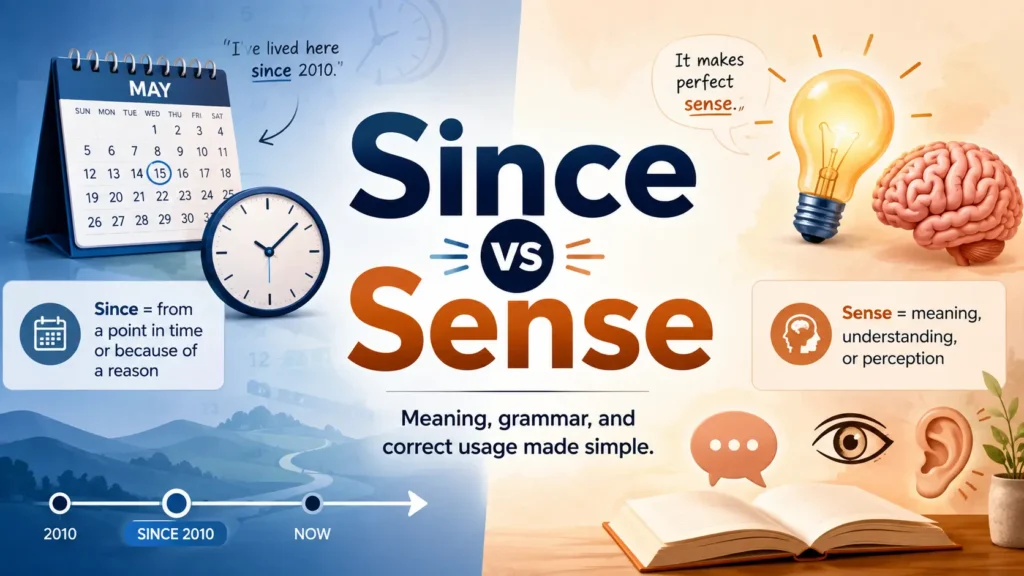
If you’re confused about since vs sense, you’re not alone. These words can sound similar, but they have completely different meanings and grammatical functions. Since usually refers to a starting point in time or introduces a reason, while sense relates to meaning, logic, perception, awareness, or judgment.
For example, you might say, “I’ve lived here since 2020,” but “That doesn’t make sense.” Understanding this simple difference will help you avoid one of the most common spelling and word-choice mistakes in English.This guide explains since vs sense in clear, practical terms. You’ll learn how each word works, how to use it in American English, which mistakes to avoid, and how to remember the difference.
Quick Answer: Since vs Sense
The easiest way to distinguish since and sense is to focus on what you mean.
- Since is used for a starting point in time or to give a reason.
- Sense refers to meaning, logic, physical perception, awareness, or practical judgment.
Quick examples
I’ve worked here since 2020.
Here, since identifies when the action started.
Since you’re already here, let’s begin.
Here, since means because.
That doesn’t make sense.
Here, sense refers to logic or meaning.
She has a good sense of humor.
Here, sense refers to an ability or quality.
The simplest memory trick
Since = time or reason.
Sense = meaning or perception.
If you’re talking about when something started, use since. If you’re talking about whether something makes sense, or about a person’s ability to feel, notice, or judge something, use sense.
What Does Since Mean?
Since is a versatile word that can function as a preposition, conjunction, or adverb. Its meaning depends on how it’s used in a sentence.
The two most important meanings are:
- From a particular time in the past until another time, usually the present
- Because or as
Understanding these two uses will help you recognize since in different types of writing and conversation.
Since for Time
When since refers to time, it introduces the point when something began.
For example:
- I’ve lived in this city since 2020.
- She has worked at the bank since January.
- We haven’t spoken since Monday.
- He’s been learning Spanish since childhood.
- They have been married since 2015.
In each sentence, since tells you the starting point.
The action or situation began at that point and continued afterward.
For example:
I’ve known Maria since high school.
The speaker first knew Maria in high school. That relationship continued beyond that time.
Since With Dates and Specific Times
You can use since before many types of time expressions.
Common examples include:
- since 2010
- since yesterday
- since Monday
- since last summer
- since breakfast
- since my birthday
- since graduation
- since I moved here
For example:
I haven’t eaten since breakfast.
The word breakfast identifies the starting point of the period during which the person hasn’t eaten.
Similarly:
We’ve been waiting since 8 a.m.
The waiting started at 8 a.m.
Since With Clauses
You can also use since before a clause that describes a past event.
I’ve felt much better since I started exercising.
She hasn’t called since she moved away.
Things have changed since we graduated.
In these examples, since connects the current situation to a specific event in the past.
Since and Perfect Tenses
When since introduces a starting point that connects the past to the present, it often appears with the present perfect or present perfect progressive tense.
For example:
I have lived here since 2020.
She has worked there since June.
We have been waiting since noon.
The present perfect emphasizes a connection between a past starting point and the present.
However, since doesn’t always require the present perfect.
For example:
I hadn’t seen him since high school.
Here, the sentence describes a period that existed before another event in the past. Therefore, the past perfect is appropriate.
The key point is that since identifies a starting point. The tense depends on the time relationship in the complete sentence.
Since as a Reason
Since can also introduce a reason. In this use, it often means because or as.
For example:
Since it’s raining, we’ll stay inside.
This means:
Because it’s raining, we’ll stay inside.
Another example is:
Since you’re already here, you can help us.
The reason for asking the person to help is that they’re already present.
This use is common in both spoken and written American English.
However, since can sometimes be unclear because readers may initially interpret it as a time expression.
Compare:
I’ve been happier since I moved here.
Here, since clearly refers to time.
Since you’re here, let’s start the meeting.
Here, since means because.
When the meaning could be confusing, you can often replace since with because or as.
Since as an Adverb
Since can also work as an adverb meaning from that time until now or from that time until another point.
For example:
He moved to Denver five years ago and hasn’t visited us since.
The word since refers back to the time when he moved.
Another common expression is ever since.
We’ve been friends ever since college.
Ever since emphasizes that something has continued from a particular point in the past.
You may also hear:
She graduated in 2022 and has worked there ever since.
This means she has worked there continuously from the time she graduated until now.
What Does Sense Mean?
Unlike since, the word sense has several meanings related to perception, understanding, meaning, and judgment.
It can function as either a noun or a verb.
As a noun, sense may refer to:
- One of the physical senses
- Meaning
- Logic
- Practical judgment
- Awareness
- An emotional feeling or impression
As a verb, sense means to notice, detect, feel, or become aware of something.
Sense as a Noun
The noun sense has a wide range of uses.
Sense as a Physical Ability
A sense can refer to a physical ability that allows you to receive information about the world.
The traditional five senses are:
- Sight
- Hearing
- Smell
- Taste
- Touch
For example:
Dogs have an excellent sense of smell.
My sense of hearing isn’t as strong as it used to be.
The food appealed to my sense of taste.
These expressions refer to physical perception.
However, modern science recognizes that human sensory systems are more complex than the traditional five. For example, humans also have systems involved in balance, body position, temperature, and pain.
Therefore, the phrase “five senses” is useful as a traditional category, but it doesn’t describe every way the human body detects information.
Sense as Meaning
Sense can refer to the meaning or interpretation of something.
For example:
I don’t understand the sense of his argument.
Here, sense means the meaning or point of the argument.
You can also ask:
What is the sense of this sentence?
This question asks what the sentence means or communicates.
However, one of the most common expressions is make sense.
Your explanation makes sense.
That doesn’t make sense.
When something makes sense, it’s logical, understandable, or reasonable.
Sense as Practical Judgment
The word sense also refers to practical judgment.
The most familiar expression is common sense.
Use your common sense before making a decision.
It takes common sense to recognize that walking on an icy road can be dangerous.
Common sense isn’t one of the five physical senses. Instead, it means the ability to make practical judgments based on ordinary knowledge and experience.
Other expressions include:
- business sense
- financial sense
- political sense
- practical sense
For example:
She has excellent business sense.
This means she has a good ability to make smart business decisions.
Sense as Awareness or Intuition
Sense can also describe a feeling or awareness that something is happening.
For example:
I had a sense that something was wrong.
There was a sense of excitement in the room.
He felt a strong sense of relief.
In these examples, sense describes an impression, feeling, or awareness.
It doesn’t necessarily involve one of the five physical senses.
Sense as a Verb
As a verb, sense means to notice, detect, or become aware of something.
For example:
I sense that you’re upset.
She sensed tension in the room.
The dog sensed danger.
He could sense that something had changed.
The object of the verb is often something that isn’t immediately obvious.
For example:
She sensed that her friend was nervous.
She noticed or intuitively recognized the friend’s emotional state.
The verb can be used in different tenses:
| Tense | Example |
| Present | I sense a problem. |
| Past | I sensed a problem. |
| Present participle | I am sensing a problem. |
| Past participle | She has sensed a change. |
The simple forms sense, sensed, and sensing are the most common in everyday English.
Since vs Sense: The Key Differences
The most important difference between since vs sense is their meaning.
| Feature | Since | Sense |
| Main idea | Time or reason | Meaning, perception, awareness, or judgment |
| Common parts of speech | Preposition, conjunction, adverb | Noun, verb |
| Refers to time | Yes | No |
| Can mean “because” | Yes | No |
| Refers to physical perception | No | Yes |
| Refers to logic | No | Yes |
| Used in “make ___” | No | Yes |
| Example | I’ve lived here since 2020. | That makes sense. |
The words are therefore not interchangeable.
You can’t replace since with sense simply because they sound similar.
Likewise, you can’t write since when you mean sense.
Since vs Sense Examples
The following examples show how the two words work in different contexts.
Examples With Since for Time
I’ve worked here since 2019.
Why?
The sentence gives the starting year.
We haven’t seen him since Tuesday.
Why?
Tuesday is the starting point of the period.
She has been studying since breakfast.
Why?
Breakfast identifies when the activity began.
Examples With Since for Reason
Since you’re tired, you should rest.
Why?
Here, since means because.
Since the store was closed, we went home.
Why?
The store being closed explains why they went home.
Examples With Sense for Meaning
That doesn’t make sense.
Why?
The statement isn’t logical or understandable.
Your explanation makes sense.
Why?
The explanation is clear and logical.
Examples With Sense for Perception
She has a strong sense of smell.
Why?
The sentence refers to physical perception.
I could sense that he was nervous.
Why?
Here, sense is a verb meaning to notice or detect.
Examples With Sense for Judgment
He has good common sense.
Why?
The sentence refers to practical judgment.
She has excellent financial sense.
Why?
The phrase describes the ability to make sensible financial decisions.
Since vs For: A Related Grammar Difference
People who search for since vs sense sometimes also confuse since with for.
The difference is important.
Since gives a starting point.
For gives a duration.
Compare:
I’ve lived here since 2020.
I’ve lived here for six years.
The first sentence answers:
When did this begin?
The second answers:
How long has this continued?
| Since | For |
| since Monday | for three days |
| since 2020 | for six years |
| since breakfast | for several hours |
| since last summer | for several months |
| since I graduated | for a long time |
A useful rule is:
Since + starting point
For + length of time
This rule is especially useful when using perfect tenses.
Since vs Sense in Real-Life American English
These words appear in many everyday situations, but they serve different purposes.
At School
A student might write:
I’ve been studying for this exam since Monday.
A teacher might respond:
Your answer makes sense, but you need more evidence.
In the first sentence, since describes time. In the second, sense describes logic.
At Work
Consider these examples:
I’ve worked for this company since 2021.
That proposal makes financial sense.
Since the deadline changed, we need to update the schedule.
I sense some tension between the two teams.
These examples show all four common uses: time, logic, reason, and awareness.
In Emails
Professional emails often use since to describe timelines:
We’ve been waiting for approval since last week.
They may also use sense when discussing decisions:
This approach makes more sense for our team.
Both words are perfectly normal in professional American English.
In Texting and Social Media
Because since and sense can sound similar, spelling mistakes sometimes appear in casual online communication.
You might see:
That doesn’t make since.
The correct spelling is:
That doesn’t make sense.
Similarly:
I’ve known her sense 2018.
The correct version is:
I’ve known her since 2018.
Even in informal writing, choosing the correct word makes your message clearer.
Common Mistakes With Since and Sense
Mistake: Using “Sense” for a Starting Point
Incorrect:
I’ve lived here sense 2020.
Correct:
I’ve lived here since 2020.
Why?
The sentence refers to a starting point in time.
Mistake: Writing “Since” in “Make Sense”
Incorrect:
That doesn’t make since.
Correct:
That doesn’t make sense.
Why?
The fixed expression is make sense, meaning to be logical or understandable.
Mistake: Writing “Common Since”
Incorrect:
Use your common since.
Correct:
Use your common sense.
Why?
Common sense is a fixed phrase meaning practical judgment.
Mistake: Using Sense for Time
Incorrect:
I haven’t seen her sense Monday.
Correct:
I haven’t seen her since Monday.
Why?
Monday is the starting point of a period.
Mistake: Assuming Since Always Means Time
Incorrect assumption:
Since always refers to the past.
Reality:
Since can also introduce a reason.
For example:
Since you’re here, let’s get started.
Here, since means because.
How to Remember Since vs Sense
A simple memory trick can prevent most mistakes.
Remember: Since = Starting Point
Think of since as a word that often answers:
When did it begin?
Examples:
- since Monday
- since 2020
- since yesterday
- since graduation
It can also mean because:
Since you’re busy, I’ll call later.
So remember:
Since = time or reason
Remember: Sense = Meaning or Perception
Think of sense as something you can:
- make
- use
- have
- lose
- detect
Examples:
- make sense
- common sense
- five senses
- sense danger
- sense tension
So remember:
Sense = meaning, perception, awareness, or judgment
A Quick Decision Guide
When you’re unsure which word to use, ask yourself these questions.
Is the sentence about a starting point in time?
Use since.
I’ve known him since 2018.
Does the word mean “because”?
Use since.
Since you’re ready, we can leave.
Is the sentence about logic or meaning?
Use sense.
That doesn’t make sense.
Is it about physical perception?
Use sense.
Smell is one of the traditional five senses.
Is it about practical judgment?
Use sense.
She has excellent common sense.
Is it about noticing or detecting something?
Use sense as a verb.
I sense that something is wrong.
Common Expressions With Since
Knowing common expressions makes it easier to recognize since.
Ever Since
Ever since means continuously from a particular time.
We’ve been friends ever since college.
Since Then
Since then refers to the period after a particular past event.
I moved to New York in 2020. I’ve worked remotely since then.
Since When?
Since when? is common in informal conversation. It often expresses surprise.
Since when do you like country music?
The speaker is surprised to learn something new.
Common Expressions With Sense
The word sense appears in many familiar phrases.
Make Sense
Your explanation makes sense.
This means the explanation is logical or understandable.
Common Sense
Use your common sense.
This refers to practical judgment.
Sense of Humor
She has a great sense of humor.
This refers to someone’s ability to appreciate or understand humor.
Sense of Direction
I have a terrible sense of direction.
This refers to the ability to know where you are and find your way.
Sense of Responsibility
He has a strong sense of responsibility.
This describes someone’s awareness of their duties.
Sense of Belonging
The community gave her a strong sense of belonging.
This describes the feeling of being accepted and connected.
Synonyms and Related Words
The words since and sense don’t have identical synonyms in every context because their meanings change according to usage.
Synonyms for Since Meaning “Because”
Depending on context, you may use:
- because
- as
- given that
- seeing that
For example:
Since it’s raining, we’ll stay home.
You could write:
Because it’s raining, we’ll stay home.
However, these alternatives aren’t always interchangeable in every sentence.
Related Words for Since Meaning Time
Depending on the sentence, related expressions include:
- from
- from the time that
- after
- ever since
For example:
I’ve lived here since 2020.
You could express the same basic idea as:
I’ve lived here from 2020 onward.
However, the original sentence is usually more natural in everyday American English.
Related Words for Sense
Depending on the meaning, related words include:
- meaning
- logic
- understanding
- awareness
- perception
- feeling
- judgment
- intuition
For example, in:
That makes sense.
A related idea might be logic or reason.
In:
I sense danger.
A related idea might be detect or notice.
The exact replacement depends on the context.
Can Since Be Ambiguous?
Sometimes since can have two possible meanings.
Consider:
I’ve been worried since he left.
This clearly suggests time: the worry began when he left.
However, sentences beginning with since can occasionally be less clear.
Since the manager arrived, the team has been more productive.
This could mean the team became more productive after the manager arrived. In some contexts, it might also be interpreted as giving a reason, although the time meaning is more natural here.
If clarity matters, choose a more precise word.
For a reason:
Because the manager arrived, the team became more productive.
For time:
After the manager arrived, the team became more productive.
In formal or technical writing, choosing because or after can sometimes remove ambiguity.
Practice: Choose Since or Sense
Test your understanding with these sentences.
- I’ve known her ___ 2019.
- That explanation doesn’t make ___.
- ___ you’re already here, let’s start.
- He has a strong ___ of humor.
- We haven’t spoken ___ last week.
- I could ___ that something was wrong.
- Use your common ___.
- She has worked there ___ June.
Answers
- since
- sense
- Since
- sense
- since
- sense
- sense
- since
The easiest way to solve these questions is to identify the meaning first. Don’t choose based only on pronunciation.
Conclusion: Since vs Sense Made Simple
The difference between since vs sense is easy to understand once you focus on meaning. Use since when you talk about a starting point in time or give a reason. Use sense when you mean meaning, logic, perception, awareness, or judgment. For example, “I’ve lived here since 2020” uses since for time, while “That doesn’t make sense” uses sense to describe logic.
Remember the simple rule: since = time or reason, while sense = meaning or perception. If you’re unsure, look at the role of the word in the sentence instead of relying on how it sounds. With a little practice, you’ll confidently use both words in school assignments, emails, conversations, professional writing, and everyday messages.
Frequently Asked Questions About Since vs Sense
Q1. What is the difference between since and sense?
Since usually refers to a starting point in time or gives a reason. Sense refers to meaning, logic, perception, awareness, or judgment. For example, “I’ve lived here since 2020” uses since for time, while “That makes sense” refers to logic.
Q2. Is it “make sense” or “make since”?
The correct phrase is make sense. For example, “Your explanation makes sense.” It means that something is logical, clear, or easy to understand. Make since is an incorrect spelling.
Q3. Does since always refer to time?
No. Since can also introduce a reason and mean because or as. For example, “Since you’re tired, you should go home.” In this sentence, since explains the reason for going home.
Q4. Is sense a noun or a verb?
Sense can be both a noun and a verb. As a noun, it can mean a physical ability, meaning, logic, or judgment. As a verb, it means to notice, detect, or become aware of something, as in “I sense that something is wrong.”
Q5. What is the difference between since and for?
When talking about time, since gives a starting point, while for gives a length of time. For example, “I’ve worked here since 2020” gives the starting point, while “I’ve worked here for six years” gives the duration.
Q6. Why are since and sense commonly confused?
Since and sense are often confused because they can sound similar in spoken English. However, their spellings and meanings are different. Understanding the context helps you choose the correct word.
Q7. What does “that makes sense” mean?
“That makes sense” means that something is logical, reasonable, or understandable. It’s a very common expression in American English. For example, if someone explains why they changed their plans, you might reply, “That makes sense.”
Q8. What does “ever since” mean?
Ever since means continuously from a specific time in the past until another point, often the present. For example, “We’ve been friends ever since high school.” It shows that the friendship started in high school and continued afterward.
Q9. What is common sense?
Common sense means practical judgment or the ability to make reasonable decisions based on everyday knowledge and experience. For example, checking the weather before going on a long hike is a matter of common sense.
Q10. How can I easily remember since vs sense?
Use this simple memory trick: since = time or reason, while sense = meaning or perception. If you’re talking about when something started or explaining why something happened, choose since. If you’re talking about logic, meaning, feelings, or the ability to perceive something, choose sense.
Cacoon or Cocoon: Correct Spelling and Easy Examples
Someday vs Some Day: Meaning, Difference, Examples, and Easy Rules
