
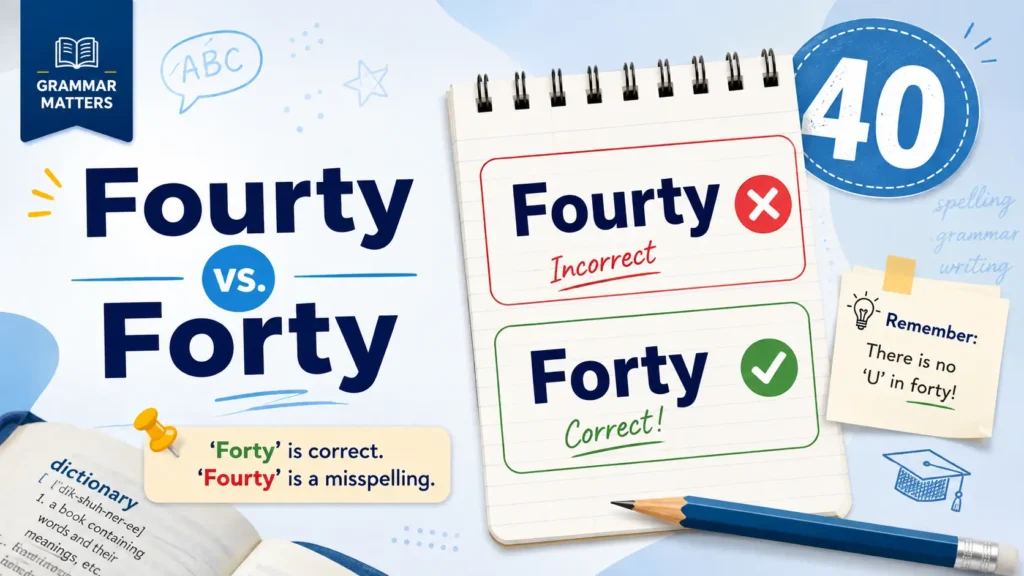
Fourty vs. forty is a common spelling confusion, but the answer is simple: forty is the correct spelling of the number 40, while fourty is incorrect. The confusion happens because four is spelled with a u, so it may seem logical to write fourty. However, standard English uses forty, without the u.
Whether you’re writing about forty dollars, forty students, forty minutes, or someone’s fortieth birthday, using the correct spelling matters. This guide explains the difference between fourty and forty, shows how to use forty in sentences, and gives you easy memory tips to avoid this common spelling mistake in American English.
Quick Answer: Is It Fourty or Forty?
The correct spelling is forty.
Fourty is an incorrect spelling of the number 40. Although it might seem logical to spell the word by adding -ty to four, English doesn’t work that way in this case.
| Word | Correct? | Meaning | Example |
| forty | ✅ Yes | The number 40 | She is forty years old. |
| fourty | ❌ No | Misspelling of 40 | ❌ She is fourty years old. |
The easiest way to remember the difference is:
Four → Forty
When four becomes forty, the u disappears.
What Does Forty Mean?
Forty is the word form of the number 40. It’s a cardinal number, which means it tells you how many people, things, or units there are.
For example:
- forty students
- forty books
- forty dollars
- forty minutes
- forty years
You can use forty in many everyday situations.
Examples of Forty in Sentences
- The school has forty classrooms.
- She saved forty dollars for the trip.
- The meeting lasted forty minutes.
- He turned forty last year.
- There were forty people at the event.
In each sentence, forty represents the number 40.
The word can appear in casual conversations, academic writing, business documents, emails, news reports, and many other types of communication.
What Does Fourty Mean?
Fourty isn’t the standard spelling of any number in modern English.
It’s simply a misspelling of forty.
The mistake usually happens because people connect the word forty directly to four. Since four contains the letters f-o-u-r, it can seem natural to write:
four + ty = fourty
However, that’s not the correct spelling.
The standard form is:
forty
So you should write:
The company hired forty new employees.
Not:
The company hired fourty new employees.
The incorrect spelling is especially common because it looks logical at first glance. However, fourty isn’t accepted as the standard spelling in modern American English.
Fourty vs. Forty: The Key Difference
The difference is simple:
Forty is correct.
Fourty is incorrect.
However, understanding why the mistake happens can make the correct spelling easier to remember.
The word forty is related historically to four, but the spelling isn’t formed by simply adding a suffix to the modern spelling of four.
That’s why we have:
- four
- forty
rather than:
- four
- ❌ fourty
This is one of those English spellings that you need to memorize because the relationship between the two words isn’t obvious from modern spelling alone.
A quick comparison
| Number | Correct Word | Incorrect Form |
| 4 | four | — |
| 40 | forty | fourty |
| 40th | fortieth | fourtieth |
Notice that neither forty nor fortieth contains the u from four.
Why Is Forty Spelled Without the “U”?
The spelling of forty has a historical origin that helps explain why it doesn’t match four exactly.
The word developed from older forms of English related to four, but its spelling changed over time. Meanwhile, the spelling of four developed along a different path and retained its u.
As a result, modern English uses:
four for 4
forty for 40
This isn’t unusual in English. Related words don’t always preserve exactly the same letters.
For example, English has many words whose spelling reflects historical changes rather than a simple modern formula. Therefore, trying to create forty by adding -ty to four leads to the common mistake fourty.
The important point for modern writers is straightforward: forty is the established standard spelling.
How to Use Forty in a Sentence
The word forty can be used wherever you need to write the number 40 in words.
Its meaning stays the same, but its role in a sentence can vary depending on what you’re describing.
Forty for Age
Use forty when talking about someone’s age.
Examples:
- She is forty years old.
- He turned forty last month.
- My brother will be forty next year.
- She celebrated her fortieth birthday.
The first three examples use forty to describe age. The last uses fortieth because it refers to an ordinal number.
Forty for Quantity
Use forty to describe a quantity of people, objects, or other items.
Examples:
- The teacher has forty students.
- I bought forty notebooks.
- The company received forty applications.
- There are forty seats in the room.
Here, forty answers the question “How many?”
Forty for Time
You can also use forty when describing a period of time.
Examples:
- The movie lasted forty minutes.
- I’ll arrive in forty minutes.
- We waited for forty minutes.
- The class runs for forty minutes.
In everyday writing, you might also see the numeral 40 instead:
The meeting lasted 40 minutes.
Both forms represent the same number. The choice depends on context and writing style.
Forty for Money
Forty is also common when discussing prices and amounts of money.
Examples:
- The shirt costs forty dollars.
- I paid forty dollars for the ticket.
- She gave me forty dollars.
- The meal was about forty dollars.
In financial or business contexts, the numeral is often more practical:
The shirt costs $40.
However, if you spell out the number, use forty, never fourty.
Forty for Measurements
You can use forty with measurements when writing the number in words.
Examples:
- The building is forty feet tall.
- The road is forty miles long.
- The package weighs forty pounds.
- The table is forty inches wide.
Again, the numeral 40 may be preferred in technical or data-heavy writing.
Forty vs. Fortieth: What’s the Difference?
A related spelling question involves forty and fortieth.
The difference is between a cardinal number and an ordinal number.
Forty means 40 and tells you how many.
Fortieth means 40th and tells you the position or order of something.
| Word | Number | Type | Example |
| forty | 40 | Cardinal | She has forty books. |
| fortieth | 40th | Ordinal | This is her fortieth birthday. |
Examples of Forty
- forty students
- forty dollars
- forty years
- forty minutes
- forty houses
Examples of Fortieth
- fortieth birthday
- fortieth anniversary
- fortieth floor
- fortieth place
- fortieth year
A common mistake is to write fourtieth.
That’s incorrect.
The correct spelling is:
fortieth
So remember:
40 = forty
40th = fortieth
Both spellings leave out the u.
Forty vs. Fourteen: Don’t Confuse 40 and 14
Forty and fourteen are sometimes confused, especially by English learners.
However, they represent completely different numbers.
| Number | Spelling | Example |
| 14 | fourteen | She is fourteen years old. |
| 40 | forty | She is forty years old. |
The difference is also important in spoken English.
In fourteen, the stress usually falls on the final syllable:
fourTEEN
In forty, the stress falls on the first syllable:
FORty
This difference in word stress helps listeners understand which number you’re saying.
For example, if you’re giving someone a price, saying fourteen dollars and forty dollars clearly requires different pronunciation.
Compare these sentences
The ticket costs fourteen dollars. = $14
The ticket costs forty dollars. = $40
The spelling is different, the number is different, and the pronunciation is different.
Why Do People Spell Forty as Fourty?
The most common reason is simple: fourty looks logical.
People see:
four
Then they assume:
four + ty = fourty
This type of spelling mistake is called an analogy-based error. In other words, someone applies a pattern that seems reasonable based on another word.
The problem is that English spelling contains many historical irregularities. Not every word follows the pattern we might expect.
The same thing happens with fortieth. Someone who sees four may naturally write:
❌ fourtieth
But the correct form is:
✅ fortieth
Therefore, the best approach isn’t to try to create the spelling from four. Instead, remember the established forms:
four → forty → fortieth
That sequence is much easier to memorize.
Is Forty Correct in American English?
Yes. Forty is the standard spelling in American English.
You’ll find it in all kinds of US writing, including:
- School assignments
- Workplace emails
- Business reports
- News articles
- Books
- Contracts
- Personal writing
- Text messages
- Social media posts
The spelling doesn’t change based on whether the writing is formal or informal.
For example:
Formal:
The company has forty employees.
Casual:
I’ll be there in forty minutes.
Academic:
The survey included forty participants.
In every case, forty is correct.
The only question is whether you should write forty or 40. That choice depends on the writing context and the style rules you’re following.
Is Forty Different in British English?
No. The standard spelling forty is used in both American and British English.
So:
American English: forty
British English: forty
The spelling fourty isn’t the standard form in either variety.
This means that unlike words such as color/colour or center/centre, you don’t need to worry about an American-versus-British spelling difference here.
If you’re writing for a US audience, use forty.
If you’re writing for a UK audience, use forty.
The answer is the same.
Should You Write 40 or Forty?
Both 40 and forty represent the same number.
The choice between them depends on the type of writing you’re doing.
Use 40 when numerals are practical
Numerals are often useful in:
- Tables
- Charts
- Data
- Statistics
- Technical documents
- Measurements
- Financial information
For example:
The study included 40 participants.
Or:
The building is 40 feet tall.
Use forty when writing the number as a word
In general prose, you may choose to spell out the number according to the style rules you’re following.
For example:
The study included forty participants.
The key spelling rule doesn’t change:
40 = forty
If you decide to write the number in words, never write fourty.
Is Forty Hyphenated?
No. The word forty by itself isn’t hyphenated.
Correct:
forty
Incorrect:
fort-y
However, when forty forms part of a compound number between 21 and 99, a hyphen is used between the tens and ones digits.
Examples include:
- forty-one
- forty-two
- forty-three
- forty-four
- forty-five
- forty-six
- forty-seven
- forty-eight
- forty-nine
For example:
She has forty-one books.
The class has forty-five students.
He waited forty-two minutes.
The rule is simple:
forty = no hyphen
forty-one = hyphenated
The hyphen belongs between the two parts of a compound number.
Common Mistakes With Fourty and Forty
The most common mistakes are easy to fix once you recognize the pattern.
Mistake: Writing Fourty Instead of Forty
Incorrect:
The company has fourty employees.
Correct:
The company has forty employees.
The number 40 is always spelled forty.
Mistake: Writing Fourtieth Instead of Fortieth
Incorrect:
Today is my fourtieth birthday.
Correct:
Today is my fortieth birthday.
The correct ordinal form is fortieth.
Mistake: Adding the U Because of Four
Incorrect thinking:
four + ty = fourty
Correct form:
forty
The spelling isn’t created by simply attaching -ty to the word four.
Mistake: Confusing Forty With Fourteen
Incorrect when you mean 40:
I am fourteen years old.
Correct:
I am forty years old.
The first sentence says the person is 14. The second says the person is 40.
Mistake: Assuming Fourty Is a British Variant
Incorrect assumption:
Maybe fourty is British English.
Correct understanding:
Forty is the standard spelling in both American and British English.
There isn’t a standard regional spelling difference here.
Real-Life Examples of Forty
Seeing the word in different contexts can make its usage easier to understand.
School
The teacher gave forty students a quiz.
Here, forty describes the number of students.
Workplace
The company received forty job applications.
Here, the word describes a quantity.
Travel
The airport is forty miles from the city.
Here, forty describes distance.
Shopping
The shoes cost forty dollars.
Here, forty describes a price.
Time
The presentation lasted forty minutes.
Here, forty describes duration.
Age
My uncle turned forty last week.
Here, forty describes age.
Anniversary
The organization celebrated its fortieth anniversary.
Here, fortieth describes a position in a sequence.
These examples show an important distinction: forty tells you the number, while fortieth tells you the order.
A Quick Case Study: Choosing Forty or Fourtieth
Imagine you’re writing a birthday invitation.
You want to say:
Join us to celebrate Sarah’s 40th birthday.
If you write the number in words, you should use:
Join us to celebrate Sarah’s fortieth birthday.
Not:
❌ Sarah’s fourtieth birthday
Now imagine you’re describing the number of guests:
We invited forty guests.
Not:
❌ We invited fourty guests.
The two forms serve different grammatical purposes:
- forty guests = a quantity
- fortieth birthday = an ordinal position
This distinction is useful in everyday writing because both words relate to the same number but aren’t interchangeable.
Grammar and Spelling Tips for Using Forty
Keep these practical rules in mind:
- Forty is the correct spelling of 40.
- Fourty is a misspelling.
- Forty doesn’t contain the letter u.
- Fortieth is the correct spelling of 40th.
- Fourtieth is incorrect.
- Forty is standard in both American and British English.
- Forty isn’t hyphenated by itself.
- Forty-one and other compound numbers are hyphenated.
- Fourteen means 14, while forty means 40.
- When writing the number as a numeral, use 40, not fourty.
A useful spelling chain is:
four → forty → fortieth
Memorizing these three forms together can prevent several common errors.
Easy Memory Tricks for Forty
Remember that four loses its U
This is the simplest trick:
FOUR → FORTY
The u disappears.
Think “FOR + TY”
You can visualize the spelling as:
FOR + TY = FORTY
This isn’t meant to explain the word’s historical development. It’s simply a spelling aid.
Remember the number family
Keep these forms together:
4 = four
14 = fourteen
40 = forty
40th = fortieth
This makes the differences easier to remember.
Use the “forty without U” rule
When you’re unsure, ask:
Does forty have a u?
The answer is no.
F-O-R-T-Y
That quick check can help you catch the mistake before submitting an assignment or sending an important email.
Synonyms and Related Number Words
Forty is a number word, so it doesn’t have true synonyms in the same way that words such as happy and joyful do.
However, there are related ways to represent the same number.
Numerical form
40
Written form
forty
Ordinal form
fortieth or 40th
Approximate expressions
Depending on the context, you might say:
- about forty
- around forty
- roughly forty
- approximately forty
- nearly forty
- more than forty
- fewer than forty
These expressions don’t replace forty, but they help describe quantities more precisely.
For example:
About forty people attended.
Nearly forty students participated.
More than forty applications were received.
Fourty vs. Forty: Quick Reference Table
| Question | Answer |
| How do you spell 40? | forty |
| Is fourty correct? | No |
| Does forty have a “u”? | No |
| What is 40th? | fortieth |
| Is fourtieth correct? | No |
| What does fourteen mean? | 14 |
| What does forty mean? | 40 |
| Is forty used in American English? | Yes |
| Is forty used in British English? | Yes |
| Is forty hyphenated? | No |
| Is forty-one hyphenated? | Yes |
Here are the Conclusion and 10 FAQs for your Fourty vs. Forty article, written in simple, natural American English with clear answers and strong search intent coverage.
Conclusion
The difference between fourty vs. forty is simple once you remember the correct spelling. Forty is the only standard spelling for the number 40, while fourty is a common misspelling. Although the word is related to four, it doesn’t keep the u. Therefore, you should always write forty in schoolwork, professional documents, emails, and everyday writing.
Remember this easy rule: four = 4, but forty = 40. The ordinal form is fortieth, not fourtieth. Also, don’t confuse forty with fourteen, which means 14. Once you memorize these forms, you’ll be able to use forty confidently and avoid one of the most common number-spelling mistakes in English.
Frequently Asked Questions About Fourty vs. Forty
Q1. Is it fourty or forty?
Forty is the correct spelling for the number 40. Fourty is a common misspelling and isn’t considered standard English.
Q2. Why is forty not spelled fourty?
Although forty is related to four, its spelling developed differently over time. The standard modern spelling is forty, without the u.
Q3. How do you spell 40 in English?
The number 40 is spelled forty.
40 = forty
Q4. Is fourty ever a correct spelling?
No. Fourty isn’t the standard spelling of 40 in modern English. You should use forty instead.
Q5. How do you spell 40th?
The correct spelling is fortieth.
40th = fortieth
Fourtieth is incorrect.
Q6. Does forty have a “u”?
No. The correct spelling is forty, spelled F-O-R-T-Y. It doesn’t contain the u found in four.
Q7. What is the difference between forty and fourteen?
Forty means 40, while fourteen means 14.
- forty = 40
- fourteen = 14
They also have different pronunciation patterns, so it’s important to say them clearly.
Q8. Is forty the same in American and British English?
Yes. Forty is the standard spelling in both American and British English. Fourty isn’t the standard spelling in either variety.
Q9. Is forty hyphenated?
No. Forty is written as one word. However, compound numbers such as forty-one, forty-two, and forty-five are normally hyphenated.
Q10. What is an easy way to remember how to spell forty?
Remember this simple pattern:
four → forty → fortieth
The word forty drops the u from four. So, when writing 40 or 40th, use forty and fortieth, never fourty or fourtieth.
Led vs Lead: What’s the Difference? Meaning, Pronunciation, Grammar, and Examples
Emigrate vs. Immigrate: What’s the Difference? Meaning, Examples, and Easy Ways to Remember
Every Day vs. Everyday: What’s the Difference and How Do You Use Them Correctly?
