
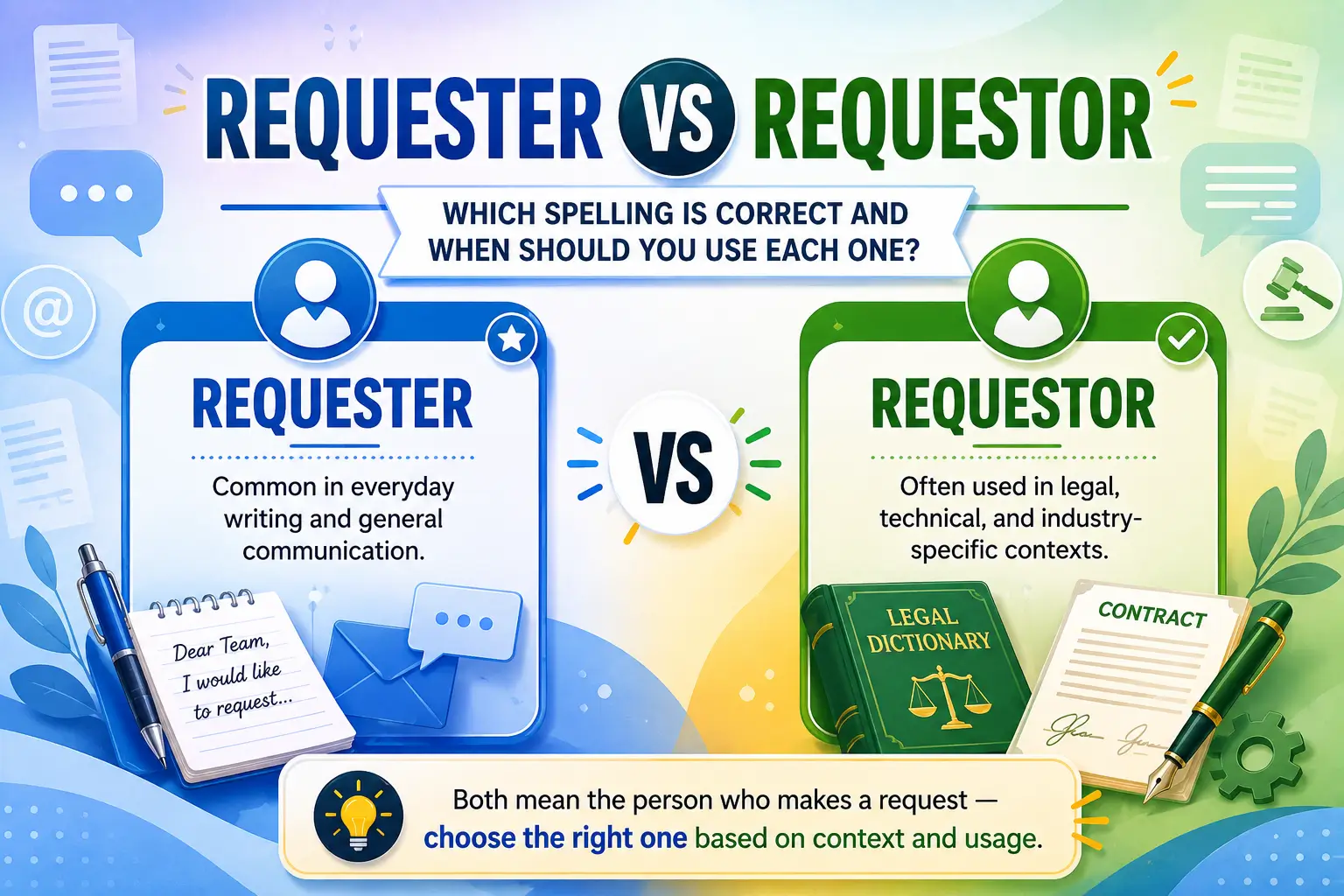
The difference between Requester and Requestor is mainly based on context, language usage, and industry standards rather than meaning. Both words describe a person who makes a request, but requester is more widely used in everyday communication, business writing, and general professional communication. In contrast, requestor appears more often in specialized environments such as IT, procurement, and technical documentation, where organizations follow specific terminology preferences. Understanding these usage differences, spelling rules, and word choice decisions helps create accurate documents and consistent documents.
In my experience reviewing professional writing, the correct choice often depends on the type of document, audience, and organization. A legal document, government record, or contract may use either spelling because of official terminology and established standards. For example, an enterprise software system may use requestor as a defined user role, while a business report or email may naturally use requester. These real-world examples show why contextual meaning, semantic meaning, and linguistic meaning matter when selecting the correct form.
Using Requester vs Requestor correctly improves writing consistency, language accuracy, and communication clarity. Whether creating website content, preparing software documentation, drafting legal paperwork, or writing workplace messages, choosing the right spelling makes your work appear more polished. Paying attention to grammar rules, professional context, and organizational language helps writers, editors, and professionals avoid confusion, reduce mistakes, and communicate with greater confidence in formal writing and technical writing.
Quick Answer: Requester vs Requestor
Requester and requestor have the same basic meaning: a person, organization, or system that makes a request.
The main difference is usage:
| Word | Meaning | Common Usage |
| Requester | Someone who makes a request | Everyday writing, business communication, general English |
| Requestor | Someone who makes a request | Legal documents, technical systems, IT, formal terminology |
For most writing situations, requester is the safer choice because it sounds more natural and is more widely accepted.
However, if you are writing for a specific system, company, contract, or industry that uses requestor, you should follow that terminology for consistency.
What Does Requester Mean?
Requester is a noun that describes a person or entity that asks for something.
The word comes from the verb request, which means to politely or formally ask for something.
The structure is:
Request + -er = Requester
The suffix -er often creates a noun that describes someone who performs an action.
Examples:
- Teach → Teacher
- Drive → Driver
- Work → Worker
- Request → Requester
A requester is simply the person who makes the request.
How Requester Is Used in Everyday English
In normal conversations and general writing, requester is the most natural choice.
You may see it used in:
- Customer service communication
- Workplace emails
- School applications
- Online forms
- Support requests
- General articles
Examples:
The requester asked for additional information before approving the project.
The word requester tells us who made the request.
The customer is the requester of the refund.
Here, the customer is the person asking for money back.
Requester Examples in Real Sentences
Example 1: Workplace
The requester submitted a vacation request to the HR department.
Why it works:
The employee is the person making the request, so requester is the natural choice.
Example 2: Customer support
Our support team contacted the requester to confirm the issue.
Why it works:
The customer who reported the problem is the requester.
Example 3: Education
The requester must provide additional documents before enrollment.
Why it works:
The person asking for admission is the requester.
What Does Requestor Mean?
Requestor is another noun form of request. It has the same basic meaning as requester, but it is often associated with specialized language.
The structure is:
Request + -or = Requestor
The suffix -or also creates nouns for people or things that perform an action.
Examples:
- Act → Actor
- Create → Creator
- Inspect → Inspector
- Request → Requestor
Although requestor follows a real English pattern, it is less common in everyday writing.
Why Requestor Appears in Formal Contexts
Many organizations use requestor as a defined term inside their systems.
For example, an IT company may label a person submitting a service ticket as the requestor because that is the term built into its software.
Similarly, a legal agreement may define the person making a request as the Requestor and capitalize it throughout the document.
In these cases, the spelling is often a matter of organizational style rather than grammar.
Requestor Examples in Real Sentences
Example 1: IT system
The requestor must provide approval before the ticket can be closed.
Why it works:
Many software platforms use requestor as a role name.
Example 2: Legal document
The Requestor agrees to provide all required information.
Why it works:
Legal documents often define specific terms and maintain that wording throughout the agreement.
Example 3: Business process
The requestor receives an automatic notification after submitting the form.
Why it works:
The company may have chosen this spelling for its internal workflow.
Requester vs Requestor: Key Differences Explained
Although both words describe someone who makes a request, their differences come from usage, style, and context.
| Feature | Requester | Requestor |
| Meaning | Person who makes a request | Person who makes a request |
| Grammar | Correct noun | Correct noun |
| Frequency | More common | Less common |
| Everyday English | Preferred | Less natural |
| Business emails | Usually preferred | Sometimes used |
| Legal writing | Acceptable | Often appears |
| IT systems | Used sometimes | Very common |
| Academic writing | Usually preferred | Less common |
The meaning does not change. The choice usually depends on the audience and context.
Why Do Two Spellings Exist: Requester vs Requestor?
English often creates nouns by adding endings such as -er and -or to verbs.
Both endings can describe someone who performs an action.
For example:
| Verb | -er Form | -or Form |
| Teach | Teacher | — |
| Operate | — | Operator |
| Create | — | Creator |
| Request | Requester | Requestor |
The confusion happens because English does not always follow one strict pattern.
Some words naturally use -er, while others traditionally use -or. In some cases, both forms become accepted over time.
The word requester follows the common English pattern used for people who perform actions.
The word requestor developed as an alternative spelling, especially in formal and technical environments.
Is Requestor a Correct English Word?
Yes. Requestor is a correct English word.
It is not a spelling mistake.
However, being correct does not mean it is always the best choice.
For example:
The requester contacted the company.
This sounds natural in everyday American English.
The requestor contacted the company.
This is also correct, but it sounds more formal or system-based.
The difference is similar to choosing between a common everyday word and a specialized workplace term.
Requester vs Requestor in American English
In the United States, requester is generally more common in general writing.
You will usually see it in:
- Articles
- Emails
- Customer communication
- Educational materials
- General business writing
Meanwhile, requestor appears more frequently in:
- Software interfaces
- Government systems
- Procurement platforms
- Legal agreements
- Internal company documentation
A good rule for American English is:
Use requester unless a specific organization or industry uses requestor as its official term.
Requester vs Requestor in Different Contexts
Business Communication
In regular workplace communication, requester usually sounds clearer and more natural.
Example:
The requester should reply with the missing details.
This works well in an email because it feels conversational.
However, a company’s internal software might use:
Requestor: John Smith
In that case, the spelling is part of the system’s terminology.
Legal Writing and Contracts
Legal writing often uses specialized vocabulary.
A contract may define a person as the Requestor and continue using that exact term throughout the document.
For example:
The Requestor shall provide all necessary documents.
The important point is consistency.
If a contract defines the term as Requestor, changing it later to Requester may create unnecessary confusion.
Technology and Software Documentation
Technical systems frequently use requestor because it describes a role inside a workflow.
Examples include:
- IT service requests
- Access management systems
- API documentation
- Approval processes
A software platform may include fields such as:
- Requestor name
- Requestor ID
- Requestor email
This does not mean requestor is more grammatically correct. It simply reflects a technical naming choice.
Requester vs Requestor Sentence Examples
Examples Using Requester
| Sentence | Explanation |
| The requester submitted a complaint. | The person made the request. |
| We contacted the requester for more information. | The person needs to provide details. |
| Every requester must complete the form. | General instructions use the common spelling. |
Examples Using Requestor
| Sentence | Explanation |
| The requestor must approve the transaction. | A formal system role is being described. |
| The requestor receives an automated email. | Common in software workflows. |
| The Requestor agrees to the terms below. | Legal-style defined terminology. |
Common Mistakes When Using Requester and Requestor
Mistake 1: Thinking Requestor Is Incorrect
Some writers assume requestor is a spelling error.
That is wrong.
Requestor is accepted English, although it is less common.
Mistake 2: Using Both Spellings in One Document
Mixing spellings can make writing look inconsistent.
Incorrect:
The requester submitted the form. The requestor will receive confirmation.
Better:
The requester submitted the form. The requester will receive confirmation.
Choose one spelling and keep it consistent.
Mistake 3: Using Requester as a Verb
Requester is only a noun.
Incorrect:
She requester additional information.
Correct:
She requested additional information.
The verb is request, not requester.
Mistake 4: Confusing Requester With Requestee
These words describe opposite roles.
| Word | Meaning |
| Requester | Person who asks for something |
| Requestee | Person who receives the request |
Example:
The requester asked the manager for approval.
The employee is the requester.
The manager is the requestee.
The manager receives the request.
Which One Should You Use? A Simple Decision Guide
Use this guide when choosing between requester vs requestor:
Use requester when:
- Writing general content
- Writing emails
- Explaining something to a broad audience
- Writing educational material
- Creating blog content
Use requestor when:
- Following a company style guide
- Writing for a specific software system
- Using legal terminology
- Referring to an established role name
The best choice is usually the one your readers expect.
Easy Memory Trick for Requester vs Requestor
Remember:
Requester = regular writing
Think:
“The person who requests something is the requester.”
Requestor = role-based writing
Think:
“A requestor is often a named role inside a system.”
This simple trick works in most situations.
Synonyms and Related Words
Depending on the situation, you may replace requester or requestor with:
- Applicant
- Customer
- User
- Client
- Petitioner
- Submitter
- Initiator
- Sender
- Caller
However, each synonym has a slightly different meaning.
For example:
- A customer buys something.
- A submitter sends information.
- A petitioner makes a formal request.
Choose the word that matches the situation.
Conclusion: Requester vs Requestor — Choosing the Right Word for the Right Context
The difference between requester vs requestor is not about one word being correct and the other being wrong. Both terms describe a person, system, or organization that makes a request. However, requester is the more common choice in everyday American English, professional communication, and general writing.
On the other hand, requestor is often used in specific environments such as IT systems, legal documents, procurement processes, and internal business platforms. When a company, software system, or organization uses a particular spelling, following that terminology helps maintain consistency and clarity.
For most writers, choosing requester is the safest option because it sounds natural and familiar to most readers. However, understanding when and why requestor appears allows you to write more accurately in professional, technical, and formal situations. The best choice depends on your audience, purpose, and the context in which the word is being used.
FAQs About Requester vs Requestor
1. What is the difference between requester and requestor?
Requester and requestor have the same basic meaning. Both refer to a person, group, or system that makes a request. The main difference is usage. Requester is more common in general writing, while requestor is often found in technical, legal, and organizational contexts.
2. Is requester or requestor the correct spelling?
Both requester and requestor are correct spellings. However, requester is the more widely accepted and commonly used form in everyday English. Requestor is considered an alternative spelling that appears more often in specialized fields.
3. Which spelling is more common: requester or requestor?
Requester is more common in modern English, especially in general communication, articles, emails, and business writing. Requestor appears less frequently but is still used in industries where it has become an established term.
4. Should I use requester or requestor in a business email?
In most business emails, requester is the better choice because it sounds more natural and familiar. For example:
The requester should provide the missing information.
However, if your company’s internal system or documentation uses requestor, you should follow that style for consistency.
5. Is requestor a wrong spelling of requester?
No, requestor is not a wrong spelling. It is a valid English word. The confusion happens because many people see requester more often and assume requestor is incorrect. In reality, both forms are accepted.
6. Why do legal documents use requestor?
Legal documents often use requestor because legal and organizational writing frequently relies on defined terms. A contract may choose Requestor as an official role name and use that spelling throughout the document for consistency.
7. Can requester and requestor be used interchangeably?
Yes, they can usually be used interchangeably because they have the same meaning. However, you should avoid switching between them in the same document. Choose one spelling and use it consistently.
8. Is requester better for academic writing?
Yes, requester is generally better for academic writing because it is more familiar to readers and works well in general English. Unless a specific source, field, or terminology guide requires requestor, most academic writers prefer requester.
9. What is the difference between requester and requestee?
A requester is the person who makes a request, while a requestee is the person who receives or responds to the request.
Example:
The employee is the requester because they asked for approval.
The manager is the requestee because they received the request.
10. Which word should I use in SEO content: requester or requestor?
For SEO content aimed at a general audience, requester is usually the better choice because it is more commonly searched and understood. However, if your content targets a technical audience, such as software developers or IT professionals, mentioning requestor may help cover industry-specific usage.