
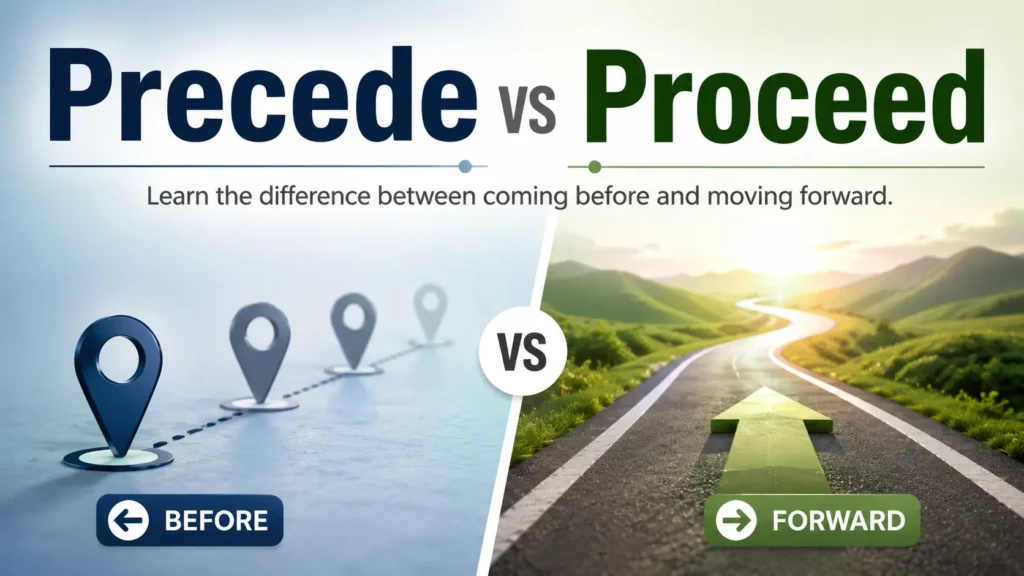
Many English learners confuse precede vs proceed because both words have similar spelling, similar pronunciation, and different meanings. Understanding their correct usage helps improve writing and speaking skills by avoiding common grammar mistakes. Precede means something happens before, while proceed means to continue or move forward with an action.
A common mistake is using proceed when you mean precede. For example, “The speech preceded the dinner” is correct because the speech happened first. However, “Please proceed to the next room” is correct because it means to advance or follow directions. These verbs cannot replace each other because their definitions are not connected.
To choose the right word, check the context and ask whether you are describing something earlier or the next action. Use precede for time, order, or a previous event, and use proceed for progress, continuation, or moving ahead. This simple grammar rule makes word choice easier.
Quick Answer: What Is the Difference Between Precede and Proceed?
Precede and proceed are both verbs, but they describe different actions.
| Word | Meaning | Main Idea | Example |
| Precede | Come before something else | Earlier in time or order | A warning message preceded the error. |
| Proceed | Continue or move forward | Next action or step | You may proceed with the next step. |
The easiest rule is:
- Precede = come before
- Proceed = continue or move forward
If something happens first, use precede.
If something happens next, use proceed.
What Does Precede Mean?
Precede is a verb that means to come before something or someone in time, order, position, or importance.
It often describes a relationship between two things where one happens or appears earlier than the other.
Examples:
- The wedding ceremony was preceded by a rehearsal.
- Chapter one precedes chapter two.
- Heavy traffic preceded the accident.
- The introduction precedes the main discussion.
In each example, one thing comes before another.
How to Use Precede in a Sentence
A common sentence pattern is:
Something + precedes + something else
Examples:
- The introduction precedes the main discussion.
- A short meeting preceded the official announcement.
- The letter B precedes the letter C in the alphabet.
- The appetizer preceded the main course.
The subject comes first, while the object comes afterward.
Precede Meaning: Coming Before in Time
One of the most common uses of precede is to describe events happening in time.
Example:
A loud noise preceded the explosion.
This means:
- The loud noise happened first.
- The explosion happened afterward.
Another example:
The announcement was preceded by several rumors.
The rumors appeared before the announcement.
This use is common when describing:
- Historical events
- News
- Processes
- Timelines
- Sequences
Precede Meaning: Coming Before in Order or Position
Precede can also describe the order or position of things.
Examples:
- The title precedes the author’s name.
- The first paragraph precedes the conclusion.
- The number 5 precedes the number 6.
- Monday precedes Tuesday.
In each example, one item appears earlier in a sequence.
Precede Meaning: Priority or Importance
In some contexts, precede can express the idea that something should come before something else because it has greater priority.
Examples:
- Safety should precede speed.
- Customer needs should precede personal preferences.
- Planning should precede action.
Here, the idea is not simply about time. One thing should receive attention before another.
What Does Proceed Mean?
Proceed means to continue, move forward, or begin the next action after a decision or instruction.
Unlike precede, which focuses on something coming earlier, proceed focuses on what happens next.
Examples:
- Please proceed to the next page.
- The company decided to proceed with the project.
- The meeting will proceed as planned.
- You may proceed after receiving approval.
The word is common in professional, legal, academic, travel, and everyday contexts.
Proceed With + Noun
Use proceed with when someone continues with a plan, activity, process, or decision.
Examples:
- They proceeded with the construction.
- We will proceed with the interview process.
- The company proceeded with the launch.
- She decided to proceed with the application.
The meaning is:
Continue with the action.
Proceed To + Verb
Use proceed to + verb when someone moves from one action to the next.
Examples:
- She proceeded to explain the problem.
- The teacher proceeded to answer questions.
- The customer proceeded to complete the form.
- He proceeded to describe what happened.
This structure means someone continued by performing another action.
Proceed To + Place
Use proceed to + place when giving directions or telling someone where to go next.
Examples:
- Please proceed to gate 12.
- Visitors should proceed to the reception desk.
- Passengers should proceed to the boarding area.
- Customers may proceed to checkout.
This usage is common in airports, offices, hospitals, stores, and official announcements.
Precede vs Proceed: Key Differences
Although precede and proceed look similar, their meanings point in different directions.
| Feature | Precede | Proceed |
| Meaning | Come before | Continue or move forward |
| Direction | Earlier in sequence | Forward in sequence |
| Focus | Previous event or position | Next action or step |
| Grammar role | Verb | Verb |
| Common pattern | Precede something | Proceed with something |
| Example | The speech preceded dinner. | The guests proceeded to dinner. |
A useful way to remember them is:
Precede answers: “What came first?”
Proceed answers: “What happens next?”
Precede vs Proceed Examples in Real-Life English
Seeing the words in everyday situations makes their meanings easier to remember.
Examples of Precede
School and Education
The teacher’s explanation preceded the exam.
The explanation happened before the students took the exam.
Workplace
The email preceded the company announcement.
The email came first.
Daily Life
A strange smell preceded the smoke.
The smell appeared before the smoke.
Events
A short introduction preceded the ceremony.
The introduction happened first.
Examples of Proceed
Workplace
The manager approved the budget, so the team proceeded with the project.
The team continued after receiving approval.
Travel
Passengers should proceed to the boarding area.
Passengers should move to that location.
Conversation
If everyone agrees, we can proceed.
The group can continue.
Online Shopping
Please proceed to checkout.
The customer should move to the next step.
Common Mistakes With Precede and Proceed
Because the two words look similar, writers sometimes choose the wrong one.
Mistake 1: Using Proceed When You Mean Precede
Incorrect:
❌ The introduction proceeded the speech.
Correct:
✅ The introduction preceded the speech.
Why?
The introduction happened before the speech.
Mistake 2: Using Precede When You Mean Continue
Incorrect:
❌ Please precede with your payment.
Correct:
✅ Please proceed with your payment.
Why?
The sentence means continue with the payment, not come before it.
Mistake 3: Confusing Preceding and Proceeding
Preceding and proceeding also have different meanings.
| Word | Meaning | Example |
| Preceding | Coming before | Read the preceding paragraph. |
| Proceeding | Continuing, or an event/process | The legal proceeding lasted three days. |
Examples:
The preceding chapter explains the background.
This means the chapter before the current one.
The court proceeding began Monday.
Here, proceeding refers to a legal process.
Simple Memory Tricks for Precede vs Proceed
A good memory trick can make the difference much easier to remember.
Remember Precede With “Pre”
The prefix pre- commonly relates to something happening before.
Examples:
- Preview = view before
- Prepay = pay before
- Precede = come before
Remember:
Precede = Before
Remember Proceed as Progress
Think of proceed as moving ahead or making progress.
Examples:
- Proceed with a plan
- Proceed to the next step
- Proceed with the application
Remember:
Proceed = Continue Forward
When Should You Use Precede?
Use precede when describing:
- Events happening earlier
- Order in a list
- Position in a sequence
- Something that comes first
- Something that should receive priority
Examples:
The introduction preceded the presentation.
The number 10 precedes the number 11.
Preparation should precede action.
A warning often precedes a major system failure.
When Should You Use Proceed?
Use proceed when you mean:
- Continue an activity
- Move to the next stage
- Follow instructions
- Take action after approval
- Move toward a location
Examples:
We can proceed after receiving permission.
Please proceed to checkout.
The meeting will proceed as planned.
The company will proceed with the expansion.
Precede vs Proceed in Formal and Informal English
Both words can appear in formal English, although proceed is also common in everyday instructions.
| Formal Expression | Simpler Alternative |
| The announcement preceded the event. | The announcement came before the event. |
| Please proceed with the application. | Please continue the application. |
Examples of proceed in everyday situations include:
- Proceed to checkout.
- Proceed carefully.
- You may proceed.
- Please proceed to the next step.
Synonyms for Precede and Proceed
Knowing synonyms can make the distinction easier.
Synonyms for Precede
Depending on the context, alternatives include:
- Come before
- Go before
- Lead up to
- Pre-date
- Introduce
Example:
Several warnings preceded the problem.
A similar sentence is:
Several warnings came before the problem.
Synonyms for Proceed
Common alternatives include:
- Continue
- Advance
- Move forward
- Go ahead
- Carry on
Example:
We will proceed with the plan.
A similar sentence is:
We will continue with the plan.
Quick Decision Guide: Precede or Proceed?
If you are unsure which word to use, ask yourself one simple question.
Does It Mean “Come Before”?
Use:
Precede
Example:
The opening speech preceded the ceremony.
Does It Mean “Continue or Move Forward”?
Use:
Proceed
Example:
The team proceeded with the project.
The easiest comparison is:
Precede = before
Proceed = forward
Practice Exercise: Precede or Proceed?
Choose the correct word for each sentence.
- The introduction will ______ the main presentation.
- Please ______ with the registration process.
- Dark clouds often ______ a storm.
- The company decided to ______ with the expansion.
- The warning message ______ the system failure.
Answers and Explanations
1. Precede
The introduction will precede the main presentation.
The introduction comes before the presentation.
2. Proceed
Please proceed with the registration process.
The person should continue the registration process.
3. Precede
Dark clouds often precede a storm.
The clouds appear before the storm.
4. Proceed
The company decided to proceed with the expansion.
The company decided to continue.
5. Precede
The warning message preceded the system failure.
The warning happened before the failure.
Conclusion: Precede vs Proceed
Understanding the difference between precede vs proceed becomes much easier when you focus on the direction of each word. Precede means something comes before another thing, whether it relates to time, order, position, or importance. On the other hand, proceed means to continue, move forward, or take the next step in a process.
A simple way to remember the difference is that precede contains “pre,” which means before, while proceed connects with the idea of progress and moving ahead. When writing emails, reports, essays, or everyday messages, choosing the correct word helps your meaning stay clear and professional.
Although these words look and sound similar, they serve different purposes. Once you understand their meanings, sentence patterns, and common uses, you can confidently use precede and proceed correctly in both spoken and written English.
FAQs About Precede vs Proceed
Q1: What is the simple difference between precede and proceed?
Precede means to come before something, while proceed means to continue or move forward. Precede focuses on something that happens earlier, whereas proceed focuses on the next action.
Example:
- “The meeting was preceded by a short introduction.”
- “We will proceed with the meeting.”
Q2: Is precede the same as before?
Yes, precede often means “to come before.” However, it is a verb, so it usually shows a relationship between two things.
Example:
- “The announcement preceded the event.”
This means the announcement happened before the event.
Q3: What does proceed mean in simple English?
Proceed means to continue, advance, or move to the next step. It is commonly used when someone continues an activity or follows instructions.
Example:
- “Please proceed to the checkout page.”
This means continue to the checkout page.
Q4: Can precede and proceed be used interchangeably?
No, precede and proceed cannot be used interchangeably because they have different meanings.
Use:
- Precede when something comes first.
- Proceed when something continues or moves forward.
Using the wrong word can change the meaning of a sentence completely.
Q5: What is the difference between preceded and proceeded?
Preceded means something happened before another event.
Example:
- “Heavy rain preceded the storm.”
Proceeded means someone continued or moved forward.
Example:
- “The team proceeded with the project.”
Q6: Is proceed a formal word?
Proceed is often used in formal situations, but it is also common in everyday English. You may see it in business emails, instructions, announcements, and conversations.
Examples:
- “Please proceed to the next step.”
- “We can proceed after approval.”
Q7: How can I remember the difference between precede and proceed?
Use this simple memory trick:
- Precede = Pre = Before
- Proceed = Progress forward
If something happens first, use precede. If something moves ahead, use proceed.
Q8: Is precede only used for time?
No. While precede commonly refers to time, it can also describe order, position, or importance.
Examples:
- “Chapter one precedes chapter two.”
- “Safety should precede convenience.”
Q9: Why do people confuse precede and proceed?
People confuse these words because they have similar spelling and pronunciation. They also both relate to movement or sequence, which makes them easy to mix up.
Learning their meanings and sentence patterns helps prevent mistakes.
Q10: What are common examples of proceed in everyday English?
Common examples include:
- “Please proceed with your payment.”
- “You may proceed after signing the form.”
- “Passengers should proceed to the boarding area.”
In each example, proceed means to continue or move forward.
Blog :
Busses vs. Buses: Which Spelling Is Correct? Meaning, Examples, and Usage
Brake vs. Break: What’s the Difference? Meaning, Usage, Examples, and Easy Tips
Every Day vs. Everyday: What’s the Difference and How Do You Use Them Correctly?
