
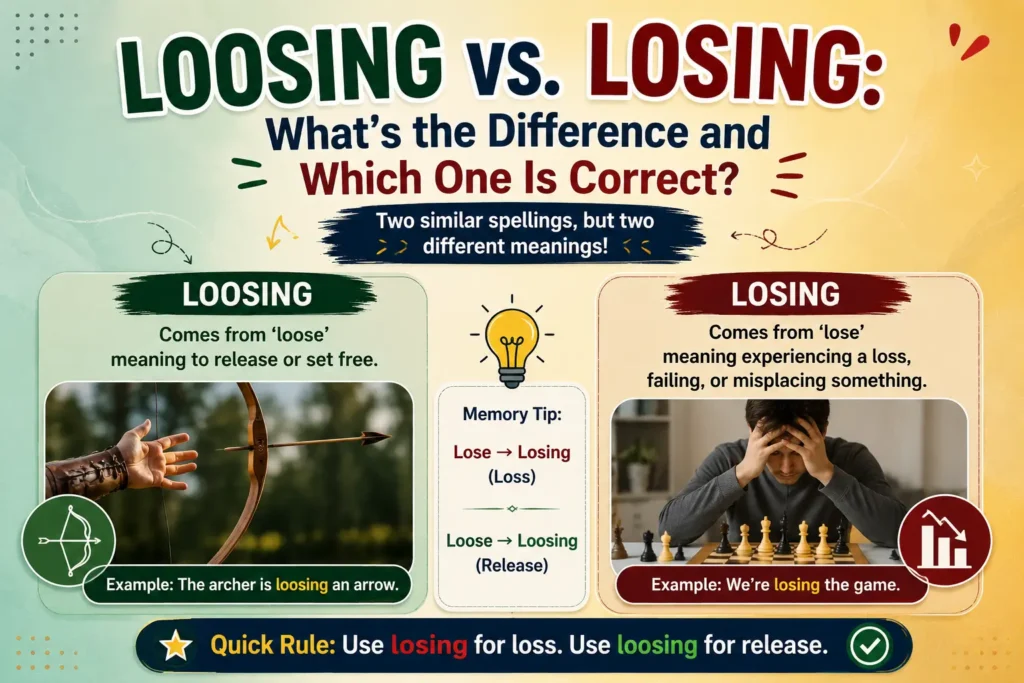
Confused about loosing vs losing? The difference becomes clear when you look at their base words and meanings. Losing comes from lose and means failing to win, misplacing something, or no longer having it. For example, you might be losing a game, losing your keys, or losing confidence. Loosing, however, comes from the verb loose and means releasing or setting something free. This word is correct but uncommon in everyday American English.
The spelling difference is small, but the meanings are not. Lose is a verb, while loose is usually an adjective that describes something not tight or securely attached. It can also be a verb meaning to release something. Therefore, losing is the correct choice for phrases like losing weight or losing the game, while loosing may be used when an archer releases an arrow.
A simple way to remember the difference is lose → losing and loose → loosing. If you’re talking about loss, choose losing. If you’re talking about release, loosing may be correct. This quick rule can help you avoid one of the most common spelling mistakes in English.
Quick Answer: Is It Loosing or Losing?
Losing is correct when you mean experiencing a loss, failing to win, misplacing something, or becoming less.
- Our team is losing the game.
- I keep losing my keys.
- She is losing weight.
- The company is losing money.
- He’s losing interest in the project.
Loosing is correct when it means releasing, freeing, or setting something loose. However, this word is uncommon in modern everyday American English.
- The archer is loosing an arrow.
- The soldiers were loosing arrows toward the target.
So, if you’re writing about losing a game, losing weight, losing money, or losing your keys, always use losing.
Quick memory rule:
Lose → Losing = experiencing a loss
Loose → Loosing = releasing or setting free
Loosing vs. Losing at a Glance
The two words differ by only one letter, but that extra o changes the base word and meaning.
| Word | Base Word | Main Meaning | How Common Is It? | Example |
| Losing | Lose | Experiencing loss, defeat, or decrease | Very common | We’re losing the game. |
| Loosing | Loose | Releasing or setting free | Uncommon | The archer is loosing an arrow. |
The most important thing to remember is that losing and loosing aren’t simply two spellings of the same word.
They come from different verbs:
- Lose → losing
- Loose → loosing
Therefore, you should choose the spelling based on the meaning you want.
What Does Losing Mean?
Losing is the present participle and gerund form of the verb lose.
The verb lose has several meanings. As a result, losing can appear in many different situations.
You can use losing when someone isn’t winning, when something has been misplaced, when something is disappearing, or when someone is experiencing a loss.
Because these situations are common, losing is a very common word in American English.
Losing Means Failing to Win
One of the most common meanings of losing is not winning a competition or contest.
For example:
Our team is losing the game.
This means the team is currently behind its opponent or is not winning.
You might also say:
- We’re losing by five points.
- The home team is losing the championship game.
- I’m losing this chess match.
- The candidate is losing the election.
- Our school is losing the tournament.
In each example, losing describes an unfavorable result in a competition.
Losing Means Misplacing Something
You can also use losing when you misplace something or can’t find it.
I keep losing my keys.
This means the speaker repeatedly misplaces their keys.
Other examples include:
- I’m always losing my phone.
- She keeps losing her glasses.
- He is losing his wallet again.
- I don’t want to lose my passport.
This use is especially common in everyday conversation.
Losing Means No Longer Having Something
Sometimes losing means that you no longer have something.
For example:
He is losing his job.
Depending on the context, this could mean that his job is being taken away or that he is about to become unemployed.
You can also say:
- The company is losing customers.
- We’re losing valuable opportunities.
- The team is losing support from its fans.
- She is losing her connection with her old friends.
Here, the word describes something that is gradually disappearing or no longer being retained.
Losing Means Experiencing a Loss
The word can also describe a serious personal or emotional loss.
She is struggling after losing her father.
In this case, losing refers to experiencing the death of someone.
Other examples include:
- He had a difficult time after losing his mother.
- The family is grieving after losing their home.
- The community is recovering after losing several historic buildings.
The exact meaning depends on the noun or situation that follows losing.
Losing Means Becoming Less
Another common use appears when something decreases or becomes weaker.
For example:
- losing weight
- losing interest
- losing confidence
- losing patience
- losing control
- losing focus
- losing energy
- losing motivation
Consider this sentence:
I’m losing interest in the project.
This means the speaker is becoming less interested.
Similarly:
She’s losing confidence in the plan.
This means her confidence is decreasing.
Therefore, losing isn’t limited to physical objects. It can describe changes in emotions, abilities, relationships, and situations.
What Does Loosing Mean?
Loosing is the present participle or gerund form of the verb loose when loose is used as a verb.
As a verb, loose can mean to release, free, or set something loose.
For example:
The archer is loosing an arrow.
Here, loosing means releasing the arrow from the bow.
The word is grammatically correct. However, it’s much less common than losing in modern American English.
Loosing Means Releasing or Setting Free
The verb loose can describe the act of releasing something or someone.
For example:
The keeper loosed the dogs from their cages.
The sentence means that the keeper released the dogs.
However, a modern American English speaker might be more likely to say:
The keeper released the dogs from their cages.
Or:
The keeper let the dogs out of their cages.
These alternatives sound more natural in everyday conversation.
Loosing an Arrow
One of the clearest traditional uses of loosing involves archery.
The archer is loosing an arrow.
The meaning is:
The archer is releasing an arrow.
You may also see this word in historical or literary writing:
The soldiers began loosing arrows toward the enemy.
This usage is valid, but it can sound old-fashioned or formal to modern readers.
In everyday American English, releasing arrows may be more familiar.
Why Loosing Is Less Common Today
The word loosing is not incorrect. Instead, it is simply uncommon.
Modern speakers often choose simpler alternatives, such as:
- releasing
- freeing
- letting loose
- letting out
For example:
The farmer is loosing the horses.
This is understandable, but:
The farmer is letting the horses loose.
or
The farmer is letting the horses out.
may sound more natural.
Therefore, you shouldn’t automatically mark loosing as wrong. Instead, check whether the sentence is talking about release rather than loss.
Loosing vs. Losing: The Main Difference
The easiest way to understand loosing vs. losing is to focus on their base words.
Losing comes from lose.
Loosing comes from loose.
| Feature | Losing | Loosing |
| Base word | Lose | Loose |
| Meaning | Experiencing loss or failing to win | Releasing or setting free |
| Common in everyday English | Yes | No |
| Common contexts | Sports, money, possessions, weight, emotions | Archery, release, literary and historical writing |
| Example | I’m losing my keys. | The archer is loosing an arrow. |
This distinction solves most spelling questions.
Ask yourself:
Does the sentence involve loss?
If yes, use losing.
We’re losing the game.
Does the sentence involve releasing or freeing something?
If yes, loosing may be correct.
The archer is loosing an arrow.
Lose, Loose, Losing, and Loosing Explained Together
Because these four words look similar, it’s helpful to understand them as a group.
Lose
Lose is a verb.
It can mean:
- To no longer have something
- To misplace something
- To fail to win
- To experience a loss
- To decrease or become less
Examples:
Don’t lose your keys.
I don’t want to lose the game.
She doesn’t want to lose her job.
Loose
Loose is most often an adjective.
It usually means not tight, not firmly attached, or not held securely.
Examples:
My shoes are loose.
The screw is loose.
She wore a loose jacket.
However, loose can also function as a verb meaning to release or set free.
That less common verb use is the source of loosing.
Losing
Losing is the -ing form of lose.
Examples:
I’m losing my wallet.
We’re losing the game.
She is losing weight.
Loosing
Loosing is the -ing form of the verb loose when it means releasing or setting free.
Example:
The archer is loosing an arrow.
The four words may look related, but their meanings and grammatical roles are different.
How to Spell Losing Correctly
A common spelling mistake is adding an extra o to losing.
The correct spelling is:
L-O-S-I-N-G
Not:
L-O-O-S-I-N-G
The reason is that losing comes from lose, not loose.
The spelling pattern is:
lose → losing
The final e is removed before adding -ing.
This pattern also appears in other English verbs:
- choose → choosing
- use → using
- close → closing
- move → moving
Therefore:
lose → losing
not:
lose → loosing
However, loosing is a different word because it comes from loose.
How to Pronounce Losing and Loosing
The pronunciation difference can help English learners distinguish these words.
In American English:
- losing is pronounced approximately LOO-zing
- loosing is pronounced approximately LOO-sing
The key difference is the middle consonant sound.
Losing has a /z/ sound.
Loosing has an /s/ sound.
Compare:
losing → LOO-zing
loosing → LOO-sing
The difference may be subtle, especially for non-native English speakers. Therefore, it’s best to remember both the pronunciation and the meaning.
Common Examples of Losing in Everyday English
The word losing appears frequently in American English.
Sports and Competitions
The Lakers are losing the game.
We’re losing by three points.
She is losing the race.
Possessions
I keep losing my keys.
He’s always losing his phone.
Don’t lose your passport.
Money and Business
The company is losing money.
The store is losing customers.
The business is losing valuable clients.
Time and Opportunities
We’re losing valuable time.
Don’t lose this opportunity.
The team is losing its chance to qualify.
Feelings and Abilities
I’m losing patience.
She’s losing confidence.
He’s losing interest in the project.
Health and Fitness
She is losing weight.
I’m trying to lose weight.
Notice the difference between lose and losing:
I want to lose weight.
I am losing weight.
After to, use the base verb lose.
After am, use the -ing form losing.
Common Examples of Loosing
Because loosing is uncommon, you’ll see it in fewer situations.
Releasing an Arrow
The archer is loosing an arrow.
This means the archer is releasing the arrow.
Releasing Animals
The farmer is loosing the horses from the stable.
This means the farmer is freeing or releasing the horses.
However, modern readers may find this phrasing unusual.
A more natural version could be:
The farmer is letting the horses out of the stable.
Historical or Literary Writing
The warriors were loosing arrows from their bows.
This sentence has a historical or literary tone.
In a modern news report, you might instead read:
The warriors were firing arrows.
The meaning is similar, but the word choice fits the context differently.
Common Mistakes With Losing and Loosing
The biggest mistake is using loosing when you actually mean losing.
Mistake: “Loosing Weight”
❌ She is loosing weight.
✅ She is losing weight.
The correct verb is lose because the person is experiencing a reduction in weight.
lose → losing
Mistake: “Loosing the Game”
❌ Our team is loosing the game.
✅ Our team is losing the game.
The team is failing to win, so the correct word is losing.
Mistake: “Loosing My Keys”
❌ I’m always loosing my keys.
✅ I’m always losing my keys.
The speaker is misplacing the keys. Therefore, the word comes from lose.
Mistake: Assuming Loosing Is Always Wrong
❌ “Loosing” is never a correct English word.
This statement is incorrect.
Loosing is a valid word when it means releasing or setting free.
For example:
The archer is loosing an arrow.
The problem isn’t the word itself. The problem is using it when you mean losing.
Mistake: Confusing Loosing With Loosening
Another common confusion involves loosening.
Compare these sentences:
I’m losing my grip.
I’m loosening my grip.
The first means you’re gradually losing control or no longer holding something firmly.
The second means you’re intentionally making your grip less tight.
These words have different meanings.
Losing vs. Loosing vs. Loosening
The three words may look similar, but their meanings are distinct.
| Word | Meaning | Example |
| Losing | Experiencing loss or no longer having something | I’m losing my keys. |
| Loosing | Releasing or setting something free | The archer is loosing an arrow. |
| Loosening | Making something less tight | She is loosening the knot. |
When You Need “Loosening”
Use loosening when something is becoming less tight or when someone intentionally makes it less tight.
Common examples include:
- loosening a knot
- loosening a screw
- loosening shoelaces
- loosening a belt
- loosening your grip
- loosening restrictions
For example:
He is loosening the knot.
This means he’s making the knot less tight.
You wouldn’t normally use loosing here.
Is Loosing a Correct English Word?
Yes. Loosing is a legitimate English word.
It is the -ing form of loose when loose is used as a verb meaning to release or set free.
However, there’s an important difference between being correct and being common.
Loosing is correct in the right context, but it isn’t common in ordinary American English.
For most everyday sentences, you’ll need losing instead.
For example:
I’m losing my phone.
We’re losing the game.
She’s losing weight.
The company is losing money.
None of these sentences should use loosing.
On the other hand:
The archer is loosing an arrow.
is grammatically correct because the meaning is releasing.
How to Choose Between Losing and Loosing
When you’re unsure about the spelling, use this simple process.
Step 1: Identify the Meaning
Ask yourself what you are trying to say.
Are you talking about:
- Failing to win?
- Misplacing something?
- No longer having something?
- Experiencing a loss?
- Becoming less?
- Releasing something?
- Setting something free?
Step 2: Find the Base Word
If the meaning comes from lose, use losing.
Lose → Losing
If the meaning comes from the verb loose, use loosing.
Loose → Loosing
Step 3: Look at the Context
These situations usually require losing:
- Losing a game
- Losing weight
- Losing money
- Losing keys
- Losing interest
- Losing confidence
- Losing patience
- Losing control
These situations may require loosing:
- Releasing an arrow
- Setting something free
- Releasing something in a literary or historical context
Step 4: Consider Natural American Usage
Even when loosing is technically correct, another word may sound more natural.
For example:
The keeper is loosing the animals.
could become:
The keeper is releasing the animals.
or:
The keeper is letting the animals out.
For modern US readers, these alternatives are often clearer.
Easy Memory Tricks for Losing vs. Loosing
Remember: Lose Has One O
Think of the base word:
LOSE
It has one o.
Therefore:
LOSE → LOSING
Use losing for loss, defeat, misplacing something, or becoming less.
Remember: Loose Has Two Os
Think of the word:
LOOSE
It has two o’s.
Therefore:
LOOSE → LOOSING
Use loosing when the meaning is releasing or setting free.
Use the “Loss or Release” Test
Ask yourself:
Is this about loss?
If yes, use losing.
I’m losing my wallet.
We’re losing the game.
She’s losing interest.
Or ask:
Is this about release?
If yes, loosing may be correct.
The archer is loosing an arrow.
This simple test works for most situations.
Losing vs. Loosing in American English
For US readers, losing is by far the more familiar and useful word.
You’ll encounter it in almost every type of everyday communication.
In School
The team is losing the competition.
I’m losing points because of careless mistakes.
At Work
Our company is losing customers.
We’re losing valuable time.
In Text Messages
I’m losing my mind!
I keep losing my keys.
On Social Media
We’re losing followers.
Don’t lose hope.
In Sports
The team is losing by ten points.
In Everyday Conversation
I’m losing interest in the show.
She’s losing patience.
By comparison, loosing appears much less often.
When it does appear, it may be connected to:
- Archery
- Historical writing
- Literature
- Older styles of English
- Descriptions of releasing or setting free
Therefore, if you’re writing a normal email, text, school assignment, or social media post, losing is usually the word you need.
Quick Practice: Can You Choose the Right Word?
Test your understanding with these examples.
- Our team is ___ the game.
- I keep ___ my keys.
- The archer is ___ an arrow.
- She is ___ weight.
- The company is ___ money.
- The soldiers were ___ arrows.
- He’s ___ interest in the project.
- The farmer is ___ the horses.
Answer Key
- losing — The team isn’t winning.
- losing — The keys are being misplaced.
- loosing — The archer is releasing an arrow.
- losing — The person’s weight is decreasing.
- losing — The company is experiencing a financial loss.
- loosing — The soldiers are releasing arrows.
- losing — His interest is decreasing.
- loosing — The horses are being released.
The examples show why meaning matters more than spelling alone.
Synonyms and Related Words
Knowing similar words can make the difference between losing and loosing easier to understand.
Synonyms Related to Losing
Depending on context, losing can be replaced by:
- failing
- misplacing
- forfeiting
- surrendering
- missing
- decreasing
- declining
- dropping
- suffering a loss
For example:
We’re losing the game.
could be expressed as:
We’re failing to win the game.
However, these words aren’t always interchangeable. The best synonym depends on the specific meaning.
Synonyms Related to Loosing
Depending on context, loosing can be replaced by:
- releasing
- freeing
- setting free
- letting loose
- letting out
- unleashing
For example:
The archer is loosing an arrow.
could be described as:
The archer is releasing an arrow.
Again, the exact synonym depends on the context.
Conclusion
Understanding loosing vs losing becomes much easier when you remember the words they come from. Losing comes from lose and is used when you fail to win, misplace something, experience a loss, or become less of something. For example, you can be losing a game, losing weight, or losing your keys. In contrast, loosing comes from loose when it is used as a verb meaning to release, free, or set something loose. Although loosing is a correct word, it is uncommon in everyday American English.
The easiest memory trick is lose → losing and loose → loosing. If the meaning involves loss, use losing. If it involves release, loosing may be the right choice. By focusing on the meaning and the base word, you can confidently choose the correct spelling and avoid common mistakes.
Frequently Asked Questions About Loosing vs. Losing
Q1. Is it loosing or losing?
Both loosing and losing are real words, but they have different meanings. Losing comes from lose and refers to loss, defeat, or no longer having something. Loosing comes from loose and means releasing or setting something free.
Q2. Is it losing weight or loosing weight?
The correct phrase is losing weight. The word comes from the verb lose, so the correct -ing form is losing.
She is losing weight through regular exercise.
Q3. Is it losing the game or loosing the game?
The correct phrase is losing the game. When someone isn’t winning a competition, the verb is lose.
Our team is losing the game.
Q4. Is loosing a misspelling of losing?
Sometimes, but not always. Loosing is a legitimate English word that means releasing or setting free. However, it is often used incorrectly when someone actually means losing.
Q5. What does loosing mean?
Loosing is the -ing form of the verb loose when it means to release or set something free.
The archer is loosing an arrow.
This means the archer is releasing the arrow.
Q6. What does losing mean?
Losing is the -ing form of lose. It can mean failing to win, misplacing something, experiencing a loss, or becoming less.
I’m losing my keys.
We’re losing the game.
She’s losing interest in the project.
Q7. What is the difference between loose and lose?
Loose usually means not tight or not securely attached, while lose is a verb meaning to no longer have something, fail to win, or experience a loss.
My shoes are loose.
Don’t lose your shoes.
Q8. What is the difference between losing and loosening?
Losing means experiencing a loss or no longer having something. Loosening means making something less tight.
I’m losing my grip.
I’m loosening my grip.
The first suggests a loss of control, while the second means you’re intentionally making your grip less tight.
Q9. Is loosing commonly used in American English?
No. Loosing is grammatically correct when it means releasing or setting something free, but it is uncommon in modern everyday American English. Words such as releasing, freeing, or letting loose are often more natural.
Q10. How can I remember the difference between losing and loosing?
Remember the base words: lose → losing and loose → loosing. Think of losing as being connected with loss, while loosing is connected with release. This simple memory trick will help you choose the correct word in most situations.
