
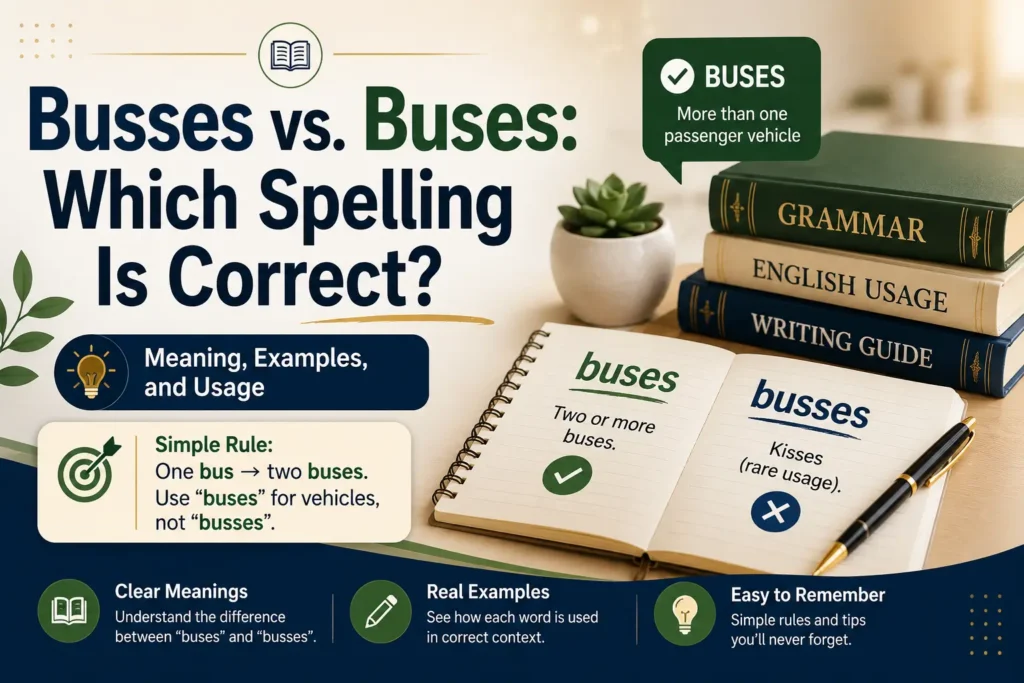
If you’ve ever hesitated between busses vs. buses, the answer is simpler than it may seem. When you mean two or more passenger vehicles, buses is the standard plural of bus in modern American English. For example, “The city added several new buses to its public transportation system.”
The spelling busses can also be found in some dictionaries, but it’s a rare variant when used as the plural of bus. As a result, many readers may see it as a spelling error. The word busses can also relate to the uncommon word buss, meaning a kiss, which creates another layer of confusion.
So, how can you remember the difference? Keep this simple rule in mind: one bus, two buses. If you’re writing about school transportation, public transit, or shuttle vehicles, buses is the clear and natural choice.
Quick Answer: Busses vs. Buses
The simplest rule is:
One bus → two buses
Use buses when you mean more than one passenger vehicle.
Use busses only when you’re referring to the uncommon word buss, which means a kiss, or when busses is used as a verb meaning kisses.
| Word | Meaning | Example |
| bus | One passenger vehicle | The bus is late. |
| buses | More than one passenger vehicle | The buses are late. |
| buss | A kiss; also an uncommon verb meaning to kiss | He gave her a buss. |
| busses | Multiple kisses or “kisses” as a verb | The poem describes several busses. |
Therefore, if you’re asking how to spell the plural of the vehicle bus, the answer is buses, not busses.
What Does “Buses” Mean?
Buses is the standard plural form of the noun bus.
A bus is a large vehicle designed to carry several passengers. Depending on the context, it might be used for public transportation, school transportation, tourism, airport travel, or private group transportation.
When you have more than one bus, you use buses.
For example:
- One bus is waiting outside.
- Two buses are waiting outside.
- The school has 25 buses.
- Several buses arrived at the station.
The word buses is extremely common in everyday American English.
Common Types of Buses
You may see buses used in many different situations, including:
- City buses that provide public transportation
- School buses that transport students
- Shuttle buses that move passengers between locations
- Tour buses used for sightseeing
- Airport buses that transport travelers
- Intercity buses that connect different cities
- Charter buses rented for private groups
Examples of “Buses” in Sentences
The city added several new buses to its public transportation system.
The word buses is correct because the sentence refers to multiple vehicles.
The school buses arrived just before 8 a.m.
Again, buses refers to more than one vehicle.
Three airport buses were waiting outside the terminal.
The plural form is buses, not busses, because the sentence concerns transportation.
Electric buses are becoming more common in urban transportation systems.
Here, buses describes multiple passenger vehicles powered by electricity.
In each example, the rule is the same:
bus → buses
What Does “Busses” Mean?
Busses is a real word, but it doesn’t normally mean multiple buses in modern standard American English.
Instead, busses is connected to the word buss, which means a kiss. The word buss can function as either a noun or a verb, although it is uncommon in contemporary everyday English.
For example, as a noun:
The old poem describes several affectionate busses.
Here, busses means kisses.
As a verb:
He busses her on the cheek.
Here, busses means kisses.
However, most modern readers would find these versions more natural:
The old poem describes several affectionate kisses.
He kisses her on the cheek.
The word buss has a somewhat old-fashioned, literary, or playful quality. Therefore, it may appear in historical writing, literature, or stylized language, but it’s not the normal word most Americans use in everyday conversation.
Busses vs. Buses: The Key Differences
The most important difference is meaning.
Buses relates to transportation.
Busses relates to kissing.
However, there’s an important detail. Busses is not simply an alternative spelling that you should freely use for the plural of bus. The two forms are connected to different words.
| Feature | Buses | Busses |
| Base word | bus | buss |
| Main meaning | Multiple passenger vehicles | Multiple kisses |
| Part of speech | Plural noun | Plural noun or verb |
| Common usage | Very common | Rare |
| Transportation meaning | Yes | Not the standard modern form |
| Kissing meaning | No | Yes |
| Best modern choice | Use for vehicles | Usually use kisses for clarity |
The distinction becomes much easier when you look at the base words:
bus → buses
buss → busses
Because bus and buss are separate words, their plural forms also have different meanings.
Why Is the Plural of “Bus” “Buses” Instead of “Busses”?
The spelling buses follows a common English plural pattern.
Many nouns that end in certain sounds or letters form their plurals by adding -es. This often happens with words ending in s, x, z, ch, or sh.
For example:
| Singular | Plural |
| bus | buses |
| box | boxes |
| class | classes |
| dish | dishes |
| church | churches |
| quiz | quizzes |
So, the plural of bus is:
bus + es = buses
This is the standard spelling used in modern American English.
The confusion comes from the fact that busses also exists as a word. However, that doesn’t make it the standard plural spelling of the transportation noun bus.
The two words simply happen to look similar.
The Important Spelling Pattern
Remember:
One bus, two buses.
The additional -es creates the plural form.
By contrast:
One buss, two busses.
Here, buss is the word associated with kissing.
Therefore, the spelling difference reflects a difference in the base word.
When Should You Use “Buses”?
You should use buses whenever you’re referring to multiple passenger vehicles.
This includes almost every normal transportation context.
Public Transportation
The city’s buses run every 15 minutes during rush hour.
Several buses were delayed because of heavy traffic.
The transit agency plans to add more electric buses.
In these sentences, buses refers to multiple vehicles used for transportation.
School Transportation
The school district operates dozens of buses.
The children lined up beside the buses after the field trip.
Several school buses arrived at the same time.
Again, buses is the correct spelling.
Workplace Transportation
The company provides shuttle buses for employees.
Employees can take the shuttle buses from the parking lot.
The conference organizers arranged buses for attendees.
The same rule applies because these are transportation vehicles.
Travel and Tourism
The tourists boarded the buses for the city tour.
Several tour buses were parked near the museum.
The airport operates shuttle buses between the terminals.
In all these examples, use buses.
When Is “Busses” Correct?
Busses can be correct when it comes from the word buss, meaning kiss.
However, this usage is relatively rare.
There are two main grammatical possibilities.
“Busses” as a Plural Noun
As a noun, buss means a kiss. Therefore, busses can mean multiple kisses.
For example:
The novel describes the lovers’ passionate busses.
This sentence is grammatically possible. However, most modern readers would probably expect:
The novel describes the lovers’ passionate kisses.
The second version is more natural and easier to understand.
“Busses” as a Verb
Buss can also mean to kiss.
In the third-person singular present tense, it becomes busses.
For example:
He busses his daughter on the cheek.
Grammatically, this means:
He kisses his daughter on the cheek.
However, busses is not the usual modern choice.
A contemporary writer would almost always choose:
He kisses his daughter on the cheek.
The word busses may be appropriate in a literary or intentionally old-fashioned style, but kisses is clearer for general readers.
Correct and Incorrect Examples of Buses and Busses
Context is the key to choosing the correct word.
Example: Public Transportation
Correct:
The buses arrived at the station.
Why: The sentence refers to multiple passenger vehicles.
Incorrect for this meaning:
The busses arrived at the station.
Why: The word busses does not represent the standard modern plural of the transportation noun bus.
Example: School Transportation
Correct:
The school district bought five new buses.
Why: Five vehicles are being discussed.
Example: Kissing
Possible but uncommon:
The character gave his mother several affectionate busses.
Meaning: The character gave her several kisses.
More natural:
The character gave his mother several affectionate kisses.
The second sentence is preferable in most modern writing.
Example: Verb Usage
Possible but uncommon:
He busses her goodbye.
More natural:
He kisses her goodbye.
Both communicate the idea of kissing, but kisses is the familiar modern verb.
Common Mistakes With Busses and Buses
The most frequent mistake is using busses when you mean multiple transportation vehicles.
Mistake 1: “The Busses Are Late”
Incorrect:
The busses are late.
Correct:
The buses are late.
If you’re talking about transportation, choose buses.
Mistake 2: “School Busses”
Incorrect:
The school has ten busses.
Correct:
The school has ten buses.
This is a common spelling mistake because busses looks like it could be a normal plural form.
However, the standard plural is buses.
Mistake 3: Assuming “Busses” Is Always Wrong
This mistake goes in the opposite direction.
It’s not accurate to say that busses is always incorrect. The word exists and can be used in connection with buss, meaning a kiss.
For example:
The poem refers to stolen busses.
If the context makes clear that busses means kisses, the spelling can be correct.
Still, kisses would usually be more natural today.
Mistake 4: Choosing Based on Sound
Pronunciation doesn’t make the distinction easy.
The words buses and busses, when used in their respective meanings, can sound alike or very similar. Therefore, you can’t reliably choose the spelling by listening to the word.
Instead, ask yourself:
What does the word mean in this sentence?
If it means passenger vehicles, use buses.
If it means kisses, busses may be appropriate.
Buses vs. Busses in American English
For modern American English, the practical rule is very simple.
Use buses as the plural of bus.
This applies to:
- Public buses
- School buses
- City buses
- Shuttle buses
- Tour buses
- Airport buses
- Charter buses
- Intercity buses
The spelling buses is standard in everyday conversation, school assignments, professional writing, journalism, transportation schedules, and business communication.
By contrast, busses is uncommon. When it means kisses, it may sound literary, old-fashioned, or unusual.
Therefore, most American English writers will rarely need to use busses.
Buses vs. Busses in Formal and Informal Writing
Your choice also depends on the meaning and audience.
Academic Writing
Use buses when writing about transportation.
The study examined how public buses affect urban mobility.
Professional Writing
Use buses in reports, emails, schedules, and workplace announcements.
Additional shuttle buses will be available after the event.
Public Information
Transportation agencies and public organizations should use buses when referring to multiple vehicles.
Extra buses will operate during the holiday weekend.
Creative Writing
The word busses may appear in creative or literary writing when it means kisses.
The characters exchanged playful busses before saying goodbye.
However, even in creative writing, kisses may be the better choice if you want modern, straightforward language.
Is “Busses” Ever Used for More Than One Bus?
You may occasionally encounter busses used as a plural form of bus, particularly in older or variant usage. However, buses is the standard and preferred spelling for contemporary American English.
This distinction is important.
English has many words with historical spelling variations. A form that appears in an older text doesn’t necessarily represent the preferred spelling today.
For modern writing, the safest and clearest rule is:
bus → buses
Therefore, if you’re writing a school assignment, professional report, news article, transportation announcement, or blog post, use buses when you mean multiple vehicles.
How Are “Buses” and “Busses” Pronounced?
Pronunciation can add to the confusion because spelling isn’t the best way to tell these words apart.
Buses, meaning multiple vehicles, is commonly pronounced approximately:
BUH-siz
The final syllable sounds like “iz.”
When busses is used in connection with buss, meaning kisses, it is also generally pronounced with a similar ending sound.
Therefore, pronunciation alone won’t tell you which spelling is correct.
Instead, focus on meaning.
Transportation → buses
Kissing → busses may be possible
Because busses is rare, however, you may want to use kisses when that’s what you mean.
Buses vs. Busses in American and British English
The spelling of the plural transportation noun is generally the same in American and British English:
bus → buses
So, this isn’t a case where Americans use one spelling and British speakers use another.
For example:
American English:
The city added more buses to its public transportation system.
British English:
The city added more buses to its public transportation system.
The spelling remains buses.
While American and British English have many vocabulary differences, the standard plural of the vehicle bus is not one of the major differences.
Bussed vs. Bused: Another Word That Causes Confusion
The confusion doesn’t stop with busses vs. buses. You may also encounter bussed and bused.
These forms are related to the verb bus, but they represent a different grammar question.
For example, bus can mean to transport someone by bus.
The students were bused to another school.
The verb can also refer to clearing dishes or tables in a restaurant.
The server bussed the tables after the customers left.
Different style guides and dictionaries may show variation in how some forms are spelled, especially depending on the meaning of the verb.
The important point is that bussed/bused should not be confused with the plural noun buses.
When you’re simply talking about multiple transportation vehicles, the answer remains:
One bus, two buses.
A Simple Decision Guide: Buses or Busses?
When you’re unsure, use this quick process.
Choose “Buses” If…
Use buses when:
- You’re talking about passenger vehicles.
- You’re referring to public transportation.
- You’re discussing school transportation.
- You’re writing about shuttle services.
- You’re talking about tour vehicles.
- You’re writing a professional or academic document about transportation.
Example:
The city purchased 20 new buses.
Choose “Busses” If…
Use busses only when you’re intentionally using the word buss.
This could mean:
- Multiple kisses
- The uncommon verb form meaning “kisses”
Example:
The poem describes several affectionate busses.
Even then, consider whether kisses would be clearer.
Choose “Kisses” for Modern Clarity
In most everyday situations, kisses is the better word if you’re talking about kissing.
For example:
She gave him two kisses goodbye.
This is clearer and more natural than:
She gave him two busses goodbye.
The first sentence is the obvious choice for contemporary American English.
Quick Reference: Buses vs. Busses
| If you mean… | Use this word | Example |
| One passenger vehicle | bus | The bus is here. |
| Multiple passenger vehicles | buses | The buses are here. |
| One kiss, using a rare literary noun | buss | He gave her a buss. |
| Multiple kisses, using a rare literary noun | busses | The poem mentions several busses. |
| To kiss, using a rare verb | buss | He may buss her cheek. |
| “Kisses” as the verb | busses | He busses her cheek. |
| Modern word for multiple kisses | kisses | They exchanged kisses. |
Memory Tricks for Remembering Busses vs. Buses
A good memory trick can make this distinction easy.
Memory Trick 1: Think About Vehicles
Remember:
Bus → buses
If you can ride it, drive it, or wait for it at a bus stop, it’s probably buses when plural.
One bus. Two buses.
Memory Trick 2: Think About Kisses
Remember:
Buss → kiss
If you’re reading an old poem or literary passage about affection, buss may mean kiss.
Its plural is busses.
Still, remember that kisses is much more common today.
Memory Trick 3: Ask One Question
Whenever you’re uncertain, ask:
Am I talking about vehicles?
If the answer is yes, write buses.
If you’re talking about kisses, busses may be technically correct, but kisses will usually sound more natural.
Related Words and Useful Vocabulary
Understanding related words can make the distinction easier.
Transportation Words
- bus — a passenger vehicle
- buses — more than one bus
- bus stop — a location where passengers wait for buses
- bus route — the path a bus follows
- bus driver — a person who drives a bus
- bus station — a facility where buses arrive and depart
- shuttle bus — a bus that regularly transports people between specific locations
- school bus — a bus used to transport students
Kissing-Related Words
- kiss — touching someone with the lips as an expression of affection
- kisses — more than one kiss or the verb form
- buss — an uncommon or literary word meaning kiss
- busses — an uncommon plural or verb form related to buss
The most useful modern distinction is simple:
Buses are vehicles. Kisses are affectionate gestures.
Conclusion: Busses vs. Buses
The difference between busses vs. buses mainly comes down to meaning and modern usage. If you’re talking about more than one passenger vehicle, buses is the standard spelling in American English. Use it for school buses, city buses, public transportation, shuttle buses, and tour buses.
Although busses appears as a rare variant in some dictionaries, it isn’t the usual choice for modern writing. It can also be connected to buss, an uncommon word meaning a kiss. However, most people today use kiss or kisses instead.
The easiest way to remember the correct spelling is one bus, two buses. When your meaning is transportation, choose buses. This spelling is clear, familiar, and appropriate for everyday, academic, and professional writing.
Frequently Asked Questions About Busses vs. Buses
Q1. Is it “busses” or “buses”?
Buses is the standard spelling for the plural of bus when referring to passenger vehicles. For example, “The buses arrived at the station.”
Q2. What is the correct plural of “bus”?
The standard plural is buses. The simple pattern is one bus, two buses.
Q3. Is “busses” a correct word?
Yes, busses is a legitimate word, but it is uncommon. It may appear as a rare variant plural of bus or as a form related to buss, meaning a kiss.
Q4. Why is “busses” sometimes used instead of “buses”?
Busses has appeared as an alternative plural spelling of bus in English. However, buses has become the overwhelmingly preferred form in modern usage.
Q5. Should I use “buses” in American English?
Yes. Buses is the standard choice in modern American English when you’re referring to multiple vehicles.
Q6. Is “buses” also correct in British English?
Yes. Buses is also the common plural form in British English. Therefore, this spelling generally works in both major varieties of English.
Q7. Is “busses” always wrong?
No. Busses isn’t always wrong because it has legitimate uses. However, if you’re referring to multiple transportation vehicles, buses is the standard spelling you should choose.
Q8. What does “busses” mean besides multiple buses?
Busses can be related to the word buss, which means a kiss. It may therefore refer to multiple kisses or function as a verb meaning “kisses.” This usage is rare today.
Q9. How can I easily remember “buses” vs. “busses”?
Remember this simple rule: one bus, two buses. If you’re talking about vehicles, use buses. If you’re talking about the rare word buss, then busses may be appropriate.
Q10. Which spelling is best for formal writing: “buses” or “busses”?
Use buses when referring to multiple vehicles. It’s the standard and widely recognized spelling for academic, professional, business, and everyday writing.
