
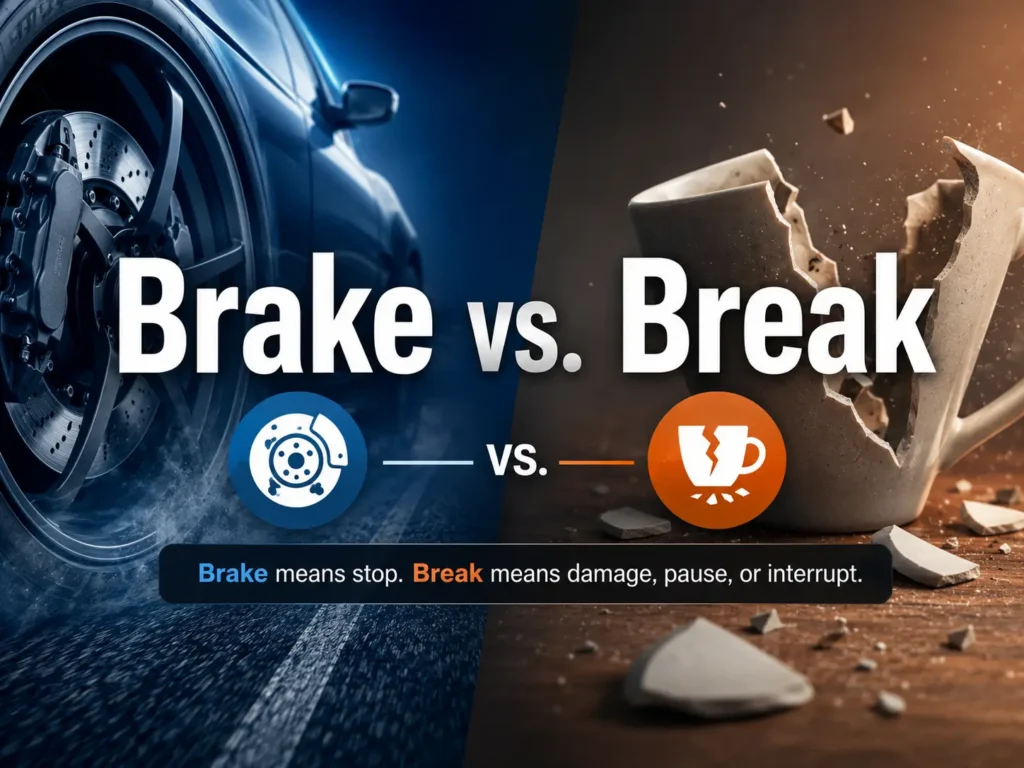
If you’ve ever wondered about brake vs. break, you’re not alone. These two words are easy to confuse because they sound exactly the same, but they have different spellings and meanings. Brake is connected mainly to slowing down or stopping a vehicle or machine, while break has many meanings, including damaging something, interrupting something, separating something, or taking a short rest.
The difference becomes much easier once you connect each word with its main idea. Brake helps you stop. Break can mean damage, separate, interrupt, or rest. In this guide, you’ll learn how to use both words correctly, understand their verb forms, avoid common mistakes, and remember the difference with simple tricks.
Quick Answer: Brake vs. Break
The simplest distinction is:
- Brake = a device used to slow or stop something, or the action of slowing or stopping.
- Break = to damage, separate, interrupt, violate, or stop working; it can also mean a short period of rest.
Compare these examples:
I had to brake suddenly when the car in front of me stopped.
I accidentally broke my phone.
Let’s take a break before we continue.
The car’s brakes need to be replaced.
In the first and fourth sentences, the words relate to stopping a vehicle. Therefore, brake is correct. In the second sentence, the phone was damaged, so broke is correct. In the third, break means a period of rest.
Both words are pronounced /breɪk/, which sounds like “brayk.” Because they are homophones, you must use the meaning and context to choose the correct spelling.
Brake vs. Break at a Glance
| Word | Part of Speech | Main Meaning | Example |
| Brake | Noun | A device that slows or stops movement | The car’s brakes need repair. |
| Brake | Verb | To slow or stop using a brake | The driver had to brake quickly. |
| Break | Verb | To damage or separate something | Don’t break the glass. |
| Break | Verb | To interrupt or violate something | Don’t break the rules. |
| Break | Noun | A short period of rest | Let’s take a break. |
| Break | Verb | To stop functioning | My laptop broke yesterday. |
The easiest rule to remember
Brake = stop or slow down.
Break = damage, separate, interrupt, violate, or rest.
This shortcut won’t cover every possible meaning of break, but it works for most everyday situations.
What Does “Brake” Mean?
The word brake is closely connected with movement and stopping. It can function as both a noun and a verb.
Brake as a Noun
As a noun, a brake is a device or system that slows down or stops a moving vehicle or machine.
You can find brakes on many types of transportation and equipment, including:
- Cars
- Trucks
- Buses
- Bicycles
- Motorcycles
- Trains
- Industrial machines
For example:
The mechanic said my car needs new brakes.
The bicycle’s rear brake isn’t working properly.
Check the brakes before driving down the mountain.
In these examples, brake refers to the physical mechanism that controls movement.
The plural form is brakes when you’re referring to more than one brake or the braking system generally.
Brake as a Verb
As a verb, brake means to slow down or stop something by using a brake.
For example:
The driver braked when the traffic light turned red.
You should brake before entering the sharp curve.
I had to brake suddenly to avoid the cyclist.
The verb can be used in different forms:
| Verb Form | Example |
| Brake | You should brake before the turn. |
| Braked | The driver braked suddenly. |
| Braking | The car is braking now. |
| Braked | The driver has braked several times. |
One common mistake is writing breaked when you mean the past tense of brake.
Correct: The driver braked suddenly.
Incorrect: The driver breaked suddenly.
The past tense of brake is braked.
Common Words and Phrases With Brake
Because brake is associated with vehicles and machinery, it often appears in transportation-related expressions.
Brake pedal
A brake pedal is the pedal a driver presses to slow or stop a vehicle.
Press the brake pedal gently.
Brake pads
Brake pads are components of a vehicle’s braking system that help create the friction needed to slow the vehicle.
The mechanic recommended replacing the worn brake pads.
Brake lights
Brake lights are red lights that signal when a vehicle is slowing down or stopping.
One of my brake lights isn’t working.
Emergency brake
An emergency brake, also called a parking brake in many contexts, is used to keep a parked vehicle from moving. Depending on the vehicle, it may be operated with a lever, pedal, or electronic control.
Make sure the emergency brake is engaged before parking on the hill.
Hit the brakes
Hit the brakes means to apply the brakes quickly.
I had to hit the brakes when a deer crossed the road.
Slam on the brakes
This means to brake very suddenly and forcefully.
The driver slammed on the brakes to avoid hitting the truck.
Put the brakes on something
This is a figurative expression meaning to slow down or stop an activity, plan, or process.
The company put the brakes on the expansion plan.
Here, no actual vehicle is involved. The phrase simply means that progress was slowed or stopped.
What Does “Break” Mean?
Unlike brake, which has a fairly focused meaning, break is a very versatile English word. It can be a noun or a verb and appears in many everyday expressions.
Its meaning depends heavily on context.
Break as a Verb: To Damage Something
One common meaning of break is to damage something or cause it to separate into pieces.
Be careful not to break the glass.
I accidentally broke my phone.
The child broke the toy.
She broke her arm while playing soccer.
The verb break is irregular, so its forms don’t follow the regular pattern of adding -ed.
| Form | Word | Example |
| Base form | break | Don’t break the plate. |
| Past tense | broke | I broke the plate. |
| Past participle | broken | The plate is broken. |
| Present participle | breaking | He is breaking the old box. |
Therefore, you should never write:
Incorrect: I breaked my phone.
Instead, write:
Correct: I broke my phone.
You can also say:
My phone is broken.
The distinction between broke and broken is important because they serve different grammatical roles.
Break as a Verb: To Stop Working
Break can also mean that something stops functioning properly.
My computer broke yesterday.
The printer keeps breaking.
The washing machine broke down this morning.
In these examples, the object doesn’t necessarily have to be physically shattered. Instead, it no longer works as it should.
The phrase break down is especially common when talking about machines, vehicles, or systems that stop functioning.
My car broke down on the highway.
However, brake and break down aren’t interchangeable.
The car’s brakes failed.
This refers to the stopping system.
The car broke down.
This means the vehicle itself stopped functioning.
Break as a Verb: To Separate or Divide
Break can describe dividing something into smaller pieces or parts.
Break the cookie in half.
She broke the chocolate into small pieces.
Let’s break the project into smaller tasks.
This meaning can be physical or abstract. You can break an object into pieces, but you can also break a large task into manageable sections.
Break as a Verb: To Interrupt
The word break can also mean to interrupt something that is happening.
The loud noise broke the silence.
The phone call broke my concentration.
The announcement broke the routine of the day.
In these sentences, nothing is physically damaged. Instead, something is interrupted or brought to an end.
Break as a Verb: To Violate a Rule, Law, or Promise
English commonly uses break when someone fails to follow a rule, law, agreement, or promise.
He broke the law.
Don’t break the rules.
She broke her promise.
They broke the agreement.
Again, the word is being used figuratively. A rule or promise isn’t a physical object that can be shattered. Instead, break means to violate or fail to honor it.
Break as a Noun: A Period of Rest
One of the most common noun uses of break is a short period when you stop working or doing an activity.
I need a break.
Let’s take a break.
We have a 15-minute break between classes.
She went outside during her lunch break.
This meaning appears frequently in American English in workplaces, schools, and everyday conversation.
Common expressions include:
- Coffee break
- Lunch break
- Work break
- Study break
- Commercial break
- Spring break
Example in the workplace
I’ll finish the report after my lunch break.
Example in school
We have a short break between classes.
Example at home
I’ve been cleaning for three hours. I need a break.
In all these examples, break means a pause or period of rest.
Brake vs. Break: The Key Differences
The best way to distinguish brake vs. break is to focus on what the word is doing in the sentence.
Use “Brake” When You’re Talking About Stopping Movement
Choose brake when the context involves:
- Slowing a vehicle
- Stopping a vehicle
- A vehicle’s braking system
- A bicycle’s stopping mechanism
- A machine’s stopping mechanism
- Controlling speed
Examples:
The driver had to brake suddenly.
My car needs new brakes.
The cyclist applied the brakes.
The train began braking before the station.
Use “Break” When You’re Talking About Damage
Choose break when something is damaged or shattered.
Don’t break the glass.
I broke my phone.
The window is broken.
Use “Break” When You’re Talking About Rest
Let’s take a break.
I need a lunch break.
The students are on break.
Use “Break” When You’re Talking About Interruption
The noise broke the silence.
Don’t break my concentration.
Use “Break” When You’re Talking About Rules or Promises
Don’t break the rules.
He broke his promise.
The Meaning Test
When you’re unsure, ask yourself:
Is this about slowing or stopping movement?
If yes, use brake.
Is it about damage, rest, interruption, separation, or violating something?
If yes, use break.
Brake vs. Break in Everyday American English
The difference becomes easier when you see how these words work in familiar situations.
Driving
I had to brake when the car stopped suddenly.
Here, brake is a verb because the driver is slowing the vehicle.
My brakes are making a strange noise.
Here, brakes is a noun referring to the vehicle’s stopping system.
My car broke down on the way to work.
Here, broke down means the vehicle stopped functioning.
These three sentences demonstrate an important distinction:
- Brake = slow or stop the vehicle.
- Brakes = the stopping mechanism.
- Broke down = the vehicle stopped working.
School
We have a 20-minute break after the second class.
Here, break means a period of rest.
The teacher asked us to break the assignment into three parts.
Here, break means divide something into smaller sections.
Students shouldn’t break school rules.
Here, break means violate.
Work
I’ll call you after my lunch break.
Let’s take a short break before the next meeting.
The manager decided to put the brakes on the proposal.
The first two examples use break literally. The third uses brakes figuratively to mean slowing or stopping progress.
Texting and Casual Conversation
You’ll often see break in casual phrases such as:
- “I need a break.”
- “Give me a break!”
- “Don’t break it.”
- “My phone broke.”
- “Let’s take a break.”
By contrast, brake usually appears in conversations about driving or machinery:
- “Hit the brakes!”
- “The brakes are bad.”
- “You need to brake earlier.”
Brake vs. Break: Verb Forms You Need to Know
Understanding the verb forms is especially helpful because brake and break have very different past-tense forms.
Forms of Brake
| Verb Form | Word | Example |
| Base | brake | You need to brake now. |
| Past | braked | The driver braked suddenly. |
| Present participle | braking | The car is braking. |
| Past participle | braked | The driver has braked several times. |
The important point is that brake is a regular verb.
Its past tense is braked.
Forms of Break
| Verb Form | Word | Example |
| Base | break | Don’t break the glass. |
| Past | broke | She broke the glass. |
| Present participle | breaking | He is breaking the chocolate. |
| Past participle | broken | The glass is broken. |
Break is an irregular verb.
Therefore:
Brake → braked
Break → broke → broken
This is one of the most important differences to remember.
Breaking vs. Braking: What’s the Difference?
The words breaking and braking are especially easy to confuse because they sound nearly identical.
Breaking
Breaking is the present participle of break.
It can mean damaging, separating, interrupting, or violating something.
She is breaking the chocolate into pieces.
The child is breaking the toy.
They are breaking the rules.
Braking
Braking is the present participle of brake.
It means slowing or stopping a moving vehicle or machine.
The driver is braking for the red light.
The car is braking suddenly.
The train is braking as it approaches the station.
Compare the two
The driver is braking the car.
The driver is slowing the car.
The driver is breaking the rule.
The driver is violating a rule.
The extra -ing word doesn’t change the basic distinction. Braking is related to stopping movement, while breaking has the many meanings associated with break.
Brake, Brakes, Break, and Breaks: What’s the Difference?
Adding -s can create another layer of confusion.
Brake
A singular noun or verb.
The car has a faulty brake.
You should brake before the turn.
Brakes
The plural of brake, usually referring to multiple braking components or the braking system.
The car’s brakes need repair.
Break
A noun meaning a pause or a verb meaning to damage, separate, interrupt, and more.
Let’s take a break.
Don’t break the glass.
Breaks
The plural noun meaning periods of rest or the third-person singular form of break.
We get two breaks during the workday.
He often breaks his pencils.
Side-by-Side Comparison
| Word | Meaning | Example |
| Brake | A stopping mechanism or the action of stopping | Brake before the corner. |
| Brakes | Stopping mechanisms | The car’s brakes need repair. |
| Break | A pause, damage, separation, interruption, etc. | Let’s take a break. |
| Breaks | Plural of break or third-person verb form | She takes frequent breaks. |
Common Brake vs. Break Mistakes
Because brake and break are homophones, these mistakes often happen in writing rather than speech.
Mistake: “Take a Brake”
Incorrect: I need to take a brake.
Correct: I need to take a break.
You’re talking about resting, so break is correct.
Mistake: “Hit the Breaks”
Incorrect: Hit the breaks!
Correct: Hit the brakes!
You’re telling someone to stop or slow a vehicle.
Mistake: “Don’t Brake the Glass”
Incorrect: Don’t brake the glass.
Correct: Don’t break the glass.
The glass could become damaged, so break is correct.
Mistake: “I Breaked My Phone”
Incorrect: I breaked my phone.
Correct: I broke my phone.
The past tense of break is broke.
Mistake: “The Car Is Breaking”
Potentially confusing: The car is breaking.
If you mean the car is stopping, the correct word is braking.
The car is braking.
If you mean the car is becoming damaged or failing, breaking may be appropriate, although breaking down is often more natural for a vehicle.
The car is breaking down.
Context matters because breaking and braking describe completely different actions.
Why Spell-Check May Not Catch Brake vs. Break Mistakes
A useful writing tip is to remember that spell-check tools may not identify this error.
For example:
I need to take a brake.
The word brake is spelled correctly. However, it doesn’t fit the meaning of the sentence.
Similarly:
Hit the breaks!
The word breaks is also spelled correctly. The problem is that the sentence requires brakes.
This is why proofreading requires more than checking spelling. You also need to consider meaning, context, and word choice.
Common Expressions With Brake and Break
Expressions With Brake
Hit the brakes means to apply the brakes quickly.
The driver hit the brakes when the pedestrian stepped into the road.
Slam on the brakes means to brake suddenly and forcefully.
She slammed on the brakes to avoid the collision.
Put the brakes on something means to slow down or stop a plan or activity.
The company put the brakes on the expansion.
Expressions With Break
Take a break means to pause and rest.
Let’s take a break after this meeting.
Break the ice means to make people feel more comfortable in a new or awkward social situation.
The speaker told a joke to break the ice.
Break the news means to tell someone important information, often information that may be difficult to hear.
She had to break the news to her family.
Break a habit means to stop a repeated behavior.
I’m trying to break the habit of checking my phone constantly.
Break a promise means to fail to do what you promised.
He broke his promise to call.
Break the rules means to violate rules.
Employees who break the rules may face disciplinary action.
Give me a break is an informal expression that can show disbelief, frustration, or a request for someone to stop criticizing you.
You expect me to finish all of that in ten minutes? Give me a break!
How to Remember the Difference Between Brake and Break
The easiest memory trick is to connect brake with stop.
Brake = Stop
Think of a car.
A car uses brakes to slow down or stop.
The driver pressed the brake.
If the sentence involves stopping a moving vehicle, brake is probably correct.
Break = Damage or Pause
Think of a glass or a rest.
You can break a glass.
You can take a break.
You can also break a rule or break a promise.
The one-question test
Ask:
“Am I talking about slowing or stopping movement?”
If yes, choose brake.
If not, ask:
“Am I talking about damage, separation, interruption, rules, promises, or rest?”
If yes, choose break.
This quick test can help you make the right choice in most everyday situations.
Practice: Choose Brake or Break
Fill in each blank with the correct word or form.
- I had to ___ when the traffic light changed.
- Let’s take a short ___.
- Don’t ___ that glass.
- The mechanic said my ___ need repair.
- I accidentally ___ my phone.
- Please don’t ___ the rules.
- The driver slammed on the ___.
- We get two ___ during the workday.
- The train is ___ as it approaches the station.
- The child is ___ the cookie into pieces.
Answer Key
- brake — The driver is slowing or stopping.
- break — A break is a period of rest.
- break — The glass could be damaged.
- brakes — These are the vehicle’s stopping mechanisms.
- broke — This is the past tense of break.
- break — The phrase means to violate rules.
- brakes — The driver is using the vehicle’s stopping system.
- breaks — These are periods of rest.
- braking — The train is slowing down.
- breaking — The child is separating the cookie into pieces.
Synonyms and Related Words
Although brake and break don’t have the same meaning, knowing related words can make their uses clearer.
Words Related to Brake
Depending on the context, related words include:
- Slow
- Stop
- Decelerate
- Halt
- Restrain
- Control
For example:
The driver braked before the intersection.
You could describe the action more generally as slowing or decelerating, but braking specifically refers to using a braking system.
Words Related to Break
Depending on the meaning, related words include:
- Damage
- Shatter
- Crack
- Split
- Divide
- Interrupt
- Pause
- Rest
- Violate
- Disrupt
The correct synonym depends on the context.
For example, break can mean shatter when talking about glass:
She broke the glass.
It can mean pause when talking about work:
She took a break.
It can mean violate when talking about rules:
He broke the rules.
Because break has so many meanings, context is always important.
Conclusion: Brake vs. Break
Understanding brake vs. break becomes easier when you focus on their meanings. Use brake when talking about slowing down or stopping a vehicle, bicycle, or machine. Use break when you mean to damage, separate, interrupt, or take a short rest. Remember that both words sound the same, but their spellings and meanings are different. The verb forms are also important: brake becomes braked, while break changes to broke in the past tense and broken as a past participle. With these simple rules in mind, you can choose the correct word confidently in everyday conversations, schoolwork, emails, and professional writing.
Frequently Asked Questions About Brake vs. Break
Q1. What is the main difference between brake and break?
Brake relates to slowing or stopping movement, especially with a vehicle or machine. Break can mean to damage, separate, interrupt, violate, or take a short rest.
Q2. Are brake and break homophones?
Yes. Brake and break are homophones because they have the same pronunciation but different spellings and meanings.
Q3. Is it “take a brake” or “take a break”?
The correct phrase is take a break. Here, break means a short period of rest from work, school, or another activity.
Q4. Is it “hit the brake” or “hit the break”?
When talking about stopping a vehicle, use brake. The common expression is hit the brakes, meaning to apply the vehicle’s braking system.
Q5. What is the past tense of brake?
The past tense of brake is braked. For example: The driver braked suddenly to avoid the accident.
Q6. What is the past tense of break?
The past tense of break is broke. For example: She broke her phone yesterday.
Q7. What is the past participle of break?
The past participle of break is broken. For example: The window has been broken.
Q8. What is the difference between braking and breaking?
Braking means slowing or stopping a vehicle or machine. Breaking is related to the verb break and can mean damaging, separating, interrupting, or violating something.
Q9. How can I remember the difference between brake and break?
Think of brake = stop. A car uses brakes to slow down or stop. Think of break for damage, rest, or interruption, such as break a glass or take a break.
Q10. Why are brake and break easy to confuse?
They’re easy to confuse because they sound exactly the same. However, their meanings are different. Brake is mainly connected with stopping or slowing, while break has several meanings related to damage, separation, interruption, and rest.
