
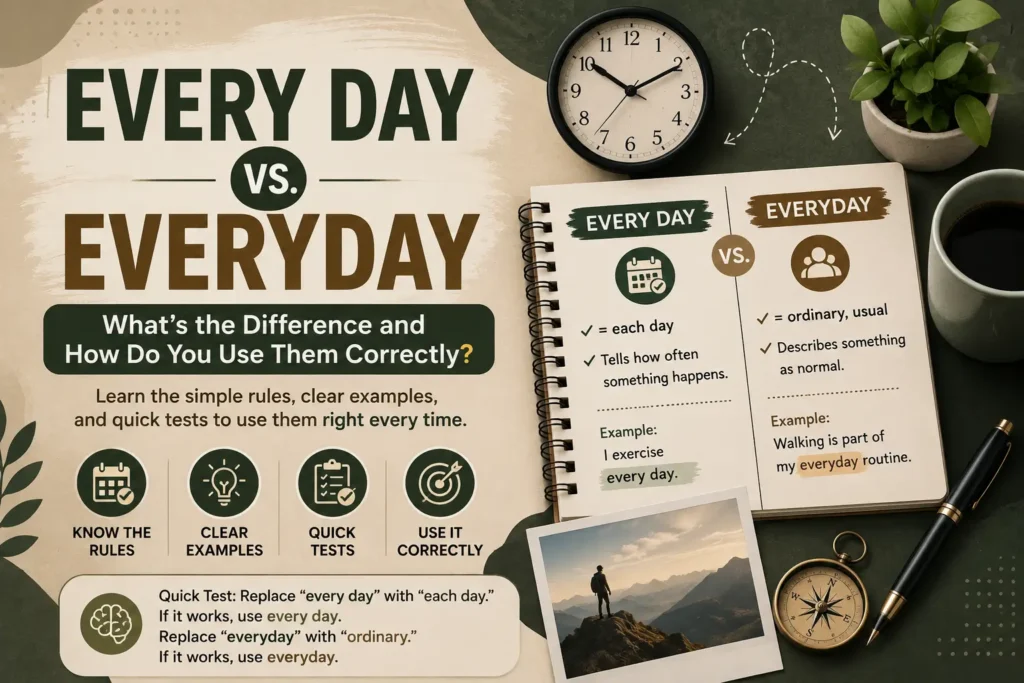
Every day vs everyday is a common English usage question because the two forms look and sound almost identical. However, they have different meanings and grammatical roles. Every day means each day and tells you how often something happens, as in “I practice English every day.” Everyday is an adjective that means ordinary, usual, or routine, as in “English is part of my everyday life.” The difference is small, but using the wrong form can make your sentence incorrect or change its meaning.
The good news is that you don’t need to memorize a complicated grammar rule. A simple test can help: if you can replace the phrase with “each day,” use every day. If you mean “ordinary” or “usual,” use everyday. Once you understand this difference, you’ll be able to use both forms correctly in school, work, emails, conversations, and everyday writing.
Quick Answer: Every Day vs. Everyday
The fastest way to understand every day vs. everyday is to look at what you mean.
- Every day = each day or on each day
- Everyday = ordinary, usual, common, or routine
Use every day when you’re talking about how often something happens.
I check my email every day.
Use everyday when you’re describing something as normal or routine.
Checking email is an everyday part of my job.
A helpful test is to replace every day with each day. If the sentence still makes sense, use every day. If you can replace everyday with ordinary or usual, use everyday.
| Expression | Meaning | Grammatical Role | Example |
| every day | Each day | Adverbial phrase | I exercise every day. |
| everyday | Ordinary or usual | Adjective | Exercise is an everyday activity. |
The key difference: every day describes frequency, while everyday describes a quality or type of thing.
What Does “Every Day” Mean?
Every day is a two-word phrase that means each day. It tells the reader or listener how often something happens.
For example:
I walk my dog every day.
This means I walk my dog each day.
The phrase every day usually works as an adverbial phrase. In simple terms, it gives information about an action, especially its frequency.
Here are more examples:
- She studies English every day.
- We have a team meeting every day.
- He calls his parents every day.
- I check the news every day.
- They practice soccer every day.
- My daughter reads for 20 minutes every day.
In each sentence, every day answers a question like “How often?”
How often do you exercise?
I exercise every day.
How often does she study?
She studies every day.
The “Each Day” Test
The simplest way to identify every day is to substitute each day.
I practice pronunciation every day.
Replace the phrase:
I practice pronunciation each day.
The meaning is almost the same. Therefore, every day is correct.
Try another example:
We check the schedule every day.
Replacement:
We check the schedule each day.
Again, the sentence works.
Therefore, if you mean each day, write the expression as two separate words: every day.
What Does “Everyday” Mean?
Everyday is one word and functions as an adjective. It describes something that is ordinary, normal, usual, common, or part of regular life.
For example:
These are my everyday shoes.
The word everyday describes the shoes. It suggests that they’re the shoes you normally wear rather than special shoes for formal events.
Here are some other examples:
- This is my everyday backpack.
- Cooking is an everyday activity for many families.
- We use everyday language in casual conversations.
- These problems are part of everyday life.
- The product is designed for everyday use.
- She prefers simple clothes for everyday wear.
Notice that everyday usually describes a noun.
- everyday clothes
- everyday life
- everyday activities
- everyday problems
- everyday language
- everyday use
- everyday experiences
In these examples, everyday doesn’t mean that something necessarily happens seven days a week. Instead, it means that something is normal, regular, or ordinary.
For example:
These are my everyday shoes.
The speaker may not wear them literally every day. They could wear them five days a week or whenever they need comfortable shoes. The point is that they’re used for regular, ordinary occasions.
Every Day vs. Everyday: The Main Difference
The biggest difference between these expressions is their grammatical function.
Every day tells you when or how often something happens.
Everyday describes what something is like.
Compare these two sentences:
I wear these shoes every day.
Here, every day tells us how often I wear the shoes.
Now look at this sentence:
These are my everyday shoes.
Here, everyday describes the shoes as regular or ordinary shoes.
The expressions are closely related in meaning, but they’re not interchangeable.
| Feature | Every Day | Everyday |
| Spelling | Two words | One word |
| Meaning | Each day | Ordinary or usual |
| Main function | Shows frequency | Describes a noun |
| Part of speech | Adverbial phrase | Adjective |
| Common question | How often? | What kind? |
| Replacement | Each day | Ordinary, usual, regular |
| Example | I walk every day. | These are my everyday shoes. |
A Simple Side-by-Side Example
I exercise every day.
This means I exercise each day.
Exercise is part of my everyday routine.
This means exercise is part of my normal routine.
Both sentences can describe the same person’s life. However, the two expressions perform different grammatical jobs.
You can even use both in one sentence:
I use my everyday notebook every day.
The first everyday describes the notebook. The second every day tells us how often the notebook is used.
How “Every Day” Works in a Sentence
Because every day expresses frequency, it commonly appears with verbs.
For example:
I study every day.
She works from home every day.
They practice after school every day.
You can also place every day at the beginning of a sentence for emphasis or a smoother transition.
Every day, I take the train to work.
Every day, she spends time reading.
Both positions are grammatically correct.
The placement may change the rhythm of the sentence, but the basic meaning remains the same.
Examples From Everyday Routines
- I drink coffee every day.
- He takes his dog for a walk every day.
- We eat dinner together every day.
- She checks her calendar every day.
- I practice speaking English every day.
In all of these examples, the phrase means each day.
How “Everyday” Modifies a Noun
Because everyday is an adjective, it typically modifies a noun.
For example:
Everyday clothes are usually comfortable and practical.
The adjective everyday describes clothes.
Consider these common expressions:
Everyday Life
Smartphones are part of everyday life for many people.
Here, everyday means normal or ordinary life.
Everyday Activities
Cooking, cleaning, and commuting are common everyday activities.
These are routine activities.
Everyday Language
The teacher explained the concept using everyday language.
This means simple, ordinary language rather than highly technical terms.
Everyday Use
This laptop is designed for everyday use.
The laptop is intended for regular activities rather than specialized professional tasks.
Everyday Problems
Traffic and scheduling are everyday problems for many commuters.
The problems are common and ordinary.
How to Choose Between Every Day and Everyday
When you’re unsure, don’t focus only on how the word sounds. Instead, focus on the meaning and grammatical role.
Use “Every Day” When You Mean “Each Day”
Ask yourself:
Does this mean each day?
If yes, use every day.
I read the newspaper every day.
She calls her sister every day.
We practice for the presentation every day.
You could replace each example with each day without changing the basic meaning.
Use “Everyday” When You Mean “Ordinary” or “Usual”
Ask yourself:
Does this mean ordinary, usual, or routine?
If yes, use everyday.
These are my everyday clothes.
This is an everyday problem.
Walking is an everyday activity for him.
The word describes a noun rather than telling you how often an action happens.
Common Mistakes With Every Day and Everyday
Because these expressions look and sound similar, they’re easy to mix up. Fortunately, most mistakes are easy to correct once you understand the difference.
Mistake: “I Use It Everyday”
Incorrect:
I use this app everyday.
Correct:
I use this app every day.
The intended meaning is each day, so the phrase needs two words.
Mistake: “Every Day Clothes”
Incorrect:
I need some new every day clothes.
Correct:
I need some new everyday clothes.
Here, the word describes the type of clothes. The meaning is ordinary or regular clothes, so everyday is the correct adjective.
Mistake: Assuming “Everyday” Means “Every Day”
This is one of the most common misunderstandings.
Consider:
Walking is an everyday activity.
This doesn’t necessarily mean that everyone walks each day. Instead, it describes walking as a normal or routine activity.
If you want to emphasize frequency, write:
I walk every day.
The first sentence describes the activity. The second tells us how often someone performs it.
Mistake: Choosing Based on Sound
In spoken American English, every day and everyday can sound very similar.
Therefore, pronunciation isn’t a reliable way to choose the correct spelling.
Instead, ask:
- Do I mean each day?
- Do I mean ordinary or usual?
- Am I describing how often something happens?
- Am I describing a noun?
The answers will usually make the correct choice clear.
Every Day vs. Everyday vs. Daily
The word daily is another term that can cause confusion.
Daily generally means happening each day or related to each day. It can function as an adjective or an adverb.
Compare the following:
| Expression | Meaning | Example |
| every day | Each day | I walk every day. |
| daily | Each day | I take a daily walk. |
| everyday | Ordinary or usual | Walking is an everyday activity. |
Consider these examples:
I exercise every day.
I have a daily exercise routine.
Exercise is part of my everyday life.
The first focuses on frequency. The second describes something that occurs each day. The third describes exercise as part of normal life.
When “Daily” Is Better Than “Every Day”
Daily is especially common in schedules, instructions, labels, reports, and formal contexts.
For example:
- Take one tablet daily.
- Submit your daily report by 5 p.m.
- The manager reviews the numbers daily.
- We publish a daily newsletter.
In casual conversation, however, every day is often more natural:
I check the numbers every day.
Both forms can be correct when the intended meaning is each day.
Every Day vs. Each Day
Every day and each day often have nearly the same meaning.
I practice guitar every day.
I practice guitar each day.
Both mean that the practice happens on each day.
However, each day can sometimes put more emphasis on individual days.
For example:
Each day brings a new challenge.
This sentence treats the days as individual units, with each one bringing something new.
By contrast:
I practice guitar every day.
This sounds more like a statement about a regular habit.
In ordinary American English, every day is very common when discussing routines and habits.
Common Everyday Expressions
The word everyday appears in many natural English expressions.
Everyday Life
Everyday life means normal or ordinary life.
Technology has changed everyday life.
Everyday Activities
These are routine activities that people commonly do.
Shopping and cooking are part of many people’s everyday activities.
Everyday Language
This means ordinary language that people use in normal conversation.
The professor explained the difficult idea in everyday language.
Everyday Use
This describes something intended for normal, regular use.
This backpack is durable enough for everyday use.
Everyday Clothes
These are clothes worn for normal occasions rather than formal or special events.
I need comfortable everyday clothes for work and errands.
Everyday Items
These are ordinary objects used regularly.
A phone, wallet, and keys are common everyday items.
Real-Life Examples of Every Day vs. Everyday
Understanding the difference is easier when you see it in familiar situations.
At School
I review my notes every day.
This tells us how often the student reviews notes.
Reviewing notes is an everyday part of my study routine.
This describes reviewing notes as a normal part of the routine.
At Work
I check my work email every day.
The phrase shows frequency.
Answering emails is an everyday responsibility in many office jobs.
The adjective describes a normal responsibility.
In Texting
I don’t call my friends every day.
This means I don’t call them each day.
That’s an everyday problem for busy people.
This means the problem is common or routine.
On Social Media
She posts photos every day.
This tells us how often she posts.
Her account focuses on everyday experiences.
This means her content focuses on ordinary life.
At Home
We clean the kitchen every day.
This describes frequency.
Cleaning the kitchen is an everyday chore.
This describes the chore as a routine household task.
A Practical Decision Guide
When you’re writing and hesitate between the two forms, use this quick process.
Step One: Ask What You Mean
If you mean each day, choose:
every day
If you mean ordinary or usual, choose:
everyday
Step Two: Try a Replacement
Replace every day with each day.
I exercise every day.
I exercise each day.
If the meaning remains clear, use every day.
For everyday, try ordinary or usual.
These are my everyday shoes.
These are my usual shoes.
The meaning is similar, so everyday works.
Step Three: Check the Grammatical Job
If the expression tells you how often an action happens, you probably need every day.
If it describes a noun as ordinary or routine, you probably need everyday.
This method is more reliable than memorizing long lists of rules.
Memory Tricks for Remembering the Difference
Here are a few simple ways to remember every day vs. everyday.
The “Each Day” Trick
Every day has a space because it means each day.
every day = each day
The “Ordinary” Trick
Everyday is one word when it means ordinary or usual.
everyday = ordinary
The Question Trick
Ask:
How often?
Answer:
Every day.
Ask:
What kind?
Answer:
Everyday.
For example:
How often do you exercise?
I exercise every day.
What kind of shoes are these?
They’re my everyday shoes.
The Best Example to Remember
I use my everyday notebook every day.
The first word describes the notebook. The second phrase tells you how often you use it.
Synonyms and Related Words
Understanding related words can help clarify the meaning of each expression.
Words Related to “Every Day”
When every day means each day, related expressions include:
- each day
- daily
- day after day
- on a daily basis
- every single day
However, these aren’t always perfect substitutes in every sentence. For example, every single day adds emphasis, while daily may sound more formal or concise.
Words Related to “Everyday”
When everyday means ordinary or routine, related words include:
- ordinary
- usual
- normal
- routine
- regular
- common
- typical
- familiar
For example:
These are my everyday shoes.
You could say:
These are my regular shoes.
The exact nuance may vary, but the general idea is similar.
Quick Practice: Choose Every Day or Everyday
Test your understanding with these examples.
- I check my calendar ______.
- These are my ______ shoes.
- She practices piano ______.
- Traffic is an ______ problem.
- We use this computer for ______ tasks.
- He calls his parents ______.
- Cooking is part of her ______ routine.
- I read for 30 minutes ______.
- This backpack is designed for ______ use.
- They review their goals ______.
Answers
- every day — It means each day.
- everyday — It describes the shoes as regular or usual.
- every day — It tells us how often she practices.
- everyday — It describes the problem as common or ordinary.
- everyday — It describes routine tasks.
- every day — It means each day.
- everyday — It describes a normal routine.
- every day — It describes frequency.
- everyday — It means regular or normal use.
- every day — It means each day.
The key is to focus on meaning, not just the appearance of the word.
Conclusion: Every Day vs. Everyday
Understanding every day vs. everyday becomes much easier when you focus on the meaning and grammatical role of each form. Use every day when you mean each day or want to show how often something happens. For example, “I read every day” means I read each day. On the other hand, use everyday as an adjective when you mean ordinary, usual, common, or routine, as in “Reading is part of my everyday life.”
When you’re unsure, try the simple replacement test. If you can replace the words with “each day,” choose every day. If you can replace them with “ordinary” or “usual,” choose everyday. Remembering this small difference will help you avoid a common English mistake and make your writing clearer and more accurate.
Frequently Asked Questions About Every Day vs. Everyday
Q:1 What is the main difference between every day and everyday?
Every day means each day and describes how often something happens. Everyday is an adjective that means ordinary, usual, or routine and describes a noun.
Q:2 Is “everyday” one word or two?
Everyday is one word when it means ordinary, usual, or routine. For example, “These are my everyday shoes.” When you mean each day, use the two-word phrase every day.
Q:3 Is “I use it everyday” correct?
No, not if you mean that you use something each day. The correct sentence is:
I use it every day.
Q:4 Is “everyday life” correct?
Yes. Everyday life is the correct expression because everyday describes the noun life. It means normal or ordinary life.
Q:5 How can I quickly remember every day vs. everyday?
Use the “each day” test. If you can replace the phrase with each day, use every day. If you mean ordinary or usual, use everyday.
Q:6 Is everyday an adjective?
Yes. Everyday is an adjective. It describes a noun and usually means ordinary, normal, common, usual, or routine.
Q:7 Is every day an adverb?
Every day is a two-word phrase that commonly functions as an adverbial phrase. It tells you how often an action happens.
She exercises every day.
Q:8 Are every day and daily the same?
They can have a similar meaning when they describe something that happens each day. However, daily can be an adjective or adverb, while everyday usually means ordinary or routine.
I exercise every day.
I have a daily exercise routine.
Exercise is part of my everyday life.
Q:9 Which is correct: everyday clothes or every day clothes?
Everyday clothes is correct when you mean ordinary or regular clothes.
I wear comfortable everyday clothes.
If you mean that you wear the clothes each day, you could say:
I wear these clothes every day.
Q:10 Can every day and everyday be used in the same sentence?
Yes. For example:
I use my everyday backpack every day.
The first everyday describes the backpack as a regular or usual backpack. The second every day means each day and tells us how often you use it.
