
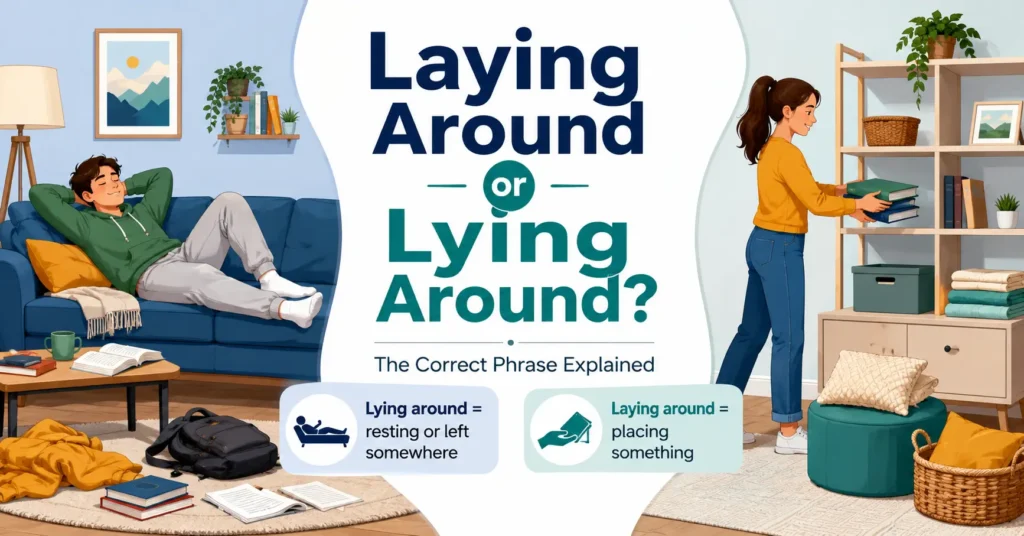
Laying around or lying around can confuse you because the phrases look alike, but one means resting and the other means placing an object in English.
In practice, lying around means a person or thing is resting, inactive, or sitting somewhere without an object. Laying around comes from lay, so it needs an object being placed, like books, tools, or papers.
A simple check helps: ask, “Is someone placing something?” If yes, use laying. If no, use lying. This rule prevents common mistakes, grammatical mix-ups, and an unclear sentence in texts, emails, captions, and professional documents. As a teacher, I’ve seen this one test build real confidence for learners, writers, and editors. When the idea is rest, inaction, or clutter, choose lying around. When the idea is action, placement, and a clear object, choose laying. It saves writing time too.
Quick Answer: Laying Around or Lying Around?
The correct phrase is usually lying around.
Use lying around when something or someone is resting, sitting, scattered, unused, or left somewhere.
Use laying around only when someone is placing objects around a space.
| Phrase | Usually Correct? | Meaning | Example |
| Lying around | Yes | Resting, sitting, scattered, or left somewhere | The toys are lying around the living room. |
| Laying around | Sometimes | Placing things around an area | She is laying towels around the pool. |
Here is the simplest rule:
Lie means rest or remain. Lay means place or put.
That one sentence solves most of the confusion.
Read this also: Brazil or Brasil: Correct Spelling, Meaning, Difference, and How to Use Each One
What Does “Lying Around” Mean?
Lying around means that someone or something is resting, sitting, scattered, idle, unused, or left in a place.
It can describe people, animals, objects, money, tools, clothes, papers, food containers, or anything that is simply “there” without being actively placed at that moment.
Lying around for people
When you use lying around for a person, it usually means that person is resting, relaxing, or being inactive.
Examples:
- He spent Sunday lying around on the couch.
- I don’t want to spend the whole weekend lying around.
- She was lying around after a long day at work.
- They were lying around by the pool after lunch.
This phrase can sound casual. Depending on the context, it may feel relaxed or slightly negative.
For example, “I was lying around all afternoon” sounds harmless. However, “He’s always lying around instead of helping” sounds critical.
The words stay the same, but the tone changes.
Lying around for animals
Animals can also be lying around when they are resting or staying in one place.
Examples:
- The dog is lying around in the sun.
- The cat has been lying around on my laptop again.
- The puppies were lying around after playing outside.
This use is natural because animals rest, stretch, nap, and stay in place. They are not placing anything. They are simply resting.
Lying around for objects
Objects can be lying around too. In this case, the phrase means the items are sitting somewhere, scattered, unused, or left out.
Examples:
- There are clothes lying around your room.
- Don’t leave sharp tools lying around.
- Old receipts were lying around in the drawer.
- I found some coins lying around under the sofa.
This is one of the most common uses of lying around. It often describes clutter.
If your desk looks like a paper tornado hit it, papers are probably lying around everywhere.
What Does “Laying Around” Mean?
Laying around comes from the verb lay, which means to put or place something somewhere.
That means laying around is only correct when someone is actively placing objects around an area.
The key word is object.
You don’t just “lay.” You lay something.
Examples:
- She is laying flowers around the memorial.
- The workers are laying cables around the stage.
- He kept laying tools around the garage.
- They are laying blankets around the picnic area.
In each sentence, someone places something:
| Sentence | Object Being Placed |
| She is laying flowers around the memorial. | flowers |
| Workers are laying cables around the stage. | cables |
| He is laying tools around the garage. | tools |
| They are laying blankets around the picnic area. | blankets |
Without an object, laying around usually becomes incorrect in standard English.
So this sentence is wrong in formal grammar:
- Incorrect: I was laying around all day.
This version is correct:
- Correct: I was lying around all day.
Why? Because you were resting. You were not placing yourself like a blanket on the couch. Although, after a long week, it might feel that way.
Lying Around vs. Laying Around: Main Difference
The difference between lying around and laying around comes down to action.
Lying around describes a state.
Laying around describes an action.
When something is lying around, it is already there.
When someone is laying something around, that person is putting it there.
| Feature | Lying Around | Laying Around |
| Main verb | Lie | Lay |
| Meaning | Resting, sitting, staying, or scattered | Placing things somewhere |
| Needs an object? | No | Yes |
| Common subject | People, animals, objects | A person or thing doing the placing |
| Example | The shoes are lying around. | She is laying shoes around the room. |
Here is another way to see it:
- The clothes are lying around.
The clothes are sitting there. - She is laying clothes around the room.
She is putting clothes in different places.
That difference matters because the grammar changes the meaning.
The Grammar Rule Behind Lie and Lay
The verbs lie and lay confuse many people because they look and sound similar. They also have tricky past tense forms.
Still, the basic rule is simple.
Lie means to rest, recline, or remain
Use lie when the subject rests, reclines, or stays somewhere by itself.
Examples:
- I lie down when I’m tired.
- The cat likes to lie near the window.
- My keys must be lying around somewhere.
- Those boxes have been lying in the garage for months.
The subject does not place another object. It simply rests or remains.
Lay means to put or place something
Use lay when the subject puts something somewhere.
Examples:
- Please lay the book on the table.
- She is laying the plates around the dining room.
- He laid the phone beside his laptop.
- They have laid the tiles carefully.
The verb lay needs a direct object. That object receives the action.
Ask yourself, “What is being laid?”
If the sentence gives you an answer, laying may be correct.
If it doesn’t, use lying.
The Object Test: The Fastest Way to Choose
The object test is the easiest way to decide between lying around and laying around.
Ask this question:
Is someone placing something?
If yes, use laying.
If no, use lying.
| Sentence | Ask “Laying what?” | Correct Form |
| I was ___ around all day. | Nothing is being placed. | lying |
| She was ___ pillows around the room. | Pillows are being placed. | laying |
| Papers were ___ around the desk. | Papers are sitting there. | lying |
| He was ___ traps around the garden. | Traps are being placed. | laying |
This test works because lay is a transitive verb. That simply means it needs an object.
No object? No laying.
Why “Around” Doesn’t Change the Rule
Many people think the word around changes the grammar. It doesn’t.
Around only adds a sense of location, spread, disorder, or casual movement.
It can mean:
- in different places
- nearby
- casually present
- scattered
- not being used
- without clear order
But it does not change the difference between lie and lay.
Compare these sentences:
- The bags are lying around the hallway.
- She is laying bags around the hallway.
The first sentence means the bags are already there.
The second sentence means she is putting bags in different spots.
Same word: around.
Different verb. Different meaning.
Correct Verb Forms: Lie, Lay, Lain, and Laid
This is where things get messy.
The past tense of lie is lay. That one detail causes most of the trouble.
Here is the clean breakdown.
Verb forms of “lie” when it means rest
| Tense | Form | Example |
| Present | lie | I lie down after work. |
| Present participle | lying | I am lying around today. |
| Past | lay | Yesterday, I lay on the couch. |
| Past participle | lain | I have lain there before. |
So, yes, this sentence is correct:
- Yesterday, I lay around all afternoon.
That sounds odd to many people because lay also belongs to the verb lay. But in this sentence, lay is the past tense of lie.
Verb forms of “lay” when it means place
| Tense | Form | Example |
| Present | lay | I lay the book on the table. |
| Present participle | laying | I am laying books around the room. |
| Past | laid | I laid the book there yesterday. |
| Past participle | laid | I have laid the book there before. |
The word laid always belongs to lay, not to lie when it means rest.
That means this sentence is incorrect:
- Incorrect: I laid around all day.
Use this instead:
- Correct: I lay around all day.
For everyday speech, many people still say “laid around.” However, in polished writing, schoolwork, editing, and professional communication, lay is the standard past tense of lie.
Real-Life Examples of “Lying Around”
Examples make this rule much easier to feel.
People lying around
Use lying around when a person is resting, relaxing, wasting time, or staying inactive.
Examples:
- I spent the morning lying around and drinking coffee.
- He was lying around after practice because his legs were sore.
- We were lying around on the grass, watching the clouds.
- She doesn’t like lying around when there’s work to do.
Notice that nobody is placing an object. The person is resting or being inactive.
Animals lying around
Examples:
- The dog is lying around near the front door.
- The cat has been lying around in the laundry basket.
- The horses were lying around in the shade.
- Our puppy loves lying around after a walk.
Again, the animals are resting. They are not putting anything anywhere.
Objects lying around
Examples:
- Your shoes are lying around in the hallway.
- There are empty cups lying around the living room.
- I found old photos lying around in the attic.
- Don’t leave your wallet lying around in public.
Here, lying around means the objects are left somewhere, often carelessly.
Money, tools, and unused items lying around
You can also use lying around for things that are unused or available.
Examples:
- I had a spare charger lying around.
- Do you have any old boxes lying around?
- There might be extra screws lying around in the garage.
- I found some cash lying around in my jacket pocket.
This use is common and natural. It does not always mean messy. Sometimes it simply means “available somewhere.”
Real-Life Examples of “Laying Around”
Use laying around when someone is putting objects in different places.
Placing items around a room
Examples:
- She is laying cushions around the reading nook.
- The decorator is laying fabric samples around the studio.
- He was laying tools around the workspace before starting the repair.
- They are laying mats around the gym floor.
These sentences work because something is being placed.
Setting up an event
Examples:
- The staff is laying table cards around the banquet hall.
- Volunteers are laying flowers around the entrance.
- The crew is laying cables around the stage.
- Workers are laying carpet runners around the venue.
This use often appears in event planning, construction, design, decorating, and setup work.
Arranging objects intentionally
Examples:
- She was laying stones around the garden path.
- He kept laying notes around the office as reminders.
- The teacher was laying worksheets around the classroom.
- The artist is laying sketches around the floor to compare them.
In these sentences, the subject controls the action. The objects don’t simply exist there. Someone puts them there.
Common Mistakes With Lying Around and Laying Around
Even strong writers mix up lying around and laying around. The mistake is common because the verbs overlap in sound and tense.
Still, once you know what to check, the fixes are simple.
Using “laying around” for a person resting
Incorrect:
She was laying around all afternoon.
Correct:
She was lying around all afternoon.
Why? She was resting. She was not placing anything.
Using “laying around” for scattered objects
Incorrect:
There were papers laying around the desk.
Correct:
There were papers lying around the desk.
Why? The papers were sitting there. They were not placing other objects.
Using “laid” as the past tense of “lie”
Incorrect:
I laid around after lunch.
Correct:
I lay around after lunch.
Why? When lie means rest, its past tense is lay.
Forgetting the object after “laying”
Incorrect:
The dog is laying around.
Correct:
The dog is lying around.
Why? There is no object after laying. The dog is resting.
Assuming popular speech is always correct
A lot of people say “laying around” in casual conversation. That doesn’t make it the best choice in careful writing.
Language does change over time. However, standard grammar still treats lying around as the correct form when no object is being placed.
If you want your writing to sound polished, use the standard form.
Lying Around in Casual, Professional, and Academic Writing
The phrase lying around can appear in many types of writing. The tone depends on the situation.
Casual conversation
In conversation, lying around sounds relaxed and natural.
Examples:
- I’m just lying around today.
- There are snacks lying around in the kitchen.
- My headphones are lying around somewhere.
This phrasing works well in texts, chats, personal stories, and everyday speech.
Professional writing
In professional writing, lying around often describes clutter, safety issues, or misplaced items.
Examples:
- Please don’t leave documents lying around the office.
- Tools should not be lying around near the walkway.
- Sensitive files were found lying around on shared desks.
Here, the phrase helps show risk, carelessness, or lack of organization.
Academic writing
In academic writing, the phrase may sound too casual unless the context supports it.
For formal essays, you may choose a more precise word.
Instead of:
- Several materials were lying around the lab.
You might write:
- Several materials were left unattended in the lab.
Still, if the sentence needs a natural, descriptive tone, lying around can work.
Creative writing
In stories, lying around can create mood.
Examples:
- Empty bottles were lying around the apartment.
- He spent three days lying around, pretending the phone would not ring.
- Dusty boxes lay around the room like memories nobody wanted to open.
In creative writing, the phrase can suggest boredom, neglect, exhaustion, clutter, or stillness.
How Context Changes the Meaning
Context decides whether the sentence describes a state or an action.
Look at these examples:
| Sentence | Meaning |
| The towels are lying around the pool. | The towels are already there. |
| She is laying towels around the pool. | She is putting towels there. |
| The cables are lying around the stage. | The cables are sitting there. |
| Workers are laying cables around the stage. | Workers are placing the cables. |
The objects may be the same. The setting may be the same. Yet the meaning changes because the verb changes.
That’s the heart of the rule.
Lying shows position.
Laying shows placement.
Easy Memory Tricks That Actually Work
Grammar tricks should be useful, not clever for no reason. These work because they focus on meaning.
Lie means relax
Use lie when the subject rests, reclines, stays, or remains.
Think:
- lie down
- lie still
- lying on the bed
- lying around the house
If the subject is not putting something somewhere, lying is probably correct.
Lay means place
Use lay when the subject places something.
Think:
- lay the book down
- lay the baby in the crib
- lay the plates on the table
- laying blankets around the room
If you can replace lay with place, the sentence probably works.
Example:
- She is laying blankets around the room.
- She is placing blankets around the room.
That makes sense.
Now try this:
- I am laying around today.
- I am placing around today.
That makes no sense. Use lying.
The “laying what?” test
Ask: Laying what?
If the answer is clear, laying may be correct.
Examples:
- She is laying flowers.
Laying what? Flowers. Correct. - He is laying bricks.
Laying what? Bricks. Correct. - I am laying around.
Laying what? Nothing. Incorrect.
The clutter test
If you’re talking about clutter, use lying around.
Examples:
- Clothes are lying around.
- Toys are lying around.
- Papers are lying around.
- Empty boxes are lying around.
Clutter sits there. It doesn’t place anything.
Synonyms for “Lying Around”
Sometimes lying around is the best phrase. Other times, a synonym may fit better.
Synonyms for people
| Phrase | Best Use |
| lounging | relaxed, casual resting |
| lazing around | informal, slightly lazy tone |
| resting | neutral and simple |
| relaxing | positive, calm tone |
| sitting around | inactive or waiting |
| doing nothing | direct and casual |
| taking it easy | friendly, light tone |
Examples:
- He was lounging on the couch.
- We spent the afternoon taking it easy.
- She was sitting around waiting for a call.
Synonyms for objects
| Phrase | Best Use |
| scattered | messy or spread out |
| left out | not put away |
| sitting around | casual and common |
| spread around | placed in different areas |
| unattended | formal or safety-related |
| misplaced | lost or put in the wrong place |
| unused | not being used |
Examples:
- Papers were scattered across the desk.
- Tools were left out overnight.
- Several boxes were sitting around the storage room.
Related Words and Grammar Confusions
The lying around vs laying around confusion belongs to a larger group of grammar mix-ups.
Here are related words worth knowing:
| Confusing Pair | Difference |
| Lie vs. lay | Lie means rest. Lay means place. |
| Lying vs. laying | Lying means resting or remaining. Laying means placing. |
| Lay vs. laid | Lay can be present tense of “lay” or past tense of “lie.” Laid is past tense of “lay.” |
| Lie vs. lied | Lied means told an untruth. It does not mean rested. |
| Lain vs. laid | Lain belongs to “lie.” Laid belongs to “lay.” |
| Sitting around vs. lying around | Sitting around suggests inactivity. Lying around suggests resting, clutter, or being left somewhere. |
One important note: lying can also mean telling an untruth. However, in the phrase lying around, it usually means resting, reclining, staying, or being left somewhere.
Context tells you which meaning fits.
Practice: Choose Lying Around or Laying Around
Try these sentences before checking the answers.
| Sentence | Correct Answer |
| The dog is ___ around by the fireplace. | lying |
| She is ___ candles around the bathtub. | laying |
| Dirty clothes were ___ around the room. | lying |
| He spent Sunday ___ around and reading. | lying |
| Workers are ___ bricks around the garden edge. | laying |
| My keys are probably ___ around somewhere. | lying |
| The designer is ___ color samples around the table. | laying |
| Don’t leave food ___ around outside. | lying |
Answer explanations
The dog is lying around because it is resting.
She is laying candles because she is placing candles.
Dirty clothes are lying around because they are sitting there.
He is lying around because he is relaxing.
Workers are laying bricks because they are placing bricks.
Keys are lying around because they are somewhere nearby.
The designer is laying samples because the samples are being placed.
Food is lying around because it has been left somewhere.
Quick Recap: Laying Around or Lying Around?
Use lying around when:
- A person is resting.
- An animal is resting.
- An object is sitting somewhere.
- Items are scattered.
- Something has been left out.
- Nothing is being placed.
- The sentence describes a state or position.
Use laying around when:
- Someone is placing objects.
- The sentence has a direct object.
- The action means putting or arranging.
- You can answer the question “laying what?”
Here is the fastest summary:
| If you mean… | Use… |
| resting | lying around |
| relaxing | lying around |
| sitting somewhere | lying around |
| scattered or left out | lying around |
| putting objects around | laying around |
| arranging items around a place | laying around |
FAQs About Laying Around or Lying Around
Q1:Is it “laying around” or “lying around”?
The correct phrase is usually lying around. Use it when a person, animal, or object is resting, sitting, scattered, or left somewhere. For example, “The dog is lying around on the floor” is correct.
Q2:Is “laying around” ever correct?
Yes, laying around can be correct, but only when someone is placing objects around a space. For example, “She is laying blankets around the room” is correct because blankets are the objects being placed.
Q3:Why is “I am laying around” incorrect?
“I am laying around” is incorrect in standard English because laying needs an object. You should say, “I am lying around,” because you are resting or being inactive, not placing something.
Q4:Can objects be “lying around”?
Yes, objects can be lying around. This means they are sitting somewhere, scattered, unused, or left out. For example, “There are clothes lying around the bedroom” means the clothes are not put away.
Q5:What is the easiest way to remember the difference?
Remember this simple rule: lie means rest, and lay means place. If someone or something is resting, use lying around. If someone is placing an object, use laying around.
Conclusion: The Final Rule for Laying Around or Lying Around
Understanding laying around or lying around becomes simple when you focus on the action in the sentence. Lying around is the right choice when someone or something is resting, sitting, scattered, unused, or left in a place. For example, “The books are lying around the room” means the books are just sitting there.
Laying around is different because it comes from lay, which means to place something. So, it only works when there is an object. For example, “She is laying books around the room” means she is putting books in different spots.
The easiest way to remember the rule is this: lie means rest, and lay means place. If the sentence does not answer “laying what?” then laying around is probably wrong. Use lying around instead.
With this simple check, you can avoid common grammar mistakes, write clearer sentences, and use lying around vs laying around with more confidence in everyday English.

1 thought on “Laying Around or Lying Around? The Correct Phrase Explained With Clear Examples”