
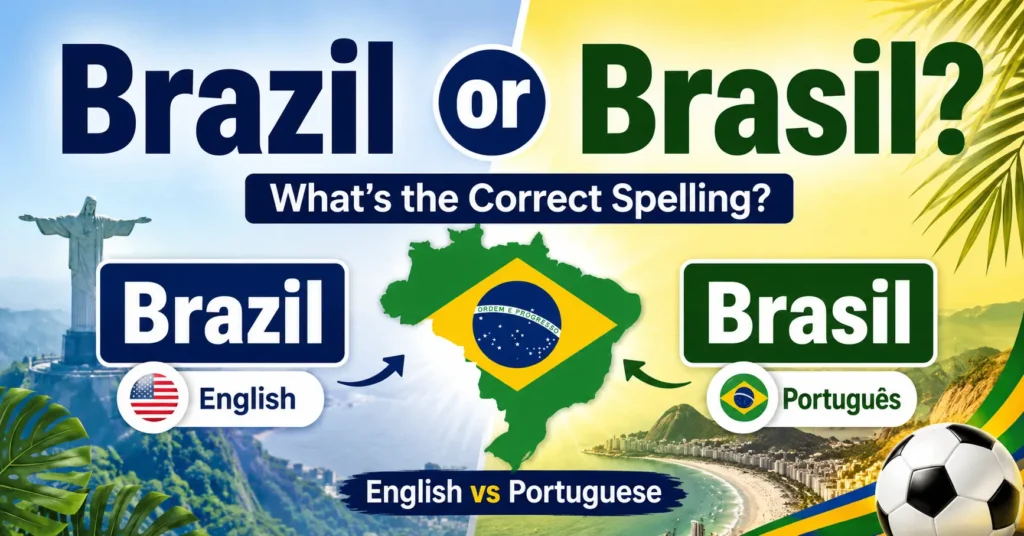
Brazil or Brasil means the same country, but the spelling changes with the language, not with the place itself.
Use Brazil in English writing because it is the correct spelling, standard form, and widely accepted choice for an English audience. Use Brasil in Portuguese writing, Portuguese contexts, and local usage. This simple split removes most spelling confusion.
The country is a South American country, the largest in South America, and the fifth largest country in the world by area and population. For clear communication, match your spelling with your audience. Write “I visited Brazil” in English and “Eu visitei o Brasil” in Portuguese.
Quick Answer: Brazil or Brasil?
Use Brazil when writing in English.
Use Brasil when writing in Portuguese.
That’s the rule nine times out of ten.
| Situation | Correct Spelling | Example |
| English sentence | Brazil | She traveled to Brazil last summer. |
| Portuguese sentence | Brasil | Ela viajou para o Brasil. |
| English academic essay | Brazil | Brazil is the largest country in South America. |
| Portuguese official name | Brasil | República Federativa do Brasil |
| Brand name or slogan | Keep the original | Banco do Brasil |
| Translation into English | Brazil | Brasil becomes Brazil in English. |
The easiest way to remember it:
Brazil is English. Brasil is Portuguese. Same country, different spelling.
That one sentence solves most of the confusion.
Read this also: Border or Boarder: Meaning, Difference, Spelling, and Easy Examples
Brazil or Brasil: Basic Definitions
Before getting into grammar, history, and examples, let’s define both terms clearly.
What Does Brazil Mean?
Brazil is the standard English name for the country in South America. English-language newspapers, schools, maps, government documents, academic papers, and international organizations use Brazil.
For example:
- Brazil is famous for the Amazon rainforest.
- The capital of Brazil is Brasília.
- Brazilian Portuguese differs from European Portuguese.
- Many tourists visit Brazil for beaches, music, food, and nature.
In English, Brazil is not slang. It’s not an informal spelling. It’s the correct country name.
The full official English name is Federative Republic of Brazil. The United Nations also lists the country as Brazil in English-language member-state references.
What Does Brasil Mean?
Brasil is the Portuguese spelling of the same country.
Portuguese speakers write:
- Eu moro no Brasil.
- O Brasil é um país diverso.
- A cultura do Brasil é muito rica.
In English, these mean:
- I live in Brazil.
- Brazil is a diverse country.
- The culture of Brazil is very rich.
The full Portuguese name is República Federativa do Brasil. That’s why you’ll often see Brasil in official Portuguese names, government materials, banks, football references, and cultural slogans.
So, Brasil is not wrong. It’s just not the standard spelling in English.
Brazil vs Brasil: Key Difference
The main difference between Brazil and Brasil is language.
| Feature | Brazil | Brasil |
| Language | English | Portuguese |
| Refers to | The country | The same country |
| Correct in English? | Yes | Only in special contexts |
| Correct in Portuguese? | No | Yes |
| Used in formal English writing? | Yes | Usually no |
| Used in Portuguese names? | No | Yes |
| English adjective | Brazilian | Not “Brasilian” |
| Example | I visited Brazil. | Eu visitei o Brasil. |
The spelling changes because the language changes. The country doesn’t.
Is Brasil Wrong in English?
Usually, yes.
That sounds harsh, but it’s the truth. If you’re writing a normal English sentence, Brasil looks like a mistake unless you have a clear reason for using it.
For example, this sentence looks incorrect in English:
I want to visit Brasil next year.
The better version is:
I want to visit Brazil next year.
However, Brasil is correct in English when it appears as part of a Portuguese name, quote, slogan, or cultural reference.
These examples are fine:
- Banco do Brasil
- República Federativa do Brasil
- “Eu amo o Brasil”
- Visit Brasil
- Governo do Brasil
The mistake is not using Brasil. The mistake is using it without context.
Is Brazil Wrong in Portuguese?
Yes, in normal Portuguese writing, Brazil is not the correct spelling.
A Portuguese speaker would write:
Eu moro no Brasil.
Not:
Eu moro no Brazil.
When translating into Portuguese, change Brazil to Brasil. When translating into English, change Brasil to Brazil.
That’s the whole game.
Why Do Two Spellings Exist?
The spelling difference exists because English and Portuguese developed different written forms of the country’s name.
The Portuguese form is Brasil. English uses Brazil.
The name connects to pau-brasil, or brazilwood, a tree known for producing a red dye. Brazilwood played an important role in early colonial trade, and the land became associated with the name Brasil in Portuguese.
In simple terms, the name stuck.
Over time, English adopted the spelling Brazil with a z, while Portuguese kept Brasil with an s. That doesn’t mean one version is fake and the other is real. It means each language settled on its own form.
Brazil or Brasil Is Not a British vs American English Issue
This point matters because many people get it wrong.
Some spelling differences do come from British and American English:
| American English | British English |
| color | colour |
| center | centre |
| traveling | travelling |
| organize | organise |
But Brazil vs Brasil is not like that.
Both American English and British English use Brazil.
A British newspaper would write:
Brazil won the match.
An American newspaper would also write:
Brazil won the match.
Neither would normally write:
Brasil won the match.
So don’t treat Brasil as a British spelling. It isn’t. Brasil is Portuguese.
When to Use Brazil
Use Brazil whenever you write in English for a general audience.
That includes school, work, business, travel, SEO, journalism, and academic writing.
Use Brazil in Academic Writing
If you’re writing an essay, report, thesis, or research paper in English, use Brazil.
Correct:
Brazil has one of the largest economies in Latin America.
Incorrect:
Brasil has one of the largest economies in Latin America.
Academic writing rewards consistency. Brazil is the accepted English form, so don’t switch unless you’re discussing Portuguese spelling directly.
Use Brazil in Business Communication
Use Brazil in English emails, proposals, contracts, presentations, and reports.
Correct:
Our company plans to expand into Brazil next year.
Incorrect:
Our company plans to expand into Brasil next year.
Business writing needs clarity. Brazil removes doubt.
Use Brazil in Travel Content
If your travel blog, itinerary, or guide is written in English, use Brazil.
Correct:
The best time to visit Brazil depends on the region.
Incorrect:
The best time to visit Brasil depends on the region.
You can still mention local Portuguese names. For example:
In Portuguese, Brazil is called Brasil.
That gives readers useful context without making the article look inconsistent.
Use Brazil in SEO Content
For English SEO, use Brazil as the main keyword.
Most English-speaking readers search for phrases like:
- travel to Brazil
- is Brazil safe
- Brazil facts
- Brazilian food
- Brazil or Brasil
- difference between Brazil and Brasil
Use Brasil when the article specifically explains the spelling difference. Don’t force it into every sentence. Keyword stuffing reads badly, and readers can smell it from a mile away.
When to Use Brasil
Use Brasil when the context is Portuguese, branded, official in Portuguese, or culturally intentional.
Use Brasil in Portuguese Sentences
This is the most obvious case.
Correct Portuguese:
O Brasil é um país enorme.
English translation:
Brazil is a huge country.
Use Brasil when the sentence itself is in Portuguese.
Use Brasil in Portuguese Official Names
Keep Brasil in official Portuguese names.
Examples:
- República Federativa do Brasil
- Governo do Brasil
- Banco do Brasil
- Instituto Brasileiro de Geografia e Estatística
Translating these names depends on context. In a formal English article, you may translate the meaning once. However, if the official name matters, keep the original.
Use Brasil in Brand Names
Never “correct” a brand name just because you’re writing in English.
For example, Banco do Brasil should stay Banco do Brasil. Writing “Banco do Brazil” looks wrong because it changes the name.
The same rule applies to campaigns, institutions, businesses, and cultural projects.
Use Brasil for Cultural Identity
Sometimes Brasil appears in English-language spaces because the writer wants a Brazilian, Portuguese, or cultural feel.
For example:
- Brasil vibes
- Made in Brasil
- Eu amo Brasil
- Team Brasil
- Visit Brasil
This can work in branding, social media, music, fashion, football, and tourism. However, it should feel intentional. If it looks random, it weakens the writing.
Examples of Brazil and Brasil in Sentences
Examples make the rule easier to see.
Correct Examples with Brazil
- Brazil is the largest country in South America.
- She moved to Brazil for work.
- The Amazon rainforest covers a large part of Brazil.
- Brazilian music includes samba, bossa nova, funk, and many regional styles.
- Many travelers visit Brazil for Carnival.
- The official language of Brazil is Portuguese.
- Brazil has a rich mix of Indigenous, African, European, and immigrant influences.
Correct Examples with Brasil
- In Portuguese, Brazil is spelled Brasil.
- “Eu amo o Brasil” means “I love Brazil.”
- Banco do Brasil keeps the Portuguese spelling.
- República Federativa do Brasil is the Portuguese full name.
- Some campaigns use Brasil to create a local identity.
- A Brazilian football fan may write “Vai, Brasil!”
Side-by-Side Sentence Table
| Weak Sentence | Better Sentence | Why |
| I visited Brasil last year. | I visited Brazil last year. | English sentence needs English spelling. |
| Brazil is called Brazil in Portuguese. | Brazil is called Brasil in Portuguese. | Portuguese spelling uses s. |
| Banco do Brazil is a major bank. | Banco do Brasil is a major bank. | Proper name stays Portuguese. |
| Brasilian food is delicious. | Brazilian food is delicious. | English adjective is Brazilian. |
| The Brasil flag is famous. | The Brazilian flag is famous. | Use the adjective before a noun. |
Grammar Tips for Brazil, Brasil, and Brazilian
The spelling question often creates grammar mistakes. These tips clean up the most common ones.
Use Brazilian as the English Adjective
In English, the adjective is Brazilian.
Correct:
- Brazilian food
- Brazilian music
- Brazilian culture
- Brazilian Portuguese
- Brazilian people
- Brazilian football
Avoid:
- Brasilian food
- Brasil people
- Brazil culture
- Brazil language
You can say Brazil’s culture, but before a noun, Brazilian usually sounds better.
Read this also: Too Many or To Many: Correct Usage, Grammar Rules, and Examples
Compare:
| Awkward | Natural |
| Brazil food is popular. | Brazilian food is popular. |
| Brazil people speak Portuguese. | Brazilians speak Portuguese. |
| Brazil culture is diverse. | Brazilian culture is diverse. |
| Brazil Portuguese is different. | Brazilian Portuguese is different. |
Use “In Brazil,” Not “At Brazil”
For countries, use in.
Correct:
She lives in Brazil.
Incorrect:
She lives at Brazil.
Use to Brazil for movement:
He is flying to Brazil tomorrow.
Use from Brazil for origin:
They are from Brazil.
Don’t Add “The” Before Brazil
In normal English, don’t say the Brazil.
Correct:
Brazil is in South America.
Incorrect:
The Brazil is in South America.
Some country names use the, such as the United States or the Netherlands. Brazil does not.
Real-Life Examples: Brazil or Brasil in Context
The right spelling depends on the situation. Here’s how it works in real life.
Email Example
Correct business email:
Our team is planning a market visit to Brazil in September. We’ll meet suppliers in São Paulo and review logistics options before finalizing the report.
Why it works:
- The email is in English.
- The audience likely expects English country names.
- Brazil keeps the message professional.
Academic Example
Correct academic sentence:
Brazil became a central case study in discussions of language, identity, migration, and postcolonial history in Latin America.
Why it works:
- The sentence is formal.
- The writing is in English.
- Brazil is the standard academic spelling.
Portuguese Example
Correct Portuguese sentence:
O Brasil tem uma enorme diversidade cultural e regional.
English translation:
Brazil has enormous cultural and regional diversity.
Why it works:
- The original sentence is Portuguese.
- Brasil matches the language.
Brand Example
Correct brand usage:
Banco do Brasil is one of the country’s major financial institutions.
Why it works:
- The sentence is in English.
- The proper name is Portuguese.
- The name should not be translated casually.
Social Media Example
Both may work, depending on tone.
Standard English:
Can’t wait to visit Brazil.
Cultural or Portuguese-flavored caption:
Saudades do Brasil.
The second example uses Portuguese expression and cultural feeling. That makes Brasil fit naturally.
Common Mistakes with Brazil and Brasil
Most mistakes happen because writers treat both spellings as interchangeable. They’re not.
Using Brasil in Standard English
Incorrect:
Brasil is known for Carnival.
Correct:
Brazil is known for Carnival.
Unless you’re writing in Portuguese or using a specific name, Brazil is the better choice in English.
Calling Brasil a Misspelling
This is also wrong.
Brasil is not a misspelling in Portuguese. It’s the correct Portuguese form.
A better way to explain it:
Brasil is correct in Portuguese, but Brazil is correct in English.
That’s accurate, simple, and fair.
Mixing Spellings Without Purpose
Weak:
Brazil is called Brasil, and many people visit Brasil for beaches in Brazil.
That sentence feels messy.
Better:
In English, the country is called Brazil. In Portuguese, it is called Brasil.
Clean writing beats clever writing.
Using Brasilian Instead of Brazilian
This is one of the biggest mistakes.
Incorrect:
She loves Brasilian music.
Correct:
She loves Brazilian music.
In modern English, Brazilian is the standard adjective and noun.
Changing Proper Names
Incorrect:
Banco do Brazil
Correct:
Banco do Brasil
Names are names. Don’t “fix” them into another language unless there’s a recognized English version.
Memory Tricks for Brazil or Brasil
Here are easy ways to remember the difference.
The Language Rule
English has Z: Brazil. Portuguese has S: Brasil.
That’s the fastest trick.
The Sentence Test
Ask one question:
Is the sentence in English or Portuguese?
If it’s English, use Brazil.
If it’s Portuguese, use Brasil.
The Name Test
Ask:
Is this part of a brand, title, quote, or official Portuguese name?
If yes, keep Brasil.
Examples:
- Banco do Brasil
- República Federativa do Brasil
- “Eu amo o Brasil”
The Reader Test
Ask:
What spelling will my reader expect?
English readers expect Brazil. Portuguese readers expect Brasil. Mixed audiences need context.
Synonyms and Related Words for Brazil or Brasil
Strictly speaking, Brazil does not have a true synonym. It’s a country name. However, related terms help readers understand the topic better.
| Term | Meaning |
| Brazil | English country name |
| Brasil | Portuguese country name |
| Brazilian | Person from Brazil or adjective related to Brazil |
| Brazilians | People from Brazil |
| Brazilian Portuguese | Portuguese variety spoken in Brazil |
| Portuguese | Official language of Brazil |
| República Federativa do Brasil | Portuguese full official name |
| Federative Republic of Brazil | English full official name |
| South America | Continent where Brazil is located |
| Latin America | Cultural and regional term that includes Brazil |
Related phrases:
- Brazil spelling
- Brasil spelling
- Brazil vs Brasil
- Is it Brazil or Brasil?
- Difference between Brazil and Brasil
- Correct spelling of Brazil
- Portuguese name for Brazil
These terms are useful for students, translators, editors, and SEO writers.
Brazil or Brasil for SEO Writing
If the article targets English-speaking readers, use Brazil as the main term. That includes travel blogs, grammar sites, educational articles, and general informational content.
However, an article about Brazil or Brasil should use both terms because the searcher wants to compare them.
A smart SEO structure looks like this:
| Page Area | Best Use |
| Title | Include Brazil or Brasil |
| Introduction | Use both spellings naturally |
| Main explanation | Explain Brazil vs Brasil clearly |
| Examples | Show both in sentences |
| FAQs | Answer common spelling questions |
| Conclusion | Repeat the simple rule |
Don’t overdo it. Readers don’t want a keyword smoothie. They want an answer.
Good sentence:
The difference between Brazil and Brasil comes down to language.
Bad sentence:
Brazil or Brasil is a Brazil vs Brasil spelling question about Brazil spelling and Brasil spelling.
That sounds like a search engine wrote it after three coffees. Don’t do that.
Case Study: Why “Visit Brasil” Can Be Correct
Imagine a tourism campaign uses the slogan:
Visit Brasil
At first glance, an English editor might want to change it to:
Visit Brazil
But that may be the wrong move.
Why? Because Brasil can signal local identity. It feels closer to the Portuguese name. It can make the campaign sound more Brazilian, more cultural, and less generic.
That doesn’t mean every English sentence should use Brasil. It means branding has different rules from grammar.
Here’s the difference:
| Context | Better Choice | Reason |
| English travel guide | Brazil | Clear for English readers |
| Tourism campaign slogan | Brasil may work | Cultural identity |
| Academic essay | Brazil | Formal English standard |
| Portuguese ad copy | Brasil | Portuguese spelling |
| Brand name | Keep original | Names should stay intact |
The lesson is simple: standard writing needs clarity, while branding can use identity.
Read this also: Someday vs Some Day: Meaning, Difference, Examples, and Easy Rules
Brazil or Brasil in Formal and Informal Writing
Formal Writing
Use Brazil.
Formal writing includes:
- Essays
- Reports
- News articles
- Legal documents in English
- Academic research
- Business proposals
- Government communication in English
Example:
The report examines trade between the United States and Brazil.
Informal Writing
Use Brazil unless you’re being intentionally Portuguese, cultural, or playful.
Example:
I miss Brazil so much.
But this also works if the tone is cultural:
Saudades do Brasil.
The second version carries a Brazilian Portuguese feeling. That’s not a grammar mistake. It’s a style choice.
Translation Tip: Brazil and Brasil
Translation is where many errors happen.
Use this simple table:
| Source Language | Original | Target Language | Translation |
| Portuguese | Brasil | English | Brazil |
| English | Brazil | Portuguese | Brasil |
| Portuguese | brasileiro | English | Brazilian |
| English | Brazilian | Portuguese | brasileiro / brasileira |
Also watch gender in Portuguese:
- brasileiro = Brazilian man or masculine adjective
- brasileira = Brazilian woman or feminine adjective
- brasileiros = Brazilian men or mixed group
- brasileiras = Brazilian women or feminine plural group
English is easier here. Brazilian works for all genders as an adjective.
Brazil or Brasil FAQs
Both are correct, but they are used in different languages. Brazil is the English spelling, and Brasil is the Portuguese spelling.
Use Brazil in English. It is the correct spelling, standard form, and widely accepted choice for an English audience.
Brasil is not wrong in Portuguese. It only looks incorrect when used in a normal English sentence without a clear reason.
People write Brasil because that is the country’s name in Portuguese. Brazilians use Brasil when writing in their own language.
Yes, you can use both if the article explains the difference between Brazil and Brasil. However, don’t switch between them randomly. Use Brazil for English context and Brasil for Portuguese context.
Final Thoughts on Brazil or Brasil
The difference between Brazil or Brasil is simple once you connect the spelling to the language. Brazil is the correct form in English writing, while Brasil is the correct form in Portuguese writing.
Both names refer to the same South American country, not two separate places. The spelling changes because the language context changes.
Use Brazil for formal writing, academic writing, business communication, travel writing, and content made for an English audience. Use Brasil when writing in Portuguese, using a Portuguese name, or showing local identity.
The easiest rule is this: write Brazil in English and Brasil in Portuguese. That one rule clears up most spelling confusion and helps your writing sound clear, accurate, and natural.
