
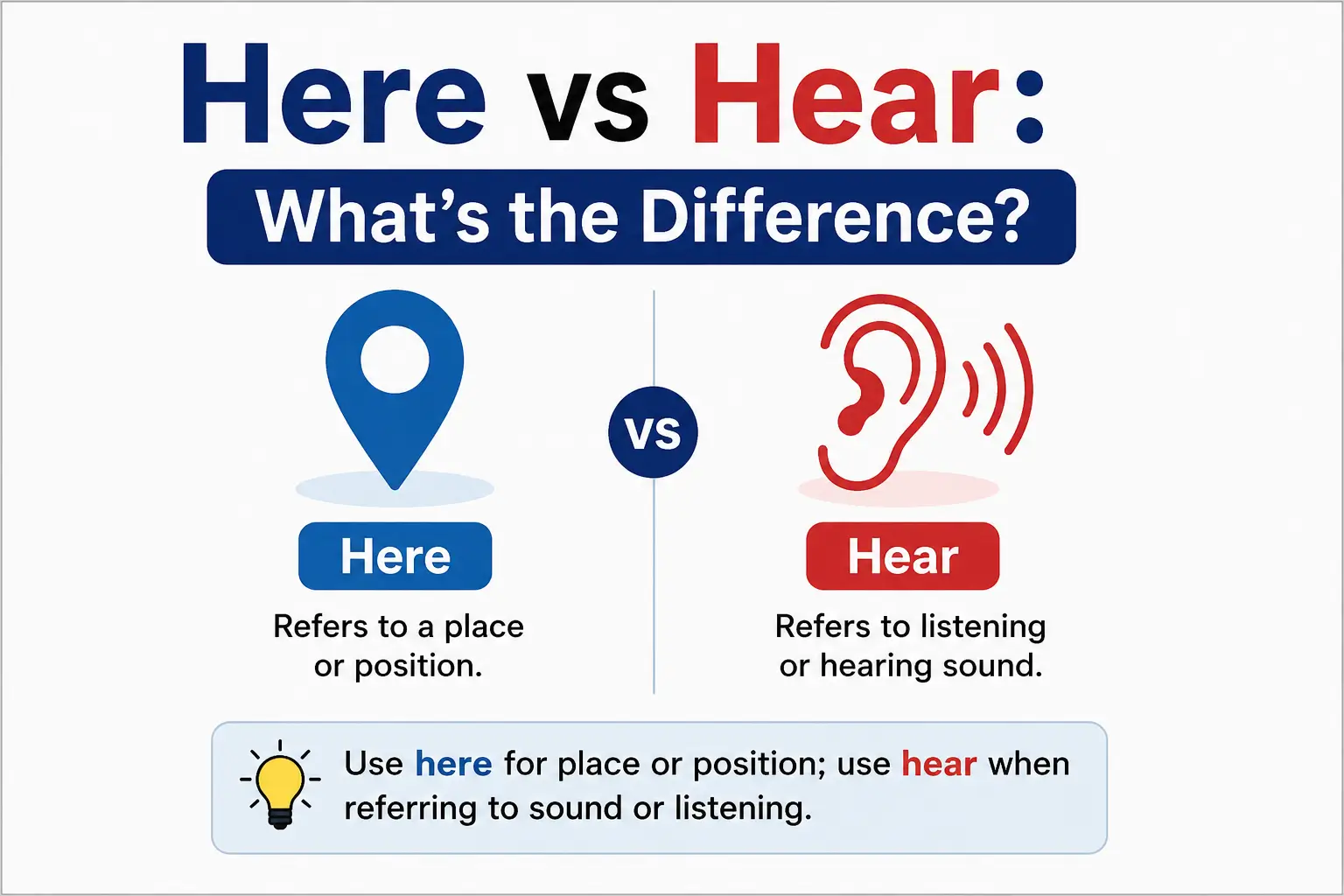
Here and Hear are common homophones with the same pronunciation, but their spelling, meaning, and sentence role are completely different. The English language has many confusing elements and quirks, yet this homophone pair becomes easy when you check the context. They sound the same, but their different spellings and different meanings change word usage.
Hear is a verb linked to perceiving sound, listening, speech, and receiving information. You hear music, a phone ring, or someone speak because sound reaches your ears. Its forms include hear, hears, heard, and hearing. For example, “I can’t hear you” is correct because it describes sound.
Here refers to a specific location, current position, place, spot, presence, present time, or current point. It usually works as an adverb, as in “Your phone is right here.” However, here can also act as a noun or an informal adjective before a noun or after a noun for emphasis. Remember: hear contains ear, while here answers “where?”
Quick Answer: What Is the Difference Between Hear and Here?
Hear is a verb that means to notice sound through your ears. It can also mean to receive information.
Here usually works as an adverb that means “in this place,” “at this location,” or “at this point.”
| Word | Main meaning | Part of speech | Example |
| Hear | To receive or notice sound | Verb | Can you hear the alarm? |
| Here | In or at this place | Adverb | Leave the package here. |
A simple test can help:
- Does the sentence involve sound or information? Use hear.
- Does the sentence involve place, presence, or position? Use here.
You hear with your ear, but you stand here.
Hear vs Here at a Glance
Although hear and here share the same pronunciation, their spelling, meaning, and grammar functions are different.
Hear Meaning
Hear means to receive sound through the ears. It is a verb, so it describes an action or experience.
Examples:
- I can hear someone knocking.
- Did you hear the announcement?
- We heard the news yesterday.
The word may describe a physical sound, such as music or a voice. However, it can also refer to receiving information.
For example:
- I heard that the store is closing.
In this sentence, the speaker may have learned the information through conversation, a message, or another source.
Here Meaning
Here most often means “in this place” or “at this location.” It usually functions as an adverb because it explains where something happens.
Examples:
- Your phone is here.
- Please wait here.
- We live here.
However, here can also refer to a point in time, a stage in a process, or a part of a document.
Examples:
- Let’s stop here for today.
- The main problem begins here.
- Here is the final report.
Hear vs Here Comparison Table
| Feature | Hear | Here |
| Pronunciation | /hɪr/ | /hɪr/ |
| Main meaning | Receive sound or information | In or at this place |
| Main part of speech | Verb | Adverb |
| Past tense | Heard | No tense form |
| Example | I hear a noise. | The keys are here. |
| Memory clue | Contains ear | Refers to a place |
| Common phrase | Hear from someone | Here you go |
How to Use Hear Correctly
Because hear is a verb, it changes form depending on the tense and subject. You can use it for sounds, information, formal decisions, and communication.
Use Hear When Talking About Sound
The most common meaning of hear is to notice sound through your ears.
Examples:
- I can hear the television downstairs.
- She heard footsteps outside.
- We couldn’t hear the speaker clearly.
- Can you hear the birds?
Hearing often happens without deliberate effort. A sound reaches your ears, even when you aren’t trying to focus on it.
For example:
- I heard a car horn while I was reading.
The person wasn’t intentionally listening for the horn. Instead, the sound reached their ears naturally.
Use Hear for Receiving Information
Hear can also mean to learn or receive information.
Examples:
- Did you hear about the new manager?
- I heard that the office will close early.
- We were sorry to hear about the accident.
- Have you heard the latest news?
In these examples, hear doesn’t only refer to physical sound. It also describes the act of becoming aware of information.
This use is common in conversation, texting, social media, and workplace communication.
Use Hear for Opinions, Requests, and Cases
In formal settings, hear can mean to listen to and consider a case, complaint, argument, or request.
Examples:
- The judge will hear the case next week.
- The committee heard several proposals.
- The manager agreed to hear the employee’s concerns.
- The board will hear public comments before voting.
Here, hear means more than simply receiving sound. It suggests that someone will listen, evaluate, and possibly make a decision.
Verb Forms of Hear
Because hear is an irregular verb, its past tense isn’t “heared.” The correct past form is heard.
| Tense or form | Word | Example |
| Base form | Hear | I can hear you. |
| Third-person singular | Hears | She hears a noise. |
| Simple past | Heard | We heard the announcement. |
| Past participle | Heard | I have heard that story. |
| Present participle | Hearing | He is hearing strange sounds. |
Incorrect:
- I heared the news yesterday.
Correct:
- I heard the news yesterday.
Correct Examples With Hear
Everyday conversation
- Can you hear me?
- I heard someone call my name.
- Did you hear that strange sound?
At school
- The students heard the teacher’s instructions.
- I couldn’t hear the video from the back row.
- We heard a presentation about climate science.
At work
- I was glad to hear that the project was approved.
- We haven’t heard from the client yet.
- The supervisor will hear your concerns.
On the phone
- I can’t hear you clearly.
- Can you hear me now?
- I heard a lot of background noise during the call.
Incorrect Uses of Hear
Incorrect:
- Please come hear.
Correct:
- Please come here.
Why: The sentence refers to a location, not sound.
Incorrect:
- Your order is hear.
Correct:
- Your order is here.
Why: The sentence means that the order has arrived or is present.
Incorrect:
- I here the alarm every morning.
Correct:
- I hear the alarm every morning.
Why: The sentence describes receiving a sound, so it needs the verb hear.
How to Use Here Correctly
Here usually tells the reader or listener where someone or something is located. It can also show arrival, presence, direction, or a point in a discussion.
Use Here to Refer to a Place
The main meaning of here is “in this place” or “at this location.”
Examples:
- Put your backpack here.
- We’ve lived here for five years.
- The restroom is right here.
- Please sign your name here.
The exact meaning depends on the speaker’s position. In conversation, here normally refers to a place near the person speaking.
Use Here to Show Arrival or Presence
Here can also show that someone or something has arrived.
Examples:
- The bus is here.
- Your guests are here.
- Dinner is here.
- I’m here for my appointment.
In these examples, here describes presence rather than a specific physical spot.
For example, “The doctor is here” means the doctor has arrived or is present in the building.
Use Here When Giving Something
Americans often say “Here you go” or “Here you are” when giving something to another person.
Examples:
- Here you go. This is your receipt.
- Here’s the document you requested.
- Here are your keys.
- Here you are. One cup of coffee.
These phrases are common in stores, restaurants, offices, and casual conversations.
Here Is and Here Are
Use here is before a singular noun. Use here are before a plural noun.
Examples:
- Here is your ticket.
- Here is the answer.
- Here are your tickets.
- Here are the answers.
In casual speech, people sometimes say “Here’s your keys.” However, edited writing usually follows standard subject-verb agreement.
Better:
- Here are your keys.
Use Here for a Point in Time or Discussion
Here doesn’t always refer to a physical place. It can also refer to a stage, moment, or section.
Examples:
- Let’s pause here.
- The discussion ends here.
- Here is where the argument becomes unclear.
- From here, the process becomes more complicated.
In academic or professional writing, here may point to a part of the document.
Example:
- The evidence presented here supports the main claim.
Correct Examples With Here
Giving directions
- Turn left here.
- Park here beside the entrance.
- The meeting room is here on the first floor.
Text messages
- I’m here.
- Are you here yet?
- Meet me here at 6:00.
Classroom instructions
- Write your answer here.
- Stop reading here.
- Place your assignment here on the desk.
Workplace communication
- The revised figures are included here.
- Please sign here.
- The client is here for the meeting.
Incorrect Uses of Here
Incorrect:
- I can’t here the audio.
Correct:
- I can’t hear the audio.
Why: The sentence refers to sound.
Incorrect:
- Did you here what she said?
Correct:
- Did you hear what she said?
Why: The speaker is asking whether someone received spoken information.
Incorrect:
- I’m waiting hear.
Correct:
- I’m waiting here.
Why: The word describes location.
Why Hear and Here Are Commonly Confused
The main reason people confuse hear and here is that they are homophones.
Hear and Here Are Homophones
Homophones are words that sound the same but have different meanings, spellings, or origins.
Other common homophones include:
- Their, there, and they’re
- To, too, and two
- Your and you’re
- Right and write
- Sea and see
Because hear and here sound identical, you can’t choose the correct spelling by pronunciation alone. Instead, you must look at the sentence’s meaning.
Pronunciation of Hear and Here
In most forms of American English, both words are pronounced like “heer.”
- Hear: /hɪr/
- Here: /hɪr/
Because the pronunciation is the same, spelling depends on context.
Compare:
- I can hear the speaker.
- The speaker is here.
Both words sound identical, but they express different ideas.
Meaning Matters More Than Sound
To choose the correct word, ask what the sentence is describing.
Use hear for:
- Sound
- Speech
- Music
- News
- Information
- Testimony
- Complaints
Use here for:
- Location
- Presence
- Arrival
- Direction
- Position
- A stage in time
- A point in a document
Key Differences Between Hear and Here
The most important difference is grammatical.
Hear is a verb. It describes an action or experience.
Here is usually an adverb. It explains location or position.
Compare these sentences:
- I hear the phone.
- The phone is here.
In the first sentence, hear describes what the speaker experiences. In the second sentence, here tells us where the phone is.
Another difference involves tense. Because hear is a verb, it can change to heard or hearing. However, here has no past or future form.
Correct:
- I heard the bell yesterday.
- I can hear the bell now.
- I’ll hear the bell tomorrow.
The word here remains unchanged:
- I was here yesterday.
- I am here now.
- I’ll be here tomorrow.
A Simple Way to Choose Between Hear and Here
You can solve most hear or here questions with three quick checks.
Ask Whether the Sentence Involves Sound
Use hear when the sentence involves a sound, voice, message, or piece of information.
Examples:
- Can you hear the dog barking?
- I heard your voicemail.
- We haven’t heard the results.
Ask Whether the Sentence Involves Place
Use here when the sentence answers the question “Where?”
Examples:
- Put the chair here.
- We’re staying here tonight.
- Your food is here.
Replace the Word
Try replacing hear with “notice a sound” or “receive information.”
- I can hear the music.
- I can notice the sound of the music.
The replacement makes sense, so hear is correct.
Now replace here with “in this place.”
- Wait here.
- Wait in this place.
Again, the meaning stays clear.
Easy Memory Tricks for Hear vs Here
Hear Contains Ear
The easiest memory trick is hidden inside the spelling:
h + ear = hear
You use your ear to hear sound.
Examples:
- Hear the music with your ear.
- If sound is involved, think of the word ear.
Here Refers to a Place
Think of here as “this place.”
- Come here.
- Sit here.
- We’re here.
You can also connect here with the question “Where?”
- Where should I sit?
- Sit here.
One-Sentence Memory Rule
If your ear is involved, use hear. If the sentence points to a place, use here.
Common Phrases With Hear
Learning common phrases can help you understand how hear works in real English.
Hear From
Hear from means to receive communication from someone.
Examples:
- I hope to hear from you soon.
- Have you heard from Maya?
- We haven’t heard from the supplier.
This phrase appears often in professional emails.
Example:
- I look forward to hearing from you.
Hear About
Hear about means to receive information concerning an event, person, or situation.
Examples:
- Did you hear about the storm?
- I was sorry to hear about your loss.
- We heard about the opening through social media.
Hear Of
Hear of usually means to know that someone or something exists.
Examples:
- Have you heard of that company?
- I’ve never heard of that expression.
- Most students have heard of Shakespeare.
Hear Someone Out
To hear someone out means to listen to everything they want to say before responding or making a judgment.
Examples:
- Please hear me out before you decide.
- The manager agreed to hear the employee out.
- Let’s hear both sides out.
I Hear You
In informal American English, “I hear you” can mean “I understand your feelings or point.”
Example:
- “This deadline feels impossible.”
- “I hear you. Let’s discuss the workload.”
The phrase doesn’t simply mean that the listener can physically hear the words. Instead, it shows understanding or empathy.
Could Hear a Pin Drop
The expression “You could hear a pin drop” means a place was extremely quiet.
Example:
- When the principal announced the news, you could hear a pin drop.
Common Phrases With Here
Here You Go
Here you go is used when giving something to someone.
Examples:
- Here you go. One large coffee.
- Here you go. I printed the form.
- Here you go. These are your tickets.
It is friendly and common in everyday American speech.
Here We Go
Here we go can show that something is starting.
Example:
- The movie is beginning. Here we go!
However, tone matters. It can also show frustration when a familiar problem starts again.
Example:
- Here we go again. The printer stopped working.
Here and There
Here and there means in several different places or occasionally.
Examples:
- We saw wildflowers here and there.
- I made a few small edits here and there.
- There were empty seats here and there.
From Here On
From here on means starting at this point and continuing into the future.
Examples:
- From here on, we’ll check every order twice.
- The trail becomes steeper from here on.
- From here on out, everyone must sign in.
Neither Here Nor There
Neither here nor there means irrelevant or unimportant to the current issue.
Example:
- His personal opinion is neither here nor there. We need to follow the policy.
The expression doesn’t refer to physical locations. Instead, it means that something doesn’t affect the main point.
“Hear, Hear” or “Here, Here”?
The correct expression is “Hear, hear!”
It is used to show strong agreement, support, or approval, especially after a speech or statement.
Example:
- “Every employee deserves a safe workplace.”
- “Hear, hear!”
The expression originally encouraged listeners to hear or pay attention to a speaker’s words. Therefore, hear is the correct spelling.
Why “Here, Here” Is Incorrect
Here, here would refer to a location, which doesn’t match the expression’s meaning.
Incorrect:
- Here, here! That was an excellent point.
Correct:
- Hear, hear! That was an excellent point.
Is “Hear, Hear” Common in American English?
American readers generally understand hear, hear, but it can sound formal, traditional, or somewhat British.
In everyday US conversation, people are more likely to say:
- Exactly!
- I agree!
- Well said!
- That’s right!
- Absolutely!
Hear vs Listen: What Is the Difference?
Hear and listen both relate to sound, but they aren’t exact synonyms.
Hear Usually Happens Naturally
You hear when sound reaches your ears, even when you aren’t making an effort.
Example:
- I heard music from the next room.
The person noticed the music but may not have focused on it.
Listen Requires Attention
You listen when you deliberately focus on a sound.
Example:
- I listened to the entire album.
The person actively paid attention.
| Word | Meaning | Example |
| Hear | Receive sound naturally | I heard a siren. |
| Listen | Pay attention to sound | I listened to the podcast. |
Notice that listen often takes the preposition to.
Correct:
- Listen to the teacher.
- I’m listening to music.
Incorrect:
- Listen the teacher.
However, hear usually doesn’t need to before the sound or person.
Correct:
- I can hear the teacher.
Here vs There: What Is the Difference?
Here refers to a place close to the speaker. There usually refers to a place farther away or already mentioned.
Examples:
- Put the cup here beside me.
- Put the box there near the door.
| Word | Location | Example |
| Here | Near the speaker | Come here. |
| There | Away from the speaker | Stand there. |
However, distance can be emotional or conversational rather than exact.
For example:
- We’ve reached an important point. Let’s continue from here.
In this sentence, here refers to a stage in the discussion.
Common Mistakes With Hear and Here
Using Here for Sound
Incorrect:
- I can’t here you.
Correct:
- I can’t hear you.
Explanation: The sentence involves sound, so it needs the verb hear.
Using Hear for Location
Incorrect:
- Please leave the files hear.
Correct:
- Please leave the files here.
Explanation: The sentence refers to a place.
Using Heared Instead of Heard
Incorrect:
- We heared the announcement.
Correct:
- We heard the announcement.
Explanation: Hear is an irregular verb. Its past tense is heard.
Writing “I Am Hear”
Incorrect:
- I am hear.
Correct:
- I am here.
Explanation: The sentence describes the speaker’s location or presence.
Confusing Hearing With Here
Incorrect:
- I’m hereing a strange noise.
Correct:
- I’m hearing a strange noise.
Explanation: The present participle of hear is hearing.
Using the Wrong Preposition
Different phrases with hear carry different meanings.
- Hear from someone: receive communication
- Hear about something: receive news about it
- Hear of something: know it exists
Compare:
- I heard from Elena yesterday.
- I heard about Elena’s promotion.
- I’ve heard of Elena’s company.
Synonyms and Related Words
Synonyms for Hear
No synonym works in every sentence. However, these words may express similar ideas in specific contexts:
- Detect
- Notice
- Catch
- Overhear
- Learn
- Discover
- Be informed
- Listen to
Examples:
- I didn’t catch what you said.
- She overheard their conversation.
- We learned about the change yesterday.
Be careful with overhear. It means to hear something without being the intended listener.
Example:
- I overheard two coworkers discussing the schedule.
Synonyms for Here
Possible alternatives depend on the sentence:
- In this place
- At this location
- At this point
- Present
- Nearby
- On this spot
Examples:
- Please wait at this location.
- Everyone is present.
- We’ll stop at this point.
Related Words
| Word | Relationship |
| Heard | Past tense of hear |
| Hearing | The act or ability of receiving sound |
| Listener | A person who listens |
| Sound | Something that can be heard |
| There | A location away from the speaker |
| Where | A question word used to ask about place |
| Nearby | Close to a location |
| Present | Existing or located in a place |
Hear and Here in Real-Life American English
At School
A teacher may say:
- “Can everyone hear me?”
- “Write your name here.”
- “I heard several strong answers.”
- “Leave your assignments here.”
The sound-related examples use hear, while the location-related examples use here.
At Work
A manager may write:
- “I was pleased to hear that the client approved the proposal.”
- “The updated schedule is included here.”
- “We haven’t heard from the vendor.”
- “Please sign here before submitting the form.”
These uses are natural in professional settings.
In Text Messages
Common messages include:
- I’m here.
- Can you hear me?
- Did you hear what happened?
- Are you here yet?
- I’ll wait here.
Because texting often moves quickly, homophone errors are common. However, checking whether you mean sound or place usually solves the problem.
On Social Media
Examples:
- Did anyone else hear that announcement?
- Here’s what you need to know.
- I’m here for this trend.
- I heard the update from a friend.
The informal expression “I’m here for this” means “I support this” or “I like this.” It doesn’t always describe a physical location.
Formal and Informal Usage Notes
Formal Uses of Hear
In legal, academic, and professional contexts, hear may describe official consideration.
Examples:
- The court will hear the appeal.
- The panel heard testimony from three experts.
- The department will hear student complaints.
Informal Uses of Hear
In casual speech, hear appears in phrases such as:
- I hear you.
- You heard me.
- Hear me out.
- I hear that!
“I hear that” may show agreement in informal American English.
Example:
- “I need a vacation.”
- “I hear that!”
Formal Uses of Here
Formal writing may use here to refer to a section of a document or argument.
Examples:
- The evidence presented here supports the conclusion.
- The analysis ends here.
- The term is used here in its legal sense.
Words such as herein, hereby, and hereafter also appear in legal or official documents. However, they often sound too formal for everyday writing.
Informal Uses of Here
Common informal phrases include:
- Here you go.
- Here we are.
- I’m here.
- Here’s the thing.
- Here we go again.
“Here’s the thing” introduces an explanation or important point.
Example:
- Here’s the thing: we don’t have enough time to restart the project.
Real-Life Mini Cases
A Phone Call
Incorrect:
- I can’t here you. Are you still hear?
Correct:
- I can’t hear you. Are you still here?
The first blank relates to sound. Therefore, it needs hear. The second asks whether the person is still present on the call, so here is correct.
A Workplace Email
Incorrect:
- I was happy to here the report is complete. You can find it hear.
Correct:
- I was happy to hear the report is complete. You can find it here.
The writer receives information, so the first word is hear. The second word points to the report’s location.
A Classroom Instruction
Incorrect:
- Please sit hear so you can here the video.
Correct:
- Please sit here so you can hear the video.
The first word identifies a place. The second describes receiving sound.
Grammar Tips for Choosing the Right Word
- Look for references to sound, such as music, voices, alarms, or speech.
- Check whether the sentence answers where.
- Remember that hear can change to heard.
- Use the ear inside hear memory trick.
- Read the whole sentence instead of checking the word alone.
- Replace here with “in this place.”
- Replace hear with “receive sound.”
- Proofread text messages, emails, and captions before sending them.
Spell-check software may not catch the error because both words are spelled correctly. Therefore, understanding the sentence’s meaning is essential.
Practice: Hear or Here?
Choose hear or here for each sentence.
- Can you ___ the announcement?
- Please place your bag ___.
- I was glad to ___ from you.
- The delivery driver is ___.
- Did you ___ the thunder last night?
- Sign your name ___.
- We haven’t ___ the final decision.
- The meeting will take place ___.
- I can ___ someone talking outside.
- Your coffee is ___.
Answers and Explanations
- Can you hear the announcement?
The sentence involves sound. - Please place your bag here.
The sentence refers to a location. - I was glad to hear from you.
“Hear from” means to receive communication. - The delivery driver is here.
The driver has arrived. - Did you hear the thunder last night?
Thunder is a sound. - Sign your name here.
The sentence points to a location on the page. - We haven’t heard the final decision.
The past participle heard is needed after “haven’t.” - The meeting will take place here.
The sentence identifies a place. - I can hear someone talking outside.
The speaker receives a sound. - Your coffee is here.
The coffee has arrived or is present.
Conclusion
Understanding Here and Hear is easy once you focus on meaning. Use hear when you talk about sound, speech, music, or receiving information. Use here when you point to a place, position, presence, or current point.
Both words sound the same, but they are not interchangeable. A simple memory trick can help: hear contains ear, while here answers the question “where?” Checking the sentence’s meaning will help you choose the correct word every time.
Frequently Asked Questions
Q1: What Is the Main Difference Between Here and Hear?
Here refers to a place, position, or presence. Hear is a verb that means to receive sound through your ears.
Q2: Is It “I Am Here” or “I Am Hear”?
The correct sentence is “I am here.” It describes your location or presence. Hear cannot be used because it relates to sound.
Q3: Is It “Can You Hear Me?” or “Can You Here Me?”
The correct form is “Can you hear me?” The sentence asks whether someone can receive your voice or sound.
Q4: Are Here and Hear Homophones?
Yes. Here and hear are homophones because they have the same pronunciation but different spellings and meanings.
Q5: How Can I Remember Here vs Hear?
Remember that hear contains the word ear, which you use for sound. Use here when you mean “in this place.”