
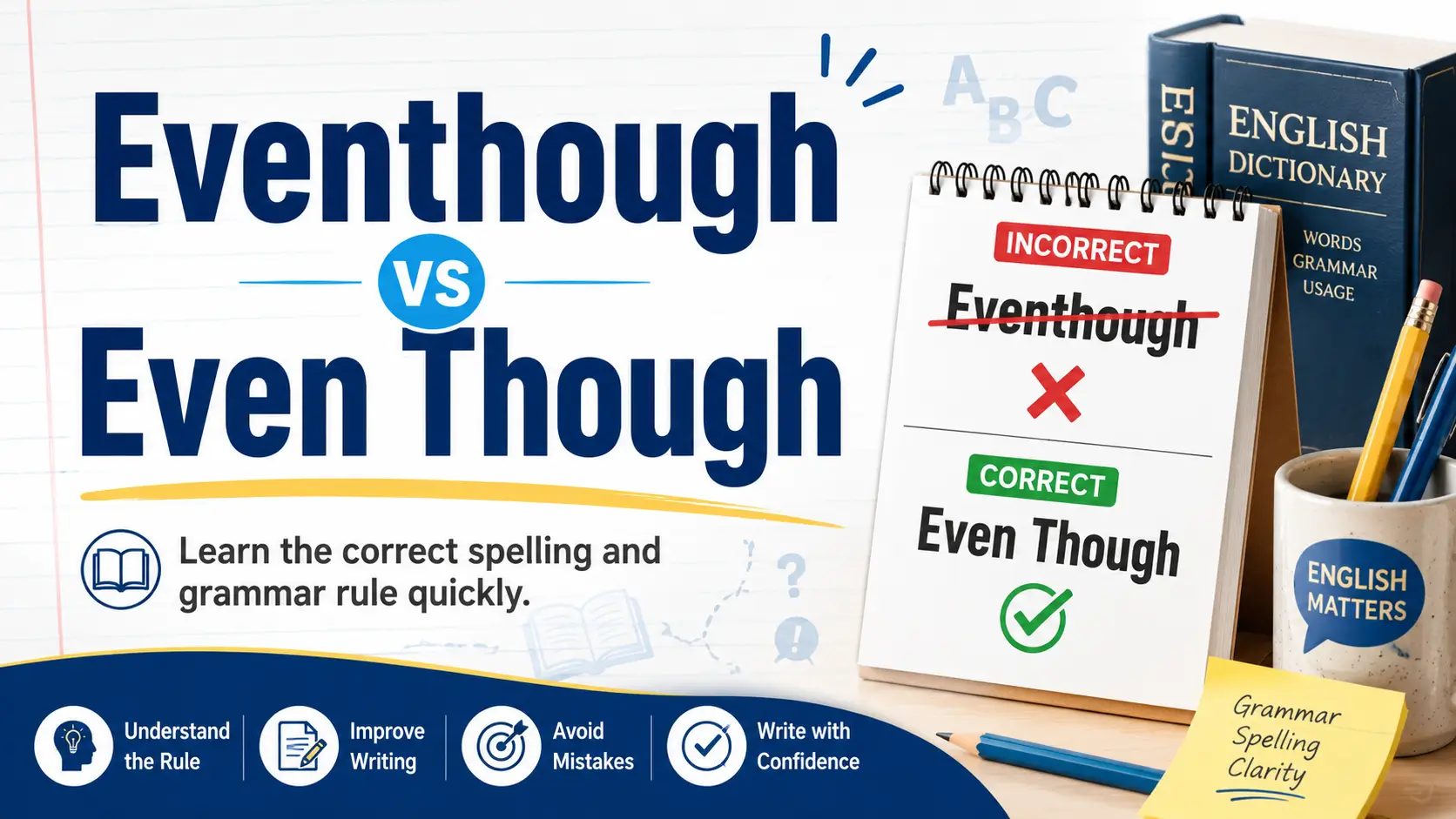
Many English learners and native speakers confuse eventhough vs even though because both forms look similar while typing fast or writing in everyday usage. However, the correct spelling is always even though, which is a proper English phrase and a standard form in English. Eventhough is an incorrect spelling and a common spelling mistake that does not follow English rules or formal correctness.
The reason behind this grammar confusion is often linked to pronunciation. In everyday speech, people naturally connect the sounds of even and though, making the phrase feel like one word. However, in standard English, these are two separate words that work together as a correct conjunction showing contrast. For example, “Even though I was tired, I finished my work” uses the phrase correctly because it connects two opposite ideas.
Understanding this small grammar difference improves writing skills, writing clarity, and professional writing. When checking sentences, focus on the sentence structure, correct form, and natural grammar usage instead of relying only on how words sound. Using even though correctly helps create clearer communication, stronger sentences, and more confident writing in academic, personal, and professional situations.
Quick Answer: Eventhough vs Even Though
The correct form is:
✅ Even though
❌ Eventhough
Even though is a conjunction used to show contrast between two ideas. Its meaning is similar to “although” or “despite the fact that.”
Quick Example
✅ Even though it was raining, we went for a walk.
❌ Eventhough it was raining, we went for a walk.
The first sentence works because the two ideas contrast:
- Rain might normally stop someone from walking.
- They went walking anyway.
That unexpected difference is exactly what even though highlights.
What Does “Even Though” Mean?
Even though introduces a fact or situation that makes another result seem surprising or unexpected.
In simple terms, it connects two contrasting ideas.
Example
Even though Maria was tired, she finished her homework.
The sentence contains two ideas:
- Maria was tired.
- Maria finished her homework.
Normally, being tired might make someone stop working. Maria continued anyway, so even though emphasizes the contrast.
More examples:
- Even though he studied every day, he found the exam difficult.
- She bought the dress even though it was expensive.
- Even though I disagree with him, I respect his opinion.
Even Though Grammar Rule Explained Simply
Even Though as a Subordinating Conjunction
Grammatically, even though is a subordinating conjunction.
That may sound technical, but the rule is straightforward. It connects a dependent clause with an independent clause while showing contrast.
The basic structure is:
Even though + dependent clause, independent clause
Example Structure
Even though I was nervous, I gave the presentation.
| Part | Explanation |
| Even though I was nervous | Dependent clause |
| I gave the presentation | Independent clause |
The first part cannot normally stand alone as a complete thought. The second part can. Together, they create a complete sentence with contrast.
How to Use Even Though in a Sentence
You can place even though at the beginning or in the middle of a sentence.
Using Even Though at the Beginning
When even though starts the sentence, place a comma after the dependent clause.
Pattern:
Even though + situation, unexpected result
Example:
✅ Even though the weather was cold, we went swimming.
More examples:
- Even though she had little experience, she got the job.
- Even though the restaurant was crowded, we found a table.
- Even though he was busy, he answered my message.
Using Even Though in the Middle
You can also place even though after the main clause.
Pattern:
Main clause + even though + contrasting clause
Example:
✅ I went to work even though I was feeling sick.
More examples:
- She smiled even though she was upset.
- They continued the project even though they faced problems.
- I enjoyed the movie even though it was very long.
In this structure, a comma is usually unnecessary.
Why Is “Eventhough” Incorrect?
Eventhough is not the standard spelling of the phrase. English keeps even and though as two separate words.
Several common habits explain why people join them together.
Pronunciation Creates Confusion
In everyday conversation, English speakers often connect neighboring words.
For example:
I went even though I was tired.
When spoken quickly, even though may sound almost like a single word. However, pronunciation doesn’t determine the correct spelling.
Similar mistakes include:
- a lot incorrectly written as alot
- in front incorrectly written as infront
The words may sound connected, but standard spelling keeps them separate.
English Has Many Combined Words
English contains many words that can look similar to phrases made from separate words.
| Separate Form | Related Combined Form |
| every day | everyday |
| some time | sometime |
| even though | remains two words |
Because English contains many compound words, someone might assume even though should also become one word.
It doesn’t.
✅ even though
❌ eventhough
Online Writing Can Spread the Mistake
Social media posts, text messages, comments, and quick online conversations often contain spelling errors.
When someone repeatedly sees eventhough online, the spelling may start to look correct. However, informal internet usage doesn’t replace standard English spelling.
For academic, professional, and published writing, always use:
✅ even though
Even Though vs Although vs Though
Even though, although, and though all express contrast, but they don’t always create the same tone or emphasis.
| Word or Phrase | Meaning | Typical Usage | Example |
| Even though | Strong contrast | Emphasizes an unexpected result | Even though it was difficult, she succeeded. |
| Although | General contrast | Common in formal writing | Although it was difficult, she succeeded. |
| Though | Contrast | Common in casual speech | Though it was difficult, she succeeded. |
Even Though vs Although
The main difference is emphasis.
Compare:
Although the phone was expensive, I bought it.
Even though the phone was expensive, I bought it.
Both are grammatically correct.
However, although presents a normal contrast, while even though makes the contrast stronger.
The second sentence suggests that the high price was a serious reason not to buy the phone, yet the person bought it anyway.
Even Though vs Though
Though is more flexible in casual English.
Examples:
- Though I was tired, I finished the work.
- I was tired. I finished the work, though.
The second example shows that though can appear naturally at the end of a sentence.
You normally cannot use even though that way.
❌ I finished the work, even though.
✅ I finished the work, though.
Even Though vs Even If
These phrases look similar, but their meanings are different.
| Phrase | Meaning | Example |
| Even though | Describes a real or known situation | Even though I was sick, I went to school. |
| Even if | Describes a possible or hypothetical situation | Even if I get sick, I will go to school. |
The easiest rule is:
Even though = the situation is real or true
Even if = the situation is possible or hypothetical
Compare the Difference
✅ Even though she failed once, she tried again.
The failure actually happened.
✅ Even if she fails again, she will keep trying.
The future failure is only a possibility.
Common Mistakes With Even Though
A few mistakes appear repeatedly in everyday writing.
Mistake: Writing Eventhough as One Word
Incorrect:
❌ Eventhough I was tired, I finished my work.
Correct:
✅ Even though I was tired, I finished my work.
Remember the simple rule:
Two words, always.
Mistake: Using “But” With Even Though
Incorrect:
❌ Even though I was tired, but I continued working.
Correct:
✅ Even though I was tired, I continued working.
Even though already creates the contrast, so adding but usually creates unnecessary repetition.
Mistake: Confusing Even Though With Even If
Incorrect:
❌ Even though I win the competition, I will celebrate.
Correct:
✅ Even if I win the competition, I will celebrate.
Winning hasn’t happened yet. It is only possible, so even if fits better.
Mistake: Incorrect Comma Usage
Correct:
✅ Even though it was late, we continued studying.
Correct:
✅ We continued studying even though it was late.
When the even though clause comes first, you normally need a comma after it.
When it comes after the main clause, a comma usually isn’t necessary.
Real-Life Examples of Even Though
Seeing the phrase in realistic situations makes the grammar easier to remember.
Everyday Conversation Examples
- Even though I was hungry, I waited for everyone before eating.
- She went outside even though it was raining.
- Even though he doesn’t like coffee, he drinks it at work.
Professional Writing Examples
In business communication, even though can explain an unexpected outcome.
- Even though sales increased, the company reduced its advertising budget.
- The project succeeded even though the team faced several challenges.
Academic Writing Examples
Academic writers frequently use contrast to explain complex relationships.
- Even though the research sample was small, the results provided useful information.
- Even though technology has improved education, teachers remain essential.
Memory Tricks to Remember “Even Though”
A few simple tricks can help you avoid writing eventhough.
Think: Two Words, One Meaning
Remember:
Even + though = always separate
Don’t combine them.
Look for Opposite Ideas
Even though often connects an expected situation with a surprising result.
For example:
- expensive → bought it anyway
- tired → continued working
- difficult → succeeded
If you can see that kind of contrast, even though may be the right phrase.
Replace It With “Despite the Fact That”
Try replacing even though with despite the fact that.
Original:
Even though it was raining, we played football.
Replacement:
Despite the fact that it was raining, we played football.
If the basic meaning stays the same, you’re probably using even though correctly.
Synonyms and Alternatives for Even Though
Depending on your sentence, several expressions can replace even though.
| Alternative | Example |
| Although | Although it was difficult, she succeeded. |
| Though | Though he was nervous, he spoke clearly. |
| Despite the fact that | Despite the fact that it was expensive, they purchased it. |
| In spite of the fact that | In spite of the fact that he was busy, he helped. |
Some alternatives sound more formal than others.
Though often feels conversational, while despite the fact that and in spite of the fact that can sound more formal or deliberate.
Does American English Use Even Though Differently?
The spelling and basic meaning of even though are the same in American and British English.
Both use:
✅ Even though
Neither standard variety treats this form as correct:
❌ Eventhough
You can use even though naturally in:
- everyday conversations
- professional emails
- school assignments
- academic papers
- reports
- online articles
- business communication
Why Correct Spelling Matters
A small spelling error can affect how readers judge your writing.
Using eventhough may:
- distract your reader
- reduce professionalism
- confuse English learners
- weaken writing clarity
- make formal content look less polished
Good grammar doesn’t mean choosing complicated words. It means communicating your ideas clearly and accurately.
Practice: Choose the Correct Option
Test your understanding with these quick examples.
Question 1
_____ she was nervous, she gave the speech.
A) Eventhough
B) Even though
✅ Answer: Even though
Question 2
I enjoyed the trip _____ the weather was bad.
A) Even though
B) Even if
✅ Answer: Even though
The bad weather was a real situation.
Question 3
_____ I lose, I will try again.
A) Even though
B) Even if
✅ Answer: Even if
Losing is only a possible future situation.
Conclusion: Eventhough vs Even Though
Understanding eventhough vs even though is a simple but important step toward improving your English writing. The correct form is always even though, written as two separate words. Although eventhough may look natural because of pronunciation and fast typing habits, it is not accepted as a standard English word.
Using even though correctly helps you create clearer sentences, avoid common spelling mistakes, and improve your overall grammar skills. Whether you are writing emails, school assignments, blog posts, or professional documents, choosing the correct phrase makes your communication more accurate and polished.
Frequently Asked Questions
Q1: Which is correct, eventhough or even though?
The correct form is even though. It is always written as two separate words. Eventhough is an incorrect spelling and should not be used in standard English writing.
Q2: Is eventhough a real English word?
No, eventhough is not recognized as a standard English word. It is a common spelling mistake caused by the way people pronounce or type even though.
Q3: What does even though mean?
Even though means “despite the fact that” or “although.” It is used to show a contrast between two ideas.
Example:
Even though it was raining, we went outside.
Q4: Why do people write eventhough instead of even though?
People often write eventhough because spoken English can make even though sound like one word. Fast typing, informal messages, and confusion with compound words can also cause this mistake.
Q5: Can I use even though in formal writing?
Yes. Even though is completely acceptable in formal writing, including academic papers, professional emails, reports, and business communication.
Q6: What type of word is even though?
Even though is a subordinating conjunction. It connects a dependent clause with an independent clause and shows contrast between ideas.
Q7: Can you start a sentence with even though?
Yes, you can start a sentence with even though. When it begins a sentence, a comma usually follows the first clause.
Example:
Even though she was tired, she completed the project.
Q8: What is the difference between even though and although?
Both phrases show contrast, but even though usually creates stronger emphasis. Although is often more neutral and slightly more common in formal writing.
Example:
- Although the task was difficult, he finished it.
- Even though the task was difficult, he finished it.
Q9: What is the difference between even though and even if?
Even though refers to a real situation or known fact, while even if refers to a possible or imaginary situation.
Example:
- Even though I was sick, I went to work. (I was actually sick.)
- Even if I get sick, I will go to work. (It may happen.)
Q10: How can I remember the correct spelling of even though?
Remember this simple rule: “Even though” has two words because even adds emphasis to though. If you see a contrast between two ideas, check whether even though fits before writing it as one word.
Laid Out vs. Layed Out: Correct Spelling, Meaning, and Examples