
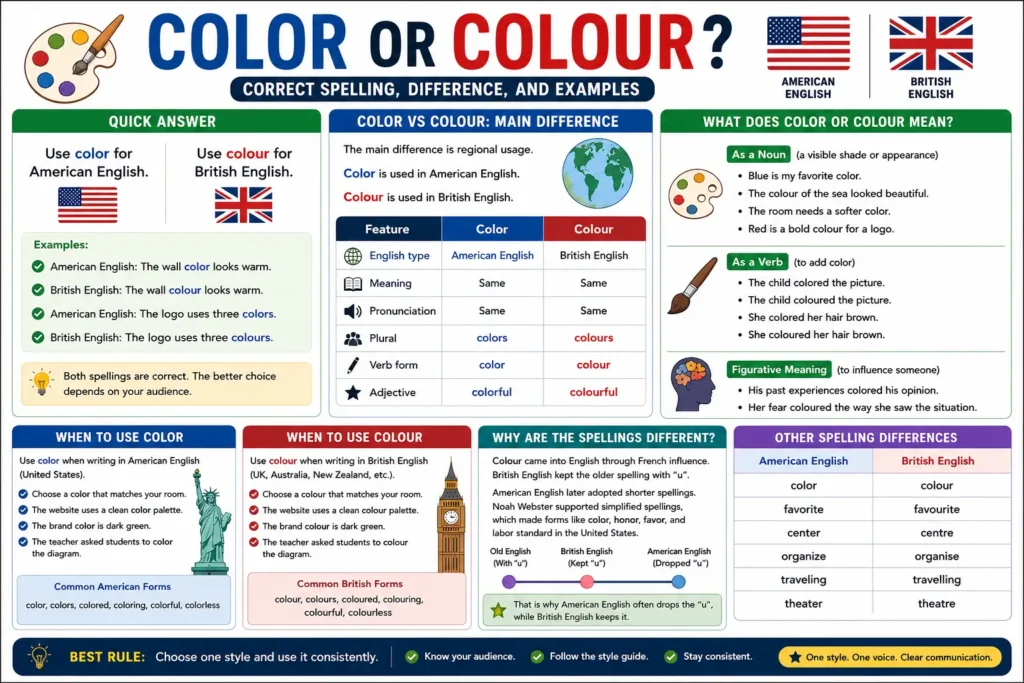
Many writers wonder whether they should use color or colour. The answer depends on the type of English you are using. Color is the standard spelling in American English, while colour is the standard spelling in British English.
Both words have the same meaning. They refer to a visible shade, hue, or appearance created by light. For example, red, blue, green, black, and white are all colors or colours, depending on your spelling style.
The main difference is not grammar or meaning. It is regional spelling. If your readers are in the United States, use color. If your readers are in the United Kingdom, Australia, New Zealand, or most British-style English regions, use colour.
The most important rule is consistency. Choose one spelling style and use it throughout your writing.
Quick Answer
Use color for American English.
Use colour for British English.
Examples:
- American English: The wall color looks warm.
- British English: The wall colour looks warm.
- American English: The logo uses three colors.
- British English: The logo uses three colours.
Both spellings are correct. The better choice depends on your audience.
Read this also: Shined vs Shone: Difference, Meaning, and Correct Usage
Color vs Colour: Main Difference
The main difference between color and colour is regional usage.
Color is used in American English.
Colour is used in British English.
They mean the same thing and are pronounced the same way. The extra u in colour only changes the spelling, not the sound.
| Feature | Color | Colour |
| English type | American English | British English |
| Meaning | Same | Same |
| Pronunciation | Same | Same |
| Plural | colors | colours |
| Verb form | color | colour |
| Adjective | colorful | colourful |
This is not about one spelling being better than the other. It is about choosing the form your readers expect.
What Does Color or Colour Mean?
Color or colour can work as a noun or a verb.
As a noun, it means the visual appearance of something.
Examples:
- Blue is my favorite color.
- The colour of the sea looked beautiful.
- The room needs a softer color.
- Red is a bold colour for a logo.
As a verb, it means to add color to something.
Examples:
- The child colored the picture.
- The child coloured the picture.
- She colored her hair brown.
- She coloured her hair brown.
The word can also have a figurative meaning. It can mean to influence someone’s thoughts, feelings, or judgment.
Examples:
- His past experiences colored his opinion.
- Her fear coloured the way she saw the situation.
Are Color and Colour Pronounced the Same?
Yes. Color and colour are pronounced the same way.
The extra u in colour does not change the sound. It only shows that the word follows British spelling.
This is why the spelling can confuse English learners. When someone says the word aloud, you cannot know which spelling they mean. The difference only appears in writing.
When to Use Color
Use color when writing in American English.
This spelling is standard in the United States. You will see it in American books, schools, websites, product pages, apps, and business writing.
Examples:
- Choose a color that matches your room.
- The website uses a clean color palette.
- The brand color is dark green.
- The teacher asked students to color the diagram.
Use color when your target readers are mainly American.
Common American forms:
| American Form | Example |
| color | What color is your car? |
| colors | The app offers five colors. |
| colored | She colored the drawing. |
| coloring | Coloring books are popular. |
| colorful | The garden looked colorful. |
| colorless | The liquid was colorless. |
If you choose American English, use the American forms throughout the article.
When to Use Colour
Use colour when writing in British English.
This spelling is standard in the United Kingdom. It is also common in Australia, New Zealand, Ireland, South Africa, and many Commonwealth countries.
Examples:
- Choose a colour that matches your room.
- The website uses a clean colour palette.
- The brand colour is dark green.
- The teacher asked students to colour the diagram.
Use colour when your target readers expect British spelling.
Common British forms:
| British Form | Example |
| colour | What colour is your car? |
| colours | The app offers five colours. |
| coloured | She coloured the drawing. |
| colouring | Colouring books are popular. |
| colourful | The garden looked colourful. |
| colourless | The liquid was colourless. |
If you choose British English, keep the British forms consistent.
Why Are the Spellings Different?
The spelling difference comes from the history of English.
The word colour came into English through French influence. British English kept the older spelling with u.
American English later adopted shorter spellings for many words. Noah Webster, an American dictionary writer, supported simplified spellings. His work helped forms like color, honor, favor, and labor become standard in the United States.
That is why American English often drops the u, while British English keeps it.
Other American and British Spelling Differences
The difference between color and colour is part of a larger spelling pattern.
| American English | British English |
| color | colour |
| favor | favour |
| honor | honour |
| labor | labour |
| neighbor | neighbour |
| behavior | behaviour |
| humor | humour |
| center | centre |
| theater | theatre |
| analyze | analyse |
These examples show that American English often uses shorter forms, while British English often keeps older spellings.
Can You Use Both Spellings in One Article?
Usually, no.
You should not mix color and colour in the same article unless you are comparing the two spellings.
Incorrect:
- Choose a wall colour that matches your furniture colors.
Correct American English:
- Choose a wall color that matches your furniture colors.
Correct British English:
- Choose a wall colour that matches your furniture colours.
Mixing both spellings can make your writing look unedited. Choose one style and use it consistently.
Color or Colour in SEO Content
For SEO content, choose the spelling your target audience uses.
If your article targets the United States, use color. If it targets the United Kingdom, Australia, or British-style English readers, use colour.
Examples:
| Target Audience | Better Keyword |
| United States | color palette |
| United Kingdom | colour palette |
| United States | hair color ideas |
| United Kingdom | hair colour ideas |
| United States | wall color trends |
| United Kingdom | wall colour trends |
Do not stuff both spellings into every sentence. That makes the writing unnatural. Use both only when the article is directly comparing color vs colour.
Colorful or Colourful?
The same rule applies to related words.
Use colorful in American English.
Use colourful in British English.
Examples:
- American English: The festival was colorful.
- British English: The festival was colourful.
More related forms:
| American English | British English |
| color | colour |
| colors | colours |
| colored | coloured |
| coloring | colouring |
| colorful | colourful |
| colorless | colourless |
| discolor | discolour |
| discoloration | discolouration |
If you use colour, use colourful too. If you use color, use colorful too.
Common Mistakes to Avoid
The biggest mistake is mixing American and British spelling in the same piece of writing.
Incorrect:
- The brand colour looks strong, but the website colors feel weak.
Correct American:
- The brand color looks strong, but the website colors feel weak.
Correct British:
- The brand colour looks strong, but the website colours feel weak.
Another mistake is thinking one spelling is always wrong. Both are correct, but they belong to different spelling styles.
Also, check your spell-check settings. If your document is set to American English, it may mark colour as incorrect. If it is set to British English, it may mark color as incorrect.
Read this also: Persue or Pursue: Correct Spelling, Meaning, and Easy Examples
Simple Rule to Remember
Use this simple rule:
- Writing for the United States? Use color.
- Writing for the United Kingdom? Use colour.
- Writing for Australia or New Zealand? Use colour.
- Writing for Canada? Use colour in most formal writing.
- Writing for a global audience? Choose one style and stay consistent.
The spelling choice is easy when you know your audience.
Quick Summary
| Question | Answer |
| Which spelling is American? | color |
| Which spelling is British? | colour |
| Do they mean the same thing? | Yes |
| Are they pronounced the same? | Yes |
| Can you use both? | Only when comparing them |
| Which is better for US SEO? | color |
| Which is better for UK SEO? | colour |
FAQs About Color or Colour
Both spellings are correct.
Color is American English, and colour is British English.
Yes, both words have the same meaning.
They refer to a visible shade, hue, or appearance.
It is not wrong, but it looks British.
For American readers, color is the standard spelling.
It is not wrong, but it looks American.
For British readers, colour is the standard spelling.
Use the spelling your target audience searches for.
Use color for US content and colour for UK or British-style audiences.
Conclusion
Color and colour have the same meaning, but they belong to different spelling styles. Use color in American English and colour in British English.The difference is not about grammar, pronunciation, or meaning. It is about regional spelling.American English uses the shorter form, while British English keeps the extra u.For clear writing, choose the spelling that matches your audience. If your readers are in the United States, use color. If they are in the United Kingdom, Australia, New Zealand, or many Commonwealth regions, use colour.Most importantly, stay consistent. Do not mix color, colour, colors, and colours without reason. A consistent spelling style makes your writing look polished, professional, and trustworthy.

2 thoughts on “Color or Colour: Correct Spelling, Difference, and Examples”