
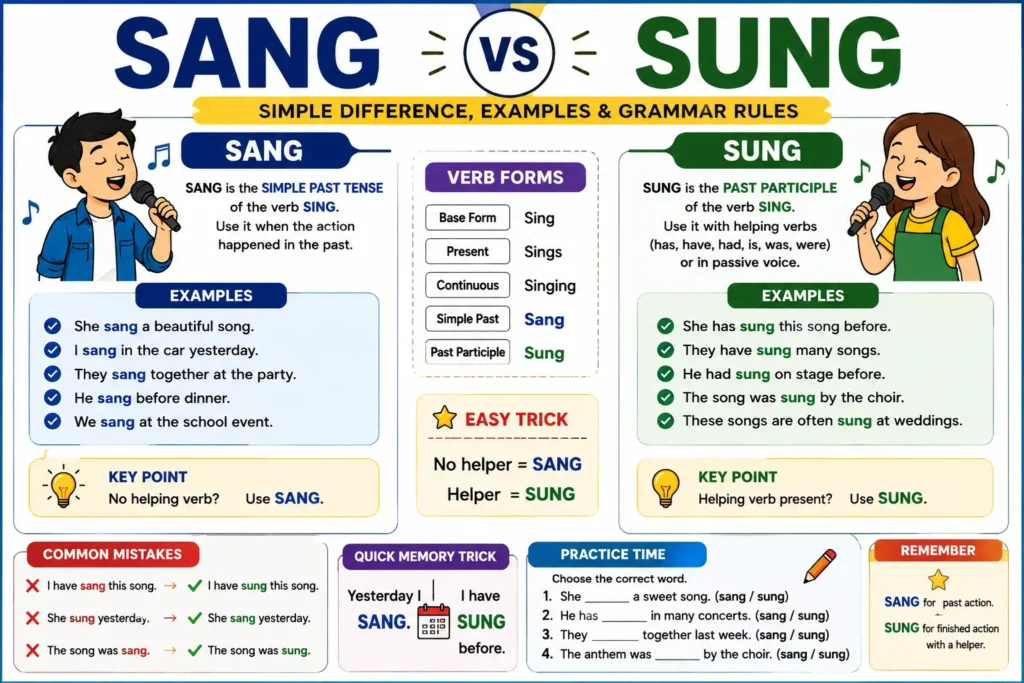
Sang vs Sung can be confusing because both words are forms of the irregular verb sing, but they serve different grammatical purposes in a sentence. Sang is the simple past tense, so you use it when talking about an action that happened in the past without a helping verb, such as “She sang at the concert last night.”
Sung, on the other hand, is the past participle, which normally appears with helping verbs such as has, have, had, or be, as in “She has sung at several concerts.” Understanding this basic difference makes it much easier to choose the correct word when writing or speaking English.A useful way to remember the difference is to focus on the verb structure around each word. If sing changes directly to a past action, use sang: “They sang together yesterday.”
If another verb helps form the tense or voice, sung is usually the correct choice: “They have sung together before” or “The song was sung beautifully.” In this guide, you’ll learn the difference between sang and sung, see clear examples in everyday sentences, understand the grammar rules behind each form, and discover an easy memory trick that can help you avoid common mistakes.
Quick Answer: Sang or Sung?
| Word | Use | Example |
|---|---|---|
| Sang | Simple past tense | She sang at the concert. |
| Sung | Past participle | She has sung at many concerts. |
Easy Rule
Use sang when there is no helping verb.
Use sung after words like has, have, had, was, or were.
Examples:
✔ I sang last night.
✔ I have sung this song before.
What Does Sang Mean?
Sang means someone performed a song in the past.
The action is finished.
Examples
- I sang in the car.
- She sang at the wedding.
- They sang after dinner.
- We sang during the school event.
- He sang beautifully last night.
Remember:
Sang usually appears without a helping verb.
Read this also: Apologize vs Apologise: Which Spelling Is Correct?
What Does Sung Mean?
Sung is the past participle of sing.
It usually comes after a helping verb.
Examples
- She has sung this song before.
- They have sung together for years.
- He had sung on stage before.
- The anthem was sung by the choir.
- These songs are often sung at weddings.
Remember:
Sung usually needs a helping verb.
Sing, Sang, Sung: Verb Forms

The verb sing is an irregular verb.
| Verb Form | Word | Example |
|---|---|---|
| Base Form | Sing | I like to sing. |
| Present | Sings | She sings well. |
| Continuous | Singing | He is singing now. |
| Simple Past | Sang | They sang yesterday. |
| Past Participle | Sung | They have sung before. |
Remember
Sing → Sang → Sung
Main Difference Between Sang and Sung
The difference is easy.
- Sang is used for simple past tense.
- Sung is used with helping verbs.
| Sentence | Correct Word |
|---|---|
| She ___ at the party. | Sang |
| She has ___ before. | Sung |
| We ___ together last week. | Sang |
| We have ___ together before. | Sung |
| The song was ___. | Sung |
When to Use Sang
Use sang when talking about a completed action in the past.
Examples
- I sang at my cousin’s wedding.
- She sang in the final round.
- We sang until midnight.
- The children sang during assembly.
- He sang one song and left.
When to Use Sung
Use sung after helping verbs or in passive voice.
Examples
- I have sung this song many times.
- She has sung in public before.
- They have sung together for years.
- The anthem was sung before the game.
- The melody has been sung for generations.
Common Mistakes
Wrong: I Have Sang
❌ I have sang this song before.
✔ I have sung this song before.
Wrong: She Sung Yesterday
❌ She sung yesterday.
✔ She sang yesterday.
Wrong: The Song Was Sang
❌ The song was sang by the choir.
✔ The song was sung by the choir.
Easy Memory Trick
Remember this sentence:
Yesterday I sang. I have sung before.
Another easy trick:
No helper = sang
Helper = sung
Read this also : Tying vs Tieing: Which Spelling Is Correct?
Practice Quiz
Choose the correct word.
- She ___ at the concert last night. (Sang)
- He has ___ this song before. (Sung)
- The anthem was ___ before the game. (Sung)
- They ___ together in school. (Sang)
- We have ___ in this choir for years. (Sung)
Similar Verbs
Many English verbs follow a similar pattern.
| Base Form | Past Tense | Past Participle |
|---|---|---|
| Sing | Sang | Sung |
| Ring | Rang | Rung |
| Drink | Drank | Drunk |
| Begin | Began | Begun |
| Swim | Swam | Swum |
FAQs
Yes. Sang is the simple past tense of sing.
Yes. Sung is the past participle of sing.
No. Say “I have sung.”
Usually no. Use sang for simple past tense.
Yes. Sung is correct in passive voice.
Conclusion
Understanding sang vs sung is easy once you learn one simple rule.
Use sang for simple past tense.
Use sung after helping verbs like has, have, had, was, and were.
Examples:
✔ She sang yesterday.
✔ She has sung before.
Remember:
No helper = sang
Helper = sung
With this simple rule, you can use both words correctly in speaking and writing.

2 thoughts on “Sang vs Sung: Meaning, Difference, and Easy Examples”