
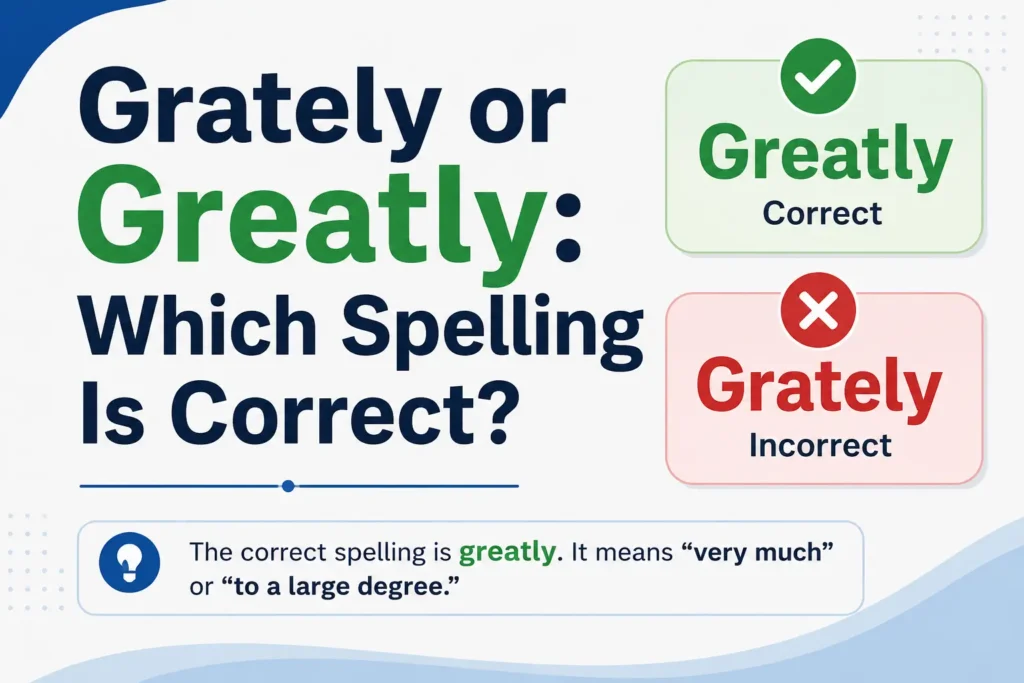
Grately or Greatly is a common spelling question, but only greatly is correct in standard English. The word grately is usually a misspelling and should not be used in formal, academic, professional, or everyday writing. Greatly is an adverb that means “very much” or “to a large degree.” For example, the correct phrase is “Your support is greatly appreciated,” not “Your support is grately appreciated.”
The confusion often happens because both spellings have a similar sound. However, the correct word formation is simple: great + ly = greatly. The full word great stays unchanged when the suffix -ly is added.
Understanding the difference between grately and greatly helps you avoid a common spelling mistake. It also improves your grammar accuracy, writing clarity, and word choice in emails, schoolwork, blog posts, social media content, and professional documents.
Quick Answer: Is It Grately or Greatly?
Greatly is the correct word in standard American English.
Grately is not the standard spelling of the adverb formed from great. Therefore, you shouldn’t use it in school assignments, emails, reports, social media posts, or professional documents.
| Spelling | Is it correct? | Meaning | Example |
| Greatly | Yes | Very much; to a large degree | Your support was greatly appreciated. |
| Grately | No | No standard meaning as an adverb | Your support was grately appreciated. |
Here’s the easiest rule to remember:
Keep the complete word great, and then add -ly: great + ly = greatly.
What Does Greatly Mean?
Greatly means very much, by a large amount, or to a considerable degree. It shows that an action, feeling, condition, or change is strong or important.
Major dictionaries classify greatly as an adverb. Its standard pronunciation is approximately “GRAYT-lee.”
Consider these examples:
- The new software greatly improved productivity.
- We greatly appreciate your patience.
- Her work has greatly influenced modern design.
- Rising costs have greatly affected small businesses.
- His condition has greatly improved.
In each sentence, greatly answers a question such as:
- How much did productivity improve?
- How strongly do we appreciate your patience?
- To what degree did her work influence design?
- How seriously were small businesses affected?
The answer is the same: to a large degree.
Read this also: ETSJavaApp Release Date: Current Status, eTrueSports Link, and Safe Download Guide
What Part of Speech Is Greatly?
Greatly is an adverb of degree. An adverb of degree tells you how much, how strongly, or to what extent something happens.
For example:
- She greatly admires her professor.
- The storm greatly damaged the coastline.
- The updated process has greatly reduced delays.
In these sentences, greatly modifies the verbs or verb phrases admires, damaged, and has reduced.
It also commonly appears before past participles, which are verb forms such as appreciated, affected, improved, and influenced:
- Your cooperation is greatly appreciated.
- The schedule was greatly affected by the weather.
- Customer service has greatly improved.
Although greatly can modify certain adjectives, it doesn’t sound natural with every adjective. For instance, greatly different is standard, but greatly happy sounds awkward. You would normally say very happy instead.
Why Grately Is Incorrect
When people write grately, they usually intend to write greatly. They remove the e from great, perhaps because some English words change before the suffix -ly is added.
However, great doesn’t lose any letters.
The correct formation is:
great + ly = greatly
Not:
grat + ly = grately
Standard American and British dictionaries both use greatly, so grately isn’t an alternative British spelling.
Why Grately Looks Like a Possible Word
The spelling grately may look believable for several reasons.
First, English spelling rules have many exceptions. For example:
- true → truly
- due → duly
- whole → wholly
A learner may assume that great changes in a similar way. It doesn’t.
Second, people often pronounce unstressed syllables quickly. When you hear greatly in fast conversation, you may not notice each letter represented in the spelling.
Finally, typing quickly can cause writers to omit the e. Spell-check normally catches the error, but it may remain in images, usernames, filenames, or text entered into design software.
Can Grately Ever Appear in Writing?
You might occasionally see Grately as a surname, username, company name, fictional term, or intentional brand spelling. Proper names don’t always follow standard dictionary spelling.
However, those rare uses don’t make grately a correct substitute for greatly.
When the intended meaning is very much or to a large degree, use greatly.
Grately vs. Greatly: The Key Difference
The difference between grately and greatly is spelling accuracy, not meaning.
Greatly is a recognized English adverb. Grately is generally a misspelling of that adverb.
| Feature | Greatly | Grately |
| Standard English word | Yes | No, not for this meaning |
| Part of speech | Adverb | None in normal usage |
| Meaning | Very much; to a large degree | Intended misspelling of greatly |
| Used in formal writing | Yes | No |
| Used in American English | Yes | No |
| Used in British English | Yes | No |
| Example | Sales increased greatly. | Sales increased grately. |
The two forms aren’t interchangeable. Replacing greatly with grately creates a spelling error.
How Great Becomes Greatly
The suffix -ly often turns an adjective into an adverb.
An adjective describes a person, place, thing, or idea:
- a great opportunity
- a quick response
- a careful driver
An adverb often describes an action:
- The opportunity greatly benefited her.
- He responded quickly.
- She drove carefully.
The Basic Spelling Pattern
For many adjectives, you can add -ly without changing the original word:
| Adjective | Adverb |
| great | greatly |
| quick | quickly |
| careful | carefully |
| serious | seriously |
| complete | completely |
| fortunate | fortunately |
Therefore, the full word great remains visible inside greatly.
When Words Change Before -ly
Some adjectives do change when they become adverbs.
Words ending in -y often replace the y with i:
- happy → happily
- easy → easily
- angry → angrily
Many words ending in -le drop the final e:
- simple → simply
- gentle → gently
- probable → probably
A few other words have irregular forms:
- true → truly
- due → duly
- whole → wholly
However, great doesn’t belong to any of these groups. Simply add -ly without removing a letter.
How to Use Greatly in a Sentence
Correct spelling is only the first step. You also need to place greatly where it clearly modifies the intended action or condition.
Greatly Before a Main Verb
Greatly often appears directly before the verb it modifies:
- I greatly admire your honesty.
- The new highway greatly reduced travel time.
- Her research greatly influenced later studies.
- Regular practice will greatly improve your pronunciation.
- Poor communication can greatly damage workplace relationships.
This position is clear and natural, especially in formal or professional writing.
Greatly After a Helping Verb
When a sentence contains a helping verb, greatly often appears between the helping verb and the main verb:
- The neighborhood has greatly changed.
- Her confidence has greatly improved.
- The project was greatly affected by supply delays.
- Energy costs have greatly increased.
- The final price may be greatly reduced.
Helping verbs include is, was, has, have, had, will, can, may, and could.
Greatly After the Main Verb
In some sentences, greatly can come after the verb:
- We appreciate your support greatly.
- The new policy benefited employees greatly.
- Her communication skills have improved greatly.
This placement is grammatically correct. Still, placing greatly before the main verb often sounds smoother:
- We greatly appreciate your support.
- The new policy greatly benefited employees.
- Her communication skills have greatly improved.
The best position depends on rhythm and emphasis.
Common Phrases With Greatly
Certain words commonly appear with greatly because the combination sounds natural to English speakers. These common pairings are called collocations.
Greatly Appreciated
Greatly appreciated means valued very much or received with strong gratitude.
Correct examples include:
- Your assistance is greatly appreciated.
- A response by Friday would be greatly appreciated.
- We greatly appreciate your continued support.
- Your patience during this transition is greatly appreciated.
This phrase is common in business emails, customer service messages, fundraising requests, and formal notices.
However, would be greatly appreciated can sometimes sound indirect:
- Your immediate response would be greatly appreciated.
A clearer professional version may be:
- Please respond by 3:00 p.m. today. Thank you for your help.
Both versions are correct. The second is simply more direct.
Greatly Missed
Greatly missed means that someone’s or something’s absence is strongly felt.
- She will be greatly missed by everyone on the team.
- His kindness is greatly missed.
- The neighborhood store has been greatly missed since it closed.
- Your presence at our weekly meetings is greatly missed.
In personal writing, deeply missed may sound more emotional. Meanwhile, greatly missed often has a respectful or formal tone.
Greatly Improved
Use greatly improved when something has become much better:
- Her reading skills have greatly improved.
- The company’s response time has greatly improved.
- Road safety was greatly improved after the redesign.
- Image quality has greatly improved in the latest version.
When possible, add specific details:
- Less precise: Customer satisfaction has greatly improved.
- More precise: Customer satisfaction rose from 72% to 89%.
The second version provides evidence instead of relying only on emphasis.
Greatly Increased and Greatly Reduced
These phrases describe a large change in amount, size, risk, cost, or frequency:
- Remote work has greatly increased schedule flexibility.
- The medication greatly reduced her discomfort.
- Heavy rain greatly increased the risk of flooding.
- Automation has greatly reduced processing time.
In data-heavy writing, a number may communicate the change more clearly:
- Processing time fell from 40 minutes to 12 minutes.
Greatly Influenced and Greatly Affected
Both phrases describe a strong effect, but their tone differs slightly.
Greatly influenced often suggests that something helped shape a decision, style, belief, or development:
- Her teaching style was greatly influenced by her first mentor.
Greatly affected means that something experienced an important effect, which may be positive or negative:
- Local businesses were greatly affected by the road closure.
Greatly Appreciated or Grately Appreciated?
The correct phrase is greatly appreciated.
- Correct: Your feedback is greatly appreciated.
- Incorrect: Your feedback is grately appreciated.
Here, greatly modifies appreciated. It tells the reader how strongly the feedback is valued.
You can use the phrase in several settings.
In a Work Email
- Your review of the attached document would be greatly appreciated.
- We greatly appreciate your flexibility during the schedule change.
In Customer Service
- Your patience is greatly appreciated while we investigate the issue.
- We greatly appreciate your business.
At School
- Parent volunteers are needed, and any help would be greatly appreciated.
- Your comments on my first draft would be greatly appreciated.
In Casual Messages
The phrase is correct in casual communication, but it may sound formal. You might choose a warmer alternative:
- I’d really appreciate your help.
- Thanks so much for helping.
- Your help would mean a lot.
Greatly Missed or Grately Missed?
The correct phrase is greatly missed.
- Correct: She will be greatly missed.
- Incorrect: She will be grately missed.
The phrase often appears in retirement messages, farewell notes, memorial writing, and workplace announcements.
For example:
- After 25 years of service, Mr. Carter will be greatly missed by students and staff.
- Her warmth, humor, and leadership will be greatly missed.
- The old community center is greatly missed by local families.
More personal alternatives include:
- We’ll miss her so much.
- His absence is deeply felt.
- Things haven’t been the same without him.
When Greatly Sounds Natural
Greatly is standard English, but its tone is usually neutral to formal. It sounds most natural when describing a strong effect, change, feeling, or judgment.
Professional Writing
In business communication, greatly can sound polished and respectful:
- The new system has greatly improved workflow efficiency.
- We greatly value our relationship with your organization.
- Delayed shipments have greatly affected production.
- Your cooperation would be greatly appreciated.
However, clear details are still important. Don’t use greatly to hide weak or vague claims.
Academic Writing
Academic writers may use greatly to describe a strong influence or change:
- Access to clean water greatly affects public health.
- Temperature changes greatly influenced seedling development.
- The revised method greatly reduced measurement errors.
Still, researchers should use precise figures when available. Also, don’t replace greatly with significantly unless the context supports that choice. In research, statistically significant has a technical meaning based on statistical analysis.
Everyday Conversation
Although greatly is grammatically correct in conversation, Americans often choose really, a lot, or very much instead.
Compare these sentences:
| More formal | More conversational |
| I greatly enjoyed the presentation. | I really enjoyed the presentation. |
| Your help is greatly appreciated. | I really appreciate your help. |
| The change greatly affected me. | The change affected me a lot. |
| We greatly admire her. | We admire her so much. |
Neither style is automatically better. Choose the version that matches the situation.
Greatly vs. Very, Really, and Significantly
Words that express degree aren’t always interchangeable. Each one has its own grammar patterns and tone.
| Word | Typical tone | Common use | Example |
| Greatly | Neutral to formal | Verbs, changes, effects, participles | The update greatly improved security. |
| Very | Neutral | Adjectives and adverbs | The update was very effective. |
| Really | Neutral to casual | Verbs, adjectives, and emphasis | The update really helped. |
| Significantly | Formal or technical | Important or measurable differences | Costs decreased significantly. |
| Deeply | Emotional or serious | Feelings, beliefs, and personal effects | We were deeply concerned. |
| Considerably | Formal | Large differences in degree or amount | Wait times were considerably shorter. |
Greatly vs. Very
Very usually modifies adjectives and other adverbs:
- very happy
- very useful
- very slowly
- very expensive
Greatly more often modifies verbs or participles:
- greatly improved
- greatly admired
- greatly reduced
- greatly appreciated
Therefore, this sentence sounds unnatural:
- Awkward: She was greatly happy with the result.
Use:
- Natural: She was very happy with the result.
However, greatly works with certain adjectives:
- The two plans are greatly different.
- This model is greatly superior to the older version.
The choice depends on natural usage, not only a simple grammar formula.
Greatly vs. Really
Really is more flexible and conversational:
- I really enjoyed the movie.
- The new chair is really comfortable.
- We really appreciate your help.
Greatly creates a more formal tone:
- I greatly enjoyed the lecture.
- We greatly appreciate your assistance.
In a text message to a friend, really will usually sound more natural. In a formal letter, greatly may be a better fit.
Greatly vs. Significantly
Both words can describe a large change:
- Sales greatly increased.
- Sales significantly increased.
However, significantly often suggests that the change is important, noticeable, or measurable.
In scientific writing, it may also refer to a statistical result. Therefore, don’t use it merely as a more impressive synonym for greatly when no statistical test supports the claim.
Greatly vs. Deeply
Deeply often emphasizes emotional intensity:
- deeply worried
- deeply grateful
- deeply affected
- deeply committed
Greatly usually emphasizes degree more generally:
- greatly improved
- greatly reduced
- greatly admired
- greatly appreciated
Both may be correct in some sentences, but the emotional tone changes:
- We were greatly concerned about the delay.
- We were deeply concerned about the child’s safety.
The second sentence feels more personal and serious.
Synonyms for Greatly
The best synonym depends on meaning, tone, and context.
Formal Alternatives
- significantly
- considerably
- substantially
- profoundly
- materially
- immensely
Examples:
- The redesign substantially reduced maintenance costs.
- Her discoveries profoundly influenced the field.
- The error materially affected the financial report.
Neutral Alternatives
- very much
- strongly
- to a large extent
- by a large amount
- markedly
Examples:
- We strongly support the proposal.
- The two versions differ to a large extent.
- His performance has markedly improved.
Casual Alternatives
- really
- a lot
- so much
- by far
Examples:
- The course really helped me.
- Her confidence improved a lot.
- We appreciate you so much.
Choosing the Right Synonym
Don’t replace greatly without checking the full sentence.
For example:
- Original: The medication greatly reduced the pain.
- Formal: The medication substantially reduced the pain.
- Casual: The medication helped a lot.
- Precise: The medication reduced reported pain by 40%.
The last version is best when verified data is available.
Great, Greatly, Grateful, and Gratefully
Several similar-looking words create spelling confusion.
| Word | Part of speech | Meaning | Example |
| Great | Adjective | Excellent, important, or large | She did a great job. |
| Greatly | Adverb | Very much or to a large degree | Her work greatly improved. |
| Grateful | Adjective | Thankful | I’m grateful for your help. |
| Gratefully | Adverb | In a thankful way | She gratefully accepted the offer. |
| Grate | Verb or noun | To shred, irritate, or hold fuel in a fireplace | Grate the cheese carefully. |
A common mistake is writing greatful instead of grateful.
- Correct: I’m grateful for your support.
- Incorrect: I’m greatful for your support.
This may seem inconsistent because greatly keeps the full word great, while grateful doesn’t contain great. However, the two words have different histories and spelling patterns. Learn each spelling as a separate word.
Common Mistakes With Greatly
Misspelling It as Grately
- Incorrect: We grately value your opinion.
- Correct: We greatly value your opinion.
Remember that great stays complete.
Confusing Great With Greatly
Great is usually an adjective, while greatly is an adverb.
- Correct: She made a great improvement.
- Correct: Her writing greatly improved.
- Incorrect: Her writing great improved.
Use great before a noun. Use greatly to describe the degree of an action or change.
Using Greatly With an Unnatural Adjective
- Awkward: The children were greatly excited.
This sentence isn’t necessarily ungrammatical, but Americans would more naturally say:
- The children were very excited.
- The children were really excited.
Natural word combinations matter as much as basic grammar rules.
Overusing Greatly
Repeating greatly makes writing sound mechanical.
Weak version:
The new manager greatly improved communication, greatly reduced delays, and greatly increased employee satisfaction.
Improved version:
The new manager improved communication, reduced delays, and raised employee satisfaction across the department.
You don’t need an intensifier before every verb. Strong verbs and specific evidence often communicate more clearly.
Using Redundant Wording
Avoid combining greatly with another phrase that repeats the same meaning.
- Wordy: Costs were greatly reduced by a lot.
- Better: Costs were greatly reduced.
- Better: Costs were reduced by 35%.
Similarly, avoid phrases such as:
- greatly increased considerably
- greatly improved a great deal
- greatly reduced significantly
Choose one clear expression of degree.
Placing Greatly Too Far From the Verb
Unclear placement can make the sentence harder to read.
- Awkward: The company changed its customer service policy after receiving complaints greatly.
- Better: The complaints greatly influenced the company’s customer service policy.
- Better: After receiving many complaints, the company changed its customer service policy.
Place greatly close to the word or phrase it modifies.
Real-Life Examples of Greatly
Workplace Email
We greatly appreciate the time you spent reviewing the proposal. Your suggestions helped us clarify the timeline and budget.
Here, greatly appreciate sounds respectful and professional.
School Assignment
The invention of the printing press greatly increased access to written information.
The adverb shows that the increase was large or important.
Customer Service Message
Shipping delays have greatly affected delivery times in several regions.
This sentence explains the extent of the effect without sounding overly emotional.
Social Media Post
Thanks to everyone who donated. Your support is greatly appreciated!
The phrase works, although We really appreciate your support would sound more conversational.
Academic Report
Water availability greatly influenced plant growth during the early development stage.
The sentence is clear, but adding measurements would make the claim stronger when data is available.
Memorial or Farewell Message
Her kindness, patience, and sense of humor will be greatly missed.
This is a respectful and natural use of the phrase.
A Practical Case Study: One Missing Letter
Imagine a small business sends this message to hundreds of customers:
Your continued support is grately appreciated.
Readers will probably understand the intended meaning. However, the missing e may make the message look rushed or poorly reviewed. That matters because customer-facing text represents the business.
The corrected version is:
Your continued support is greatly appreciated.
An even warmer option is:
We greatly appreciate your continued support.
This example shows why proofreading headings, email subject lines, advertisements, and graphics is important. A small spelling mistake can distract readers from an otherwise professional message.
Easy Ways to Remember the Correct Spelling
Keep Great Inside Greatly
Look at the word in two parts:
GREAT + LY
The complete spelling of great appears at the beginning.
Connect It With “To a Great Degree”
Greatly means to a great degree.
Both expressions contain great, so the meaning can remind you of the spelling.
Memorize a Common Phrase
Use this model sentence:
Your help is greatly appreciated.
Once the phrase becomes familiar, the spelling will feel more natural.
Say the Word in Two Parts
Pronounce it slowly:
great + lee
This method can help you remember the t and e before -ly.
Proofreading Tips for Catching Grately
Before publishing or submitting your work:
- Search the document for grately.
- Use spell-check, but don’t depend on it completely.
- Read important sentences aloud.
- Review titles and headings separately.
- Check email subject lines before sending.
- Inspect text inside graphics and social media images.
- Proofread on a different screen or device.
- Ask another person to review important public documents.
Text inside an image may not be checked by your writing software. Therefore, pay special attention to posters, advertisements, presentations, and website banners.
Correct and Incorrect Examples
| Incorrect sentence | Correct sentence | Explanation |
| Your help is grately appreciated. | Your help is greatly appreciated. | Greatly is the correct spelling. |
| The update great improved performance. | The update greatly improved performance. | An adverb is needed to modify improved. |
| I am greatly happy today. | I am very happy today. | Very sounds more natural with happy. |
| Sales greatly increased a lot. | Sales greatly increased. | A lot repeats the same idea. |
| She did greatly on the test. | She did great on the test. | Great is common here in informal American English. |
| We grately admire her courage. | We greatly admire her courage. | Keep the full word great. |
| His skills have great improved. | His skills have greatly improved. | Greatly modifies the verb phrase. |
| I’m greatful for your advice. | I’m grateful for your advice. | Grateful has a different spelling. |
Quick Practice: Grately or Greatly?
Choose the correct word for each sentence.
- Your cooperation is grately / greatly appreciated.
- The new schedule has great / greatly reduced confusion.
- We were greatly / very happy to hear the news.
- Her presentation skills have grately / greatly improved.
- The two designs are greatly / great different.
- I greatly / very admire her honesty.
- The repairs reduced noise greatly / great.
- The team was greatly / really excited about winning.
Answers
- Greatly — It correctly modifies appreciated.
- Greatly — An adverb is needed to modify reduced.
- Very — Very happy is the more natural combination.
- Greatly — Grately is misspelled.
- Greatly — It modifies the adjective different.
- Greatly — It modifies the verb admire.
- Greatly — It explains how much the noise was reduced.
- Really — Really excited sounds more natural in everyday American English.
Frequently Asked Questions
Q1: Is grately a correct English word?
No, grately is not the correct spelling when you mean “very much” or “to a large degree.” It is usually a misspelling of greatly. In standard English, you should always use greatly.
Q2: What does greatly mean?
Greatly means very much, considerably, or to a large extent. It is an adverb that shows how strongly an action or change happens.
For example:
- The new plan greatly improved productivity.
- We greatly appreciate your help.
Q3: Is it greatly appreciated or grately appreciated?
The correct phrase is greatly appreciated.
Correct: Your feedback is greatly appreciated.
Incorrect: Your feedback is grately appreciated.
Here, greatly modifies the word appreciated and shows that the feedback is valued very much.
Q4: How can I remember the correct spelling of greatly?
Keep the complete word great and add -ly:
great + ly = greatly
A useful memory phrase is “Your help is greatly appreciated.” Remembering this common expression can help you avoid writing grately.
Q5: Can greatly be used in formal and informal writing?
Yes, greatly is correct in both formal writing and informal writing. However, it often sounds more natural in professional, academic, or respectful communication.
For example:
- Formal: We greatly appreciate your cooperation.
- Informal: We really appreciate your help.
Both sentences are correct, but the second sounds more conversational.
Conclusion
When choosing between Grately or Greatly, always use greatly. It is the correct English adverb meaning “very much” or “to a great degree,” while grately is normally a spelling mistake.
You can use greatly in phrases such as greatly appreciated, greatly improved, greatly affected, and greatly missed. These combinations are common in professional writing, academic writing, emails, reports, and everyday communication.
The easiest way to remember the correct spelling is to keep the full word great and add -ly. Following the simple pattern great + ly = greatly will improve your grammar accuracy, strengthen your writing skills, and make your meaning clear to every reader.
