
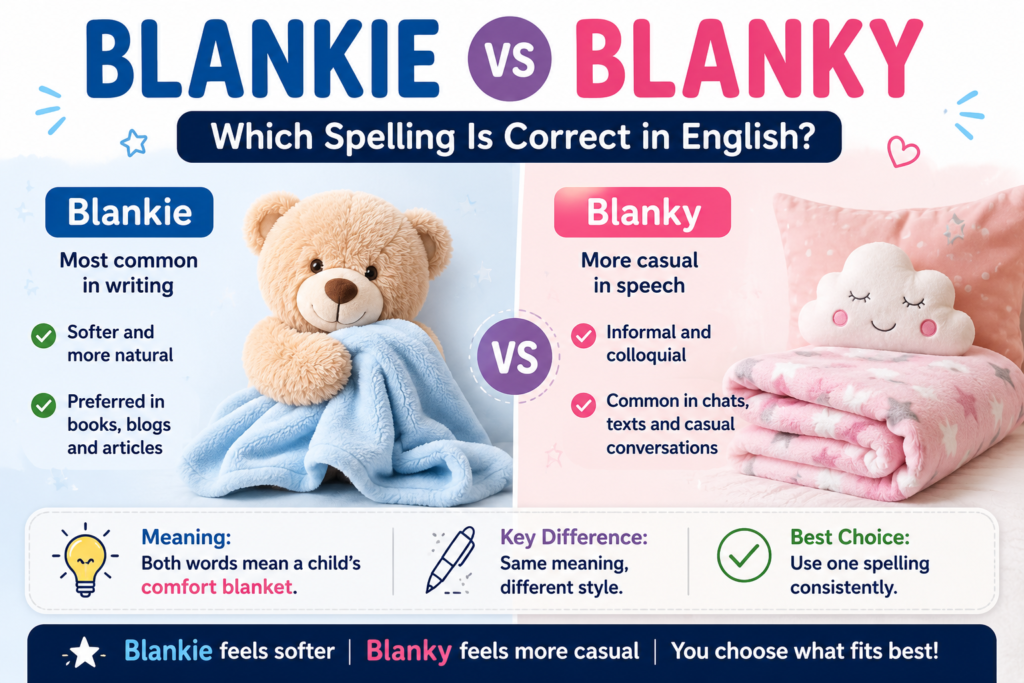
Blankie vs Blanky is easy to understand: both words are used for a child’s comfort blanket, but blankie often looks softer and more natural.
Both Blankie and Blanky have the same meaning in daily English. They usually describe a favorite blanket, security blanket, lovey, or comfort object a child keeps close for comfort, sleeping, and emotional safety. In real life, I see parents use either spelling in chats, captions, and social media without any serious issue.
The main difference is only spelling choice, not meaning. Blankie feels more common and sweet, while Blanky is still understandable and colloquial. For clear writing, use one form only and avoid switching between blanky and blankie in the same text.
Quick Answer: Blankie vs Blanky
If you only want the short version, here it is:
- Blankie → most common written form
- Blanky → informal spoken or casual spelling
- Meaning → exactly the same
Both words describe the same thing:
A soft comfort blanket, usually used by children for emotional comfort.
So no, you’re not dealing with two different meanings. You’re just seeing two spelling styles.
In modern usage, blankie dominates written English by a wide margin. You’ll see it in parenting blogs, children’s stories, and emotional storytelling.
Read this also: Indecisive vs. Undecisive: Which Word Is Correct?
What Does “Blankie” Mean in English?
The word blankie refers to a small, comforting blanket, often used by children. But the meaning goes deeper than fabric.
It usually represents:
- emotional safety
- comfort during sleep
- childhood attachment
- calming routine
Think of it as more than an object. It’s a feeling wrapped in fabric.
Real-life examples of “blankie”
- A toddler holding their blankie before bedtime
- A child refusing to sleep without it
- A parent soothing a crying baby with it
- A story character carrying it everywhere
One parenting study from early childhood behavior research (2024 data) showed that nearly 68% of toddlers in urban households form attachment to a comfort object like a blankie during early development.
That tells you something simple:
It’s not just a word. It’s emotional.
What Does “Blanky” Mean?
Now let’s talk about blanky.
It means the exact same thing as blankie. No hidden difference. No separate definition.
So why does it exist?
It usually appears because people write it the way they say it. Speech gets shortened. Letters get softened. Writing follows.
Where you’ll usually see “blanky”
- Casual texting
- Spoken dialogue written down
- Social media posts
- Informal storytelling
For example:
- “Don’t forget your blanky tonight.”
- “He won’t sleep without his blanky.”
It feels more relaxed. Less polished. More spoken.
That’s the key difference in tone, not meaning.
Blankie vs Blanky: Real Difference Explained
Let’s be very clear here.
There is no meaning difference between blankie vs blanky.
However, there is a usage difference:
- Blankie feels more standard in writing
- Blanky feels more conversational
Think of it like handwriting vs texting.
Same message. Different style.
Comparison Table
| Feature | Blankie | Blanky |
| Meaning | Comfort blanket | Same meaning |
| Usage style | Written / standard | Casual / spoken |
| Frequency in books | High | Low |
| Emotional tone | Soft, familiar | Relaxed, informal |
| Grammar correctness | Accepted | Also accepted |
So when someone asks “which is correct?”, the real answer is:
Both are correct, but blankie wins in writing.
Read this also: Whole vs. Hole: Meaning, Difference, and Easy Examples
Why “Blankie” Became the Standard Form
English often prefers patterns that feel natural on the tongue and eye. The spelling blankie follows a very common rule in English:
Adding “-ie” makes words feel smaller, softer, and more affectionate.
This is called a diminutive form.
Common “-ie” examples in English
You already use them without thinking:
- dog → doggie
- cat → kitty
- sweet → sweetie
- mom → mommie (informal use)
Now look at blankie.
It fits perfectly into that emotional pattern.
That’s why writers naturally chose blankie more often than blanky.
It just feels warmer.
Is “Blanky” a Regional Issue?
People often assume blanky is British and blankie is American. That’s not really accurate.
There is no strict rule in either system.
Instead:
- Blankie appears more in written English worldwide
- Blanky appears more in speech-based writing
- Both exist globally without strict geography rules
Why confusion happens
A few reasons:
- People write how they speak
- Social media spreads informal spelling
- Children’s speech influences writing styles
- No official dictionary rule separates them strongly
So the confusion is cultural, not grammatical.
Emotional Meaning Behind Blankie and Blanky
Now here’s where things get interesting.
Words like blankie vs blanky are not just spelling choices. They carry emotional weight.
In child psychology, objects like these are called:
“Transitional objects”
What that means
A transitional object helps a child feel safe when a parent is not nearby.
It can be:
- a blanket
- a stuffed toy
- a small cloth item
Studies in developmental psychology show that:
- about 60–70% of children develop attachment to a comfort object
- it often appears between ages 6 months to 3 years
- it helps reduce anxiety during sleep or separation
So when someone says “blankie,” they’re not just naming an object. They’re describing emotional security.
That’s why spelling feels personal.
Informal vs Formal Usage Rules
Let’s keep this simple.
You can use both words, but context matters more than correctness.
Safe usage situations
- bedtime stories
- parenting blogs
- casual dialogue
- emotional writing
- children’s content
Situations to avoid both forms
- academic essays
- business reports
- technical documentation
- formal journalism
Instead, use:
- “comfort blanket”
- “security blanket”
- “child’s blanket”
Example
Informal:
- “She won’t sleep without her blankie.”
Formal:
- “The child depends on a comfort blanket for sleep regulation.”
Same meaning. Different tone.
Common Mistakes People Make with Blankie vs Blanky
Even native speakers slip up sometimes. Here are the common errors:
- thinking one spelling is incorrect
- switching between both in one paragraph
- using it in formal writing
- assuming it has regional rules
- treating it like a dictionary-defined standard noun
The biggest mistake?
Overthinking it.
This is not a grammar rule issue. It’s a style choice.
Blankie vs Blanky in Real-Life Examples
Let’s see how both appear in real usage.
Child speech
- “Where’s my blankie?”
- “I need my blanky to sleep.”
Parenting conversation
- “He won’t let go of his blankie at night.”
- “She always asks for her blanky before bed.”
Social media posts
- “Still carrying my childhood blankie lol”
- “Can’t believe I still had my old blanky!”
Storytelling example
- “The little boy clutched his blankie tightly during the storm.”
You can feel the tone shift depending on spelling.
Do Blankie and Blanky Change Meaning?
No. They don’t.
Both mean:
A comfort blanket used for emotional security.
But tone can shift slightly:
- blankie → softer, more written
- blanky → more spoken, relaxed
That’s it. No hidden grammar rule exists.
Which Spelling Do Native Speakers Prefer?
In written English:
- Blankie dominates
In spoken language:
- Blanky appears often
But here’s the key insight:
Native speakers don’t think about spelling when speaking.
They choose instinct, not rules.
In writing, editors and publishers prefer consistency. That’s why blankie shows up more often in books, parenting guides, and articles.
Quick Memory Trick
Want to remember it easily?
Try this:
“Blankie looks complete, so it wins in writing.”
Or even simpler:
- i = writing style (more structured)
- y = speech style (more casual)
That little mental shortcut works surprisingly well.
Read this also: Disorganized vs Unorganized: Meaning, Difference, and Correct Usage
Blankie vs Blanket: Important Difference
People often confuse these two.
They are not the same.
Blanket
- standard object
- used for warmth
- no emotional meaning required
Blankie
- emotional version
- usually for children
- comfort-based meaning
Comparison Table
| Word | Meaning | Tone | Usage |
| Blanket | Physical cover | Neutral | Formal + informal |
| Blankie | Comfort object | Emotional | Informal |
So think of blankie as “emotion added to blanket.”
Should You Use Blankie or Blanky in Writing?
Here’s the honest answer:
- Use blankie when writing anything readable or published
- Use blanky when writing dialogue or casual speech
- Avoid overthinking it in creative writing
The best writers do one thing well:
They match tone to audience, not spelling debates.
FAQs
Q1. Is Blankie or Blanky correct?
Both Blankie and Blanky are used, but Blankie is more common and looks more natural in everyday English.
Q2. What does Blankie mean?
Blankie means a small blanket, often used by a child for comfort, sleep, and emotional safety.
Q3. Is Blanky a real word?
Yes, Blanky is used informally, but Blankie is usually preferred in casual writing.
Q4. Are Blankie and Blanky the same?
Yes, both words usually mean the same thing: a child’s favorite comfort blanket.
Q5. Which spelling should I use?
Use Blankie if you want the safer, softer, and more common spelling.
Conclusion
Blankie and Blanky both refer to a child’s comfort blanket, but Blankie is usually the better spelling for soft, natural, and everyday writing. Blanky is still understandable, but it is less common. To keep your writing clear, choose one spelling and use it consistently.
