
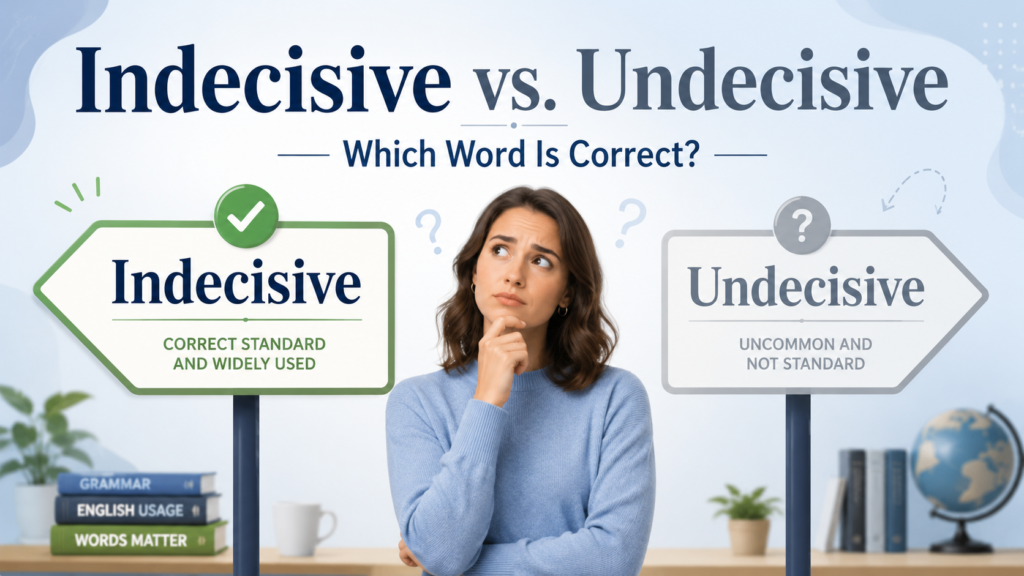
Indecisive vs. undecisive seems confusing, but standard English accepts indecisive as the clear, correct form for modern writing and everyday speech. The adjective describes a person who cannot make decisions easily. Undecisive may look logical, yet it remains a rare and uncommon form.
The confusion comes from negative prefixes. English uses in- in indecisive and un- in undecided, but not every word follows the same pattern. Because both forms sound similar, learners may mix them up. A simple rule helps: use indecisive for difficulty choosing and undecided for one open decision.
This guide gives English learners, students, beginners, and writers a clear explanation of the meaning, grammar, usage rules, and sentence usage. Practical examples improve writing accuracy and show natural usage. When the choice feels unsure, remember the word family: decisive, indecisive, decision, and indecision. This approach also prevents common mistakes in professional communication.
Quick Answer: Indecisive or Undecisive?
Use indecisive in standard modern English.
The word means unable or slow to make a decision. It may also describe something that fails to produce a definite conclusion.
Undecisive is a rare alternative. Although some dictionaries record it, most speakers, editors, teachers, and professional writers prefer indecisive.
| Word | Modern Status | Main Meaning | Recommended Use |
| Indecisive | Standard and widely accepted | Unable to decide or not producing a clear result | Use in everyday, academic, and professional writing |
| Undecisive | Rare and unfamiliar | Similar in meaning to indecisive | Avoid unless discussing unusual or historical usage |
Consider these examples:
- Preferred: Maria felt indecisive about which course to take.
- Rare and distracting: Maria felt undecisive about which course to take.
The second sentence may still make sense. However, its unusual word choice can distract readers.
Best practice: Choose “indecisive” whenever you mean unable to decide.
What Does Indecisive Mean?
Indecisive is an adjective. It usually describes a person who finds it difficult to make a choice.
For example:
- Ben is indecisive when he reads a long restaurant menu.
- I felt indecisive about accepting the new job.
- The customer remained indecisive after comparing both products.
In each sentence, someone struggles to choose between possible options.
However, the word has more than one use. It can describe people, behavior, leadership, communication, and outcomes.
Unable or Slow to Decide
This is the most familiar meaning.
An indecisive person may:
- Delay making a choice
- Change their mind repeatedly
- Ask for more time
- Compare the same options again
- Worry about making the wrong decision
- Avoid committing to one plan
For example:
Liam wanted to order quickly, but he became indecisive after seeing twenty different pizzas.
The sentence doesn’t mean Liam lacks intelligence. It simply means he has trouble choosing at that moment.
Lacking Firm Direction
The word can also describe behavior or communication that doesn’t show a clear decision.
Examples:
- Her indecisive answer confused the client.
- The manager’s indecisive response delayed the project.
- His indecisive tone suggested that the plan might change.
- The committee took an indecisive approach to the problem.
Here, the focus falls on the response, tone, or action rather than the person’s entire personality.
Producing No Clear Result
In a less common sense, indecisive can describe a contest, battle, debate, election, or event that settles nothing.
Examples:
- The debate ended with an indecisive result.
- The opening round proved indecisive.
- The battle was costly but indecisive.
In modern everyday writing, inconclusive often sounds more natural for research, evidence, tests, and medical findings.
Compare:
- Less natural: The laboratory results were indecisive.
- More natural: The laboratory results were inconclusive.
Is Undecisive a Real Word?
The answer needs a little care.
Undecisive isn’t completely invented. Some dictionaries record it as an alternative form related to indecisive. You may also find it in historical texts, regional writing, or unedited online content.
Still, dictionary recognition doesn’t mean two forms have equal status.
A dictionary may record a word because people have used it. That doesn’t automatically make it the clearest choice for present-day communication.
In most situations, undecisive can create three problems:
- Spell-checking software may flag it.
- Readers may assume it is a spelling mistake.
- Editors may replace it with indecisive.
Therefore, use indecisive in:
- Essays
- Exams
- Applications
- Résumés
- Cover letters
- Business emails
- Reports
- News articles
- Website content
- Social media posts
Rare forms can interest language historians. Everyday writers usually need the form readers recognize immediately.
Indecisive and Undecisive: Key Differences
The two words share a similar intended meaning, but their usage differs sharply.
| Feature | Indecisive | Undecisive |
| Part of speech | Adjective | Adjective |
| Basic meaning | Unable to decide; not conclusive | Similar intended meaning |
| Common in modern English | Yes | No |
| Suitable for formal writing | Yes | Usually best avoided |
| Familiar to most readers | Yes | Often unfamiliar |
| Standard in American English | Yes | Rare |
| Standard in British English | Yes | Rare |
| Recommended choice | Yes | No, in most contexts |
The practical difference is simple: indecisive communicates smoothly, while undecisive may make readers pause.
Good writing should remove unnecessary obstacles. When two words express the same basic idea, choose the one your audience already knows.
Why Is Indecisive the Standard Form?
The word combines the negative prefix in- with decisive.
The structure looks like this:
in- + decisive = indecisive
In this use, in- means “not” or “lacking.”
English uses the same negative prefix in many familiar words:
| Positive Form | Negative Form |
| complete | incomplete |
| accurate | inaccurate |
| capable | incapable |
| active | inactive |
| direct | indirect |
| decisive | indecisive |
However, English also uses un- to create negative words:
- certain → uncertain
- willing → unwilling
- clear → unclear
- decided → undecided
- known → unknown
That overlap explains the confusion. Both prefixes can express negation, but writers cannot exchange them freely.
English word formation follows established usage. We say inaccurate, not unaccurate. We say uncertain, not incertain in ordinary modern English. Likewise, we normally say indecisive, not undecisive.
Language isn’t always a tidy machine. Sometimes, convention wins.
Why Do People Say Undecisive?
The unusual form sounds believable for several reasons.
Undecided Is Correct
The strongest source of confusion is the standard word undecided.
Compare these forms:
- decide
- decided
- undecided
- decisive
- indecisive
Because undecided begins with un-, a learner may assume undecisive must follow the same pattern.
However, the two adjectives developed through different established forms:
- decisive → indecisive
- decided → undecided
Both are correct, but they don’t mean exactly the same thing.
Un- Feels Natural
English speakers regularly add un- to adjectives. Therefore, undecisive may feel logical even to someone who has never seen it in careful writing.
That logic isn’t foolish. It simply conflicts with modern convention.
People Copy Unedited Writing
A word can spread quickly through:
- Comments
- Forums
- Text messages
- Social media posts
- Automatically generated content
- Poorly edited websites
Seeing a word online proves that someone used it. It doesn’t prove that editors recommend it.
Sound Offers Little Help
The prefixes in- and un- are both unstressed in many sentences. During quick speech, listeners may focus more on the stronger syllables in decisive.
As a result, spelling from sound can lead writers in the wrong direction.
Indecisive vs. Undecided
These words overlap, but they aren’t perfect substitutes.
Indecisive often describes a tendency, personality trait, behavior, or style of decision-making.
Undecided describes a choice that hasn’t been made yet.
| Word | Main Focus | Example |
| Indecisive | Difficulty making decisions | He is indecisive when choosing investments. |
| Undecided | A decision remains unresolved | He is undecided about this investment. |
Consider a shopper named Ava.
Ava can be indecisive because she often struggles to choose between products. Today, she may be undecided about whether to buy the blue coat or the black one.
The first word describes her decision-making pattern. The second describes one unfinished choice.
When Indecisive Fits Better
Use it when you mean:
- Someone regularly struggles to choose
- A response lacks firmness
- Leadership lacks direction
- An action appears hesitant
- A result settles nothing
Example:
The director seemed indecisive during the crisis.
When Undecided Fits Better
Use it when:
- A choice remains open
- Someone needs more information
- No final position has been selected
- A vote or contest remains unresolved
Example:
The director is still undecided about the new policy.
That sentence doesn’t necessarily criticize the director. A careful person may remain undecided for a good reason.
Indecisive vs. Ambivalent
Writers often confuse indecisive with ambivalent.
Indecisive means unable to choose.
Ambivalent means having mixed or conflicting feelings.
A person can feel ambivalent without needing to make a decision. Likewise, someone can be indecisive even when both choices feel equally good.
Compare:
- She felt indecisive because both apartments met her needs.
- She felt ambivalent because she wanted to move but hated leaving her neighborhood.
In the first sentence, she cannot choose.
In the second, she holds opposing feelings.
Sometimes, both words fit:
He felt ambivalent about the promotion, which made him indecisive about accepting it.
His mixed feelings caused his difficulty choosing.
Indecisive vs. Hesitant
Hesitant describes someone who pauses or acts slowly because of doubt, fear, or uncertainty.
Indecisive focuses more directly on difficulty choosing.
Examples:
- Rosa was hesitant to speak in front of the crowd.
- Rosa was indecisive about which topic to discuss.
A hesitant person may already know what they want but feel nervous about acting. An indecisive person may not know which option to select.
Indecisive vs. Uncertain
Uncertain has a broader meaning. It can describe a lack of knowledge, confidence, or predictability.
Examples:
- I am uncertain whether the train will arrive on time.
- I am indecisive about whether to take the train or drive.
The first sentence concerns missing knowledge.
The second concerns a difficult choice.
Indecisive vs. Inconclusive
Use inconclusive when evidence, research, tests, or results fail to provide a definite answer.
Examples:
- The evidence was inconclusive.
- The medical test produced inconclusive results.
- The study reached an inconclusive conclusion.
The last example sounds repetitive. A cleaner version would be:
The study produced no firm conclusion.
Although indecisive can describe a result that settles nothing, inconclusive usually sounds more precise in research and analysis.
Is Indecisive Always Negative?
The word often carries a mildly critical tone.
Calling someone indecisive may suggest that they:
- Waste time
- Avoid responsibility
- Lack confidence
- Delay other people
- Change direction too often
For example:
The team grew frustrated with its indecisive manager.
This sentence clearly criticizes the manager.
However, difficulty deciding doesn’t always reveal a character flaw. A person may need more time because:
- The decision carries serious consequences.
- Important information is missing.
- Several choices offer equal value.
- The risks remain unclear.
- Other people need to give input.
In these cases, a neutral phrase may sound fairer:
- She hasn’t decided yet.
- He needs more information.
- The committee is still reviewing its options.
- They haven’t reached a decision.
Word choice shapes tone. Describe the situation accurately rather than attaching a harsh label too quickly.
How to Use Indecisive Correctly
The adjective can modify people, behavior, responses, leadership, and outcomes.
Describing a Person
- I become indecisive when a menu offers too many choices.
- The buyer seemed indecisive during the final meeting.
- An indecisive customer may need a clear comparison.
Describing Behavior
- Her indecisive behavior slowed the discussion.
- His indecisive manner made everyone nervous.
- Repeated changes created an indecisive approach.
Describing Communication
- The email sounded polite but indecisive.
- His indecisive answer left the question unresolved.
- The spokesperson gave an indecisive response.
Describing Leadership
- Indecisive leadership can leave employees without priorities.
- The board criticized the CEO’s indecisive reaction.
- During an emergency, an indecisive leader may lose valuable time.
Describing an Outcome
- The debate ended with an indecisive result.
- The first round remained indecisive.
- Neither side gained an advantage in the indecisive battle.
Use this final meaning carefully. For tests and research, inconclusive often fits better.
Real-Life Examples
Clear examples reveal how the word behaves outside grammar exercises.
Daily Decisions
- I’m indecisive about what to cook tonight.
- She felt indecisive while choosing a dress.
- Too many options can make anyone indecisive.
- He became indecisive after hearing both arguments.
School and College
- The student felt indecisive about choosing a major.
- Her indecisive thesis statement weakened the introduction.
- He remained undecided about joining the science club.
- Indecision delayed the group’s final topic choice.
Work and Business
- The client gave an indecisive response to the proposal.
- An indecisive manager may slow a fast-moving project.
- The board remained undecided after reviewing the figures.
- Clear deadlines can reduce indecision during planning.
Shopping
- Similar prices made the customer indecisive.
- I was indecisive until I compared the warranties.
- The shopper remained undecided between two laptops.
- A simple comparison chart helped her choose.
Emails and Messages
- I’m still undecided about Friday’s meeting time.
- His reply sounded indecisive and unclear.
- Please review the options before making a decision.
- We haven’t chosen a final date yet.
Notice that undecided often sounds more natural when discussing one specific unresolved choice.
Practical Case Study: Choosing the Most Accurate Word
Imagine that a project manager writes:
The client is very indecisive about our proposal.
This sentence may sound critical. It suggests that the client struggles to make decisions in general or keeps wavering without a clear reason.
Suppose the client is waiting for updated cost estimates. A better sentence would be:
The client remains undecided while waiting for the updated estimate.
The revision does two things:
- It describes the current situation accurately.
- It avoids judging the client’s personality.
Now consider another example:
The manager changed the deadline four times and refused to approve a final plan.
In this case, indecisive fits well:
The manager’s indecisive behavior caused repeated delays.
Good vocabulary doesn’t merely avoid spelling errors. It captures the exact situation and tone.
Common Mistakes to Avoid
Treating Both Forms as Equally Common
A rare dictionary entry doesn’t make undecisive as familiar as indecisive.
Use the standard form unless you are quoting an older source or discussing unusual language.
Using Undecisive in Formal Writing
Avoid the rare form in:
- Academic papers
- Professional emails
- Job applications
- Business reports
- Public statements
- Marketing copy
Even when readers understand it, the unusual spelling may reduce confidence in the writing.
Confusing Indecisive With Undecided
Awkward:
I am indecisive about the final answer because I haven’t received the data.
Clearer:
I am undecided about the final answer because I haven’t received the data.
The second version describes a temporary unresolved choice rather than a personal tendency.
Using Indecisive When Ambivalent Fits
Less precise:
She was indecisive about leaving because she felt happy and sad.
Better:
She felt ambivalent about leaving because she felt both happy and sad.
The problem involves mixed emotions, not merely difficulty choosing.
Using Indecisive for Scientific Evidence
Less natural:
The research findings were indecisive.
Better:
The research findings were inconclusive.
Inconclusive is the usual choice when evidence doesn’t support a firm answer.
Applying the Label Too Harshly
Calling someone indecisive may sound judgmental.
Instead of:
You’re always indecisive.
Try:
You seem unsure which option works best.
The second version addresses the immediate choice without attacking the person.
Word Forms Related to Indecisive
Understanding the word family makes spelling easier.
| Word | Part of Speech | Meaning | Example |
| decide | Verb | Make a choice | We need to decide today. |
| decision | Noun | A choice or conclusion | She made a decision. |
| decisive | Adjective | Firm or producing a clear result | He took decisive action. |
| indecisive | Adjective | Unable to decide or not conclusive | She felt indecisive. |
| indecision | Noun | Difficulty or delay in deciding | Indecision slowed the project. |
| indecisiveness | Noun | The quality of being indecisive | His indecisiveness frustrated the team. |
| indecisively | Adverb | In an uncertain or wavering way | She answered indecisively. |
| undecided | Adjective | Not yet decided | The date remains undecided. |
Indecision and Indecisiveness
These nouns are related but slightly different.
Indecision often refers to a state or period of difficulty choosing.
After several minutes of indecision, Mia selected the blue dress.
Indecisiveness often describes a repeated quality or habit.
The director’s indecisiveness affected the entire department.
In everyday writing, indecision usually sounds shorter and more natural.
Synonyms for Indecisive
No synonym fits every sentence. Choose one that matches the exact meaning.
Words for Difficulty Choosing
- Hesitant
- Uncertain
- Undecided
- Wavering
- Irresolute
- Vacillating
- Torn
- Doubtful
- Unsure
Words for an Unclear Result
- Inconclusive
- Unresolved
- Unsettled
- Indefinite
- Unclear
Synonym Comparison
| Word | Best Used For | Example |
| hesitant | Reluctance to act | She was hesitant to answer. |
| undecided | One unresolved choice | He is undecided about the offer. |
| ambivalent | Mixed feelings | She feels ambivalent about moving. |
| wavering | Changing between positions | His support is wavering. |
| irresolute | Weak resolve; formal tone | The leader appeared irresolute. |
| inconclusive | Evidence or results | The test was inconclusive. |
Avoid swapping synonyms blindly. Context decides which word sounds natural.
Antonyms of Indecisive
Useful opposites include:
- Decisive
- Determined
- Resolute
- Firm
- Certain
- Confident
- Committed
Examples:
- She made a decisive choice.
- The team remained firm under pressure.
- He sounded confident during the presentation.
- The director took decisive action.
- They reached a definite conclusion.
The closest direct opposite is usually decisive.
American and British English Usage
Both American and British English use indecisive as the standard modern form.
This isn’t a difference like:
- color and colour
- center and centre
- traveled and travelled
Writers on both sides of the Atlantic normally choose indecisive.
Therefore, don’t use undecisive as though it were a required British or American variation. It remains uncommon in both varieties.
How to Pronounce Indecisive
The word has four syllables:
in-de-ci-sive
A simple pronunciation guide is:
in-di-SY-siv
The strongest stress falls on SY.
Because speakers say the opening syllables quickly, learners may not clearly hear whether the word begins with in- or un-. That makes memorizing the word family more reliable than spelling by sound.
Easy Memory Tricks
Connect It to Indecision
The standard noun indecision begins with in-.
Therefore:
- indecision
- indecisive
They belong to the same family.
Start With Decisive
Think of the opposite pair:
- decisive
- indecisive
Adding in- turns the meaning negative.
Separate It From Undecided
Remember this pair:
A person may be indecisive, while a choice remains undecided.
That sentence captures the most useful distinction.
Use a Short Formula
in + decisive = indecisive
Short formulas stick because they remove guesswork.
Quick Practice Exercise
Choose the best word for each sentence.
- The buyer felt indecisive / undecisive after comparing both offers.
- The committee remains indecisive / undecided about the final date.
- Her indecision / indecisive delayed the decision.
- The medical results were indecisive / inconclusive.
- A decisive / indecisive leader made the choice immediately.
- He felt indecisive / ambivalent because he wanted to stay and leave.
- The manager’s repeated changes made him appear indecisive / undecided.
Answer Key
| Question | Correct Answer | Why |
| Buyer comparing offers | indecisive | It describes difficulty choosing |
| Committee and final date | undecided | One decision remains open |
| Delay caused by inability to choose | indecision | A noun is required |
| Medical results | inconclusive | The evidence gives no firm answer |
| Leader choosing immediately | decisive | The action is firm and prompt |
| Wanting to stay and leave | ambivalent | The person has conflicting feelings |
| Repeated changes | indecisive | It describes wavering behavior |
Frequently Asked Questions
Q1:Is indecisive or undecisive correct?
Indecisive is the standard and widely accepted word in modern English. Use it when someone has difficulty making a decision. Undecisive is rare and may look incorrect to many readers.
Q2:What does indecisive mean?
Indecisive describes a person who struggles to choose between options. It can also describe behavior, leadership, or a response that lacks firm direction.
Q3:Is undecisive a real word?
Undecisive has appeared in limited dictionary and historical usage. However, it is not the normal choice in current English. Most teachers, editors, and professional writers prefer indecisive.
Q4:What is the difference between indecisive and undecided?
Indecisive often describes a person’s behavior or decision-making habit. Undecided usually means that one specific choice has not yet been made.
Example:
- She is indecisive when choosing clothes.
- She is still undecided about which dress to buy.
Q5:What is the noun form of indecisive?
The main noun is indecision, which means difficulty making a choice. Indecisiveness is also correct and often describes an ongoing habit or quality.
Conclusion
The indecisive vs. undecisive question has a simple answer: use indecisive in modern standard English. It is the accepted adjective for someone who struggles to make a decision, changes choices often, or gives an answer without firm direction. Although undecisive may seem logical because English uses the prefix un- in words such as undecided, it remains a rare and unfamiliar form. In most school, business, and everyday writing, it is better to avoid it. Remember the useful word family: decide, decision, decisive, indecisive, and indecision. Use undecided when one particular choice remains open. This small difference helps your sentences sound clearer, more accurate, and more professional. When spelling feels uncertain, connect the word with indecision and choose indecisive.

1 thought on “Indecisive vs. Undecisive: Which Word Is Correct?”