
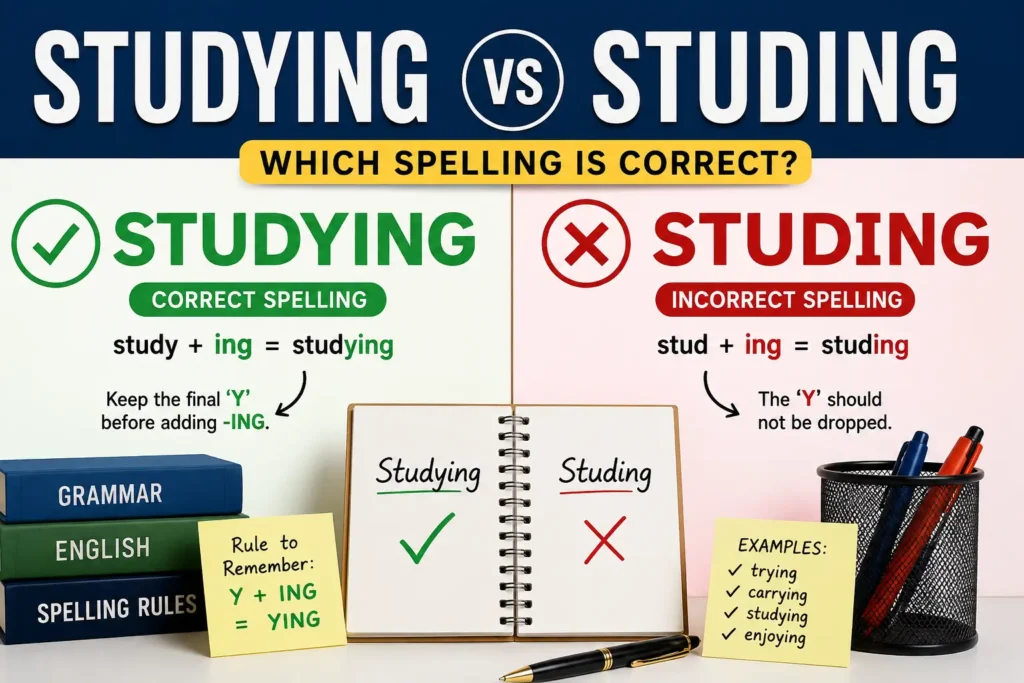
The difference between studying and studing may seem small, yet one missing letter changes the word from correct to incorrect. The studying vs studing question often confuses English learners, students, and fast typists because both forms can sound almost identical in speech.
However, only studying is accepted in standard English.The correct spelling keeps the final y from the base verb study before adding -ing. In simple terms, the spelling rule is study + ing = studying. You should use this form in school assignments, emails, applications, reports, and everyday messages.
This guide explains why the incorrect spelling appears, how the word works in grammar, and how to avoid the mistake. You will also see practical examples, common errors, and easy memory tips that make the rule clear, useful, and easy to remember. By the end, you’ll know exactly which form to choose and why the final y must remain.
Quick Answer: Studying or Studing?
Studying is the correct present participle and gerund form of the verb study.
Studing is incorrect because it removes the final y from the base word.
| Word | Correct? | Explanation | Example |
| Studying | Yes | The correct -ing form of study | Ava is studying for her exam. |
| Studing | No | A misspelling that drops the final y | Ava is studing for her exam. |
Whenever you are unsure, start with the base word:
- Base verb: study
- Suffix: -ing
- Correct form: studying
Why Is “Studying” Spelled With a Y?
English verbs that end in y normally keep that letter when you add -ing.
For example:
- study → studying
- try → trying
- carry → carrying
- apply → applying
- enjoy → enjoying
- play → playing
You do not remove the y before adding -ing. You also do not change it to i.
That means both of these forms are wrong:
- studing
- studiing
The correct form is always studying.
The easiest rule to remember
Keep the y before adding -ing.
This rule also works with words such as crying, trying, carrying, and copying.
Why Does “Study” Become “Studied” but “Studying” Keeps the Y?
This is where many writers become confused.
When a verb ends in a consonant followed by y, the y usually changes to i before -ed or -es.
Examples include:
- study → studied
- study → studies
- carry → carried
- carry → carries
- try → tried
- try → tries
However, the y stays before -ing.
| Base Verb | Past Tense | Third-Person Form | -ing Form |
| study | studied | studies | studying |
| carry | carried | carries | carrying |
| try | tried | tries | trying |
| hurry | hurried | hurries | hurrying |
| copy | copied | copies | copying |
The ending controls the spelling change:
- Before -ed, change y to i
- Before -es, change y to i
- Before -ing, keep the y
This difference explains why studied is correct but studiing is not.
What Does “Studying” Mean?
Studying comes from the verb study. It can describe learning, preparing, researching, or examining something carefully.
The exact meaning depends on the sentence.
Learning a subject
In education, studying means spending time gaining knowledge or reviewing information.
Examples:
- Marcus is studying chemistry.
- We spent the afternoon studying vocabulary.
- She prefers studying in the library.
- The students are studying world history.
Studying may include reading, taking notes, solving problems, reviewing lessons, or discussing ideas.
Preparing for an exam
You can also use the word when someone prepares for a test, quiz, or professional qualification.
Examples:
- I’m studying for my driving test.
- She has been studying for her final exam.
- The trainees are studying for a safety certificate.
Notice the difference between these two patterns:
- I am studying biology.
- I am studying for a biology exam.
The first sentence names the subject. The second names the exam you are preparing to take.
Researching a topic
Researchers and professionals also study subjects.
Examples:
- Scientists are studying changes in the climate.
- The company is studying customer behavior.
- Historians are studying the newly discovered letters.
- Doctors are studying the results of the trial.
In these examples, studying means investigating a topic in a careful and organized way.
Examining something closely
The word does not always refer to school or research. It can also mean looking at something carefully.
Examples:
- The detective was studying the photograph.
- She stood quietly, studying his expression.
- The mechanic is studying the damaged engine.
- He spent several minutes studying the map.
Here, the person is observing something closely to understand it better.
Is “Studing” a Real Word?
Studing is not the accepted form of study in standard English.
You may see it in text messages, comments, social media posts, or search queries. However, it usually appears because someone typed quickly or applied the wrong spelling rule.
Always use studying in:
- Schoolwork
- College applications
- Business emails
- Résumés
- Cover letters
- Reports
- Academic writing
- Text messages
- Social media posts
The level of formality does not change the spelling.
How “Studying” Works in Grammar
The word studying can play two main roles in a sentence. It can work as a present participle or as a gerund.
Studying as a present participle
A present participle combines with a form of be to create continuous tenses.
Examples:
- I am studying now.
- She is studying economics.
- They were studying when I called.
- He will be studying tomorrow.
- We have been studying since noon.
The helping verb changes to show time. The spelling of studying remains the same.
| Tense | Structure | Example |
| Present continuous | am/is/are + studying | She is studying. |
| Past continuous | was/were + studying | She was studying. |
| Future continuous | will be + studying | She will be studying. |
| Present perfect continuous | has/have been + studying | She has been studying. |
Studying as a gerund
A gerund is an -ing form that functions like a noun.
Examples:
- Studying takes patience.
- I enjoy studying at night.
- Studying before class helps me prepare.
- He finds studying in groups useful.
Compare these sentences:
- She is studying French.
- Studying French requires regular practice.
In the first sentence, studying forms part of the verb phrase. In the second, it names an activity.
Common Mistakes With “Studying”
Writers often make more than one mistake with this word. These examples show how to correct them.
Dropping the final Y
Incorrect:
- I am studing tonight.
- She has been studing all morning.
Correct:
- I am studying tonight.
- She has been studying all morning.
Keep the complete base word study before adding -ing.
Changing Y to I
Incorrect:
- He is studiing biology.
- We were studiing together.
Correct:
- He is studying biology.
- We were studying together.
The y-to-i change does not apply before -ing.
Leaving out the helping verb
Incorrect:
- She studying for her test.
- They studying at the library.
Correct:
- She is studying for her test.
- They are studying at the library.
Continuous tenses need a form of be, such as am, is, are, was, or were.
Using the base verb after “be”
Incorrect:
- I am study for my exam.
- He is study economics.
Correct:
- I am studying for my exam.
- He is studying economics.
After am, is, or are, use the -ing form when describing an ongoing action.
Adding an unnecessary apostrophe
Incorrect:
- She is study’ing for her exam.
- The student’s are studying.
Correct:
- She is studying for her exam.
- The students are studying.
Apostrophes do not form -ing verbs or regular plurals.
Correct Examples in Everyday Writing
The following examples show how to use the word naturally.
School and college
- Noah is studying mathematics.
- I spent two hours studying for my test.
- She is studying engineering at university.
- They enjoy studying together after class.
Work and professional training
- He is studying for an accounting qualification.
- The manager is studying the sales report.
- Our team is studying customer feedback.
- She has been studying the new safety rules.
Research and observation
- Researchers are studying sleep patterns.
- The doctor is studying the scan results.
- The coach spent hours studying game footage.
- The artist stood outside, studying the light.
Emails and messages
- I can’t meet tonight because I’m studying.
- Are you still studying?
- She’s studying at the library today.
- We were studying when the internet stopped working.
“Studying” and “Learning”: What Is the Difference?
The words studying and learning are related, but they are not always interchangeable.
Studying describes a focused activity. It may involve reading, practicing, reviewing notes, or researching information.
Learning describes the broader process of gaining knowledge or skill.
| Studying | Learning |
| A planned activity | A broader process |
| Often involves focused effort | Can happen naturally |
| May include reading and practice | Can come from experience |
| Does not always guarantee understanding | Suggests knowledge or skill develops |
For example:
- I am studying Spanish grammar tonight.
- I am learning Spanish by speaking with my neighbors.
Studying is one way to learn, but people can also learn through experience, observation, practice, and conversation.
American and British English
American and British English both use the spelling studying.
There is no regional difference.
Some words change between the two varieties, such as color/colour or center/centre. However, this word remains the same:
- American English: She is studying.
- British English: She is studying.
Neither variety accepts studing as the standard spelling.
How to Pronounce “Studying”
The word usually has three syllables:
stud-y-ing
A simple pronunciation guide is:
STUHD-ee-ing
The first syllable carries the main stress.
In quick speech, the final sounds may blend together. However, the written form still keeps the y.
Breaking the word into parts can help:
- stud
- y
- ing
Then combine them:
stud + y + ing = studying
Easy Ways to Remember the Correct Spelling
A useful memory trick should be quick and simple.
Keep the whole base word
Begin with study. Then add -ing without removing any letters.
Compare it with “trying”
If try becomes trying, then study becomes studying.
Remove the ending to check your spelling
Take away -ing:
- studying − ing = study
- studing − ing = stud
Only the first result gives you the correct base verb.
Remember this short rule
Y stays before ING.
Frequently Asked Questions
Q1:Which is correct: studying or studing?
Studying is correct. Studing is a misspelling because it removes the final y from the base verb study.
Q2:Why does studying keep the letter Y?
English verbs ending in y normally keep that letter when you add -ing. Therefore, study becomes studying.
Q3:Is studing a real English word?
No. Studing isn’t an accepted form of study in standard American or British English. It usually appears as a typing or spelling mistake.
Q4:Why does study become studied but not studiing?
Before -ed, the final y changes to i, producing studied. Before -ing, the y remains, so the correct form is studying, not studiing.
Q5:Is studying a verb or a noun?
It can serve both roles. In “She is studying,” it forms part of a continuous verb tense. In “Studying takes patience,” it works as a gerund and names an activity.
Conclusion
The studying vs studing choice becomes simple once you focus on the base verb. Studying is the correct spelling, while studing is an incorrect spelling that drops the final y. In standard English, verbs such as study, try, and carry keep the letter y before the -ing ending. That is why the reliable formula is study + ing = studying. Use the correct form when describing learning, exam preparation, research, or careful observation. It works in both American and British English, whether you are writing an assignment, email, report, or casual message. When doubt appears, remove -ing and check the remaining word. If it returns to study, your spelling is right. This quick check will help you write more accurately and avoid the same mistake in future writing.
