
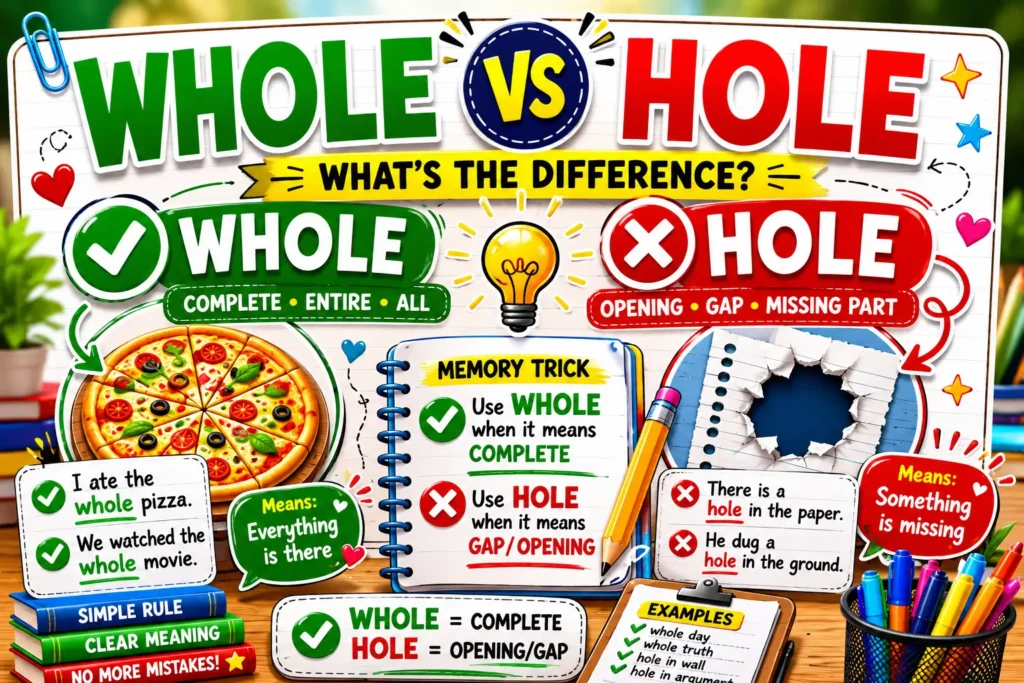
The difference between whole and hole may look small, but choosing the wrong word can completely change a sentence. The whole vs. hole question often confuses students, writers, and English learners because both words share the same pronunciation.
They are homophones, which means they sound alike but have different spellings and meanings. Use whole when you mean complete, entire, or all of something. Use hole when you mean an opening, gap, hollow space, or missing part. For example, “the whole book” means the complete book, while “a hole in the book” means part of it is torn or missing.
Learning the correct word depends on context, not sound. This guide explains the meaning difference, common grammar patterns, useful examples, and simple memory tricks so you can avoid mistakes and improve your writing accuracy in school, emails, reports, and everyday messages.
Whole vs. Hole: Quick Answer
The main difference is simple:
| Word | Meaning | Main Grammar Role | Example |
| Whole | Complete, entire, or not missing any main parts | Usually an adjective; sometimes a noun | I watched the whole movie. |
| Hole | An opening, gap, hollow space, or missing part | Noun | There is a hole in the wall. |
A quick memory rule is:
Whole means everything is present. Hole means something is missing.
Compare these examples:
- A whole cake is complete.
- A hole in a cake is an empty or missing area.
- The whole story includes every important detail.
- A hole in the story means some information is missing.
Why Do Whole and Hole Sound the Same?
Whole and hole are homophones. They usually have the same pronunciation even though their spellings and meanings differ.
Both words sound like HOHL and rhyme with bowl and role.
The w in whole is silent. Since you cannot hear it, writers sometimes choose the wrong spelling.
Other common homophones include:
| Homophones | Difference |
| right / write | correct or direction / form words |
| hear / here | listen / this place |
| peace / piece | calm / a part |
| break / brake | separate or rest / stop a vehicle |
| there / their / they’re | place / possession / they are |
Spell-checking software may not catch a homophone mistake because both words are spelled correctly. You must check whether the word fits the meaning of the sentence.
For example:
- Incorrect: I saw a whole in the road.
- Correct: I saw a hole in the road.
The spelling checker may accept whole, but the sentence needs hole because it refers to an opening.
What Does Whole Mean?
Whole means complete, entire, undivided, or not missing any important parts.
You can use it for objects, groups, periods of time, stories, ideas, and situations.
Examples:
- She ate the whole apple.
- We watched the whole movie.
- The whole class passed the test.
- He told the whole truth.
- I spent the whole morning working.
In each sentence, whole means all or the complete amount.
Whole as an Adjective
Most often, whole works as an adjective. An adjective describes a noun.
In the phrase whole day, the word whole describes the noun day.
Common examples include:
| Phrase | Meaning |
| the whole day | the entire day |
| the whole class | every student in the class |
| the whole family | all family members |
| the whole story | the complete story |
| the whole truth | all the truth |
| the whole world | everyone or everywhere |
| the whole thing | the complete thing |
You can often replace whole with entire or complete.
- I stayed home the whole day.
- I stayed home the entire day.
Both sentences have the same meaning.
Whole as a Noun
Whole can also work as a noun. In this role, it means a complete unit made from different parts.
Examples:
- The parts form a whole.
- Look at the problem as a whole.
- The team improved as a whole.
- The chapter works better as a whole.
The phrase as a whole means “as one complete thing.”
For example:
The company performed well as a whole.
This means the company performed well overall, even if some departments had problems.
Whole With Abstract Ideas
Whole can describe ideas and situations as well as physical objects.
Common phrases include:
- the whole truth
- the whole point
- the whole issue
- the whole situation
- the whole picture
- the whole reason
Example:
We need to understand the whole picture before making a decision.
Here, whole picture means all the important facts and details.
What Does Hole Mean?
Hole means an opening, gap, hollow area, or missing part.
A hole may appear when something is cut, torn, dug, drilled, damaged, or removed.
Examples:
- There is a hole in my shirt.
- The dog dug a hole in the yard.
- Rain came through a hole in the roof.
- My shoe has a hole near the toe.
- The carpenter drilled a hole in the wood.
In each sentence, hole names an opening or empty space.
Hole as a Noun
Hole normally works as a noun.
It may refer to a physical opening:
- a hole in the wall
- a hole in the ground
- a hole in a sock
- a hole in a pipe
- a hole in the roof
It can also describe a figurative gap:
- a hole in the plan
- a hole in the argument
- a hole in the evidence
- a hole in the budget
- a hole in the schedule
A figurative hole is not a real opening. Instead, it means something important is missing.
Physical Meaning of Hole
A physical hole is an opening you can usually see or touch.
Examples:
- The child poked a hole in the paper.
- My jeans have a hole near the knee.
- The dentist found a small hole in the tooth.
- The storm left a hole in the roof.
In these examples, the opening is real.
Figurative Meaning of Hole
In figurative language, hole can describe a weakness, flaw, missing detail, or empty position.
| Phrase | Meaning |
| hole in the argument | a weakness in the reasoning |
| hole in the evidence | missing proof |
| hole in the budget | a financial gap |
| hole in the schedule | an empty period |
| hole in the team | a missing role or person |
| hole in the story | an unexplained or missing detail |
Example:
There is a hole in your argument because you ignored the main evidence.
The sentence means the argument has a weakness.
Whole vs. Hole: Key Grammar Difference
Grammar offers another useful clue.
Whole often appears before a noun because it usually describes something complete.
Examples:
- the whole day
- the whole class
- the whole house
- the whole meal
- the whole reason
Hole usually acts as the noun itself.
Examples:
- a hole
- the hole
- this hole
- several holes
- a hole in the wall
Here is the difference:
| Word | Main Job | Example |
| Whole | Describes something complete | The whole class listened. |
| Whole | Names a complete unit | The parts form a whole. |
| Hole | Names an opening or gap | There is a hole in the door. |
This grammar clue helps, but meaning should always guide your final choice.
Two Easy Tests to Choose the Correct Word
When you feel unsure, try one of these replacement tests.
The Complete Test
Ask:
Can I replace the word with complete or entire?
If the answer is yes, use whole.
Examples:
- I cleaned the whole room.
- I cleaned the entire room.
That replacement works.
Another example:
- She told me the whole story.
- She told me the complete story.
Again, the meaning remains clear.
Now test an incorrect sentence:
- There is a whole in my shoe.
- There is a complete in my shoe.
That does not make sense, so you need hole.
The Opening Test
Ask:
Can I replace the word with opening or gap?
If the answer is yes, use hole.
Examples:
- There is a hole in the fence.
- There is an opening in the fence.
That works.
Another example:
- The plan has a hole.
- The plan has a gap.
That also works.
Now test this sentence:
- I worked the hole day.
- I worked the opening day.
That does not make sense, so use whole.
Common Mistakes With Whole and Hole
Most errors happen because writers follow the sound instead of the meaning.
Hole Day
Incorrect:
- I worked the hole day.
- We waited the hole afternoon.
Correct:
- I worked the whole day.
- We waited the whole afternoon.
Use whole because you mean the entire period of time.
Whole in the Wall
Incorrect:
- There is a whole in the wall.
- The mouse ran through a whole.
Correct:
- There is a hole in the wall.
- The mouse ran through a hole.
Use hole because you mean an opening.
Hole Truth
Incorrect:
- Tell me the hole truth.
- She explained the hole story.
Correct:
- Tell me the whole truth.
- She explained the whole story.
Use whole because you mean all the information.
Whole in an Argument
Incorrect:
- There is a whole in your argument.
Correct:
- There is a hole in your argument.
Use hole because the argument contains a gap or weakness.
Whole in a Budget
Incorrect:
- The repairs created a whole in the budget.
Correct:
- The repairs created a hole in the budget.
Here, hole describes a financial gap.
Common Phrases With Whole
Some phrases regularly use whole.
| Phrase | Meaning | Example |
| the whole day | the entire day | We waited the whole day. |
| the whole time | during all that time | She smiled the whole time. |
| the whole truth | complete truth | Tell me the whole truth. |
| the whole story | complete story | You have not heard the whole story. |
| as a whole | as one complete unit | The team improved as a whole. |
| on the whole | generally | On the whole, the plan worked well. |
As a Whole
Use as a whole when you want to discuss something as one complete unit.
- The class performed well as a whole.
- The article reads better as a whole after the edits.
- The company grew as a whole.
On the Whole
Use on the whole to mean generally or overall.
- On the whole, the event was successful.
- On the whole, the new system works well.
This phrase sounds slightly formal but works well in reports and essays.
Common Phrases With Hole
Hole also appears in several common expressions.
| Phrase | Meaning |
| hole in the wall | an opening or a small hidden place |
| hole-in-the-wall café | a small, simple restaurant |
| hole-in-one | a golf shot completed in one stroke |
| black hole | an object in space with extremely strong gravity |
| rabbit hole | a topic that leads to deep searching |
| loophole | a gap in a rule or law |
| dig yourself into a hole | create more trouble for yourself |
Example:
I searched for one grammar rule and fell down a rabbit hole of language history.
The phrase rabbit hole means the search led to more and more related information.
Whole and Hole in Real-Life Writing
School Writing
Use whole for complete groups, texts, or ideas.
- The whole class visited the museum.
- Read the whole chapter before answering.
- The character changes throughout the whole story.
Use hole for openings or gaps.
- The animal dug a hole under the fence.
- The essay has a hole in its argument.
- There is a hole in the evidence.
Emails and Business Writing
Correct use improves clarity.
- Please review the whole document.
- The whole team should receive the update.
- We found a hole in the current plan.
- The missing invoice created a hole in our records.
Everyday Messages
- I spent the whole weekend at home.
- My favorite jacket has a hole in the sleeve.
- We watched the whole series.
- There is a hole in the road near my house.
Casual writing can still be clear and correct.
Whole and Hole With Time
Use whole when you mean an entire period.
Common phrases include:
- whole day
- whole night
- whole week
- whole month
- whole year
- whole summer
Examples:
- I slept through the whole morning.
- They trained for the whole summer.
- She worked for the whole week.
Use hole only when referring to a gap or open period.
For example:
- There is a hole in next week’s schedule.
A more natural version would be:
- There is a gap in next week’s schedule.
Whole and Hole With Groups
Use whole when you mean every member of a group.
- The whole family arrived early.
- The whole team celebrated.
- The whole office joined the meeting.
- The whole neighborhood heard the alarm.
Use hole when someone’s absence creates a gap.
- Her resignation left a hole in the team.
- The injured player left a hole in the lineup.
The contrast is simple:
- The whole team means all members.
- A hole in the team means someone important is missing.
Whole and Hole With Objects
The same object can be whole and also contain a hole.
| Object | Whole Example | Hole Example |
| shirt | The whole shirt is blue. | The shirt has a hole near the collar. |
| cake | She baked a whole cake. | The cake has a hole in the middle. |
| wall | The whole wall needs paint. | There is a hole in the wall. |
| shoe | The whole shoe is wet. | There is a hole in the sole. |
| paper | Read the whole paper. | Punch a hole in the paper. |
The sentence’s meaning decides which word you need.
Easy Memory Tricks
Whole Begins With W
Think of the w in whole as meaning with everything.
- whole story = story with everything included
- whole family = everyone in the family
- whole truth = everything that is true
The O in Hole Looks Like an Opening
The letter o looks like a small opening.
Use this picture to remember:
- hole in a sock
- hole in a wall
- hole in the ground
- hole in an argument
Remember the Main Contrast
Whole means no important part is missing. Hole means a part is missing.
A whole sweater is complete. A sweater with a hole has an opening.
Practice Quiz
Choose whole or hole.
- I spent the ___ morning cleaning.
- There is a ___ in the bucket.
- She told the ___ truth.
- The dog dug a ___ near the tree.
- The ___ team stayed late.
- Your essay has a ___ in the final paragraph.
- We watched the ___ movie.
- My jacket has a ___ in the sleeve.
Answers
- whole
- hole
- whole
- hole
- whole
- hole
- whole
- hole
Frequently Asked Questions
Q1:What is the main difference between whole and hole?
Whole means complete, entire, or all of something. Hole means an opening, gap, hollow area, or missing part.
Q2:Are whole and hole pronounced the same?
Yes. Whole and hole are homophones, so they share the same pronunciation even though their spellings and meanings differ.
Q3:Is it whole day or hole day?
The correct phrase is whole day because it means the entire day. For example: “I spent the whole day studying.”
Q4:Can whole work as both an adjective and a noun?
Yes. It works as an adjective in “the whole class” and as a noun in “The parts form a whole.”
Q5:How can I remember the difference between whole and hole?
Replace the word with complete or entire. If the sentence still makes sense, use whole. If opening or gap fits better, use hole.
Conclusion
The whole vs. hole difference becomes easy once you focus on meaning instead of pronunciation. Use whole when something is complete, entire, or includes all its important parts. Choose hole when you mean an opening, gap, hollow area, or missing section. Because these homophones sound identical, the surrounding sentence must guide your word choice. Try the complete test: if “complete” or “entire” fits, use whole. Then try the gap test: if “opening” or “gap” makes sense, use hole. These quick checks improve writing accuracy and prevent common spelling mistakes in assignments, emails, reports, and everyday communication. Remember the core rule: whole means nothing important is missing, while hole means something is missing. With that contrast in mind, you can select the correct spelling quickly and confidently.

1 thought on “Whole vs. Hole: Meaning, Difference, and Easy Examples”