
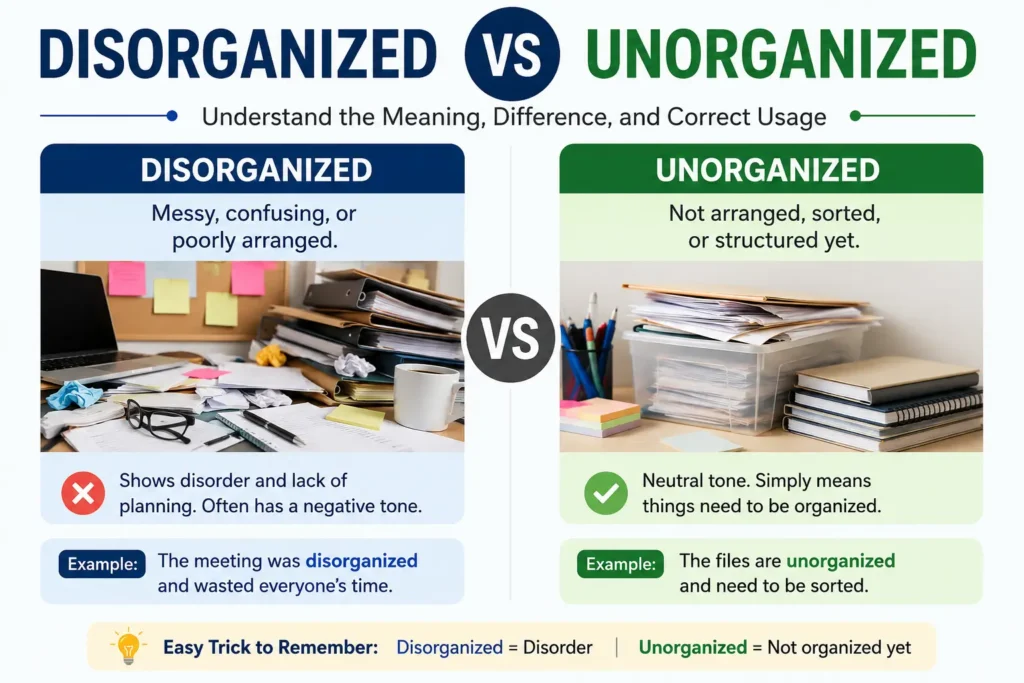
Understanding disorganized vs unorganized can make your English writing clearer, more accurate, and more professional. Both words are connected to order, but they do not always give the same meaning. Disorganized usually describes something messy, confusing, poorly planned, or difficult to follow.
Unorganized often means something has not been sorted, arranged, or structured yet. This difference matters because the wrong word can change the tone of your sentence. For example, calling a report disorganized sounds like criticism, while calling files unorganized simply means they still need sorting.
In daily life, school, work, emails, and documents, knowing the meaning of both words helps you choose the right expression. This guide explains their correct usage, gives simple examples, and shows how to use each word naturally in real situations. By the end, you will know which word fits formal writing, casual conversation, and everyday descriptions.
Disorganized vs Unorganized: Main Difference
Both words describe a lack of order, but they are not always used in the same way.
| Word | Meaning | Tone | Best Used For |
| Disorganized | Messy, confusing, or poorly arranged | More negative | Meetings, people, essays, schedules, rooms, plans |
| Unorganized | Not arranged, sorted, or structured yet | More neutral | Files, notes, data, papers, supplies, records |
In simple words, disorganized often describes something that feels out of control. Unorganized usually describes something that still needs a system.
Example:
- The office became disorganized after the move.
- The documents are still unorganized and need sorting.
Both sentences talk about order, but the feeling is different. The first suggests disorder. The second simply suggests unfinished organization.
See this also: Damnit or Dammit? Correct Spelling, Meaning, and Usage
What Does Disorganized Mean?
Disorganized means lacking order, structure, planning, or clear arrangement. It is often used when something feels messy, confusing, scattered, or difficult to follow.
This word can describe people, places, events, writing, schedules, thoughts, and systems.
Examples:
- A disorganized desk has papers, books, and items scattered everywhere.
- A disorganized person may forget tasks or miss deadlines.
- A disorganized essay jumps from one idea to another without clear flow.
- A disorganized meeting wastes time because there is no clear agenda.
The word disorganized usually has a negative tone. It suggests that the lack of order is causing a problem.
For example:
The presentation was disorganized and hard to follow.
This means the presentation was not just unsorted. It was confusing for the audience.
What Does Unorganized Mean?
Unorganized means not arranged, sorted, grouped, or structured yet. It usually sounds less negative than disorganized.
Use unorganized when something has not been put into order, but it is not necessarily chaotic or badly managed.
Examples:
- Unorganized notes have not been arranged by topic.
- Unorganized files have not been placed into folders.
- Unorganized data has not been cleaned or categorized.
- An unorganized group has not formed a clear structure yet.
For example:
The unorganized files need to be labeled.
This sentence does not sound harsh. It simply means the files still need arrangement.
When to Use Disorganized
Use disorganized when the lack of order creates confusion, delay, or difficulty.
Common uses include:
- Disorganized planning
- Disorganized writing
- Disorganized thinking
- Disorganized schedule
- Disorganized workspace
- Disorganized presentation
- Disorganized meeting
Examples:
| Sentence | Why It Works |
| Her desk looked disorganized after a busy week. | The desk became messy. |
| The meeting felt disorganized and unproductive. | The meeting lacked structure. |
| His disorganized notes made studying harder. | The notes caused confusion. |
| The essay was disorganized because the ideas jumped around. | The writing lacked clear flow. |
Use disorganized when the situation feels messy, confusing, or poorly managed.
When to Use Unorganized
Use unorganized when something has not been arranged or sorted yet.
This word works well for materials, information, documents, records, and early-stage work.
Common uses include:
- Unorganized files
- Unorganized papers
- Unorganized notes
- Unorganized data
- Unorganized supplies
- Unorganized records
- Unorganized materials
Examples:
| Sentence | Why It Works |
| The unorganized files were waiting to be labeled. | The files had not been sorted yet. |
| She collected unorganized notes before writing her report. | The notes were still raw. |
| The unorganized data needed cleaning before analysis. | The data needed structure. |
| The volunteers remained unorganized until a leader assigned roles. | The group had no structure yet. |
Use unorganized when the situation needs arrangement, not strong criticism.
Easy Way to Remember the Difference
Here is a simple trick:
Disorganized = disorder
Unorganized = not organized yet
Think of it this way:
- A messy desk is disorganized.
- A new stack of papers is unorganized.
- A confusing essay is disorganized.
- Raw research notes are unorganized.
- A meeting with no agenda is disorganized.
- A folder of unsorted documents is unorganized.
If something feels chaotic, use disorganized.
If something simply needs sorting, use unorganized.
Disorganized vs Unorganized in Real Life
At Work
A disorganized project may have unclear deadlines, missing updates, and confused team members.
An unorganized project folder may simply contain documents that have not been sorted yet.
Examples:
- The project became disorganized after the deadline changed.
- The project files are still unorganized in the shared folder.
In School
A disorganized essay lacks structure. The ideas may feel scattered or hard to follow.
Unorganized notes may still contain useful information, but they have not been arranged clearly.
Examples:
- The essay felt disorganized because each paragraph jumped to a new topic.
- My class notes are unorganized, so I need to rewrite them before the exam.
At Home
A disorganized room looks messy and difficult to use.
An unorganized box may contain useful items that simply need labeling.
Examples:
- His room became disorganized after a long week.
- The storage box is unorganized, but everything inside is useful.
In Emails
A disorganized email jumps between different points without a clear purpose.
An unorganized inbox contains emails that have not been sorted into folders.
Examples:
- The email felt disorganized because it mixed several topics together.
- My inbox is unorganized, so I need to create folders.
Correct Usage Examples
Correct Use of Disorganized
- The office looked disorganized after the move.
- His speech sounded disorganized and hard to follow.
- A disorganized schedule can cause missed deadlines.
- The report felt disorganized because the sections appeared out of order.
- She struggled with a disorganized workflow.
Correct Use of Unorganized
- The files are still unorganized.
- He sorted the unorganized notes before the exam.
- The team reviewed the unorganized data before building the chart.
- We found several unorganized boxes in the storage room.
- The documents remained unorganized until Friday.
Common Mistakes to Avoid
1. Using Disorganized for Everything
Not every unsorted thing is disorganized.
For example, if you just received a stack of new papers, they are probably unorganized, not disorganized. They simply have not been sorted yet.
Better:
- The new papers are unorganized.
- The messy desk is disorganized.
2. Using Unorganized for Confusing Situations
If something feels chaotic, confusing, or poorly planned, disorganized is usually better.
Weak:
The meeting was unorganized and confusing.
Better:
The meeting was disorganized and confusing.
A confusing meeting is not just waiting to be sorted. It has a structure problem.
3. Ignoring Tone
Tone matters. Disorganized can sound critical. Unorganized sounds softer and more neutral.
Compare:
- Your report is disorganized.
- Your notes are unorganized.
The first sentence sounds like criticism. The second sounds like the notes simply need arrangement.
4. Assuming Both Words Always Mean the Same Thing
In casual speech, people sometimes use these words interchangeably. However, in careful writing, the difference matters.
Use disorganized for disorder.
Use unorganized for things not yet arranged.
Similar Words You Can Use
Sometimes another word may fit better than both disorganized and unorganized.
| Word | Best Use |
| Messy | Casual spaces or appearance |
| Chaotic | Strong disorder or confusion |
| Untidy | Mild physical mess |
| Unsorted | Files, data, papers, or items |
| Jumbled | Mixed-up order |
| Scattered | Ideas, objects, or attention |
| Disorderly | Formal description of poor order |
| Poorly planned | Events, schedules, or projects |
| Unarranged | Items not placed in order |
| Confusing | Thoughts, explanations, or plans |
Examples:
- “Unsorted files” may sound more exact than “unorganized files.”
- “Chaotic meeting” sounds stronger than “disorganized meeting.”
- “Poorly planned event” may be clearer than “disorganized event.”
The best word depends on the situation you want to describe.
Practice: Choose the Correct Word
| Sentence | Correct Word |
| The desk became messy after a long week. | Disorganized |
| The new files have not been sorted yet. | Unorganized |
| The presentation jumped between unrelated ideas. | Disorganized |
| The raw data needs labels and categories. | Unorganized |
| The meeting had no agenda and no clear goal. | Disorganized |
Simple rule:
Messy or confusing = disorganized
Not sorted yet = unorganized
FAQs About Disorganized vs Unorganized
1. What is the difference between disorganized and unorganized?
Disorganized means messy, confusing, or poorly arranged. Unorganized means something has not been arranged, sorted, or structured yet.
2. Which word is more negative: disorganized or unorganized?
Disorganized is more negative because it suggests poor planning, confusion, or disorder. Unorganized sounds more neutral and simply means something needs arrangement.
3. Should I say disorganized files or unorganized files?
Use unorganized files if the files have not been sorted yet. Use disorganized files if the files are messy, mixed up, or difficult to use.
4. Can disorganized and unorganized be used interchangeably?
Sometimes people use them interchangeably in casual speech, but in careful writing, they are different. Use disorganized for disorder and unorganized for things not yet arranged.
5. Is it better to say a disorganized person or an unorganized person?
In most cases, disorganized person sounds more natural. It describes someone who struggles with planning, time management, or keeping things in order.
Final Takeaway
The simplest way to remember disorganized vs unorganized is to focus on the situation. Use disorganized when something feels messy, confusing, poorly arranged, or hard to manage. Use unorganized when something has not been sorted, arranged, or structured yet. This small difference can make your English writing sound more polished and accurate. A disorganized meeting may waste time because it has no clear plan, while an unorganized folder may only need labels and sorting. In professional writing, emails, schoolwork, and daily communication, the right word improves clarity and avoids confusion. If the situation shows disorder, choose disorganized. If it simply needs arrangement, choose unorganized. That is the easiest rule for correct usage with clear examples. Once you understand the tone, both words become much easier to use correctly.
