
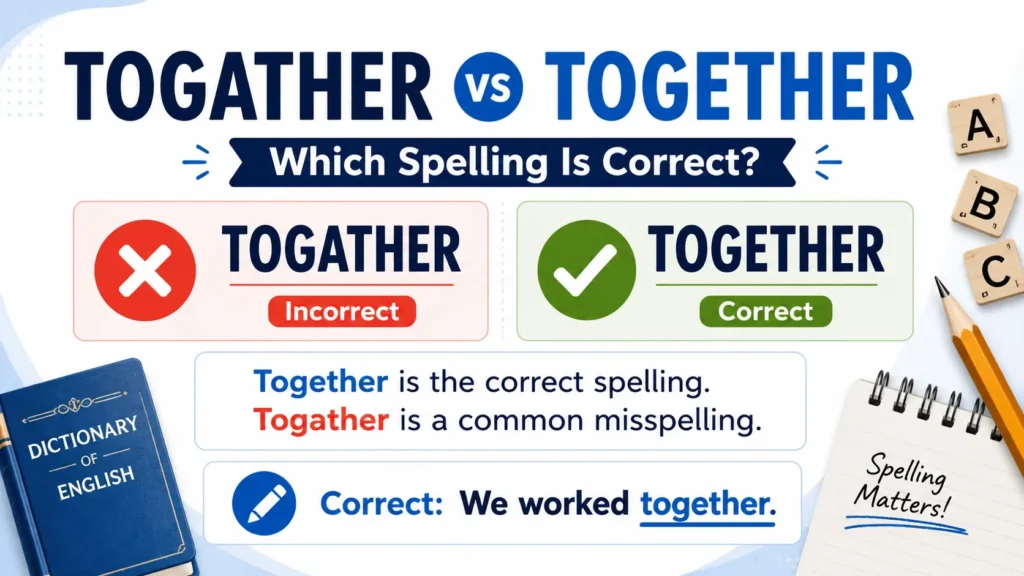
The together vs togather question has a simple answer: together is the correct spelling in standard English, while togather is a misspelling. Together means being with others, working as a group, or forming a united whole. This correct usage follows normal grammar rules and supports spelling accuracy.
The error often comes from pronunciation. In quick spoken English, similar sounds can hide the middle e, which creates spelling confusion. Typing errors, fast replies, and weak proofreading also spread the wrong form through social media, online content, emails, essays, and business reports.
A useful memory trick is to notice “get” inside together: to-get-her. Check reliable English dictionaries or grammar authorities when uncertain. Practical examples such as “We worked together” and “Put the pieces together” show the word structure clearly. This habit helps language learners improve everyday writing, school writing, formal writing, and professional writing with greater confidence.
Togather vs Together: The Quick Answer
Use together in all standard writing.
Correct: Our class worked together on the project.
Incorrect: Our class worked togather on the project.
Although togather appears in online posts, texts, and search queries, it isn’t the accepted spelling of together. Spell-check tools usually mark it as an error, but they may miss it in names, usernames, or informal content.
At-a-Glance Comparison
| Form | Correct? | Meaning or status | Example |
| Together | Yes | With each other, as a group, or combined | We studied together. |
| Togather | No | A common misspelling of together | We studied togather. |
| Toghether | No | Another common misspelling | They worked toghether. |
| All together | Yes | Everyone or everything as one group | Sing all together. |
| Altogether | Yes | Completely or in total | The trip cost $500 altogether. |
Simple rule: When you mean “with each other,” write together.
What Does Together Mean?
Together has several closely related meanings. In most cases, it shows that people, things, ideas, or actions are connected rather than separate.
Dictionaries mainly classify together as an adverb. It can describe people being in one place, acting jointly, forming a whole, or doing something at the same time. It can also work informally as an adjective meaning calm, capable, and well organized.
Being in the Same Place
Use together when two or more people or things are in one location.
- The family spent the weekend together.
- We sat together during the concert.
- Keep the documents together in one folder.
- The children stood together near the entrance.
Here, together answers a question such as “How were they positioned?” or “In what way were they present?”
Acting or Working as a Group
Together often describes cooperation.
- The employees worked together to solve the problem.
- We can finish faster if we plan together.
- The neighbors came together after the storm.
- Students and teachers worked together on the event.
In these examples, the people aren’t simply in the same place. They’re also sharing effort or responsibility.
Joining or Combining Things
Use together when separate parts form one object, mixture, or complete idea.
- Mix the flour and sugar together.
- Glue the broken pieces together.
- She tied the boxes together with string.
- The report brings several ideas together.
The word shows that separate items become connected, combined, or organized as one whole.
Being in a Relationship
In everyday American English, together can mean that two people are in a romantic relationship.
- Maya and Chris have been together for three years.
- Are they still together?
- The couple got back together last summer.
The exact meaning depends on context. “They went to dinner together” doesn’t always suggest romance. However, “They have been together for years” often does.
Being Calm and Organized
In informal English, together may describe a person who appears confident, prepared, and emotionally controlled.
- She always seems so together at work.
- I wasn’t very together after the long flight.
- He looks calm and together, even under pressure.
This adjective use is informal. Therefore, in formal reports, you may prefer words such as organized, composed, or well prepared. Merriam-Webster records this adjective sense as organized, balanced, or self-possessed.
Read this also: Brazil or Brasil: Correct Spelling, Meaning, Difference, and How to Use Each One
Is Togather a Real Word?
Togather isn’t the standard modern spelling of together. When you mean “with each other” or “as a group,” writing togather is an error.
This distinction matters because gather is a real verb.
- We will gather in the conference room.
- Please gather the papers.
- The students gathered together after class.
The phrase gather together contains two separate words. You shouldn’t combine them into togather.
Correct and Incorrect Forms
| Incorrect | Correct |
| Let’s work togather. | Let’s work together. |
| We will togather the files. | We will gather the files. |
| The team came togather. | The team came together. |
| Please togather everyone. | Please gather everyone. |
The last example is especially useful. If you need an action word meaning “bring into a group,” use gather. If you need an adverb meaning “with each other,” use together.
Why Do People Write Togather Instead of Together?
The misspelling has several causes. Understanding them can make the correct form easier to remember.
Pronunciation Can Hide the E
In normal speech, people rarely pronounce every letter with equal force. The first syllable of together is weak, so it often sounds like “tuh” rather than a strong “toe.”
As a result, some writers focus on the louder middle sound and spell the word as togather.
Gather Is a Familiar Word
The word gather is common and has a related meaning. Both gather and together can involve people or things forming a group.
Because the meanings overlap, the brain may wrongly build together from “to + gather.” However, that isn’t how the modern word is spelled.
Fast Typing Encourages Guessing
People often type familiar words without checking each letter. If someone remembers the sound but not the spelling, togather may appear naturally.
This mistake is common in:
- Text messages
- Social media captions
- Online comments
- Informal emails
- First drafts
- Voice-to-text results
Autocorrect Isn’t Perfect
Autocorrect may fix togather, but it doesn’t always do so. It may treat the term as a name, username, business title, or unusual proper noun.
Therefore, proofreading still matters. Don’t depend on software alone.
How to Pronounce Together
In standard American English, together is commonly pronounced:
tuh-GETH-er
The word has three syllables:
to – geth – er
The main stress falls on the second syllable: GETH. The first and last syllables are weaker. Oxford’s American English entry gives the pronunciation as /təˈɡɛðər/.
Pronunciation Breakdown
| Part | Approximate sound |
| to | tuh |
| geth | geth, with the th sound in this |
| er | er |
The th sound is voiced. Your throat vibrates when you say it, just as it does in this, that, and weather.
Don’t pronounce the middle like the word gather. The vowel in together is closer to the short e in get.
Why the Spelling Makes Sense
The modern word together has a long history. It developed through Middle English and Old English forms rather than being newly created from the modern phrase “to gather.” Merriam-Webster traces it through Middle English togedere and Old English togædere.
You don’t need to memorize those older forms. However, the history explains why together shouldn’t be respelled according to how the modern verb gather looks.
Think of together as one complete word with its own spelling.
Memory line: We get things done when we work together.
The word get appears near the middle of together. That visual clue can help you avoid replacing the e with an a.
What Part of Speech Is Together?
Together is usually an adverb. An adverb adds information about how, where, or in what manner an action happens.
Together as an Adverb
- We traveled together.
- The children played together.
- Join the two pieces together.
- The team solved the issue together.
In each sentence, together describes an action.
Together as an Informal Adjective
Sometimes together describes a person or situation.
- She is a very together person.
- He finally feels more together.
- The presentation looked polished and together.
This use is common in conversation and informal writing. Still, it may sound too casual in academic or highly formal documents.
Together Is Not Normally a Verb
You can’t usually add verb endings to together.
Incorrect: We togethered after work.
Correct: We got together after work.
Incorrect: The manager togethered the teams.
Correct: The manager brought the teams together.
Choose a verb such as gather, join, combine, unite, or meet, depending on the meaning.
How to Use Together Correctly in Sentences
The word fits naturally into casual, academic, and professional English.
Everyday Conversation
- Let’s eat together tonight.
- We watched the game together.
- Can you keep these items together?
- They grew up together.
School and Academic Writing
- The students worked together on the science project.
- Taken together, the results support the main argument.
- The two studies provide stronger evidence when considered together.
- Several factors worked together to produce the change.
In academic writing, phrases such as taken together and considered together help writers connect evidence.
Workplace Communication
- Let’s review the proposal together.
- The design and marketing teams worked together.
- Please attach the forms together.
- We need to bring these ideas together in one plan.
Relationships and Family
- Our family tries to have dinner together.
- The couple has been together since college.
- The siblings traveled together during the summer.
- Hard times brought the family closer together.
Instructions
- Mix the ingredients together.
- Press the two sides together.
- Place similar files together.
- Read both sections together before answering.
Social Media and Texting
- Great day with the whole group together!
- We finally got everyone together for a photo.
- Better together.
- Let’s study together tomorrow.
Short phrases such as Better Together are common in slogans and captions. They work because the missing subject and verb are easy to understand from context.
Where Does Together Go in a Sentence?
The position of together can change based on emphasis.
After the Main Verb
This is the most common placement.
- We worked together.
- They laughed together.
- The pieces fit together.
After the Object
When the verb has an object, together often comes after it.
- She taped the pages together.
- He combined the lists together.
- We moved the desks together.
However, combine together can sound repetitive because combine already means to join. Often, “He combined the lists” is enough.
At the Beginning of a Sentence
Placing together first gives the word extra emphasis.
- Together, we can solve this problem.
- Together, the two reports offer a complete picture.
- Together, they built a successful company.
A comma usually follows together when it introduces the whole sentence.
Before the Main Verb
This position is possible, especially when emphasizing joint action.
- The two departments together created the new policy.
- These facts together show why the plan failed.
Still, some sentences sound smoother with together later:
- The two departments created the policy together.
How to Use “Together With”
Together with means along with, in addition to, or in association with.
- The principal, together with two teachers, attended the meeting.
- Your application, together with the fee, must arrive by Friday.
- The laptop was packed together with its charger.
Subject-Verb Agreement
The phrase together with doesn’t work exactly like and. It usually doesn’t make a singular subject plural.
Correct: The manager, together with her assistants, is reviewing the report.
Incorrect: The manager, together with her assistants, are reviewing the report.
The true subject is manager, which is singular. The phrase about the assistants adds information but doesn’t control the verb.
Compare:
- The manager and her assistants are reviewing the report.
- The manager, together with her assistants, is reviewing the report.
Commas with Together With
Use commas when the phrase gives extra, nonessential information.
- Daniel, together with his brother, runs the store.
Without the extra phrase, the sentence still makes sense: “Daniel runs the store.”
When the phrase is closely tied to the meaning, commas may be unnecessary.
- The jacket was sold together with the matching pants.
Togather vs Together in Correct and Incorrect Examples
| Incorrect sentence | Correct sentence | Why |
| We studied togather. | We studied together. | Togather is misspelled. |
| The family lives togather. | The family lives together. | Use together for people sharing a place. |
| Put the pieces togather. | Put the pieces together. | The parts are being joined. |
| They came toghether. | They came together. | Toghether has an extra h. |
| We worked to gether. | We worked together. | The word isn’t normally split. |
| The whole team are together working. | The whole team is working together. | The revised order sounds more natural. |
Together vs Altogether vs All Together
These forms look similar, but they don’t always mean the same thing.
Together
Together means with each other, in one place, or in a combined form.
- We traveled together.
- Hold the papers together.
- The team worked together.
Altogether
Altogether is one word. It usually means completely, entirely, or in total.
- The plan was altogether too expensive.
- She stopped attending altogether.
- There were 25 guests altogether.
All Together
All together means that everyone or everything acts as one group or at the same time.
- The students answered all together.
- Put the books all together on the shelf.
- Let’s sing all together.
Side-by-Side Comparison
| Expression | Main meaning | Example |
| Together | With each other or combined | We worked together. |
| Altogether | Completely or in total | It cost $80 altogether. |
| All together | Everyone or everything at once | They shouted all together. |
A Simple Test
Replace altogether with completely or in total.
- The event was canceled completely.
- The event was canceled altogether.
If that replacement works, use altogether.
Replace all together with all at once or as one group.
- The children laughed all at once.
- The children laughed all together.
Common Misspellings of Together
Writers may create several incorrect versions.
| Misspelling | Correct form |
| togather | together |
| toghether | together |
| togeter | together |
| togethor | together |
| to gether | together |
| togther | together |
The most reliable check is the letter pattern:
t-o-g-e-t-h-e-r
Notice that together contains two e letters after the opening to:
to + geth + er
Common Phrases with Together
Come Together
To come together means to meet, join, or form a united group.
- The community came together to help the family.
- All the details are finally coming together.
The second example means that a plan or situation is beginning to work properly.
Work Together
To work together means to cooperate.
- Both departments must work together.
- We worked together to meet the deadline.
Pull Together
To pull together means to unite and make a shared effort.
- The team pulled together during the crisis.
- We’ll succeed if everyone pulls together.
Get It Together
Get it together is informal. It means to become organized, calm, or effective.
- I need to get it together before the meeting.
- The company must get its schedule together.
Because the phrase can sound critical, use it carefully when speaking to another person.
Put Something Together
To put something together can mean to assemble, prepare, or create it.
- She put the bookshelf together.
- I’m putting a presentation together.
- They put a strong team together.
Put Our Heads Together
This phrase means to share ideas and solve a problem as a group.
- Let’s put our heads together and find an answer.
- The engineers put their heads together to fix the issue.
Stick Together
To stick together means to remain united or support one another.
- Friends should stick together.
- The players stuck together after the loss.
Synonyms for Together
No single synonym works in every sentence. Choose one that matches the context.
Meaning “As a Group”
- Jointly
- Collectively
- Cooperatively
- As one
- Side by side
Example: The teams worked jointly on the research.
Meaning “In the Same Place”
- With each other
- In one place
- In a group
- Close by
- Side by side
Example: The friends sat side by side.
Meaning “Combined”
- Joined
- Connected
- United
- Mixed
- Assembled
- Linked
Example: The two wires were connected.
Meaning “At the Same Time”
- Simultaneously
- At once
- At the same moment
Example: Both alarms rang simultaneously.
Some synonyms sound formal. For everyday conversation, together is often the clearest choice.
Antonyms of Together
The opposite depends on the meaning.
- Apart — The chairs were moved apart.
- Separately — Submit the forms separately.
- Alone — She traveled alone.
- Individually — Each student worked individually.
- Disconnected — The two sections felt disconnected.
- Divided — The group remained divided.
Compare:
- We completed the task together.
- We completed the task separately.
How to Remember the Correct Spelling
Use one or more of these memory tricks.
Find “Get” Inside Together
toGETher
When people work together, they often get things done.
Break It into Three Parts
to – geth – er
Don’t break it into “to + gather.” That false split leads to the wrong vowel.
Remember the Middle E
The correct spelling contains geth, not gath:
- Correct: together
- Incorrect: togather
Write a Memory Sentence
We get better when we learn together.
Writing the correct word several times in a meaningful sentence can build stronger spelling memory than reading it alone.
Mini Editing Example
Imagine a student writes this sentence in a group project:
“We worked togather and put all our research altogether in one folder.”
Two different corrections are needed:
“We worked together and put all our research all together in one folder.”
The first word means cooperatively, so use together. The second phrase means all the research in one place, so all together is clearer than altogether.
This example shows why spell-check alone may not solve every problem. A program may recognize altogether as a real word even when the sentence requires all together.
Quick Practice
Choose the correct option.
- The classmates studied togather/together after school.
- The cost was $90 altogether/all together.
- Please stand altogether/all together for the photo.
- The broken chair was glued togather/together.
- We stopped using the old system altogether/all together.
- The director, together with two actors, is/are attending.
- Let’s put our ideas together/toghether.
- The children sang all together/altogether.
Answer Key
- Together — The classmates studied with each other.
- Altogether — It means “in total.”
- All together — Everyone should stand as one group.
- Together — The chair’s parts were joined.
- Altogether — It means “completely.”
- Is — The singular subject is director.
- Together — Toghether is misspelled.
- All together — The children sang at the same time.
Frequently Asked Questions
Q1.Is togather a correct English word?
No, togather is not the correct spelling when you mean “with each other” or “as a group.” The correct word is together.
Q2.Why do people spell together as togather?
People often write togather because the word can sound similar to gather when spoken quickly. Fast typing and weak proofreading can also cause the mistake.
Q3.What does together mean?
Together means being with other people, working as a group, or joining separate things into one whole.
Q4.How can I remember the spelling of together?
Look for the word get inside it: to-get-her. This simple memory trick can help you remember the correct spelling.
Q5.Is together used in formal writing?
Yes, together is correct in formal, academic, professional, and casual writing. For example: “The two departments worked together on the project.”
Conclusion
The answer to together vs togather is simple: together is the correct spelling, while togather is a spelling mistake. Use together when people work as a group, stay in one place, or combine things. Remember the word get inside together to avoid the error. This spelling is correct in both formal and informal English, including emails, essays, reports, and social media posts.
