
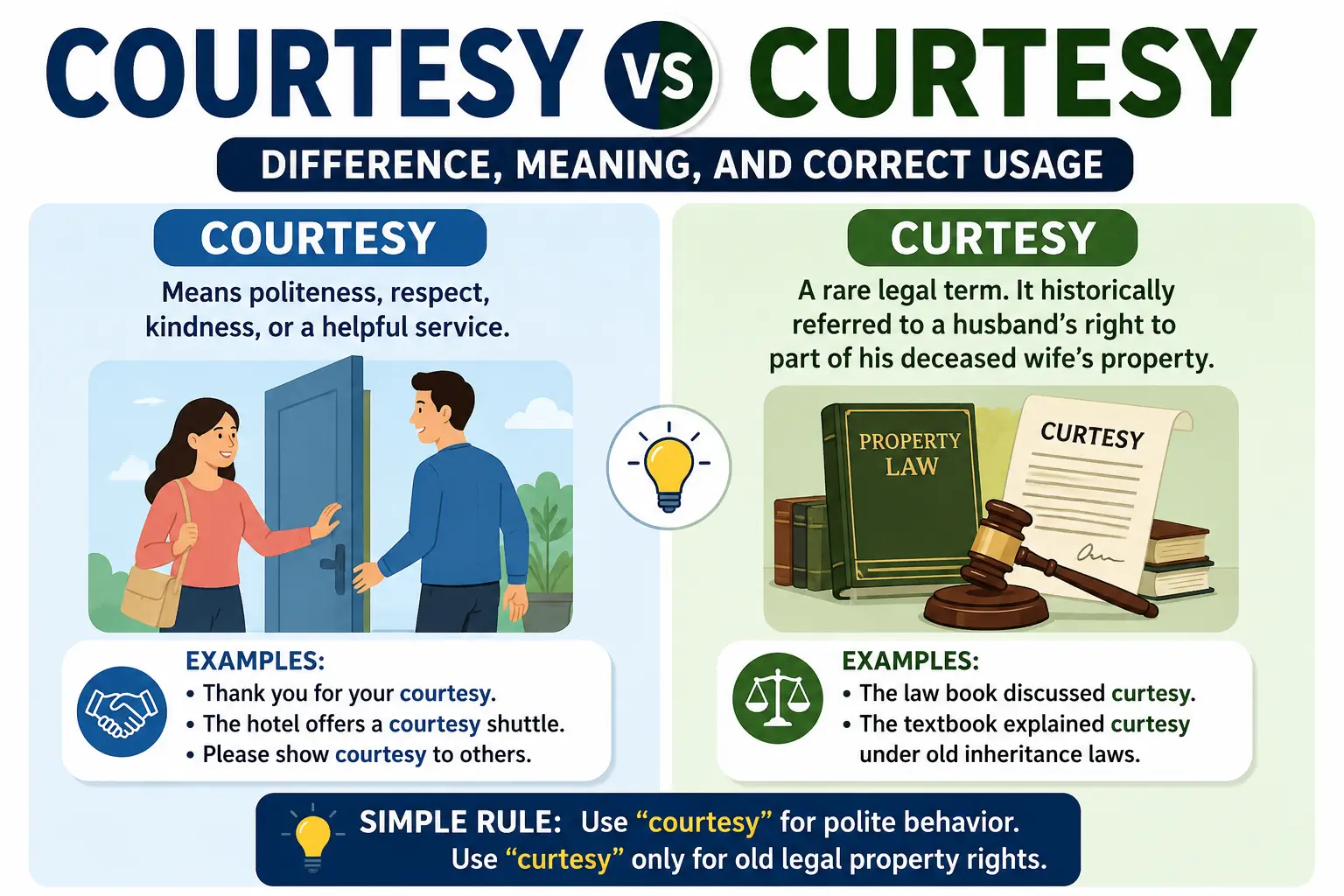
Courtesy vs curtesy is a confusing word pair because both spellings are real, but they don’t mean the same thing. In everyday American English, courtesy is the word you almost always need. It means polite behavior, respect, kindness, or a helpful service. Curtesy, on the other hand, is a rare legal word connected to old property and inheritance laws.
That one missing “o” changes the meaning completely.
So, if you’re writing an email, school paper, business message, social media caption, customer service reply, or formal note, you probably mean courtesy. If you’re discussing historical estate law, legal history, or old marital property rights, then curtesy may be correct.
This guide explains the difference between courtesy and curtesy, how to use each word, why people mix them up, and how to avoid this spelling mistake in real-life writing.
Quick Answer: Courtesy vs Curtesy
Courtesy means politeness, respect, kindness, or a thoughtful action.
Curtesy is a rare legal term. It historically referred to a husband’s right to part of his deceased wife’s property.
Here’s the simplest rule:
Use “courtesy” for polite behavior. Use “curtesy” only for old legal property rights.
Most readers searching for courtesy vs curtesy want to know whether curtesy is a misspelling. The answer is: not always. Curtesy is a real word, but it’s wrong if you use it to mean politeness.
Simple Examples
| Sentence | Correct Word | Why |
| Thank you for your courtesy. | Courtesy | It means politeness or respect. |
| The hotel offers a courtesy shuttle. | Courtesy | It means a free helpful service. |
| The law book discussed curtesy. | Curtesy | It refers to a legal property term. |
| Please show curtesy to your teacher. | Incorrect | The sentence needs courtesy. |
What Does Courtesy Mean?
Courtesy is a noun that means polite, respectful, or considerate behavior. It can also refer to a kind act, a favor, a free service, or something provided with permission.
You use courtesy when someone behaves in a thoughtful way.
For example:
- Holding the door open is a small courtesy.
- Saying “thank you” shows courtesy.
- Replying to an email on time is professional courtesy.
- Letting someone speak without interrupting is common courtesy.
In American English, courtesy appears in everyday conversation, workplace writing, customer service messages, school settings, travel, hotels, emails, and formal announcements.
Courtesy as Polite Behavior
The most common meaning of courtesy is simple: kind and respectful behavior toward others.
Examples:
- She treated every customer with courtesy.
- Please show courtesy to other passengers.
- The teacher appreciated the students’ courtesy during the presentation.
- It’s common courtesy to clean up after yourself.
In these sentences, courtesy refers to how people treat each other.
Courtesy as a Helpful Service
Courtesy can also describe something offered as a helpful service, often for free.
Examples:
- The dealership gave us a courtesy car.
- The clinic sent a courtesy reminder before the appointment.
- The hotel provides a courtesy shuttle to the airport.
- The company made a courtesy call after the service visit.
In these examples, courtesy means the service is provided as a helpful gesture.
Courtesy as Permission or Credit
You may also see the phrase “courtesy of.” It means something was provided by, supplied by, or used with permission from someone.
Examples:
- Photo courtesy of the school district.
- Tickets were provided courtesy of a local business.
- The image appears courtesy of the museum.
- Refreshments are available courtesy of the event sponsor.
This phrase is common in publishing, events, media, school newsletters, and business writing.
Read this also: ETSJavaApp Release Date: Current Status, eTrueSports Link, and Safe Download Guide
What Does Curtesy Mean?
Curtesy is a noun, but it’s not a common everyday word. It belongs mostly to legal history and property law.
Historically, curtesy referred to a husband’s legal right to use or inherit part of his deceased wife’s property, usually under old common-law rules. It was often discussed with dower, which referred to a wife’s rights in her husband’s property.
In simple terms, curtesy was about property rights after a spouse died.
Examples:
- The law professor explained curtesy and dower.
- The textbook discussed curtesy under old inheritance laws.
- The court reviewed older rules involving curtesy.
- The historian wrote about curtesy in common-law marriage systems.
Unless you’re writing about law, estates, inheritance history, or old property systems, you probably don’t need curtesy.
Is Curtesy Still Used Today?
Curtesy is still a real English word, but it’s rare. You may find it in:
- legal dictionaries
- property law textbooks
- historical law discussions
- estate-law research
- older court cases
- academic writing about common law
However, most modern writers never need it. In everyday writing, curtesy is usually a mistake when the writer means courtesy.
Also, legal rules about inheritance and marital property vary by place and time. So, if you see curtesy in a legal document, don’t guess its effect. The word has a specific legal background, and modern law may treat it differently depending on the jurisdiction.
Courtesy vs Curtesy: Main Difference
The main difference between courtesy and curtesy is meaning.
Courtesy is about respectful behavior.
Curtesy is about old legal property rights.
| Feature | Courtesy | Curtesy |
| Meaning | Politeness, respect, kind behavior, helpful service, or permission credit | A historical legal right related to a husband’s interest in a deceased spouse’s property |
| Part of speech | Noun | Noun |
| Common today? | Yes | Rare |
| Used in emails? | Yes | Almost never |
| Used in business writing? | Yes | Almost never |
| Used in legal history? | Sometimes | Yes |
| Example phrase | common courtesy | dower and curtesy |
| Best context | Everyday, professional, academic, customer service | Legal, historical, estate-law discussion |
The One-Sentence Difference
Courtesy is a social word. Curtesy is a legal-history word.
That’s the fastest way to remember the difference.
Why People Confuse Courtesy and Curtesy
Many people confuse courtesy vs curtesy because the words look almost identical. They also sound very similar, especially in casual speech.
However, the meanings are completely different.
They Differ by Only One Letter
The spelling difference is small:
- courtesy = has “courte”
- curtesy = has “curte”
That missing “o” makes the word look like a typo. Since both spellings exist, readers often wonder which one is right.
Spellcheck May Not Save You
Spellcheck tools may accept curtesy because it’s a real word. That doesn’t mean it’s correct in your sentence.
For example:
- Wrong: Thank you for your curtesy.
- Right: Thank you for your courtesy.
A spellchecker may not always catch that error because curtesy is spelled correctly as a word. The problem is word choice, not spelling alone.
Most People Rarely See Curtesy
Another reason for the confusion is simple: most people see courtesy often, but they almost never see curtesy.
You may hear or read:
- courtesy call
- courtesy reminder
- courtesy copy
- professional courtesy
- common courtesy
- courtesy shuttle
But you probably won’t see curtesy unless you’re reading legal history or property law.
How to Pronounce Courtesy and Curtesy
In American English, courtesy is usually pronounced like:
KUR-tuh-see
Curtesy is often pronounced very similarly. Because the pronunciation can be almost the same, you can’t rely on sound alone.
That’s why context matters.
If the sentence is about manners, respect, or a helpful service, use courtesy.
If the sentence is about old property law, use curtesy.
How to Use Courtesy Correctly
Use courtesy when you mean politeness, respect, kindness, a favor, or a helpful service.
Courtesy in Everyday Life
Examples:
- It’s common courtesy to say “excuse me.”
- Please show courtesy to your neighbors.
- He showed great courtesy by helping the elderly passenger.
- Waiting your turn is a basic courtesy.
These examples describe respectful behavior.
Courtesy in School and Academic Writing
Examples:
- Students should show courtesy during class discussions.
- The speaker answered every question with patience and courtesy.
- Academic debate requires both honesty and courtesy.
- It’s a matter of courtesy to credit your sources.
In school writing, courtesy works well when you discuss respect, manners, ethics, or classroom behavior.
Courtesy in Business Communication
Examples:
- Thank you for your courtesy during our call.
- As a courtesy, we’re sending this reminder before your appointment.
- The company values professionalism, honesty, and courtesy.
- We appreciate your patience and courtesy.
In professional writing, courtesy sounds polite and polished. It’s common in emails, customer service messages, HR communication, and formal notices.
Courtesy in Customer Service
Examples:
- Our team will follow up as a courtesy.
- A courtesy refund was issued.
- The representative handled the complaint with courtesy.
- We sent a courtesy notice before closing the account.
Here, courtesy can mean either respectful behavior or a helpful action done for the customer.
Courtesy in Emails
Examples:
- This is a courtesy reminder about your meeting tomorrow.
- As a courtesy, please reply by Friday.
- Thank you for your courtesy and understanding.
- We’re sharing this update as a courtesy to all staff members.
Email writers often use courtesy when they want to sound helpful without being too formal.
How to Use Curtesy Correctly
Use curtesy only when you’re discussing the legal term.
Curtesy in Legal Contexts
Examples:
- The article explained the history of curtesy.
- The professor compared dower and curtesy.
- The old legal doctrine of curtesy gave certain property rights to a surviving husband.
- The court’s opinion mentioned curtesy in a historical property-law discussion.
These sentences are correct because they discuss law.
Curtesy Does Not Mean Politeness
This is the biggest mistake.
Incorrect:
- Thank you for your curtesy.
- Please treat guests with curtesy.
- A little curtesy goes a long way.
- The manager showed great curtesy.
Correct:
- Thank you for your courtesy.
- Please treat guests with courtesy.
- A little courtesy goes a long way.
- The manager showed great courtesy.
If the idea is kindness or respect, courtesy is the correct word.
Correct vs Incorrect Examples
Examples help the difference stick. Let’s look at common situations where writers mix up courtesy and curtesy.
Everyday Examples
Incorrect:
She showed great curtesy to the visitors.
Correct:
She showed great courtesy to the visitors.
Why: The sentence talks about polite behavior, so courtesy is correct.
Incorrect:
It’s common curtesy to let people exit before you enter.
Correct:
It’s common courtesy to let people exit before you enter.
Why: The phrase is common courtesy, not common curtesy.
Business Examples
Incorrect:
We sent a curtesy reminder about your payment.
Correct:
We sent a courtesy reminder about your payment.
Why: A reminder sent as a helpful service is a courtesy.
Incorrect:
Thank you for your curtesy during the meeting.
Correct:
Thank you for your courtesy during the meeting.
Why: The sentence means respect and professionalism.
Legal Examples
Correct:
The old property rule involved curtesy.
Why: This sentence discusses a legal term.
Correct:
The chapter explains the difference between dower and curtesy.
Why: Curtesy belongs in a legal or historical context.
Incorrect:
The old property rule involved courtesy.
Why: If the sentence means the legal doctrine, curtesy is the correct term.
Courtesy vs Curtesy vs Curtsy
There’s one more word that adds confusion: curtsy.
Curtsy means a respectful gesture where someone bends the knees, often associated with formal greetings, ceremonies, dance, or royal settings.
Sometimes, people also spell it curtsey. In modern American English, curtsy is more common.
Three Words, Three Meanings
| Word | Meaning | Example |
| Courtesy | Politeness, respect, or a helpful service | Thank you for your courtesy. |
| Curtesy | Rare legal property term | The lecture covered curtesy and dower. |
| Curtsy | A respectful knee-bending gesture | The dancer made a curtsy. |
Do Not Mix These Up
Incorrect:
- The girl made a courtesy before the queen.
- The girl made a curtesy before the queen.
Correct:
- The girl made a curtsy before the queen.
Why: A physical gesture is a curtsy, not courtesy or curtesy.
Common Phrases with Courtesy
The word courtesy appears in many useful phrases. These are common in American English.
| Phrase | Meaning | Example |
| common courtesy | basic polite behavior | It’s common courtesy to reply. |
| professional courtesy | respectful behavior in work settings | He showed professional courtesy during the call. |
| courtesy call | a polite or helpful call | The office made a courtesy call. |
| courtesy reminder | a helpful reminder | This is a courtesy reminder about your appointment. |
| courtesy copy | a copy sent for information | She sent me a courtesy copy of the report. |
| courtesy of | provided by or with permission from | Snacks were provided courtesy of the sponsor. |
| as a courtesy | as a helpful gesture | As a courtesy, we extended the deadline. |
These phrases almost always use courtesy, not curtesy.
Read this also: Up to Date or Up-to-Date: Meaning, Difference, Examples, and Grammar Rule
Courtesy as a Noun and an Attributive Noun
Courtesy is mainly a noun.
Examples:
- He showed courtesy.
- We appreciate your courtesy.
- Courtesy matters in every workplace.
However, courtesy can also appear before another noun, as in courtesy call or courtesy shuttle. In that position, it works like a describing word, but it’s still often understood as a noun used before another noun.
Examples:
- courtesy call
- courtesy car
- courtesy copy
- courtesy notice
- courtesy reminder
- courtesy shuttle
This is common in English. Other nouns work this way too, such as school bus, coffee cup, and business meeting.
Courtesy vs Courteous
Another related word is courteous.
Courtesy is a noun.
Courteous is an adjective.
That means courtesy names the idea, while courteous describes a person or action.
| Word | Part of Speech | Example |
| Courtesy | Noun | She showed courtesy. |
| Courteous | Adjective | She was courteous. |
More examples:
- Correct: The employee showed courtesy.
- Correct: The employee was courteous.
- Incorrect: The employee was courtesy.
- Incorrect: The employee showed courteous.
Use courteous when describing someone’s behavior. Use courtesy when naming the behavior itself.
Synonyms for Courtesy
You can use several words instead of courtesy, depending on the sentence.
Common Courtesy Synonyms
| Synonym | Best Use |
| politeness | general respectful behavior |
| respect | serious or formal situations |
| kindness | warm, caring behavior |
| consideration | thoughtfulness toward others |
| civility | calm, respectful public behavior |
| good manners | everyday polite habits |
| thoughtfulness | caring attention to others |
| professionalism | workplace behavior |
Examples:
- Her politeness impressed the guests.
- Please show respect during the meeting.
- A little consideration makes teamwork easier.
- The manager handled the issue with professionalism.
Antonyms of Courtesy
Opposite words include:
- rudeness
- disrespect
- discourtesy
- impoliteness
- thoughtlessness
- inconsideration
Example:
- Interrupting the speaker showed discourtesy.
Discourtesy means rude or disrespectful behavior. It’s more formal than rudeness, but it’s still useful in professional or academic writing.
Related Words You Should Know
Here are a few related words that can help you understand the full word family.
| Word | Meaning | Example |
| courtesy | polite behavior or helpful service | Thank you for your courtesy. |
| courteous | polite and respectful | The staff was courteous. |
| courteously | in a polite way | She responded courteously. |
| discourtesy | rude or disrespectful behavior | His interruption was a discourtesy. |
| curtesy | rare legal term | The article discussed curtesy. |
| curtsy | respectful knee-bending gesture | She gave a curtsy. |
These words look related, but not all of them share the same everyday meaning.
Real-Life Examples of Courtesy
The best way to understand courtesy is to see it in real situations.
At Work
A coworker is presenting during a meeting. You disagree with one point, but you wait until they finish before responding.
That’s courtesy.
Better sentence:
- Waiting your turn to speak shows professional courtesy.
In Email
A client misses an appointment. You send a polite follow-up instead of an angry message.
That’s courtesy.
Better sentence:
- As a courtesy, we’re sending a reminder to reschedule your appointment.
In School
A student asks a question during class. Other students stay quiet and listen.
That’s courtesy.
Better sentence:
- Listening while others speak is a basic classroom courtesy.
In Customer Service
A company lets a customer return an item a few days after the deadline.
That may be a courtesy.
Better sentence:
- The store accepted the late return as a one-time courtesy.
In Public Places
You lower your voice during a phone call in a quiet waiting room.
That’s courtesy.
Better sentence:
- Speaking softly in shared spaces is common courtesy.
Common Mistakes with Courtesy vs Curtesy
Mistakes with courtesy vs curtesy usually happen because the words are visually similar. However, each mistake has an easy fix.
Mistake: Using Curtesy for Politeness
Wrong:
- Please show curtesy to your classmates.
Right:
- Please show courtesy to your classmates.
Why: The sentence is about respectful behavior.
Mistake: Thinking Curtesy Is an Alternate Spelling
Wrong idea:
- “Curtesy” is just another way to spell “courtesy.”
Correct idea:
- Curtesy is a separate word with a separate legal meaning.
Mistake: Using Courtesy for the Legal Term
Wrong:
- The legal text explained courtesy rights.
Right:
- The legal text explained curtesy rights.
Why: The sentence refers to legal property rights, not politeness.
Mistake: Confusing Courtesy with Curtsy
Wrong:
- She gave a graceful courtesy.
Right:
- She gave a graceful curtsy.
Why: A knee-bending gesture is a curtsy.
Mistake: Writing “Was Courtesy” Instead of “Was Courteous”
Wrong:
- The receptionist was courtesy.
Right:
- The receptionist was courteous.
Why: You need an adjective after was. The adjective is courteous.
Memory Trick for Courtesy vs Curtesy
Here’s an easy way to remember the difference:
Courtesy has court in it. Think of “courtly manners,” which means polite and respectful behavior.
So:
- courtesy = polite behavior
- curtesy = rare legal term
- curtsy = formal gesture
Another quick trick:
If you mean kindness, choose courtesy.
If you mean law, check whether curtesy is the legal term you need.
If you mean a bow-like gesture, choose curtsy.
For most daily writing, courtesy is the safest and correct choice.
Usage Checklist: Which Word Should You Choose?
Use this quick checklist before you publish, submit, or send your writing.
| Question | Use This Word |
| Are you talking about politeness? | Courtesy |
| Are you talking about respect? | Courtesy |
| Are you talking about a helpful service? | Courtesy |
| Are you writing a business email? | Courtesy |
| Are you writing a customer reminder? | Courtesy |
| Are you discussing old property law? | Curtesy |
| Are you discussing dower and inheritance history? | Curtesy |
| Are you describing a formal knee-bending gesture? | Curtsy |
When in doubt, ask yourself: “Could I replace this word with politeness?” If yes, use courtesy.
Mini Practice: Courtesy or Curtesy?
Choose the correct word for each sentence.
- Thank you for your ______ during the delay.
- The legal textbook explained dower and ______.
- The hotel offers a ______ shuttle.
- It’s common ______ to reply to an invitation.
- The old court case mentioned ______ rights.
- The manager handled the complaint with ______.
- The lecture focused on old rules of ______.
- This is a ______ reminder about your appointment.
Answers
- Thank you for your courtesy during the delay.
- The legal textbook explained dower and curtesy.
- The hotel offers a courtesy shuttle.
- It’s common courtesy to reply to an invitation.
- The old court case mentioned curtesy rights.
- The manager handled the complaint with courtesy.
- The lecture focused on old rules of curtesy.
- This is a courtesy reminder about your appointment.
FAQs About Courtesy vs Curtesy
Q1: Is it courtesy or curtesy?
Use courtesy when you mean politeness, respect, kindness, or a helpful service. Use curtesy only when you’re talking about the rare legal term related to old property rights.
For everyday American English, courtesy is almost always correct.
Q2: Is curtesy a real word?
Yes, curtesy is a real word. However, it’s rare. It usually appears in legal history, property law, estate discussions, or older legal documents.
It does not mean polite behavior.
Q3: Is curtesy a misspelling of courtesy?
It depends on the sentence. If someone writes curtesy when they mean politeness, then yes, it’s a mistake. But curtesy itself is not a fake word. It has a separate legal meaning.
Q4: What is the main difference between courtesy and curtesy?
The main difference is meaning. Courtesy means politeness or respectful behavior. Curtesy is a historical legal term connected to a husband’s property rights after his spouse’s death.
Q5: Which word should I use in an email?
Use courtesy.
Examples:
- This is a courtesy reminder.
- Thank you for your courtesy.
- As a courtesy, we’re extending the deadline.
You should almost never use curtesy in an email unless the email is about legal history or property law.
Q6: Can courtesy be used as a verb?
In standard American English, courtesy is mainly a noun. Instead of using it as a verb, use phrases like:
- show courtesy
- extend courtesy
- provide something as a courtesy
- treat someone with courtesy
Better example:
- We extended the deadline as a courtesy.
Q7: What does “courtesy of” mean?
Courtesy of means provided by, supplied by, or used with permission from someone.
Examples:
- Photos are shown courtesy of the museum.
- Lunch was provided courtesy of the sponsor.
- The tickets came courtesy of a local business.
Q8: What is the difference between courtesy and courteous?
Courtesy is a noun. Courteous is an adjective.
Examples:
- She showed courtesy.
- She was courteous.
- The staff treated us with courtesy.
- The staff was friendly and courteous.
Q9: What is the difference between curtesy and curtsy?
Curtesy is a legal term. Curtsy is a formal gesture where someone bends the knees as a sign of respect.
Examples:
- The law book discussed curtesy.
- The dancer made a graceful curtsy.
Q10: Does British English use courtesy and curtesy differently?
The main difference is not really American vs British English. Courtesy is common in both. Curtesy is rare and legal in both. The gesture word may appear as curtsy or curtsey, but curtsy is common in modern American English.
Q11: Why does spellcheck accept curtesy?
Spellcheck may accept curtesy because it’s a real word. However, spellcheck doesn’t always know what you mean. That’s why you still need to check the context.
If the sentence is about manners, respect, or kindness, use courtesy.
Q12: Is courtesy formal or informal?
Courtesy works in both formal and informal English.
Informal:
- A little courtesy would be nice.
Formal:
- We appreciate your courtesy and cooperation.
Professional:
- This is a courtesy notice regarding your account.
Conclusion: Courtesy Is the Word You Usually Need
Courtesy vs curtesy comes down to one clear difference: courtesy means politeness, respect, kindness, or a helpful service, while curtesy is a rare legal word connected to old property and inheritance rules.
For emails, essays, workplace messages, customer service replies, school assignments, social media posts, and daily conversation, courtesy is almost always the correct spelling.
Use curtesy only when you’re discussing legal history, estate law, old property rights, or terms like dower and curtesy.
So, the next time you’re choosing between courtesy and curtesy, remember this simple rule:
If you mean respectful behavior, write “courtesy.” If you mean old property law, write “curtesy.”
That one letter matters. It can change your sentence from polished and professional to confusing or incorrect. In most real-life American English, courtesy is the word that shows the meaning you want.
1 thought on “Courtesy vs Curtesy: Difference, Meaning, and Correct Usage”