
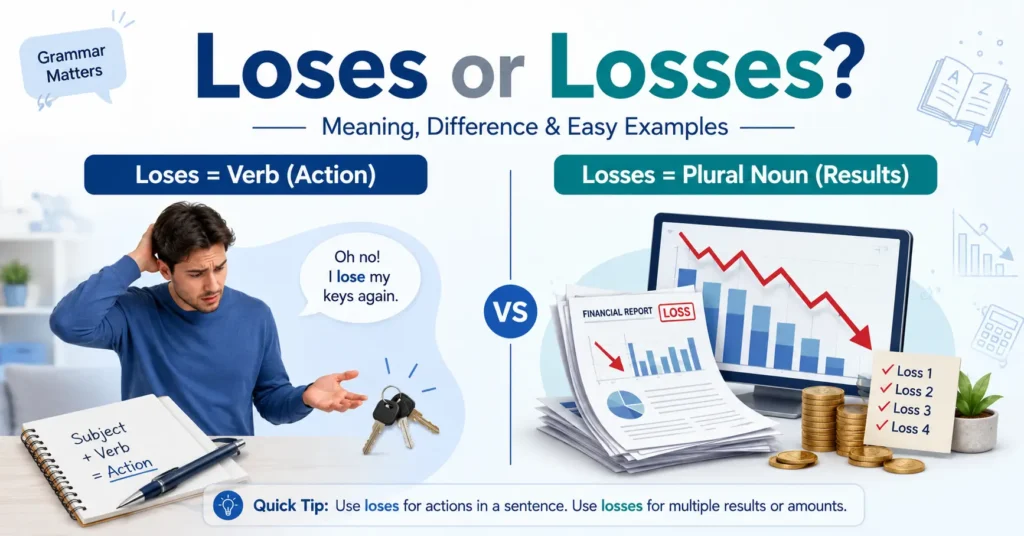
Loses or losses can confuse you when you’re writing a sentence and want the correct English word. The purpose of this guide is simple: it helps you understand the difference between loses and losses so you can use both words correctly in English writing, school exams, emails, and daily conversations.
Both words look close, but they don’t mean the same thing. Loses is a verb that shows an action, while losses is a plural noun that talks about more than one loss, result, or damage.
For example, you can say, “He loses his keys,” but you should say, “The company reported losses.” Once you learn this simple grammar rule, you won’t need to second-guess yourself again.
Loses or Losses — Quick Answer
Use loses when you need a verb. It means someone or something fails to keep, win, find, maintain, or control something.
Use losses when you need a plural noun. It means more than one loss, such as lost money, defeats, damage, deaths, or emotional setbacks.
| Word | Part of Speech | Meaning | Example |
| Loses | Verb | Fails to keep, win, or maintain something | She loses her keys often. |
| Losses | Plural noun | More than one loss | The company reported heavy losses. |
Here’s the easiest way to remember it:
Loses is an action. Losses are results.
So, write:
- Correct: He loses money every month.
- Correct: The business had serious losses last year.
- Incorrect: He losses money every month.
- Incorrect: The business had many loses last year.
Read this also: In Between or In-Between? The Correct Spelling, Meaning, and Examples
What Does Loses Mean?
Loses is the third-person singular form of the verb lose. You use it with singular subjects like he, she, it, the company, the team, the phone, or the student.
The word loses means someone or something:
- fails to win
- misplaces something
- no longer has something
- becomes unable to keep control
- becomes weaker in value, power, or quality
For example:
- She loses focus when the room gets noisy.
- He loses his wallet at least twice a year.
- The team loses whenever its defense falls apart.
- A phone loses battery faster in cold weather.
- The company loses customers after poor service.
In each sentence, loses shows an action. Something is happening.
Grammar Rule for Loses
Use loses when the subject is singular and the sentence happens in the present tense.
| Subject | Correct Verb Form |
| I | lose |
| You | lose |
| We | lose |
| They | lose |
| He | loses |
| She | loses |
| It | loses |
| The company | loses |
| The team | loses |
Notice the pattern. Loses works with he, she, it, and singular nouns.
Examples:
- He loses patience quickly.
- She loses interest after a few minutes.
- It loses value over time.
- The store loses money during slow months.
- The player loses confidence after repeated mistakes.
What Does Losses Mean?
Losses is the plural form of the noun loss. You use it when you talk about more than one loss.
A loss can mean:
- money lost
- a defeat
- damage
- a death
- a missed chance
- a decline in value
- an emotional setback
So, losses means several of these things.
Examples:
- The company reported financial losses.
- The storm caused major property losses.
- Investors worried about market losses.
- The team learned from its early-season losses.
- Many families suffered personal losses during the crisis.
In these sentences, losses names things. It does not show action.
Grammar Rule for Losses
Use losses when you need a noun that refers to multiple losses.
| Singular | Plural |
| one loss | two losses |
| a financial loss | financial losses |
| a business loss | business losses |
| a personal loss | personal losses |
| a market loss | market losses |
You can often place a number or adjective before losses.
Examples:
- three losses
- heavy losses
- painful losses
- unexpected losses
- repeated losses
- major losses
That’s a strong clue. If a word like many, several, heavy, or financial fits before it, you probably need losses.
Loses vs Losses: Key Difference
The biggest difference between loses and losses comes down to grammar.
Loses tells what someone or something does.
Losses names the things or results that came from losing.
| Feature | Loses | Losses |
| Part of speech | Verb | Plural noun |
| Base word | Lose | Loss |
| Meaning | Fails to keep, win, or maintain | More than one loss |
| Used with | He, she, it, singular nouns | Numbers, adjectives, plural ideas |
| Example | She loses time every morning. | The delays caused losses. |
| Easy clue | Shows action | Names results |
Here’s a simple comparison:
- A company loses money.
- The money it lost becomes losses.
Or:
- A team loses games.
- Those defeats are losses.
The first sentence shows action. The second sentence names the result.
Lose, Loses, Lost, Loss, and Losses
Writers often confuse loses or losses because these words belong to the same word family. They look related because they are related. Still, each one has its own job.
| Word | Part of Speech | Meaning | Example |
| Lose | Verb | To fail to keep, win, or find something | Don’t lose your ticket. |
| Loses | Verb | He, she, or it fails to keep, win, or find something | She loses her keys often. |
| Lost | Verb/adjective | Past form of lose | He lost the game. |
| Loss | Noun | One loss | The loss hurt the team. |
| Losses | Plural noun | More than one loss | The losses hurt the business. |
This table solves many related grammar mistakes. For example, don’t write “he loss” or “he losses.” The correct form is he loses.
Also, don’t write “many lose” when you mean several bad results. The correct noun is losses.
How to Use Loses Correctly
Use loses when you describe a present-tense action by a singular subject.
Common Sentence Patterns with Loses
| Pattern | Example |
| loses + object | He loses his phone all the time. |
| loses + money | The shop loses money in winter. |
| loses + interest | She loses interest when the lesson drags. |
| loses + control | The driver loses control on the icy road. |
| loses + value | The car loses value every year. |
| loses + confidence | The player loses confidence after a mistake. |
| loses + focus | He loses focus during long meetings. |
Examples of Loses in Sentences
- A student loses marks when the answer lacks detail.
- A laptop loses power faster when too many apps run.
- The team loses momentum after halftime.
- She loses patience when people interrupt her.
- A brand loses trust when it ignores customer complaints.
- He loses sleep before big exams.
- The phone loses signal inside the elevator.
In each example, loses acts like a verb. It tells you what the subject does.
How to Use Losses Correctly
Use losses when you talk about multiple losses or negative results.
Common Sentence Patterns with Losses
| Pattern | Example |
| financial losses | The startup faced financial losses. |
| heavy losses | The army suffered heavy losses. |
| market losses | Investors feared market losses. |
| property losses | The fire caused property losses. |
| personal losses | She wrote about her personal losses. |
| job losses | The factory closure led to job losses. |
| data losses | A bad backup system can cause data losses. |
Examples of Losses in Sentences
- The company reduced its losses after cutting waste.
- Farmers faced crop losses after weeks of heavy rain.
- The team’s early losses damaged its playoff chances.
- Small business losses can grow quickly without a plan.
- The family handled several painful losses in one year.
- The report measured tax losses from fraud.
- Poor security can lead to data losses.
Here, losses works as a noun. It names the negative results.
Loses or Losses in Real-Life Contexts
Grammar feels easier when you see words in real situations. Here’s how loses or losses works across common writing contexts.
Business English
Business writing uses both words often.
Use loses when a company performs the action:
- The company loses revenue during slow seasons.
- The store loses customers because of poor service.
- A brand loses credibility after misleading ads.
Use losses when you describe business results:
- The company reported losses for the second quarter.
- Rising costs caused heavy losses.
- The annual report explains the firm’s operating losses.
Mini case study:
A small bakery sells fewer cakes during winter. It loses sales because customer traffic drops. At the end of the season, the owner reviews the numbers and sees three months of losses. The action is loses. The result is losses.
Sports Writing
Sports writers use loses for action and losses for records or results.
- The team loses when its defense struggles.
- The boxer loses speed in later rounds.
- The club’s recent losses upset the fans.
- Three straight losses pushed the team down the table.
Think of a scoreboard. The team loses one game. Over time, those games become losses on its record.
School and Academic Writing
Students often make this mistake in essays.
Correct examples:
- A student loses points for missing citations.
- The essay loses clarity when the argument jumps around.
- The study reviews economic losses after natural disasters.
- The article discusses learning losses in remote education.
Academic writing needs precision. Loses shows action. Losses names outcomes.
Technology and Devices
Technology writing often uses both forms.
- A phone loses battery when apps run in the background.
- A laptop loses speed when storage gets full.
- Poor backups can cause data losses.
- Cyberattacks may lead to financial and data losses.
For tech topics, ask yourself: Is the device doing something, or are you naming the damage? That question usually gives you the answer.
Personal and Emotional Situations
Both words can describe emotional experiences.
- She loses confidence after harsh feedback.
- He loses motivation when progress feels slow.
- People handle personal losses in different ways.
- Grief after major losses can take time to process.
Use losses for emotional pain when more than one loss happened, or when you speak generally about life events.
Common Mistakes with Loses and Losses
Mistakes with loses or losses usually happen because the words look similar. However, the fixes are simple.
Using Losses as a Verb
Incorrect: He losses money every week.
Correct: He loses money every week.
Why? Losses is not a verb. You need loses because the sentence shows action.
Using Loses as a Noun
Incorrect: The company had many loses.
Correct: The company had many losses.
Why? The sentence talks about multiple negative results. You need the noun losses.
Confusing Loses with Looses
This mistake appears everywhere online.
Loses means fails to keep, win, or find something.
Looses means releases or sets free. It’s a real word, but it’s much less common.
Examples:
- Correct: She loses her keys.
- Correct but rare: The farmer looses the horses from the stable.
Most of the time, people who write looses actually mean loses.
Using Loses with Plural Subjects
Incorrect: They loses every game.
Correct: They lose every game.
Use lose with plural subjects like they, we, and the players.
More examples:
- Incorrect: The students loses marks.
- Correct: The students lose marks.
- Incorrect: We loses time in traffic.
- Correct: We lose time in traffic.
Using Loss Instead of Losses
Incorrect: The storm caused many loss.
Correct: The storm caused many losses.
Use loss for one. Use losses for more than one.
Pronunciation of Loses and Losses
Pronunciation can help you hear the difference.
| Word | Pronunciation Help | Sound |
| Loses | LOO-ziz | The “s” sounds like z |
| Losses | LOSS-iz | The “ss” keeps an s sound |
Say these out loud:
- She loses her place.
- The company had losses.
The first word sounds closer to loo-ziz. The second sounds closer to loss-iz.
That sound difference gives your brain another clue. If you hear the z sound, you probably need loses. If you hear the s sound, you probably need losses.
Synonyms for Loses
Use synonyms carefully. Not every synonym works in every sentence. Still, these words can help you understand the meaning of loses.
| Meaning | Possible Synonyms |
| Fails to win | fails, gets defeated, falls short |
| Misplaces | mislays, can’t find, forgets where something is |
| No longer has | gives up, parts with, forfeits |
| Becomes weaker | declines, drops, fades |
| Fails to keep control | slips, falters, breaks down |
Examples:
- She loses focus.
Similar meaning: She loses concentration. - The team loses the match.
Similar meaning: The team gets defeated. - The car loses value.
Similar meaning: The car declines in value.
Synonyms for Losses
The best synonym for losses depends on the context.
| Context | Possible Synonyms |
| Business | deficits, shortfalls, negative returns |
| Sports | defeats, setbacks |
| Property | damages, destruction |
| Personal life | griefs, bereavements, hardships |
| Finance | declines, downturns, reductions |
Examples:
- The company had financial losses.
Similar meaning: The company had financial deficits. - The team suffered several losses.
Similar meaning: The team suffered several defeats. - The storm caused property losses.
Similar meaning: The storm caused property damage.
Related Words You Should Know
Understanding related words can stop future mistakes.
| Word | Meaning | Example |
| Lose | Base verb | Don’t lose your receipt. |
| Loses | Verb for he/she/it | He loses track of time. |
| Lost | Past tense | She lost her phone. |
| Loss | One loss | The loss shocked fans. |
| Losses | More than one loss | The losses hurt profits. |
| Loser | Person or team that loses | No one wants to feel like a loser. |
| Losing | Present participle | They are losing money. |
| Loosen | Make less tight | Please loosen the knot. |
| Loose | Not tight | The screw is loose. |
| Looses | Releases, sets free | He looses the dog from its chain. |
The most common mix-up is lose vs loose, but loses vs losses causes trouble too. Keep each word tied to its grammar job.
Easy Memory Tricks for Loses or Losses
The Action Trick
If someone or something does the losing, use loses.
- She loses her keys.
- The phone loses signal.
- The company loses money.
Ask: “What does the subject do?”
If the answer is “loses,” you need the verb.
The Result Trick
If you’re naming the result of losing, use losses.
- The company had losses.
- The team’s losses hurt morale.
- The flood caused losses.
Ask: “Can I count these?”
If yes, losses probably fits.
The He/She/It Trick
Use loses with singular subjects in the present tense.
- He loses.
- She loses.
- It loses.
- The business loses.
However, use lose with plural subjects.
- They lose.
- We lose.
- The workers lose.
- The teams lose.
The Double-S Trick
Losses has a double s because it comes from loss.
- loss → losses
Loses comes from lose.
- lose → loses
So, look at the base word. That tiny spelling clue saves you from many mistakes.
Loses or Losses in One Sentence
Sometimes the best way to understand the difference is to place both words in the same sentence.
- A company loses money when its losses grow too large.
- The team loses confidence after several painful losses.
- If a phone loses data, the user may face serious data losses.
- A trader loses money when market losses get worse.
- When a student loses focus, small mistakes can lead to point losses.
These examples show the grammar clearly. Loses does the action. Losses names the result.
Quick Practice: Choose Loses or Losses
Test yourself before moving on.
| Sentence | Correct Answer |
| She always _____ her notebook. | loses |
| The company reported huge _____. | losses |
| The team _____ because it makes too many mistakes. | loses |
| Farmers faced crop _____ after the storm. | losses |
| He _____ interest when the topic gets too technical. | loses |
| The business reduced its yearly _____. | losses |
| A car _____ value after years of use. | loses |
If you got most of these right, you already understand the rule.
Professional Writing Tips for Loses and Losses
In professional writing, this mistake can make a sentence look careless. That’s especially true in emails, reports, resumes, and business content.
Use Loses for Actions
- The department loses time when tasks aren’t clear.
- The company loses leads when response times are slow.
- The software loses accuracy when the data is incomplete.
Use Losses for Results
- The report explains quarterly losses.
- Better planning helped reduce operational losses.
- The audit found preventable financial losses.
Better Business Examples
Weak: The company losses money because of bad service.
Better: The company loses money because poor service drives customers away.
Weak: The manager reviewed the team’s loses.
Better: The manager reviewed the team’s losses and made a recovery plan.
Clear grammar builds trust. It tells readers you understand both the topic and the language.
Loses or Losses for Students and Beginners
For beginners, the rule can stay very simple.
Loses = does the losing.
Losses = the losses that happened.
Examples:
- She loses her pen.
- She had many losses in the game.
- The shop loses money.
- The shop had many losses.
- The team loses often.
- The team has five losses.
Don’t overthink it. Look at the sentence job. Is the word acting like a verb or a noun?
Final Rule: Which One Should You Use?
Use loses when:
- the word shows action
- the subject is singular
- the sentence means “fails to keep,” “fails to win,” or “fails to maintain”
- the subject is he, she, it, or one singular noun
Use losses when:
- the word names things
- you mean more than one loss
- you can count the losses
- an adjective comes before it, such as heavy, financial, personal, or major
Simple Decision Table
| Question | Use |
| Is someone doing the losing? | loses |
| Are you talking about more than one loss? | losses |
| Can you replace it with “fails to keep”? | loses |
| Can you put “many” before it? | losses |
| Does it follow he, she, it, or a singular noun? | loses |
| Does it describe business, money, damage, or defeat results? | losses |
FAQs About Loses or Losses
Q1 :What is the difference between loses and losses?
Loses is a verb that means someone or something fails to keep, win, or find something. Losses is a plural noun that means more than one loss. For example, “She loses focus” and “The business had losses” are both correct.
Q2 :Is it correct to say “he losses”?
No, “he losses” is incorrect. The correct phrase is “he loses” because loses is the verb form used with he, she, or it. Example: “He loses his phone often.”
Q3 :When should I use losses?
Use losses when you talk about more than one loss. It can refer to money, business problems, sports defeats, damages, or personal pain. Example: “The company reported heavy losses last year.”
Q4 :Is losses a verb or noun?
Losses is a noun, not a verb. More specifically, it is a plural noun. It names the results of losing, such as financial losses, property losses, or personal losses.
Q5 :How can I remember loses or losses easily?
Use this simple trick: loses = action, and losses = results. If someone does the losing, write loses. If you’re talking about more than one loss, write losses.
Conclusion
Understanding loses or losses becomes easy when you remember their grammar jobs. Loses is a verb, so it shows an action. Losses is a plural noun, so it names more than one loss, result, or damage.
Use loses when someone or something does the losing. Use losses when you talk about the results of losing. This small difference can make your English writing clearer, cleaner, and more professional.
So, the next time you feel stuck, use this quick rule: loses = action, and losses = results. That one tip can help you avoid a common grammar mistake in emails, essays, reports, and everyday sentences.

1 thought on “Loses or Losses: Meaning, Difference, Grammar Rules, and Easy Examples”