
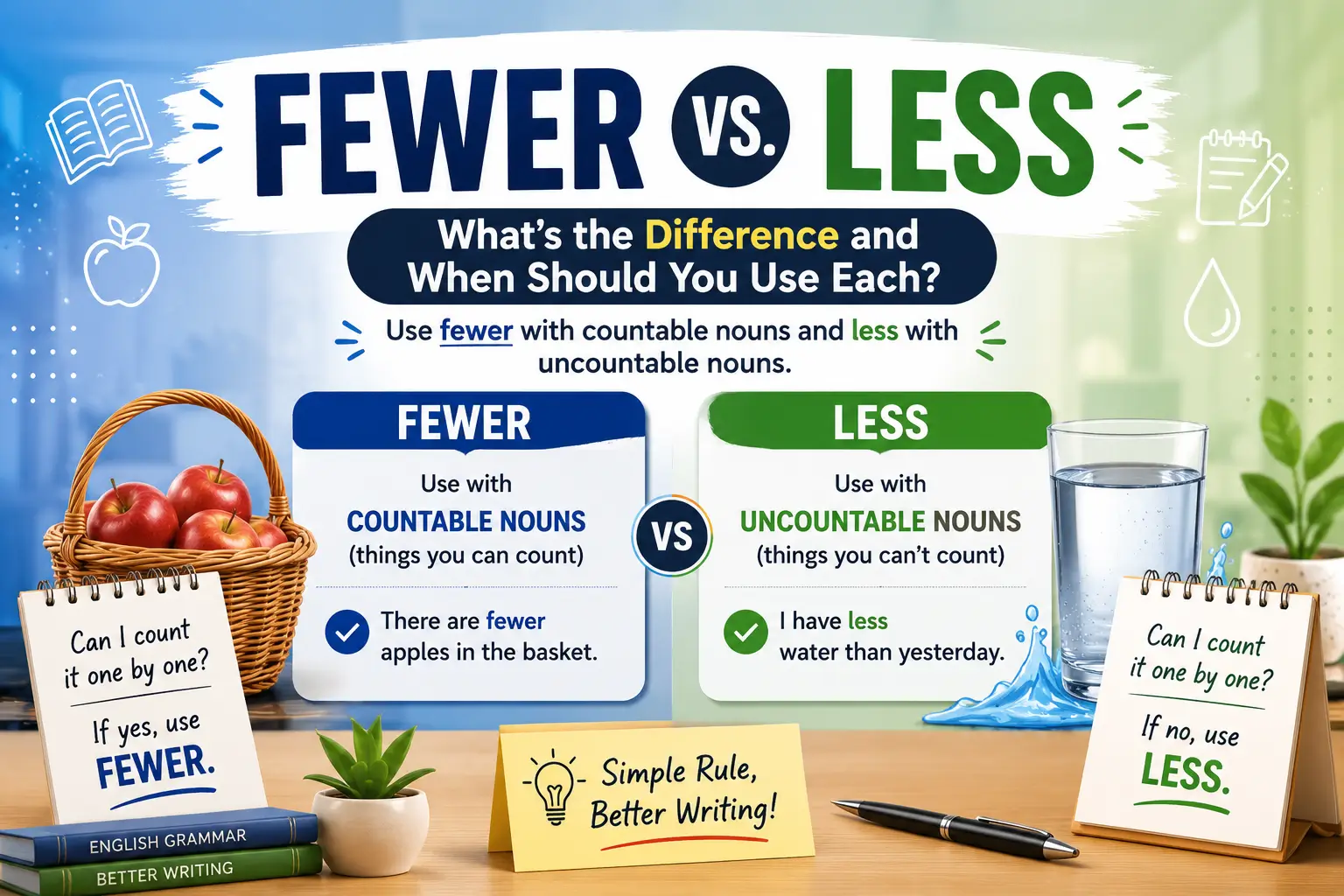
Fewer vs. less is one of the most common grammar questions in American English, and understanding the difference can instantly improve your writing. The simple rule is this: use fewer with countable nouns and less with uncountable nouns. However, English also has a few common exceptions involving money, time, distance, and measurements, which often confuse writers.
Whether you’re a student, blogger, professional, or English learner, knowing the correct use of fewer vs. less helps you write with greater confidence and accuracy. This guide explains the grammar rule in simple language, covers important exceptions, compares countable and uncountable nouns, highlights common mistakes, and provides practical examples from everyday American English so you can choose the right word every time..
Quick Answer
Here’s the simplest way to remember the difference:
- Use fewer with countable nouns.
- Use less with uncountable nouns.
Examples
✅ There are fewer students in class today.
❌ There are less students in class today.
✅ I have less water than yesterday.
❌ I have fewer water than yesterday.
A helpful question to ask yourself is:
Can I count it one by one?
- If yes, use fewer.
- If no, use less.
What Does Fewer Mean?
Fewer means a smaller number of individual things that can be counted.
Part of Speech
Adjective (sometimes used as a determiner before nouns)
Pronunciation
FYOO-er (/ˈfjuːər/)
When to Use Fewer
Choose fewer when talking about countable nouns.
Countable nouns are things you can count individually.
Examples include:
- Books
- Cars
- Apples
- Students
- Emails
- Dogs
- Houses
- Chairs
Examples
✅ There are fewer cars on the road today.
✅ We hired fewer employees this year.
✅ She bought fewer apples than last week.
✅ The teacher gave us fewer assignments this month.
Each noun above can be counted individually.
More Everyday Examples
School
- There were fewer students absent today.
- We had fewer homework assignments this week.
Work
- Our team completed fewer projects than expected.
- The company received fewer applications this month.
Home
- We need fewer decorations this year.
- There are fewer dishes to wash tonight.
What Does Less Mean?
Less means a smaller amount of something that cannot usually be counted individually.
Part of Speech
Adjective, adverb, pronoun, and sometimes determiner
Pronunciation
LESS (/lɛs/)
When to Use Less
Use less with uncountable nouns.
These nouns describe substances, ideas, or amounts rather than separate items.
Common examples include:
- Water
- Milk
- Sugar
- Air
- Time
- Information
- Knowledge
- Traffic
- Happiness
- Furniture
Examples
✅ We need less sugar.
✅ She spends less time on social media.
✅ There’s less traffic today.
✅ I have less patience than I used to.
Everyday Examples
Kitchen
- Please use less salt.
- Add less butter next time.
Office
- We need less paperwork.
- This project requires less effort.
Conversation
- Talk less and listen more.
- I have less energy today.
The Main Difference Between Fewer vs. Less
The difference comes down to whether the noun can be counted.
| Feature | Fewer | Less |
| Meaning | Smaller number | Smaller amount |
| Used with | Countable nouns | Uncountable nouns |
| Question to ask | Can I count it? | Can I measure it? |
| Examples | Books, cars, people | Water, rice, money, time |
Countable Nouns Use Fewer
Countable nouns have singular and plural forms.
You can count them:
- One book
- Two books
- Three books
Therefore:
✅ Fewer books
Not:
❌ Less books
More examples
✅ Fewer cookies
✅ Fewer chairs
✅ Fewer mistakes
✅ Fewer emails
Uncountable Nouns Use Less
Uncountable nouns describe things we usually measure instead of count.
Examples include:
- Water
- Coffee
- Milk
- Advice
- Information
- Equipment
- Music
- Peace
Correct examples
✅ Less water
✅ Less coffee
✅ Less equipment
✅ Less information
Incorrect examples
❌ Fewer water
❌ Fewer information
How to Know Whether a Noun Is Countable or Uncountable
Many learners struggle because some nouns aren’t obvious. Fortunately, there’s an easy test.
Ask Yourself This Question
Can I count individual items?
If yes → Fewer
If no → Less
Countable Nouns
You can count these one by one.
Examples include:
- Students
- Pens
- Phones
- Dogs
- Trees
- Tables
- Cookies
- Pictures
Correct sentences
✅ Fewer pens
✅ Fewer phones
✅ Fewer cookies
Uncountable Nouns
These describe substances, concepts, or materials.
Examples include:
- Water
- Air
- Knowledge
- Information
- Furniture
- Music
- Bread
- Rice
Correct sentences
✅ Less furniture
✅ Less knowledge
✅ Less bread
Some Nouns Can Change Meaning
A few nouns become countable depending on the situation.
For example:
Chicken
“I ate less chicken.”
Here, chicken means meat, so it’s uncountable.
“There are fewer chickens on the farm.”
Here, chickens means individual birds, so they’re countable.
Another example:
Paper
“I need less paper.”
(Material)
“I wrote fewer papers this semester.”
(Individual assignments)
Understanding the meaning of the noun is just as important as knowing the rule.
Quick Comparison Table
| Situation | Correct Word | Example |
| Books | Fewer | Fewer books |
| Students | Fewer | Fewer students |
| Cars | Fewer | Fewer cars |
| Apples | Fewer | Fewer apples |
| Water | Less | Less water |
| Milk | Less | Less milk |
| Time | Less | Less time |
| Traffic | Less | Less traffic |
| Sugar | Less | Less sugar |
| Advice | Less | Less advice |
Grammar Tip
If you can replace the noun with “one, two, three,” use fewer. If you would measure it instead, use less.
Examples
One apple
Two apples
Three apples
➡ Fewer apples
One water ❌
Two waters ❌ (unless referring to bottles or servings)
➡ Less water
Real-Life Example
Imagine you’re grocery shopping.
You buy:
- 8 apples
- 2 loaves of bread
- 1 gallon of milk
You might say:
✅ “I bought fewer apples this week.”
Because apples can be counted.
Later you notice:
✅ “I bought less milk.”
Milk is measured by volume, not counted as individual pieces.
This simple way of thinking works in almost every everyday situation.
Quote to Remember
“Count the things? Choose fewer. Measure the amount? Choose less.”
It’s not an official grammar rule, but it’s an easy reminder that works in most situations.
Common Situations Where Less Is Correct (Even with Numbers)
At first, the rule seems easy:
- Fewer = countable nouns
- Less = uncountable nouns
However, English has several common exceptions. In these situations, less is considered correct because you’re referring to a single amount, measurement, or unit, not individual items.
Let’s look at the most common ones.
Money
Money can be counted as dollars or cents, but when talking about the total amount, American English uses less.
Correct
- ✅ This laptop costs less than $800.
- ✅ She spent less money this month.
- ✅ I have less than $20 in my wallet.
Incorrect
- ❌ This laptop costs fewer than $800.
Why?
Here, $800 is treated as one total amount, not 800 separate one-dollar bills.
Time
Time is measured as a whole rather than counted item by item.
Correct
- ✅ The meeting lasted less than an hour.
- ✅ It takes less time to drive.
- ✅ We finished in less than five minutes.
Incorrect
- ❌ The meeting lasted fewer than an hour.
Even though minutes and hours are countable units, English normally treats time as a measurement.
Distance
Distance is another measurement.
Correct
- ✅ The store is less than three miles away.
- ✅ We walked less than one mile.
Incorrect
- ❌ The store is fewer than three miles away.
Weight
Weight refers to an amount.
Correct
- ✅ This package weighs less than 10 pounds.
- ✅ I’ve gained less weight this year.
Incorrect
- ❌ This package weighs fewer than 10 pounds.
Volume and Measurements
Measurements usually take less, even when numbers appear.
Examples include:
- liters
- gallons
- inches
- feet
- kilograms
- meters
Correct
- ✅ The bottle holds less than two liters.
- ✅ The board is less than six feet long.
- ✅ The recipe needs less than one cup of milk.
Percentages
Percentages often represent an overall amount.
Correct
- ✅ Less than 25% of the population voted.
- ✅ The battery has less than 10% charge left.
However, context matters.
Compare:
✅ Less than 20% of the water evaporated.
(Amount of water)
✅ Fewer than 20% of the students were absent.
(The percentage refers to countable people.)
Age
Age is treated as time.
Correct
- ✅ Children less than five years old ride free.
- ✅ Anyone less than 18 years old needs permission.
Statistical Expressions
Many statistics describe totals or measurements.
Examples
- less than 100 miles
- less than 40 minutes
- less than 50 pounds
- less than 30%
Although numbers appear, they’re treated as measurements.
When You Should Always Use Fewer
Whenever you’re talking about individual things that can be counted, fewer is the correct choice.
People
People are countable.
Correct
- ✅ Fewer customers visited today.
- ✅ Fewer employees attended the meeting.
- ✅ Fewer voters participated this year.
Animals
Animals are individual living things.
Correct
- ✅ There are fewer birds in the yard.
- ✅ The zoo has fewer elephants now.
- ✅ We saw fewer deer this winter.
Individual Objects
Physical objects can usually be counted.
Examples
- books
- pencils
- laptops
- cookies
- flowers
- shoes
Correct
- ✅ Fewer books
- ✅ Fewer chairs
- ✅ Fewer cookies
Groups of Countable Items
Even when discussing collections, use fewer if the items are countable.
Examples
- fewer mistakes
- fewer questions
- fewer complaints
- fewer accidents
- fewer emails
- fewer phone calls
Common Mistakes with Fewer and Less
Many native English speakers make these mistakes in everyday conversation. While informal speech is often forgiving, formal writing should follow the standard grammar rule.
Mistake 1: Using Less with Countable Nouns
❌ There were less students today.
✅ There were fewer students today.
Why?
Students can be counted.
Mistake 2: Using Fewer with Uncountable Nouns
❌ We need fewer information.
✅ We need less information.
Information isn’t counted individually.
Mistake 3: Confusing Measurements with Countable Items
❌ The race is fewer than five miles.
✅ The race is less than five miles.
Miles describe distance, which is treated as a measurement.
Mistake 4: Mixing the Rule Within One Sentence
❌ We sold less cars and fewer gasoline.
✅ We sold fewer cars and less gasoline.
Each noun follows its own rule.
Correct vs. Incorrect Examples
| Incorrect | Correct | Why? |
| Less books | Fewer books | Books are countable. |
| Less people | Fewer people | People can be counted. |
| Fewer water | Less water | Water is uncountable. |
| Fewer traffic | Less traffic | Traffic is an amount. |
| Less cookies | Fewer cookies | Cookies are countable. |
| Fewer furniture | Less furniture | Furniture is uncountable. |
| Less emails | Fewer emails | Emails are countable. |
| Fewer money | Less money | Money is treated as an amount. |
Examples of Fewer and Less in Everyday American English
Understanding grammar is easier when you see how people actually speak and write.
Conversation
Correct
“I’ve been eating less sugar lately.”
“There are fewer cars on the highway today.”
At School
“The teacher assigned fewer worksheets this week.”
“I spent less time studying because the exam was postponed.”
At Work
“Our office hired fewer employees this year.”
“We’re using less paper to reduce waste.”
“We received fewer customer complaints this month.”
“The project required less funding than expected.”
Social Media
“I’m spending less time scrolling.”
“There are fewer ads in this app now.”
Why You Sometimes See “10 Items or Less”
You’ve probably noticed grocery store checkout signs that say:
10 Items or Less
Many grammar experts point out that, technically, it should be:
10 Items or Fewer
Why?
Because items are countable.
However, the phrase “10 Items or Less” became common decades ago because it’s shorter, sounds smoother, and people immediately understand it.
Today, many stores have changed their signs to:
- 10 Items or Fewer
- 15 Items or Fewer
- Express Checkout: 10 Items or Fewer
Is “10 Items or Less” Wrong?
It depends on the context.
Formal grammar: Prefer fewer.
Everyday signs and conversation: Many people still use less, and most readers won’t notice.
If you’re writing for school, business, or professional purposes, choose fewer whenever the noun is countable.
Is the Rule Always Strict?
Not exactly.
The distinction between fewer and less has existed for centuries, but English speakers have used less with plural nouns in certain expressions for a very long time.
Modern grammar guides generally recommend:
- Follow the countable/uncountable rule in formal writing.
- Recognize that common speech doesn’t always follow it.
This balance helps you write correctly without being surprised by what you hear in everyday conversation.
Fewer vs. Less in Formal and Informal Writing
Academic Writing
Always follow the standard grammar rule.
Examples
- Fewer participants
- Less research funding
Professional Writing
Business documents, reports, and emails should also follow the standard rule.
Correct usage makes your writing look polished and professional.
Casual Conversation
Native speakers often say things like:
- “Less people showed up.”
Although common, this isn’t considered standard grammar.
Advertising and Marketing
You’ll sometimes see:
- Less fees
- Less worries
- Less bills
Advertisers often choose phrases that sound natural and are easy to remember. That doesn’t always mean they’re grammatically perfect.
Quick Tip
When you’re unsure, ask yourself:
Can I count the noun one by one?
If yes, choose fewer.
If you’re talking about an amount, measurement, or substance, choose less.
Memory Tricks to Remember Fewer vs. Less
Grammar rules are easier to remember when you connect them to a simple idea. Instead of memorizing long explanations, use one of these tricks whenever you’re unsure.
Trick 1: Count It or Measure It?
Ask yourself:
Can I count it one by one?
- Yes → Use fewer.
- No → Use less.
Examples:
- 🍎 Apples → Fewer apples
- 📚 Books → Fewer books
- 💧 Water → Less water
- ⏰ Time → Less time
This is the easiest and most reliable way to choose the correct word.
Trick 2: Think of Numbers
If you can naturally say one, two, three, the noun is countable.
Examples:
- One chair, two chairs, three chairs → Fewer chairs
- One student, two students → Fewer students
Now try this:
- One water ❌
- Two waters ❌ (unless you’re talking about bottles or servings)
Since you normally measure water, you say less water.
Trick 3: Remember the Letter “F”
Many learners find this mnemonic helpful:
- Fewer = F = Find the number
- Less = Large amount
Although it’s not an official grammar rule, it can help you remember the difference during writing.
Practice Sentences
Test your understanding by choosing fewer or less.
Choose the Correct Word
- There were _____ visitors this weekend.
- I need _____ coffee this morning.
- We have _____ meetings than last month.
- She spent _____ money on groceries.
- There are _____ cars on the road today.
- The project required _____ time than expected.
- We made _____ mistakes this time.
- Add _____ sugar to the recipe.
- The company hired _____ employees this year.
- The package weighs _____ than five pounds.
Answers with Explanations
1. Fewer
Visitors are countable.
2. Less
Coffee is uncountable.
3. Fewer
Meetings can be counted.
4. Less
Money is treated as an amount.
5. Fewer
Cars are countable.
6. Less
Time is measured.
7. Fewer
Mistakes can be counted.
8. Less
Sugar is uncountable.
9. Fewer
Employees are individual people.
10. Less
Weight is a measurement.
Quick Cheat Sheet
| If you’re talking about… | Use |
| People | Fewer |
| Students | Fewer |
| Books | Fewer |
| Cars | Fewer |
| Emails | Fewer |
| Cookies | Fewer |
| Water | Less |
| Milk | Less |
| Coffee | Less |
| Sugar | Less |
| Money | Less |
| Time | Less |
| Distance | Less |
| Weight | Less |
| Traffic | Less |
| Information | Less |
Golden Rule:
Count it → Fewer. Measure it → Less.
Synonyms and Related Words
Although fewer and less have similar meanings, they aren’t always interchangeable. Here are some related words you may encounter.
Synonyms of Fewer
- Smaller number of
- Not as many
- Reduced number of
- Limited number of
Example:
- We have a smaller number of applicants this year.
- We have fewer applicants this year.
Synonyms of Less
- Smaller amount of
- Reduced amount of
- Not as much
- Lower quantity of
Example:
- The recipe needs a smaller amount of salt.
- The recipe needs less salt.
Related Grammar Terms
Understanding these terms will also improve your grammar skills:
- Countable nouns
- Uncountable nouns
- Determiners
- Quantifiers
- Comparative adjectives
- Modifiers
These concepts often appear together when learning the difference between fewer and less.
Conclusion
Fewer vs. less may seem confusing at first, but the basic rule is easy to remember once you understand it. Use fewer for countable nouns like books, students, or emails because you can count them individually. Use less for uncountable nouns such as water, money, time, and information because they represent an amount rather than separate items.
It’s also important to remember the common exceptions. Expressions involving time, distance, money, and measurements usually take less, even when numbers appear. By asking yourself whether you can count the noun or only measure it, you’ll make the correct choice in most situations. With regular practice and real-life examples, using fewer and less correctly will soon become second nature, making your writing clearer, more natural, and more professional.
Frequently Asked Questions
Q1. What is the difference between fewer and less?
Fewer is used with countable nouns, while less is used with uncountable nouns. For example, say fewer books but less water.
Q2. Is it “fewer people” or “less people”?
The correct phrase is fewer people because people can be counted individually. Although less people is sometimes heard in casual speech, fewer people is the standard form.
Q3. Is it “10 items or less” or “10 items or fewer”?
From a grammar perspective, 10 items or fewer is correct because items are countable. However, many stores still use 10 items or less as a common expression.
Q4. Why is “less than $20” correct?
Money is usually treated as a single amount rather than individual units. That’s why less than $20 is considered correct.
Q5. Can I use less with countable nouns?
Generally, no. However, less is commonly used with measurements such as time, distance, money, weight, and percentages, even when numbers are involved.
Q6. Is “less than five minutes” grammatically correct?
Yes. Since time is considered a measurement, less than five minutes is standard English.
Q7. Why do many people confuse fewer and less?
Both words express a smaller quantity, but they apply to different types of nouns. Understanding the difference between countable and uncountable nouns makes the choice much easier.
Q8. What is the easiest way to remember fewer vs. less?
Ask yourself one question: Can I count it? If the answer is yes, use fewer. If not, use less.
Q9. Do American and British English follow the same rule?
Yes. Both American English and British English generally follow the same grammar rule, although informal speech may not always follow it strictly.
Q10. Is using fewer instead of less important in professional writing?
Yes. Using fewer and less correctly makes your writing more accurate, professional, and grammatically correct, especially in academic, business, and formal communication.