
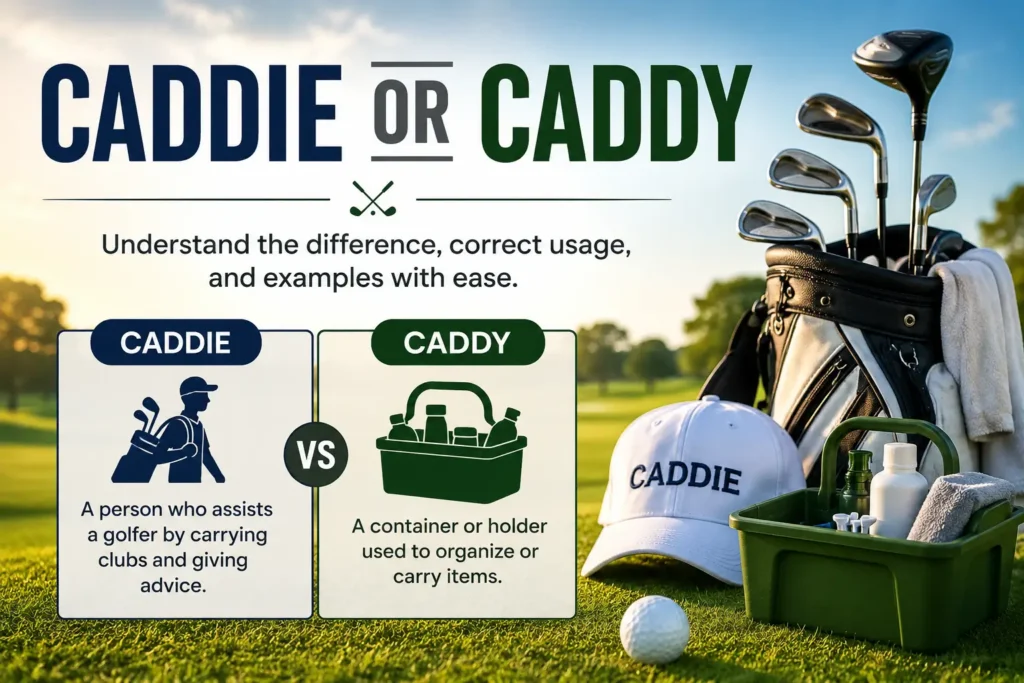
Caddie or caddy is a common spelling question, especially when you’re writing about golf. The good news is that both spellings are correct, but they don’t always have the same meaning. Caddie traditionally refers to a person who assists a golfer, while caddy is commonly used for a container or holder.
The confusion happens because the two words are usually pronounced the same. For example, a golf caddie may carry clubs and help a player understand the course, while a shower caddy holds bathroom items. The surrounding words make the intended meaning clear.
If you’re unsure which form to use, focus on context, meaning, and usage. For formal golf writing, caddie is a clear traditional choice. For objects such as a shower caddy or tea caddy, use caddy. This simple distinction can help you avoid common spelling mistakes and write with greater confidence.
Caddie vs. Caddy: The Quick Answer
Here’s the simplest way to remember the difference:
- Caddie = a person who assists a golfer.
- Caddy = a container or holder, such as a shower caddy or tea caddy.
- Caddy can also mean a golf assistant, so it isn’t automatically wrong in golf.
- Caddie and caddy are generally pronounced the same.
- The plural of both is caddies.
For formal golf writing, caddie is often the clearest choice because it immediately identifies a person who works with a golfer.
For objects, however, caddy is the normal spelling.
Quick rule: If you mean a golf assistant, caddie is the safest traditional spelling. If you mean a container or holder, use caddy.
Read this also: Startup or Start-Up: Which Spelling Is Correct?
Caddie and Caddy at a Glance
| Feature | Caddie | Caddy |
| Main meaning | A person who assists a golfer | A container or holder |
| Golf meaning | Yes | Yes, as an alternative spelling |
| Container meaning | Generally no | Yes |
| Example | The golfer thanked his caddie. | She bought a shower caddy. |
| Pronunciation | Usually /ˈkædi/ | Usually /ˈkædi/ |
| Plural | caddies | caddies |
| Common compound | golf caddie | shower caddy, tea caddy |
| Grammar category | Noun | Noun |
The important point is that the two words overlap in golf. Therefore, it would be inaccurate to say that caddy is always wrong when referring to a golf assistant.
At the same time, caddie isn’t normally the spelling you want for a bathroom or storage container.
What Does “Caddie” Mean?
A caddie is a person who assists a golfer during a round of golf.
Traditionally, a caddie carries the golfer’s clubs and equipment. Depending on the situation, a caddie may also help the golfer understand the course, estimate distances, discuss strategy, and make club selections.
In professional golf, the caddie can play an important role in helping a golfer make decisions during a round.
For example:
- The golfer asked his caddie which club he should use.
- Her caddie carried the golf bag throughout the tournament.
- The player and his caddie discussed the wind before the shot.
- His caddie helped him read the green.
In all four examples, caddie refers to a person.
Examples of “Caddie” in Sentences
Consider these everyday examples:
Golf course:
The caddie carried the player’s clubs to the next hole.
Professional golf:
The golfer and his caddie studied the course before the tournament.
Conversation:
My caddie suggested using a different club.
Sports writing:
The caddie gave the player advice about the distance to the green.
The word works naturally in both casual and professional golf contexts.
What Does “Caddy” Mean?
Caddy has more than one use.
First, it can refer to a small container or holder designed to store, carry, or organize items.
You’ll see this meaning in familiar expressions such as:
- shower caddy
- tea caddy
- bathroom caddy
- storage caddy
- desk caddy
- tool caddy
For example:
I keep my shampoo and soap in a shower caddy.
Here, caddy refers to an object, not a person.
Second, caddy can also be used as a spelling variant of caddie in golf.
For example:
The golfer’s caddy helped him choose a club.
That usage is legitimate. However, caddie remains a particularly clear and established spelling for the golf profession.
Examples of “Caddy” as a Golf Term
When caddy refers to a golf assistant, the meaning comes from the context.
- The golfer spoke with his caddy before the tournament.
- His caddy carried the clubs around the course.
- The player thanked his caddy after the final hole.
These sentences use caddy to mean a golf assistant.
However, if you’re writing formal golf content and want to avoid any possible ambiguity, caddie is usually the better choice.
Examples of “Caddy” as a Container or Holder
The container meaning is especially common in American English.
- I bought a new shower caddy for my bathroom.
- The tea leaves are stored in a tea caddy.
- She organized her makeup in a small caddy.
- The mechanic keeps his tools in a rolling caddy.
In these examples, replacing caddy with caddie would be inappropriate.
You wouldn’t normally write:
I bought a new shower caddie.
The standard expression is:
I bought a new shower caddy.
The Key Difference Between Caddie and Caddy
The clearest distinction is what the word describes.
Caddie primarily identifies a person who assists a golfer.
Caddy commonly identifies a container or holder, but it can also refer to a golf assistant.
That means the relationship isn’t perfectly symmetrical.
| Meaning | Preferred spelling |
| Person assisting a golfer | caddie |
| Golf assistant, alternative spelling | caddy |
| Bathroom container | caddy |
| Tea container | caddy |
| Storage holder | caddy |
So, if you’re unsure, ask yourself one question:
What am I talking about?
If it’s a person helping a golfer, caddie is the safest choice. If it’s a container or holder, caddy is the natural choice.
A Simple Rule for Choosing the Right Spelling
Use this practical rule:
Person on a golf course → caddie
Container or holder → caddy
There’s one important exception to remember: caddy can also be used for a golf assistant.
Therefore, the rule helps you choose the clearest spelling, but it doesn’t mean that caddy is grammatically incorrect in golf.
Is There a Grammar Difference?
There isn’t a major grammar difference between caddie and caddy.
Both are normally used as nouns.
A noun names a person, place, thing, or idea. In these words, the difference is primarily spelling and meaning.
Compare:
The caddie carried the clubs.
The caddy carried the clubs.
Both sentences can refer to a golf assistant.
Now compare:
The golfer bought a caddy for the bathroom.
Here, caddy refers to a container.
The spelling doesn’t determine whether the sentence is grammatically correct by itself. Instead, the intended meaning determines which word makes sense.
This distinction matters because people sometimes describe caddie and caddy as though one were grammatically correct and the other were grammatically incorrect. That’s too simple.
How Do You Pronounce Caddie and Caddy?
In ordinary American English, caddie and caddy are generally pronounced the same way.
A simple pronunciation guide is:
Caddie: KAD-ee
Caddy: KAD-ee
The pronunciation is roughly represented by the IPA /ˈkædi/.
Both words have two syllables:
cad-die
cad-dy
The different spellings don’t normally produce different sounds.
So, if you hear someone say caddie, you usually can’t determine from pronunciation alone whether the speaker has the word spelled with -ie or -y in mind.
Caddie vs. Caddy in American English
American English uses caddy frequently for containers and holders.
That’s why Americans commonly encounter words such as:
- shower caddy
- tea caddy
- bathroom caddy
- storage caddy
For golf, both caddie and caddy can appear.
However, caddie is a very recognizable golf term and is often the clearer option in sports writing.
For example:
The golfer consulted his caddie before hitting the ball.
This immediately signals the golf-related meaning.
By contrast:
The golfer consulted his caddy before hitting the ball.
This can also be correct, but the spelling has another common meaning. Context makes the intended meaning clear.
British English and Other English Varieties
The word caddie has a long history in British English, particularly in connection with golf.
The spelling caddy is also established in English and isn’t limited to one modern regional variety.
More importantly, regional differences shouldn’t be exaggerated. The choice between these spellings isn’t simply a case of:
American English = caddy
British English = caddie
That would be misleading.
Instead, meaning and editorial preference matter.
A golf publication may consistently use caddie. Another publication may use caddy. A dictionary may list one spelling as a variant of the other.
When you’re writing professionally, the best approach is to follow the style used by the publication, organization, or audience you’re writing for.
Caddie or Caddy in Different Contexts
The right spelling can become much easier to choose when you consider the type of writing you’re doing.
Golf and Sports Writing
In golf journalism, tournament coverage, and professional sports writing, caddie is a strong choice when you mean the golfer’s assistant.
For example:
The player and his caddie discussed the wind before the final shot.
It creates an immediate connection to golf.
Still, caddy isn’t automatically an error in this context. If a publication uses caddy as its preferred spelling, consistency matters.
Professional and Workplace Writing
Professional writing should prioritize clarity.
Suppose you’re writing an email about a golf event:
Please confirm whether each player will have a caddie during the tournament.
The meaning is obvious.
If you’re writing about workplace storage:
Please place the cleaning supplies in the storage caddy.
Here, caddy is clearly the correct choice because you’re describing a container.
Academic and Educational Writing
Students should pay attention to meaning and context rather than memorizing a false rule that says one spelling is always correct.
For a paper about golf:
A professional caddie can assist a golfer with course strategy.
For a paper about household organization:
A shower caddy provides convenient storage for toiletries.
In academic writing, consistency and accurate word choice are more important than trying to make every spelling look formal.
Casual Conversation and Texting
Informal writing gives you more flexibility, especially when the meaning is obvious.
Someone might text:
My caddy helped me read the green.
The context makes the golf meaning clear.
Likewise:
I need a new shower caddy.
There is no realistic confusion because shower caddy is a familiar expression.
Product and Everyday Object Names
When you’re talking about a container, caddy is the form you’ll normally see.
Common examples include:
- shower caddy
- tea caddy
- desk caddy
- storage caddy
- tool caddy
These compounds are worth remembering because they occur frequently in everyday American English.
Common Mistakes With Caddie and Caddy
Understanding the most common errors can make the distinction much easier.
Mistake 1: Assuming “Caddy” Is Always Wrong for Golf
Some writers learn that caddie is the golf spelling and then assume caddy must be incorrect.
That’s not accurate.
Caddy can refer to a golf assistant as an alternative spelling.
However, if you’re writing formal golf content and don’t have a specific style preference, caddie is often the safest and clearest choice.
Mistake 2: Using “Caddie” for Every Type of Caddy
The opposite mistake is treating caddie as the spelling for every object called a caddy.
For example:
❌ I put my shampoo in a shower caddie.
Better:
✅ I put my shampoo in a shower caddy.
The object is a holder, so caddy is the standard choice.
Mistake 3: Assuming One Spelling Is Universally Correct
English sometimes has multiple accepted spellings for related words.
Therefore, don’t assume that seeing caddy in a golf article automatically means the writer made a spelling mistake.
Instead, look at the meaning and context.
Mistake 4: Treating Spelling Preference as a Grammar Rule
This is another common misunderstanding.
The difference between caddie and caddy isn’t primarily a subject-verb agreement issue, tense issue, or sentence-structure issue.
It’s mainly a question of spelling and lexical meaning.
Plural Forms: Caddies
The plural form can look confusing because both spellings become caddies.
For example:
The caddies waited near the clubhouse.
Here, caddies means multiple golf assistants.
You can also say:
The store sells bathroom caddies.
In this sentence, caddies means multiple containers.
Notice what happens:
- caddie → caddies
- caddy → caddies
The spelling becomes the same in the plural.
That’s an especially useful detail to remember.
Where Did Caddie and Caddy Come From?
The history of these words is more complicated than a simple spelling difference.
Caddie developed as a term associated with a person who performs various tasks, eventually becoming strongly associated with golf.
The golf sense became established as the game developed, particularly in Scotland and Britain.
Caddy is a related spelling that developed alongside the word. English has many examples of spelling variation that become established over time.
The container meaning of caddy has its own historical development and is associated with a small container used to hold or store something, especially tea.
Because the histories overlap but aren’t identical in every detail, it’s better not to reduce the story to a claim that one spelling is simply a misspelling of the other.
Dictionary Guidance for Caddie and Caddy
Major English dictionaries recognize these words and their established uses.
The most useful takeaway from dictionary definitions is that caddie and caddy are both legitimate English words, while caddy has an additional established container meaning.
Dictionary entries also help explain why golf writing can contain both spellings.
When checking a dictionary, pay attention to:
- Definitions
- Parts of speech
- Alternative spellings
- Usage labels
- Examples
- Regional information
This is more reliable than assuming that the spelling you see most often is the only correct one.
Which Spelling Should You Use?
If you need one practical recommendation, use the following guide.
Choose “Caddie” When…
Use caddie when:
- You mean a person assisting a golfer.
- You’re writing formal golf content.
- You want the traditional golf spelling.
- You want to make the golf meaning immediately clear.
- Your publication or organization prefers caddie.
Example:
The caddie advised the golfer to use a shorter club.
Choose “Caddy” When…
Use caddy when:
- You mean a container or holder.
- You’re referring to a shower caddy.
- You’re referring to a tea caddy.
- You’re referring to another storage caddy.
- You’re writing about a golf assistant and the chosen style accepts caddy.
Examples:
The bathroom caddy holds shampoo and soap.
The golfer’s caddy carried the clubs.
The first sentence requires caddy because it describes a container. The second can use caddy because it describes a golf assistant.
Read this also: Miss, Mrs., or Ms.: Meaning, Difference, and Correct Usage
Easy Ways to Remember Caddie vs. Caddy
A simple memory trick can help.
Think “Caddie” for the Golf Person
Associate the -ie ending with the person helping the golfer:
Caddie = golf assistant
This is especially useful for formal or professional golf writing.
Think “Caddy” for the Container
Remember familiar compounds:
Shower caddy
Tea caddy
Storage caddy
If you can replace the word with holder or container, caddy is probably the spelling you need.
Just remember that caddy can also refer to a golf assistant. The memory trick is designed to help you choose the clearest form, not to declare caddy wrong in golf.
Caddie vs. Caddy: Real-Life Examples
| Situation | Best example | Why |
| Golf assistant | The caddie carried the clubs. | Refers to a person |
| Professional golf | The player spoke with his caddie. | Traditional golf spelling |
| Alternative golf spelling | The player spoke with his caddy. | Caddy can also mean golf assistant |
| Bathroom storage | I bought a new shower caddy. | Refers to a container |
| Tea storage | The tea is kept in a caddy. | Refers to a container |
| Household organization | Put the cleaning products in the caddy. | Refers to a holder |
| Plural golf assistants | Several caddies waited outside. | Plural of caddie/caddy |
| Plural containers | The store sells several caddies. | Plural of caddy |
These examples show why context matters more than the spelling alone.
Synonyms for Caddie
When caddie means a golf assistant, possible related terms include:
- golf assistant
- golf attendant
- club carrier
However, these aren’t always exact replacements.
For example, a professional caddie may perform duties beyond simply carrying clubs. Therefore, caddie remains the most precise term in golf.
Synonyms for Caddy
When caddy means a container, related words include:
- holder
- container
- organizer
- storage tray
- carrier
- case
Again, these aren’t perfect synonyms in every situation.
A shower caddy, for example, has a specific purpose and design. Calling it simply a container is technically possible but less precise.
Related Words That Are Easy to Confuse
Some golf and storage terms are related to caddie and caddy, but they don’t mean the same thing.
Caddie vs. Golf Cart
A caddie is a person.
A golf cart is a vehicle used to transport people and equipment around a golf course.
So these aren’t interchangeable:
The caddie carried the clubs.
The golf cart carried the players.
Caddie vs. Golf Bag
A golf bag holds the clubs and other equipment.
A caddie is the person who may carry that bag and assist the golfer.
Therefore:
The caddie carried the golf bag.
Both terms can appear in the same sentence because they describe different things.
Caddy vs. Holder
A caddy can be a type of holder, but not every holder is called a caddy.
For instance, shower caddy is a conventional term. Calling every storage device a caddy would sound unnatural.
Frequently Asked Questions About Caddie and Caddy
1. Is caddie or caddy the correct spelling?
Both caddie and caddy are correct. Caddie is commonly used for a person who assists a golfer, while caddy can mean a golf assistant or a container.
2. Is caddy wrong when talking about golf?
No. Caddy can be used to mean a golf assistant. However, caddie is a traditional and widely recognized spelling for this meaning.
3. What is a caddie in golf?
A caddie is a person who assists a golfer. Their duties may include carrying clubs, helping with distances, and offering information about the course.
4. What is a caddy?
A caddy can be a small container or holder used to organize or carry items. It can also refer to a golf assistant.
5. Is it shower caddie or shower caddy?
The standard spelling is shower caddy. It refers to a holder used to organize items such as shampoo, soap, and other bathroom products.
6. Is it tea caddie or tea caddy?
The standard expression is tea caddy. A tea caddy is a container traditionally used to store tea.
7. Are caddie and caddy pronounced the same?
Yes. In standard American English, they’re generally pronounced the same, approximately KAD-ee or /ˈkædi/.
8. What is the plural of caddie?
The plural is caddies.
The two caddies waited near the first tee.
9. What is the plural of caddy?
The plural is also caddies.
The store sells several bathroom caddies.
10. Which spelling should I use in formal golf writing?
Caddie is a safe choice for formal golf writing when referring to a person who assists a golfer. Still, follow the preferred spelling of your publication or organization.
Final Takeaway: Caddie or Caddy?
The choice between caddie or caddy depends mainly on meaning and context. When you mean a person who assists a golfer, caddie is the traditional and clear spelling. Caddy can also refer to a golf assistant, so it isn’t automatically wrong. However, when you mean a container or holder, caddy is the standard choice in terms such as shower caddy and tea caddy.
Both words are generally pronounced the same, which explains why they’re easy to confuse. For formal golf writing, caddie is often the safest choice. By focusing on the intended meaning instead of treating the difference as a strict grammar rule, you can choose the right spelling with confidence.
