
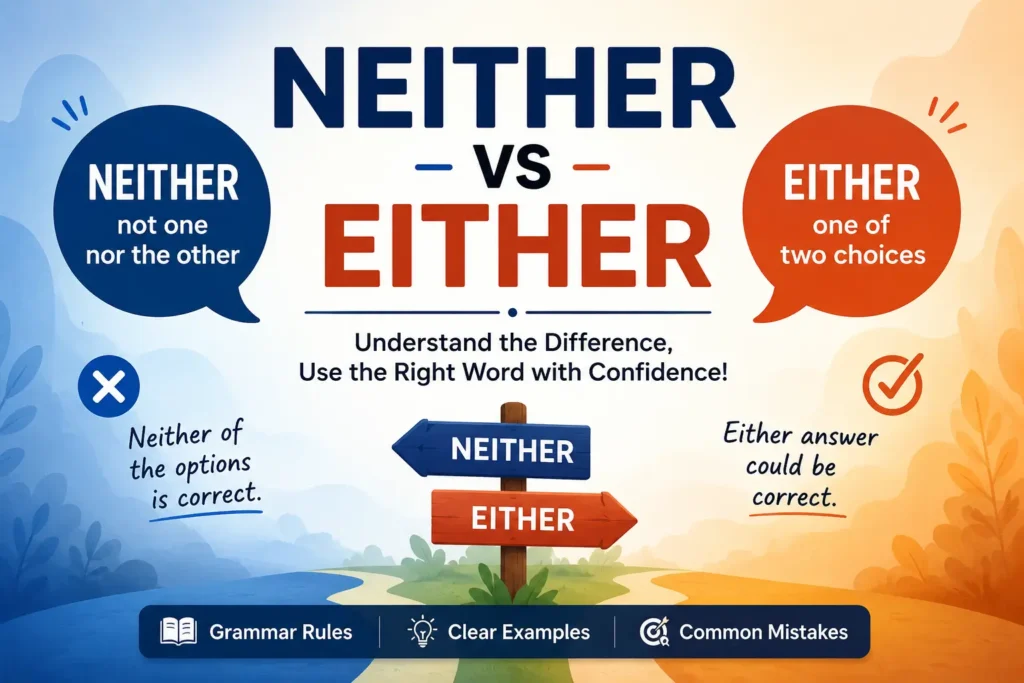
Neither vs Either is a common English grammar question because both words are used when talking about two choices, but they don’t mean the same thing. Either usually means one of two options, while neither means not one and not the other. Knowing this difference helps you choose the right word and avoid common grammar mistakes.
For example, Either answer is acceptable means one of the two answers can be accepted. In contrast, Neither answer is acceptable means both answers are unacceptable. The difference is small, but it can completely change the sentence meaning.
This guide explains the grammar rules, usage, sentence structure, and common patterns for either and neither. You’ll also learn how to use either…or, neither…nor, and negative sentences correctly in everyday American English.
Quick Answer: Neither vs Either
The easiest way to remember the difference is:
- Either = one of two choices or possibilities.
- Neither = not one and not the other.
- Either…or = presents two alternatives.
- Neither…nor = rejects both alternatives.
- Not…either = often means “not one or the other.”
- Neither do I = agrees with a negative statement.
- Neither already has a negative meaning, so it usually doesn’t need another negative word.
Compare these sentences:
Either restaurant is fine.
This means Restaurant A or Restaurant B would be acceptable.
Neither restaurant is fine.
This means Restaurant A is not fine, and Restaurant B is not fine.
So, while the two words are closely related, they don’t have the same meaning.
Read this also: Caddie or Caddy: Which Spelling Is Correct? Meaning, Usage, and Examples
What Do “Either” and “Neither” Mean?
What does “either” mean?
Either generally refers to one of two people, things, or choices. Depending on the sentence, it can mean one or the other, one of two, or introduce alternatives.
For example:
- You can choose either shirt.
- Either answer could be correct.
- Either Sarah or David will call you.
- I don’t want either option.
In the first three examples, either connects two possibilities. The exact meaning depends on the structure.
When used alone, either can function as a pronoun:
Which dessert should we order?
Either is fine.
Here, either means one of the two desserts.
What does “neither” mean?
Neither means not either one of two people or things. In practical terms, it means both choices are excluded.
For example:
- Neither answer is correct.
- Neither student finished the test.
- Neither option works for me.
- Neither of them called.
If there are two options, neither rejects both.
Compare:
Either candidate could win.
One of the two candidates could win.
Neither candidate could win.
Neither candidate could win.
This is the central distinction behind neither vs either.
Neither vs Either: Side-by-Side Comparison
| Feature | Either | Neither |
| Basic meaning | One or the other of two | Not one and not the other |
| Main idea | Choice or alternative | Rejection of both |
| Positive example | Either answer is acceptable. | — |
| Negative example | I don’t want either answer. | Neither answer is acceptable. |
| Common paired structure | either…or | neither…nor |
| Negative agreement | I don’t either. | Neither do I. |
| Can work as a pronoun | Yes | Yes |
| Can work as a determiner | Yes | Yes |
| Can work as an adverb | Yes | Yes |
| Common mistake | Adding unnecessary negatives | Using another negative with neither |
A useful memory rule is:
Either opens a choice. Neither closes both choices.
How to Use Either Correctly
Either has several grammatical uses. Learning the basic patterns makes it much easier to use naturally.
Either as a determiner
A determiner comes before a noun and helps identify it.
Examples:
- Either option will work.
- Either answer is acceptable.
- You can sit in either chair.
- Either candidate could win the election.
Here, either comes directly before a singular noun.
Notice the pattern:
either + singular noun
For example:
Either restaurant is convenient.
The sentence refers to two restaurants. It says that one or the other would be suitable.
Either as a pronoun
Either can stand alone when the noun is already understood.
For example:
Which of these two bags do you want?
Either is fine.
The word either replaces the noun phrase.
Other examples include:
- Either will work.
- You can choose either.
- I don’t like either.
- Either of them could help.
When either of is followed by a noun or pronoun, the following noun phrase is usually plural:
Either of the answers is acceptable.
Either of them is qualified.
The noun after of is plural, but the verb in formal standard usage is commonly singular because either refers to one of the two.
Either as an adverb
One of the most important uses of either appears in negative sentences.
For example:
I don’t like coffee either.
Here, either means “also” in a negative context.
Compare:
I like coffee too.
I don’t like coffee either.
The positive sentence uses too, while the negative sentence uses either.
More examples:
- She doesn’t want to go either.
- We haven’t finished either.
- He isn’t coming either.
- I can’t find my keys either.
This use is extremely common in everyday American English.
Either…or for alternatives
The structure either…or presents two alternatives.
Examples:
- You can either call me or send an email.
- We can either leave now or wait.
- Either John or Maria will lead the meeting.
- You can order either pizza or pasta.
The two parts should normally be grammatically parallel.
For example:
Correct: You can either call me or text me.
Both call and text are verbs.
Less balanced: You can either call me or an email.
The first choice is a verb, but the second is a noun phrase. A clearer version is:
You can either call me or send me an email.
How to Use Neither Correctly
Neither has a built-in negative meaning. It normally refers to two people, things, or possibilities and rejects both.
Neither as a determiner
When neither comes before a noun, the noun is normally singular.
Examples:
- Neither answer is correct.
- Neither student was prepared.
- Neither option seems practical.
- Neither restaurant is open.
The basic pattern is:
neither + singular noun
Although the meaning involves two items, the noun immediately following neither is singular.
Compare:
Neither answer is correct.
Not:
Neither answers are correct.
The second version is not the standard construction.
Neither as a pronoun
Neither can also stand alone.
For example:
Which of these two proposals do you prefer?
Neither.
This means I don’t prefer Proposal A, and I don’t prefer Proposal B.
Other examples:
- Neither is available.
- Neither of them agreed.
- Neither was suitable.
- Neither seems like a good choice.
With neither of, the noun or pronoun after of is plural:
Neither of the answers is correct.
Neither of them is ready.
Neither as an adverb
Neither can be used to agree with a negative statement.
For example:
I don’t like spicy food.
Neither do I.
The second speaker means:
I don’t like spicy food, too.
However, English doesn’t normally say “I don’t like spicy food too” to express this meaning. In a negative agreement structure, either or neither is preferred.
Other examples:
- She isn’t coming. → Neither am I.
- He doesn’t understand. → Neither do I.
- They haven’t finished. → Neither have we.
The auxiliary verb changes according to the original sentence.
Either…Or vs Neither…Nor
These two structures are among the most important patterns to understand.
Either…or presents alternatives
Use either…or when you want to identify two alternatives.
Examples:
- Either take the bus or walk.
- You can either stay home or join us.
- Either Anna or James will answer the phone.
The basic idea is:
A or B is possible.
Neither…nor rejects both alternatives
Use neither…nor when neither choice is true, possible, suitable, or acceptable.
Examples:
- Neither Anna nor James answered the phone.
- The product is neither cheap nor durable.
- Neither option solves the problem.
The basic idea is:
Not A and not B.
Compare the two structures
| Structure | Meaning | Example |
| Either A or B | A or B is an alternative | Either tea or coffee is fine. |
| Neither A nor B | A and B are both rejected | Neither tea nor coffee is available. |
A simple way to remember them is:
Either…or = this one or that one.
Neither…nor = not this one and not that one.
Verb Agreement With Either and Neither
Verb agreement is one of the trickier parts of either and neither.
Either + singular noun
When either directly modifies a singular noun, use a singular verb.
Either answer is acceptable.
Either option works.
The same pattern applies to neither:
Neither answer is acceptable.
Neither option works.
Either of + plural noun
With either of, the noun or pronoun after of is plural, but formal standard English generally uses a singular verb.
Either of the answers is acceptable.
Either of the students is qualified.
Neither of + plural noun
The same principle applies to neither of:
Neither of the answers is correct.
Neither of the students is available.
In everyday speech, you may hear plural verbs after either of and neither of, especially when the speaker is thinking about the plural noun. However, singular agreement is the safer choice in formal and professional writing.
Either…Or and Neither…Nor Verb Agreement
Things become more complicated when the two subjects connected by either…or or neither…nor don’t have the same number.
Both subjects are singular
Use a singular verb:
Either Maria or John is responsible.
Neither Maria nor John is available.
Both subjects are plural
Use a plural verb:
Either the managers or the employees are responsible.
Neither the managers nor the employees are available.
One subject is singular and one is plural
In standard English, the verb generally agrees with the subject closest to it.
Compare:
Either the manager or the employees are responsible.
The closer subject is employees, so are is used.
Now reverse the order:
Either the employees or the manager is responsible.
The closer subject is manager, so is is used.
This pattern is sometimes called proximity agreement.
For formal writing, however, it can be clearer to rewrite a complicated sentence when possible:
Either the manager is responsible, or the employees are responsible.
This avoids an awkward agreement pattern and makes the meaning easier to follow.
“Me Either” vs “Me Neither”
This is a common point of confusion, especially in American conversation.
Suppose someone says:
I don’t like horror movies.
A natural response is:
Me neither.
You can also say:
Neither do I.
Or:
I don’t either.
All three can express agreement with the negative statement, although they differ in formality and structure.
“Me neither” is common and natural
Me neither is very common in conversational American English.
Example:
I don’t want dessert.
Me neither.
It means:
I don’t want dessert either.
“Neither do I” is more formal
Neither do I is a complete grammatical construction.
For example:
I don’t understand the question.
Neither do I.
The auxiliary verb do appears because the original statement uses do in its negative form.
Other examples:
- I can’t drive. → Neither can I.
- I wasn’t invited. → Neither was I.
- I haven’t finished. → Neither have I.
What about “Me either”?
You may hear me either in informal American speech. However, me neither is the more traditional and widely accepted form for agreeing with a negative statement.
For formal writing, avoid me either. Instead, use:
Neither do I.
or
I don’t either.
Can Either and Neither Refer to More Than Two Things?
Traditionally, either and neither are associated with two choices or members of a pair.
For example:
Either of the two plans could work.
Neither of the two plans works.
When there are more than two choices, any and none are usually more natural.
Compare:
There are three restaurants nearby. Any of them would work.
None of them is open.
Using either and neither for more than two items can sound unusual or may depend on the context.
For instance, a speaker might discuss two groups or two alternatives even when each group contains several items. The important point is that either/neither naturally frame a pair of alternatives, while any/none are better suited to a larger set.
Avoid Double Negatives With Neither
One of the most common mistakes is using neither with another negative word.
Incorrect
I don’t like neither option.
The problem is that don’t and neither both create negative meaning in the same standard construction.
Correct
I don’t like either option.
Or:
I like neither option.
These sentences express essentially the same idea.
The difference is structural:
Negative verb + either
I don’t like either option.
Neither + noun
I like neither option.
Another example:
Incorrect: She didn’t invite neither person.
Correct: She didn’t invite either person.
Correct: She invited neither person.
The rule is simple: when neither supplies the negative meaning, don’t normally add another standard negative word.
Common Mistakes With Either and Neither
Mistake 1: Treating either and neither as synonyms
Incorrect meaning: Either option is unacceptable when you mean both are unacceptable.
If both options are unacceptable, say:
Neither option is acceptable.
Mistake 2: Using “neither” after a negative verb
I don’t want neither.
Use:
I don’t want either.
Or:
I want neither.
Mistake 3: Saying “neither…or”
The standard pair is:
neither…nor
So write:
Neither John nor Maria came.
Not:
Neither John or Maria came.
Mistake 4: Saying “either…nor”
The standard pair is:
either…or
For example:
Either John or Maria will call.
Mistake 5: Using the wrong verb after neither
Less standard: Neither of the students are ready.
For formal writing, use:
Neither of the students is ready.
Mistake 6: Breaking parallel structure
You can either call me or sending a message.
The two choices aren’t parallel.
Better:
You can either call me or send a message.
Mistake 7: Using “neither” when you mean “none”
If you’re discussing three or more individual choices, none is often more appropriate.
None of the five answers is correct.
The word neither would normally suggest two alternatives.
Parallel Structure With Either…Or and Neither…Nor
Parallel structure means that related parts of a sentence follow the same grammatical pattern.
This matters because it makes sentences easier to understand.
Noun + noun
You can choose either pizza or pasta.
Verb + verb
You can either call or text me.
Adjective + adjective
The solution is neither simple nor practical.
Phrase + phrase
The company is looking for either a designer or a developer.
Clause + clause
Either we leave now, or we wait until morning.
Keeping the structures balanced prevents awkward sentences and improves professional writing.
Real-Life Examples of Either and Neither
Everyday conversation
Do you want tea or coffee?
Either is fine.
This means either choice is acceptable.
Now compare:
Do you want tea or coffee?
Neither. I’ll have water.
The speaker rejects both choices.
At school
Either answer could receive full credit.
The teacher considers both answers possible choices.
Neither answer explains the main idea.
Both answers fail to explain it.
At work
Either the manager or the assistant will contact you.
One of those people will make contact.
Neither the manager nor the assistant is available.
Both people are unavailable.
In email
You can either reply to this message or call the office.
This gives the reader two alternatives.
A negative example would be:
We don’t need either document.
This means neither document is needed.
In texting
I don’t want to go out tonight.
Me neither.
This is short, casual, and natural.
Either and Neither in Questions and Negative Sentences
Questions can make the distinction less obvious.
Consider:
Do you want either of these?
This asks whether one of the two is wanted.
Now consider:
Do you want neither of these?
This asks whether both are unwanted, although the sentence is less common in ordinary conversation.
Instead, a speaker would often say:
Do you want neither one?
or simply:
You don’t want either one?
The second version is especially natural in conversation.
“I don’t want either” vs “I want neither”
These two sentences communicate the same basic idea:
I don’t want either.
I want neither.
However, I don’t want either is generally more natural in everyday American conversation.
I want neither is grammatical but can sound more formal or deliberate.
The Difference Between “Either” and “Both”
These words aren’t interchangeable.
Either usually selects one of two possibilities.
Both refers to the two together.
Compare:
Either answer is acceptable.
One answer or the other is acceptable.
Both answers are acceptable.
The two answers are acceptable.
This distinction is especially important when giving instructions.
You can choose either seat.
You need one seat.
You can use both seats.
You may use the two seats.
The Difference Between “Neither” and “None”
Neither normally deals with two alternatives.
None can refer to three or more, or to a group generally.
Compare:
Neither of the two candidates was selected.
There are two candidates.
None of the five candidates was selected.
There are five candidates.
This makes none the more natural choice when the number of possibilities is larger than two.
Pronunciation of Either and Neither
In American English, both either and neither have two common pronunciations.
Either
Common pronunciations include:
- EE-ther
- EYE-ther
Both are widely recognized in American English.
Neither
Common pronunciations include:
- NEE-ther
- NYE-ther
Again, both patterns are common.
The pronunciation difference doesn’t change the meaning.
For example:
Either answer works.
Whether you pronounce either with an “ee” sound or an “eye” sound, the grammar remains the same.
The same applies to neither.
Read this also: Domino Affect or Effect: Which One Is Correct?
Memory Tricks for Either vs Neither
If you frequently confuse these words, use a simple mental shortcut.
Think “E” for “Either choice”
Either gives you a choice:
Either A or B.
Think “N” for “Not”
Neither contains the idea of not:
Neither A nor B.
Another useful comparison is:
Either = one of the two
Neither = zero of the two
You can also remember the paired expressions:
- Either → or
- Neither → nor
If you remember those two pairs, many sentence-building problems become easier.
Quick Decision Guide
When you’re unsure which word to use, ask yourself these questions:
- Am I choosing between two possibilities?
Use either. - Am I rejecting both possibilities?
Use neither. - Am I presenting alternatives?
Use either…or. - Am I saying that both alternatives are excluded?
Use neither…nor. - Am I agreeing with a negative statement?
Use neither in Neither do I, or either at the end of a negative sentence. - Am I talking about more than two choices?
Consider any or none instead.
Practice: Choose Either or Neither
Try completing these sentences before checking the answers.
- _____ answer is acceptable.
- I don’t want _____ option.
- _____ John nor Maria attended the meeting.
- You can choose _____ the red shirt or the blue shirt.
- I don’t like horror movies. — _____ do I.
- _____ of the two restaurants is open.
- _____ candidate could win.
- She doesn’t want _____ of those shoes.
Answers and Explanations
1. Either answer is acceptable.
There are two answers, and one or the other can be accepted.
2. I don’t want either option.
The sentence already contains don’t, so either works with the negative construction.
3. Neither John nor Maria attended the meeting.
Both people are excluded, so use neither…nor.
4. You can choose either the red shirt or the blue shirt.
The sentence presents two alternatives.
5. Neither do I.
The first speaker makes a negative statement, so neither do I expresses agreement.
6. Neither of the two restaurants is open.
Both restaurants are closed.
7. Either candidate could win.
One of the two candidates could win.
8. She doesn’t want either of those shoes.
The negative verb doesn’t want pairs naturally with either.
Synonyms and Related Words
Neither either nor neither has a perfect synonym in every context. However, related words can help you understand their meaning.
Words related to either
Depending on context, either can be related to:
- one or the other
- one of two
- any one of two
- alternatively
- also, in negative constructions
For example:
Either route will get you there.
This can be understood as:
One or the other route will get you there.
Words related to neither
Depending on context, neither can be related to:
- not either
- not one or the other
- none of the two
- both excluded
For example:
Neither option works.
This means:
Not one option works, and not the other option works.
Related comparison words
Understanding these words together can make the entire system clearer:
- either → one of two
- neither → zero of two
- both → two of two
- any → one or more from a larger set
- none → zero from a larger set
- or → presents alternatives
- nor → connects negative alternatives
FAQs About Neither vs Either
Q1: What is the main difference between either and neither?
Either generally refers to one of two choices or possibilities. Neither means not one and not the other.
For example:
- Either answer could be correct. → One of the two answers could be correct.
- Neither answer is correct. → Both answers are incorrect.
Q2: Is either always positive and neither always negative?
Not exactly. Either can appear in negative sentences, such as I don’t want either option. In this structure, either means that neither of the two options is wanted.
Neither already carries a negative meaning, as in Neither option works.
Q3: What is the difference between either…or and neither…nor?
Either…or presents two alternatives:
You can either call me or send an email.
Neither…nor rejects both alternatives:
Neither John nor Maria called.
Remember: either goes with or, while neither goes with nor.
Q4: Can I use either in a negative sentence?
Yes. This is very common in American English.
For example:
I don’t like either restaurant.
You can also use either to agree with a negative statement:
I don’t like coffee either.
Here, either has a meaning similar to “also,” but it follows a negative statement.
Q5: Should I say “Me either” or “Me neither”?
Me neither is the more standard and natural response when agreeing with a negative statement in conversation.
For example:
I don’t watch reality shows.
Me neither.
You can also use the more complete form Neither do I.
Q6: Is “neither of them are” grammatically correct?
In formal standard American English, neither of them is is generally preferred.
For example:
Neither of them is available.
Although plural verbs can occur in informal speech, singular agreement is the safer choice for professional and academic writing.
Q7: Can either and neither be used with plural nouns?
When either or neither directly modifies a noun, the noun is normally singular:
Either option is acceptable.
Neither option is available.
After either of or neither of, however, the noun or pronoun is plural:
Either of the options is acceptable.
Neither of the students is ready.
Q8: Can either and neither refer to more than two choices?
They are traditionally associated with two alternatives. When discussing three or more choices, any and none are often more suitable.
For example:
Any of these five restaurants would work.
None of them is open.
Q9: Is “I don’t like neither” correct?
In standard English, I don’t like neither is considered a double negative.
Use either:
I don’t like either.
or:
I like neither.
The first structure uses a negative verb with either. The second uses neither to provide the negative meaning.
Q10: How can I easily remember the difference between either and neither?
Use this simple memory trick:
Either = one of two.
Neither = not one and not the other.
Also remember their common pairs:
- Either…or → gives alternatives
- Neither…nor → rejects both alternatives
Once you connect either with choice and neither with rejecting both choices, the difference becomes much easier to remember.
Conclusion
Understanding neither vs either becomes much easier when you focus on their basic meanings. Either generally identifies one of two choices, while neither means not one and not the other.
The most useful patterns are either…or for alternatives and neither…nor when both alternatives are rejected. Also, remember that either commonly appears in negative sentences, while neither already contains a negative meaning.
With these simple grammar rules in mind, you can avoid common mistakes, improve your sentence structure, and use either and neither more naturally in American English.
