
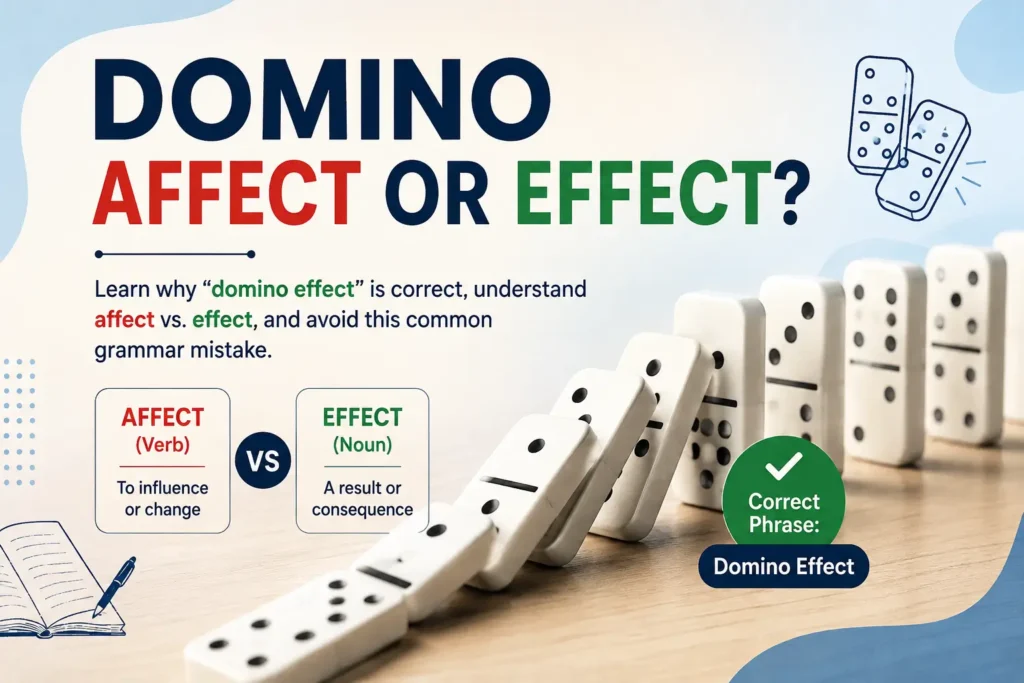
Domino affect or effect is a common grammar question, but the correct phrase is domino effect. Effect is a noun meaning a result or consequence, while affect is usually a verb meaning “to influence.” So, when one event triggers a chain of connected events, write domino effect, not “domino affect.”
The confusion is understandable because affect and effect look and sound similar. However, knowing their meaning, part of speech, and role in a sentence makes the difference much easier to understand. A quick example is: “The delay affected our plans,” but “The delay caused a domino effect.”
This guide explains domino effect, affect vs. effect, correct usage, common grammar mistakes, and practical examples from work, school, business, technology, and everyday conversation. By the end, you’ll have a simple rule for choosing the right word without second-guessing your writing.
Quick Answer: Domino Affect or Effect?
The correct phrase is domino effect.
A domino effect describes a chain of events in which one event leads to another, and the second event may trigger a third. The expression comes from the familiar image of standing dominoes: when one falls, it knocks down the next, which knocks down another.
Correct
The unexpected cancellation caused a domino effect throughout the company.
Incorrect
The unexpected cancellation caused a domino affect throughout the company.
The second sentence uses affect incorrectly. In standard American English, effect is the noun needed here because the sentence refers to a result or chain of consequences.
| Phrase | Correct? | Why? |
| domino effect | ✅ Yes | “Effect” means a result or consequence. |
| domino affect | ❌ No | “Affect” is usually a verb meaning to influence. |
| domino effects | ✅ Yes | Plural form when referring to multiple effects. |
| domino-effect | Usually no | The phrase normally doesn’t need a hyphen as a noun. |
What Does “Domino Effect” Mean?
A domino effect is a situation where one event causes a series of related events.
The events don’t have to happen at exactly the same time. What matters is the connection between them. One change creates a consequence, that consequence creates another consequence, and the process continues.
For example:
One employee calls in sick. The team has fewer workers. A project falls behind. The deadline is missed. The client becomes unhappy.
That sequence can be described as a domino effect because the first event contributes to several later events.
The phrase is common in everyday conversation, business writing, journalism, education, technology, economics, and many other areas.
Read this also: Caddie or Caddy: Which Spelling Is Correct? Meaning, Usage, and Examples
Simple Examples of the Domino Effect
- A late flight causes you to miss a connection, which makes you arrive late for a meeting.
- A student misses one assignment, falls behind, and struggles with the next exam.
- A supplier experiences a major delay, causing a manufacturer to delay production.
- A computer system fails, disrupting several connected services.
- One unexpected expense causes someone to delay another payment.
In each case, the important idea is a chain of consequences.
Why “Domino Effect” Is Correct
The key is the meaning of effect.
As a noun, effect means a result, consequence, or outcome produced by something.
For example:
The storm had a major effect on transportation.
The storm is the cause. The transportation problems are the effects.
Likewise:
The announcement had an immediate effect on the company’s stock price.
The announcement produced a result. Therefore, effect is the appropriate word.
A domino effect is simply a particular type of result: a result that leads to additional results.
What Does “Affect” Mean?
Affect is most commonly a verb. It means to influence something or someone.
For example:
Lack of sleep can affect your concentration.
Here, “affect” means “influence.”
Another example is:
Rising costs affected the company’s profits.
The rising costs influenced the company’s profits.
Because affect usually functions as a verb, it doesn’t normally work after “a” in the phrase a domino ____.
You wouldn’t normally say:
a domino influence
when you mean a chain of consequences. In the same way, you don’t say:
a domino affect
The standard expression is:
a domino effect
Affect Examples
Here are several examples of affect used correctly:
- Stress can affect your ability to concentrate.
- The weather affected our travel plans.
- Higher prices may affect consumer behavior.
- The teacher’s feedback affected how she approached the assignment.
- A software update can affect how an application performs.
In each sentence, affect describes an influence.
What Does “Effect” Mean?
Effect is most commonly a noun. It refers to a result, consequence, or change produced by something.
Consider these examples:
The new policy had an immediate effect on employees.
The medication produced several side effects.
The power outage had a serious effect on local businesses.
In each case, effect names a result.
This is why domino effect uses effect. The expression describes the consequences that follow from an initial event.
Common Patterns With Effect
You’ll often see effect in these structures:
- the effect of something
- an effect on something
- have an effect
- cause an effect
- side effect
- long-term effect
- immediate effect
- domino effect
For example:
The effect of the delay was significant.
The delay had an effect on the schedule.
The decision could have a long-term effect.
The first failure triggered a domino effect.
Affect vs. Effect: The Key Difference
The simplest distinction is this:
Affect usually describes an action or influence.
Effect usually names the result of that influence.
| Feature | Affect | Effect |
| Most common part of speech | Verb | Noun |
| Basic meaning | To influence | A result or consequence |
| Example | The noise affected my focus. | The noise had an effect on my focus. |
| Common phrase | affect someone’s decision | effect of a decision |
| Used in “domino effect”? | ❌ No | ✅ Yes |
This isn’t a perfect rule for every possible use of the words. However, it’s highly useful for everyday American English.
A Simple Formula
When you’re unsure, try this:
Affect → influence
Effect → result
For example:
The heat affected the equipment.
Ask: Did the heat influence something?
Yes.
Now consider:
The heat had an unexpected effect on the equipment.
Ask: Are you talking about the result?
Yes.
Therefore, effect is correct.
Why People Confuse Affect and Effect
The confusion isn’t surprising. The two words look and sound similar, but they usually perform different jobs.
There are several reasons people mix them up.
They Have Similar Pronunciations
In common usage, affect and effect can sound very similar. That makes spelling difficult, especially when someone has mainly heard the word rather than seen it written.
Their Meanings Are Related
Both words can appear when discussing changes or consequences.
For example:
The new schedule affected employees.
and:
The new schedule had an effect on employees.
The meaning is related, but the grammar is different.
Spellcheck Doesn’t Always Catch the Problem
Both affect and effect are real English words.
Therefore, a spellchecker may not flag this:
The decision caused a domino affect.
The word is spelled correctly as a word. It’s simply the wrong word for the sentence.
That is why understanding meaning matters more than relying on spelling tools.
How to Use “Domino Effect” Correctly
The phrase domino effect works when an initial event produces consequences that lead to further consequences.
It can appear in many sentence structures.
After “Cause”
The delay caused a domino effect across the department.
After “Create”
One small mistake created a domino effect.
After “Trigger”
The supply shortage triggered a domino effect.
With “Lead To”
The first failure led to a domino effect throughout the system.
With “Result In”
The policy change resulted in a domino effect for several businesses.
These structures are common in both professional and casual American English.
Real-Life Examples of a Domino Effect
The phrase isn’t limited to one field. It can describe connected consequences in almost any area.
Business
Imagine a manufacturer depends on one supplier for an important component.
The supplier experiences a major delay. The manufacturer can’t complete its products on schedule. Customers receive late orders. Some customers then choose another company.
That sequence can create a domino effect.
A supplier delay created a domino effect that affected production, shipping, and customer service.
The phrase works because the initial problem produces additional consequences.
Technology
Modern technology often involves interconnected systems.
Suppose a central software service stops working. Other applications depend on that service, so they begin experiencing problems as well.
The server failure caused a domino effect across several connected systems.
The expression emphasizes the chain of consequences rather than just the original technical failure.
Education
A domino effect can happen in school, too.
A student misses an important lesson. The next assignment depends on that lesson. The student struggles with the assignment and then has difficulty understanding the following topic.
Missing one important lesson can sometimes create a domino effect in a student’s coursework.
This doesn’t mean every missed lesson causes major problems. The phrase is appropriate when one problem contributes to several later problems.
Everyday Life
The concept can be much simpler.
Suppose you wake up late. You miss the bus, arrive late at work, miss a meeting, and have to stay late.
Waking up late had a domino effect on the rest of the day.
This is a natural example of the phrase in casual American English.
Domino Effect vs. Similar Expressions
Several English expressions describe connected consequences. However, they’re not always identical.
| Expression | Meaning | Example |
| Domino effect | One event leads to a chain of other events | One delay caused a domino effect. |
| Ripple effect | An event spreads outward and affects other areas | The decision had a ripple effect across the community. |
| Chain reaction | One event triggers another in a continuing sequence | The chemical reaction produced a chain reaction. |
| Cascading effect | Problems or changes spread through connected levels or systems | The outage had a cascading effect on services. |
| Snowball effect | Something grows larger or more serious as it continues | Small debts can have a snowball effect. |
Domino Effect vs. Ripple Effect
A domino effect emphasizes one event triggering another.
A ripple effect emphasizes consequences spreading outward from an initial event.
For example:
The canceled flight had a domino effect on the travel schedule.
This emphasizes the sequence of events.
The new policy had a ripple effect across the community.
This emphasizes the wider spread of consequences.
Domino Effect vs. Chain Reaction
These expressions are often close in meaning.
A chain reaction can describe scientific or physical processes as well as figurative events. A domino effect is more strongly associated with a sequence of connected consequences.
For everyday writing, either expression may work depending on the context.
Common Mistakes With “Domino Affect”
Mistake 1: Using “Affect” in the Phrase
Incorrect:
The decision created a domino affect.
Correct:
The decision created a domino effect.
The phrase requires the noun effect.
Mistake 2: Thinking “Affect” Means “Result”
Affect doesn’t normally mean “result.”
Compare:
The weather affected our plans.
Here, the weather influenced the plans.
The weather had an effect on our plans.
Here, “effect” identifies the result or influence produced by the weather.
Mistake 3: Choosing the Word by Sound
Because the words sound similar, choosing based only on pronunciation can lead to errors.
Instead, ask what the word means in the sentence.
If you mean influence, you probably need affect.
If you mean result, you probably need effect.
Mistake 4: Assuming Every Sentence Must Follow the Basic Rule
The “affect = verb, effect = noun” shortcut is useful, but it isn’t absolute.
Effect can also be used as a verb in formal contexts. For example:
The new law will effect significant changes.
Here, effect means “bring about” or “cause.”
Similarly, affect can function as a noun in specialized psychological contexts. It refers to the observable expression of emotion.
These less common uses don’t make domino affect correct. The standard expression remains domino effect.
Less Common Uses of Affect and Effect
Understanding the exceptions can prevent overgeneralization.
Effect as a Verb
As a verb, effect means to bring about or cause something to happen.
For example:
The organization hopes to effect meaningful change.
This is more formal than the common noun use.
Notice the difference:
The new policy affected employees.
The policy influenced employees.
The new policy effected major changes.
The policy brought about major changes.
The two verbs have different meanings.
Affect as a Noun
In psychology and related fields, affect can be a noun describing a person’s observable emotional expression.
For example:
The patient displayed a flat affect.
This is a specialized use. It isn’t the everyday meaning most readers need when deciding between domino affect and domino effect.
Pronunciation and Spelling
The words are also easy to confuse because their pronunciations are close.
Affect
As the common verb, affect is pronounced approximately like uh-FEKT.
The noise may affect your concentration.
Effect
Effect is commonly pronounced approximately like ih-FEKT.
The noise had an effect on your concentration.
The first vowel sound differs, but the overall sound pattern is similar enough to cause confusion.
A Practical Spelling Tip
Don’t try to solve the problem by sound alone.
Instead, identify the grammatical job of the word.
Ask:
Does this word mean “influence”?
If yes, affect is likely correct.
Then ask:
Does this word mean “result” or “consequence”?
If yes, effect is likely correct.
Is “Domino Effect” American or British English?
Domino effect is standard in both American and British English.
There isn’t a British spelling where affect replaces effect in this expression.
American English:
The decision had a domino effect.
British English:
The decision had a domino effect.
The spelling is the same.
Therefore, if you’re writing for a US audience, domino effect is the form you should use.
Synonyms and Related Expressions
Depending on your context, several expressions can replace domino effect.
Synonyms or Near-Synonyms
- chain reaction
- ripple effect
- cascading effect
- series of consequences
- knock-on effect
- snowball effect
- chain of events
However, these aren’t perfect substitutes in every sentence.
For example, snowball effect often suggests that something becomes progressively larger. A domino effect focuses more on one event leading to another.
Likewise, ripple effect often suggests consequences spreading beyond the original situation.
Choose the expression that best matches the relationship between the events.
A Useful Memory Trick for Affect vs. Effect
The classic memory trick is:
Affect = Action
Effect = End result
The repeated A can remind you that affect is commonly an action word, or verb.
The E in effect can remind you of an end result.
For example:
The storm affected the city.
The storm influenced the city.
The storm had a serious effect on the city.
The effect is the result.
Then remember:
domino effect
A domino effect describes the results that follow one another.
Don’t Rely on the Trick Alone
Memory tricks are helpful, but grammar is more reliable when you understand the sentence.
For example:
The new policy will effect major changes.
Here, effect is a verb.
So the better long-term strategy is to learn the meaning and grammatical role, not just memorize one slogan.
Read this also: Signalling or Signaling: Which Spelling Is Correct in American and British English?
Quick Comparison: Domino Affect or Domino Effect?
| Question | Answer |
| What is the correct phrase? | Domino effect |
| What does domino effect mean? | A chain of events caused by connected consequences |
| What does affect usually mean? | To influence |
| What does effect usually mean? | A result or consequence |
| Is “domino affect” standard? | No |
| Can effect be a verb? | Yes, in a less common formal use |
| Can affect be a noun? | Yes, in specialized contexts |
| Is domino effect used in American English? | Yes |
| Is domino effect used in British English? | Yes |
| What’s the easiest reminder? | Affect = influence; effect = result |
How to Check Your Sentence
When you’re writing quickly, use this three-step check.
Step 1: Look at the phrase
If you’re writing the expression for a chain of consequences, start with:
domino effect
Step 2: Check the meaning
Ask whether you’re talking about a result or consequence.
If so, effect fits.
Step 3: Read the whole sentence
Make sure the sentence actually describes connected consequences.
For example:
The first delay had a domino effect on the project.
This works because the delay affected other parts of the project.
By contrast:
The project had a domino effect.
This sentence may be grammatically correct, but it doesn’t explain what triggered what. More context would make the meaning clearer.
FAQ: Domino Affect or Effect?
Q1. Is it “domino affect” or “domino effect”?
Domino effect is the correct phrase. It describes a chain of events where one event causes or contributes to further consequences. Effect is used because it refers to the resulting outcome.
Q2. Why is “domino effect” correct?
Effect is commonly used as a noun meaning a result or consequence. A domino effect describes the results that follow one another, so effect is the appropriate word.
Q3. Is “domino affect” ever correct?
Not when you’re using the standard expression for a chain of consequences. Affect is usually a verb meaning “to influence,” so it doesn’t fit the phrase domino effect.
Q4. What does “domino effect” mean?
A domino effect happens when one event leads to another, which may lead to another. It describes a connected chain of consequences.
For example, a delayed flight can cause a missed connection, which can cause someone to miss a meeting.
Q5. What is the difference between affect and effect?
Affect is usually a verb meaning “to influence.” Effect is usually a noun meaning “a result.”
- The weather affected our plans.
- The weather had an effect on our plans.
Q6. How can I remember affect vs. effect?
Use this simple memory aid:
Affect = influence.
Effect = result.
When you see domino effect, think about the results that happen after the first event.
Q7. Can a domino effect be positive?
Yes. A domino effect doesn’t have to describe something negative.
For example:
One successful project created a domino effect, leading to more opportunities for the company.
The phrase simply describes connected consequences.
Q8. Is “domino effect” used in formal writing?
Yes. Domino effect is appropriate in many professional and academic contexts. However, technical writing may sometimes use more specific terms such as cascading effect, cascading failure, or chain reaction, depending on the subject.
Q9. Is “domino effect” the same as “ripple effect”?
They’re similar, but they emphasize different ideas. A domino effect focuses on one event triggering a sequence of events. A ripple effect often emphasizes how the consequences spread outward from an initial event.
Q10. Can “effect” ever be a verb?
Yes. Effect can be a verb meaning “to bring about” or “cause,” especially in formal writing.
For example:
The organization hopes to effect meaningful change.
This less common use doesn’t change the standard phrase domino effect.
Conclusion: Choose “Domino Effect”
If you’ve been unsure about domino affect or effect, remember that domino effect is the correct standard expression. The word effect is a noun meaning a result or consequence, which fits the idea of one event leading to another.
By contrast, affect is usually a verb meaning “to influence.” For example, “The delay affected the schedule” is correct, while “The delay caused a domino affect” is not. The easiest way to remember the difference is affect = influence and effect = result.
A domino effect can describe connected events in business, school, technology, work, economics, or everyday life. Whenever one action creates further consequences, domino effect is the phrase to choose. Understanding this small grammar difference will make your writing clearer and help you avoid a common word-choice mistake.
