
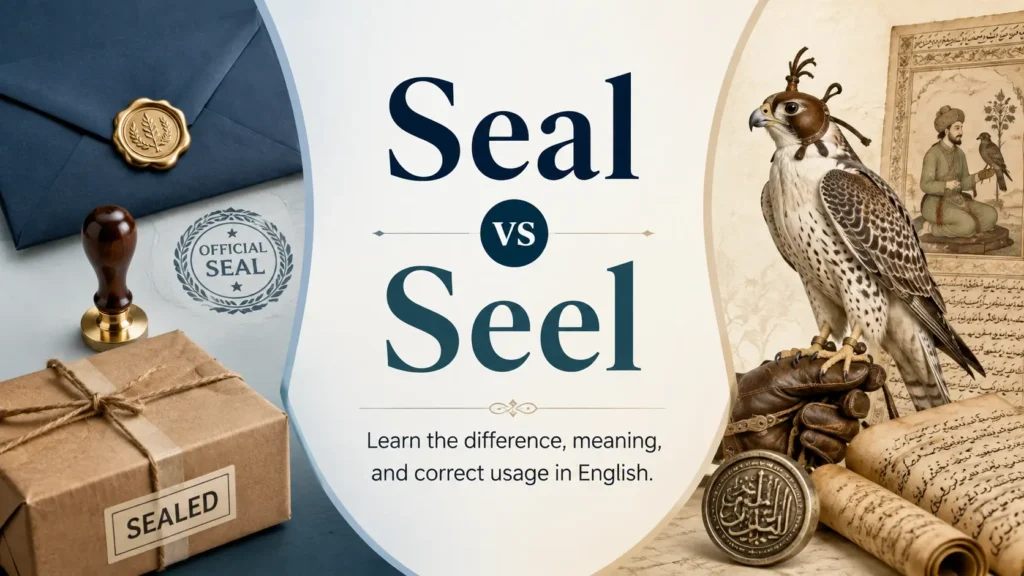
The main seal vs seel difference comes from their meaning, usage, and context. Both words have the same pronunciation in most English accents, which creates confusion for many English learners, students, and professionals. However, seal is a common modern word used in writing, business, and everyday communication, while seel is an old, rarely used historical term connected to falconry and closing a bird’s eyes. In my experience reviewing grammar and word choice issues, this is one of those spelling problems where understanding the context matters more than simply remembering the spelling.
Seal can work as both a noun and verb. As a verb, it means to close something securely, protect a package, envelope, or container, or make an agreement official. As a noun, it can mean a marine animal, an official mark, or a protective closure. For example, a company may seal a contract, place an official seal on documents, or check a package seal before shipping. These examples show how seal appears in modern professional writing, formal writing, and daily conversations.
On the other hand, seel is an archaic term rarely found outside history books, old literature, and discussions of trained hunting bird practices. The word refers to a historical method used by a falconer to sew shut or close a bird’s eyes temporarily. Because the two similar words share an identical sound, pattern recognition, and homophone confusion can affect spelling accuracy, proofreading, and writing quality. Remember this simple rule: seal relates to securing, closing, or confirming something, while seel relates only to historical falconry.
Quick Answer: Seal vs Seel
Seal is the correct word for almost every modern English situation. It can mean to close something tightly, secure or protect something, finalize an agreement, represent an official mark, or refer to a marine animal.
Seel is an archaic English verb meaning to close or stitch the eyes of a bird, particularly a trained hunting bird such as a falcon. You will rarely encounter it outside historical writing.
| Word | Meaning | Modern Usage | Example |
| Seal | Close, secure, confirm, official mark, or marine animal | Very common | “Please seal the envelope.” |
| Seel | Close a bird’s eyes in historical falconry | Extremely rare | “The falconer would seel the bird’s eyes.” |
What Does Seal Mean?
Seal is a widely used English word that functions as both a verb and a noun. Its exact meaning depends on the sentence and context.
You will see it in everyday conversations, business writing, legal documents, packaging, science, and many other areas.
Seal as a Verb
When seal works as a verb, it generally means to close something securely or make something final.
Seal meaning “to close something tightly”
This is one of its most common uses.
Examples:
- “She sealed the envelope before mailing it.”
- “Make sure you seal the container after opening it.”
- “The workers sealed the cracks in the wall.”
In each sentence, seal describes creating a secure barrier that prevents air, liquid, objects, or other materials from entering or escaping.
Common situations include:
- Sealing food containers
- Sealing packages
- Sealing windows
- Sealing cracks
- Sealing documents
Seal meaning “to make something official”
The verb seal can also describe completing, confirming, or finalizing something.
Examples:
- “The two companies sealed the deal.”
- “The signature sealed the agreement.”
- “The final approval sealed the project’s success.”
Here, seal doesn’t refer to physically closing an object. Instead, it means making something final, certain, or official.
Common expression: Seal the deal
The phrase seal the deal means to successfully complete an agreement or arrangement.
Example:
“After months of negotiation, both companies signed the contract and sealed the deal.”
You’ll commonly hear this expression in:
- Business conversations
- Sales discussions
- Professional communication
- Everyday speech
Seal as a Noun
As a noun, seal has several common meanings.
1. Seal as a marine animal
A seal is a marine animal with a streamlined body, flippers, and strong swimming ability.
Examples:
- “We watched seals swimming near the shore.”
- “The baby seal stayed close to its mother.”
This is one of the most familiar meanings of the word.
2. Seal as an official symbol
A seal can also refer to an official mark that demonstrates authority, approval, or authenticity.
Examples:
- “The certificate had the university’s official seal.”
- “The government seal appeared on the document.”
Organizations often place seals on:
- Certificates
- Legal documents
- Awards
- Official records
3. Seal as a protective closure
A seal may also refer to the material or component that keeps something securely closed.
Examples:
- “The bottle’s seal was broken.”
- “Check the seal before opening the package.”
In this context, the seal protects the contents inside.
What Does Seel Mean?
Seel is a real English word, but you will rarely encounter it in modern writing.
It is an archaic verb associated with historical falconry practices.
The word means:
To close or stitch the eyelids of a bird, especially a trained hunting bird.
Historically, falconers sometimes closed a bird’s eyes temporarily during training.
Example:
“The old manuscript described how falconers would seel a hawk’s eyes.”
You wouldn’t normally use seel in:
- Business emails
- School essays
- Social media posts
- Everyday conversations
- Modern professional writing
Modern writers would usually use clearer expressions such as:
- Close the bird’s eyes
- Cover the bird’s eyes
- Blindfold the animal
Why Are Seal and Seel Confusing?
The confusion between seal and seel mainly comes from their similar appearance and identical pronunciation.
They Sound the Same
In most American English pronunciation:
- Seal = /siːl/
- Seel = /siːl/
Because both words sound the same, pronunciation alone won’t help you choose the correct spelling.
You need to consider the meaning and context.
They Look Almost Identical
The main spelling difference appears in the vowels:
- Seal → ea
- Seel → ee
Because the spellings look so similar, learners may assume the words have related meanings. They don’t.
Although they sound alike, their meanings and modern uses are very different.
Seal vs Seel: Key Differences
The following table makes the distinction easier to see:
| Feature | Seal | Seel |
| Word type | Noun and verb | Verb |
| Meaning | Close, secure, confirm, official mark, or marine animal | Close a bird’s eyes |
| Usage today | Very common | Extremely rare |
| Context | Everyday, business, legal, scientific | Historical writing and falconry |
| Pronunciation | /siːl/ | /siːl/ |
The biggest difference isn’t pronunciation. It’s meaning and usage.
When Should You Use Seal?
Use seal when you’re talking about:
- Closing something securely
- Protecting something
- Finalizing an agreement
- Giving official approval
- An official mark
- A protective closure
- A marine animal
Seal in Packaging
Example:
“The manufacturer sealed the box before shipping.”
Here, sealed means securely closed.
Seal in Business
Example:
“The partnership was sealed after the final meeting.”
Here, the word means finalized or confirmed.
Seal in Legal Documents
Example:
“The document carries the official seal.”
In this sentence, seal refers to an official symbol or mark.
Seal as an Animal
Example:
“The seal rested on the beach.”
Here, seal refers to the marine animal.
When Should You Use Seel?
Use seel only in specific historical contexts.
You may encounter it in:
- Old texts
- Literature about falconry
- Historical research
- Discussions of medieval hunting practices
Example:
“The book explained traditional methods used by falconers, including how they would seel a bird’s eyes.”
For normal modern English writing, you will almost always need seal, not seel.
Common Mistakes With Seal and Seel
Because these words sound identical, several spelling and usage mistakes are common.
Mistake 1: Writing “Seel” When You Mean “Seal”
Incorrect:
“Please seel the package before sending it.”
Correct:
“Please seal the package before sending it.”
Packages are sealed, not seeled.
Mistake 2: Thinking Seal and Seel Are Alternative Spellings
A common misconception is that seal and seel are simply two spellings of the same word.
They aren’t.
Incorrect idea:
“Seal and seel are two ways to spell the same word.”
Correct idea:
“Seal and seel are separate words with different meanings.”
Their pronunciation may be identical, but the words aren’t interchangeable.
Mistake 3: Using Seel in Professional Writing
Incorrect:
“The company will seel the agreement tomorrow.”
Correct:
“The company will seal the agreement tomorrow.”
In modern professional English, seal is the appropriate word.
Seal vs Seel Examples in Sentences
Examples can make the difference much easier to understand.
Examples Using Seal
| Sentence | Meaning |
| “Seal the bag to keep the food fresh.” | Close securely |
| “The lawyer placed the official seal on the contract.” | Official mark |
| “The team’s victory sealed their place in the final.” | Made certain |
| “We saw a seal near the coastline.” | Marine animal |
Examples Using Seel
| Sentence | Meaning |
| “The historical text described how hunters would seel falcons.” | Historical falconry practice |
| “The author used the word seel to explain medieval traditions.” | Historical reference |
Notice that seel appears only in specialized historical situations, while seal works naturally across many modern contexts.
Common Phrases With Seal
Because seal remains common in modern English, it appears in several familiar expressions.
Seal the Deal
Meaning: To finalize an agreement successfully.
Example:
“The new contract sealed the deal between the companies.”
Seal of Approval
Meaning: Official acceptance, support, or endorsement.
Example:
“The product received the expert’s seal of approval.”
Under Seal
Meaning: Kept private or confidential, particularly in a legal context.
Example:
“The court kept the documents under seal.”
Related Words That Cause Confusion
Several other English words look or sound similar to seal, which can cause additional confusion.
Seal vs Sell
Seal and sell have different meanings and pronunciations.
| Word | Meaning | Example |
| Seal | Close or secure | “Seal the envelope.” |
| Sell | Exchange something for money | “They sell handmade products.” |
A simple way to remember the difference:
- You seal something closed.
- You sell something to a customer.
Seal vs Ceil
Ceil is another word that may create confusion because of its spelling and pronunciation.
| Word | Meaning | Example |
| Seal | Close or protect | “Seal the container.” |
| Ceil | Set or apply an upper limit | “The system may ceil the value.” |
Ceil mainly appears in mathematical or technical contexts and is uncommon in everyday conversation.
Memory Tricks to Remember Seal vs Seel
A simple association can help you remember which spelling belongs in a sentence.
Seal = Secure
Think:
Seal secures something.
Both seal and secure begin with the letter S.
Examples:
- Seal a box
- Seal an envelope
- Seal a container
- Seal a contract
If you’re talking about closing, protecting, securing, confirming, or finalizing something, seal is probably the word you need.
Seel = Sight
Think:
Seel affects seeing.
The historical word seel relates to a bird’s eyes.
Connecting seel with sight can help you remember that the word belongs to a very specific historical context rather than everyday situations involving packages, contracts, or marine animals.
Grammar Tips for Using Seal Correctly
When you’re unsure which spelling to choose, focus on meaning before sound.
Check the Meaning First
Ask yourself:
“Am I talking about closing, securing, confirming, an official mark, or a marine animal?”
If the answer is yes, choose:
Seal
Don’t Choose Based Only on Sound
English contains many words that sound alike while having different spellings and meanings.
Examples include:
- Their / There / They’re
- Two / To / Too
- Seal / Seel
Because pronunciation doesn’t always reveal the correct spelling, context matters.
Conclusion: Seal vs Seel — Which Word Should You Use?
Understanding the seal vs seel difference becomes easy once you focus on meaning and usage. Seal is the correct choice for almost all modern English situations. You will use it when talking about closing something securely, protecting a package, confirming an agreement, referring to an official mark, or describing the marine animal.
Seel, however, is an old and rarely used word connected to historical falconry. It refers to closing a bird’s eyes and mainly appears in old texts or discussions about past practices. It should not be used as a replacement for seal in everyday writing, emails, academic work, or professional communication.
When you are unsure, remember this simple tip: seal is modern, while seel is historical. Choosing the right word improves your spelling accuracy, writing clarity, and overall communication.
FAQs About Seal vs Seel
Q1: What is the main difference between seal and seel?
The main difference is their meaning and usage. Seal is a modern English word used for closing something, making an agreement official, or referring to a marine animal. Seel is an old English word related to closing a bird’s eyes in historical falconry.
Q2: Is seal the correct spelling in modern English?
Yes. Seal is the correct and commonly used spelling in modern English. It appears in everyday conversations, business writing, legal documents, and professional communication.
Q3: Is seel a real English word?
Yes, seel is a real English word, but it is considered archaic. It is rarely used today and is mainly found in historical writing, old literature, or discussions about falconry.
Q4: Can seel replace seal in a sentence?
No. Seel and seal are not interchangeable. Using seel when you mean seal creates a spelling and meaning mistake.
Incorrect:
Please seel the envelope.
Correct:
Please seal the envelope.
Q5: Why do people confuse seal and seel?
People confuse these words because they have the same pronunciation and similar spelling. Since they sound identical in spoken English, many writers rely on memory and may choose the wrong spelling.
Q6: What does seal mean as a verb?
As a verb, seal means to close something securely, protect something from outside elements, or finalize something.
Examples:
- “Seal the package before shipping.”
- “The companies sealed the agreement.”
Q7: What does seal mean as a noun?
As a noun, seal has several meanings. It can refer to a marine animal, an official symbol, or a protective closure on an object.
Examples:
- “We saw a seal near the beach.”
- “The document has an official seal.”
Q8: Is seel used in American English today?
No, seel is almost never used in everyday American English. Most people will only see it in historical books, academic discussions, or old texts about falconry.
Q9: How can I remember the difference between seal and seel?
A simple memory trick is:
Seal = Secure
Think about sealing a package, envelope, or agreement.
Seel = Sight
Remember that seel is connected with a bird’s eyes in historical contexts.
Q10: Which word should I use in professional writing: seal or seel?
Use seal in professional writing. It is the correct word for emails, reports, contracts, business documents, and formal communication. Avoid seel unless you are specifically discussing historical falconry.
Receive vs Recieve: Which Spelling Is Correct? Meaning, Rules, Examples, and Common Mistakes
Eminent vs Imminent: Meaning, Differences, Examples, and Common Mistakes
Whichever vs Whatever: What’s the Difference and When Should You Use Each?
