
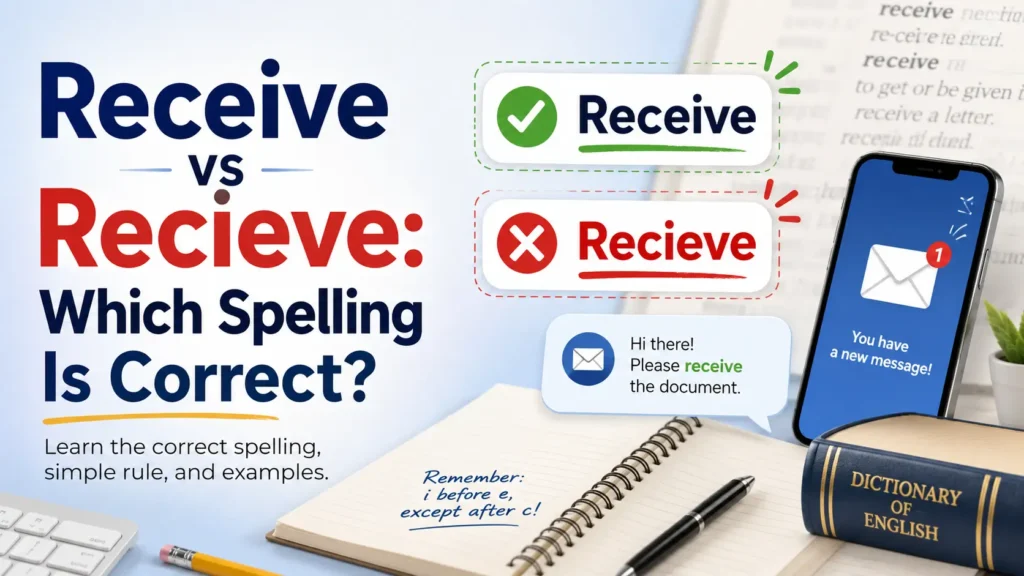
Receive vs Recieve is a common spelling confusion among English learners because the two words look almost identical. However, only receive is the correct spelling in standard English. Recieve is an incorrect spelling that happens when people accidentally reverse the order of i and e.
The difference between receive vs recieve is not about meaning because recieve does not have a separate definition or usage. Receive means to get, accept, or be given something, such as a message, gift, or information. For example, “I received your email” is correct, while “I recieved your email” is a spelling mistake.
Remembering the spelling pattern can help you avoid this common error. Receive follows the “i before e except after c” guideline because the letter c comes before ei. Although English spelling rules have exceptions, this pattern makes receive easier to remember and use correctly in everyday writing.
Quick Answer: Is It Receive or Recieve?
The correct spelling is:
✅ Receive
❌ Recieve
Receive is a verb that means to get, accept, obtain, or be given something.
Examples of Receive
- I received your email yesterday.
- She will receive her certificate next week.
- Did you receive my message?
- We received the package this morning.
Recieve is not a correct standard English spelling. If you use it in school assignments, professional emails, academic writing, or formal documents, it will normally be treated as a spelling error.
| Word | Correct? | Meaning | Example |
| Receive | ✅ Yes | To get, accept, or be given something | I received a package today. |
| Recieve | ❌ No | Common misspelling of receive | I recieve a package today. ❌ |
A simple rule to remember is:
After “c,” think “ei” in receive.
That is why we write:
- receive ✅
- deceive ✅
- conceive ✅
- perceive ✅
What Does Receive Mean in English?
Receive is a verb used when something comes to you from another person, place, organization, or source.
It can refer to physical objects, information, communication, services, treatment, feedback, awards, and other experiences.
Receive Meaning: To Get Something
The most common meaning of receive is to get something that another person sends, gives, or provides.
Examples:
- I received a birthday gift from my sister.
- The customer received the order this morning.
- We received your application.
- She received a letter from her friend.
The basic idea is simple:
Someone sends something → It reaches you → You receive it.
For example:
A company sends an email → You get the email → You receive the email.
Receive Meaning: To Accept or Be Given Something
Receive can also describe being given something that is offered, presented, or awarded.
Examples:
- She received an award for her research.
- The athlete received a medal after winning the competition.
- He happily received the invitation.
- The student received a certificate.
However, receive and accept do not always mean exactly the same thing.
Compare:
I received the job offer.
The offer was sent or given to me.
I accepted the job offer.
I agreed to take the job.
You can receive something without necessarily accepting it.
Receive Meaning: To Experience Something
In some situations, receive means to experience or be given a particular treatment, reaction, response, or service.
Examples:
- The patient received medical treatment.
- The team received positive feedback.
- The company received criticism online.
- The proposal received strong support.
This use is especially common in formal, academic, and professional English.
Receive Meaning: To Get Information or Communication
In modern English, receive is frequently used when talking about messages, emails, calls, notifications, and other forms of communication.
Examples:
- Did you receive my text message?
- I received an email from my manager.
- We received an update from the school.
- She received a notification on her phone.
These expressions are especially common in workplaces, schools, businesses, and online communication.
Receive vs Recieve: Why Is Recieve Wrong?
Recieve is incorrect because the standard English spelling is receive.
The mistake usually happens because writers reverse the positions of i and e.
The correct spelling can be broken down like this:
re + ceive = receive ✅
Not:
re + cieve = recieve ❌
The important part to remember is -ceive.
Words such as receive, deceive, perceive, and conceive all use this spelling pattern.
Why Do People Spell Receive as Recieve?
The receive vs recieve spelling mistake is extremely common. There are several reasons people confuse the two forms.
1. Confusion With the “I Before E” Rule
Many English learners remember the well-known spelling guideline:
I before E except after C.
The problem is that people sometimes remember only the first part.
Incorrect thinking:
“I usually comes before E.”
So they write:
recieve ❌
The better way to remember this particular word is:
“After C in receive, use EI.”
Therefore:
receive ✅
2. Pronunciation Does Not Clearly Show the Spelling
The American English pronunciation of receive is:
/rɪˈsiːv/
It sounds approximately like:
ri-SEEV
When you hear the word, the pronunciation does not clearly tell you whether to write ei or ie.
English contains many words whose spelling cannot be predicted perfectly from pronunciation alone, such as:
- receive
- believe
- achieve
- ceiling
This is one reason the spelling must often be learned through practice.
3. Fast Typing Can Reverse the Letters
Sometimes people know the correct spelling but accidentally type the letters in the wrong order.
Common typing and spelling mistakes include:
- recieve ❌
- definately ❌
- seperate ❌
Slowing down and proofreading frequently misspelled words can help reduce these errors.
4. English Spelling Can Be Difficult for Learners
People learning English as a second language may find words such as receive difficult because English spelling is not always predictable.
The same sound can sometimes be represented by different spellings.
For example:
- see
- sea
These words sound the same but have different spellings and meanings.
Learning common spelling patterns and practicing difficult words can make English spelling easier over time.
The Spelling Rule Behind Receive
A common spelling guideline can help you remember why receive uses ei instead of ie.
Understanding “I Before E Except After C”
The traditional guideline is:
I before E except after C, or when sounding like A as in neighbor or weigh.
Some words fit the basic pattern:
| Word | Pattern |
| believe | ie |
| piece | ie |
| field | ie |
| receive | ei after c |
| ceiling | ei after c |
For receive, the most useful part is:
C + EI = receive
However, this guideline is not a perfect rule for every English word. English has many exceptions, so it is better to use it as a memory aid rather than an absolute spelling rule.
Words That Follow the Same Pattern as Receive
Several common English verbs end in -ceive.
| Word | Meaning |
| receive | To get or be given something |
| deceive | To make someone believe something false |
| conceive | To form or develop an idea |
| perceive | To notice, understand, or interpret something |
A useful memory trick is:
If the word ends in “-ceive,” remember C + EI.
Practice these words together:
receive → deceive → conceive → perceive
Common Exceptions to the “I Before E” Guideline
Although the spelling guideline is useful for receive, it does not work for every English word.
Some words have spelling patterns that must simply be learned individually.
Examples include:
- weird
- science
- ancient
- their
Because English developed from several languages over centuries, its spelling system contains many irregular patterns.
For that reason, use “i before e except after c” as a helpful memory device rather than a rule that works without exceptions.
How to Pronounce Receive Correctly
In American English, receive is pronounced:
/rɪˈsiːv/
The stress falls on the second syllable:
re-CEIVE
A simple pronunciation guide is:
ri-SEEV
The second part of the word receives the strongest stress.
Remember that pronunciation can help you recognize the word in conversation, but it does not necessarily tell you whether the correct spelling uses ie or ei.
How to Use Receive Correctly in Sentences
The verb receive works naturally in everyday, academic, business, and professional situations.
Everyday Examples With Receive
- I received a package from Amazon.
- She received a phone call this morning.
- Did you receive the invitation?
- We received good news yesterday.
- He received a gift from his parents.
School Examples With Receive
- Students receive grades after completing exams.
- He received an excellent score on his test.
- The teacher received permission from the principal.
- Students will receive their certificates next week.
Workplace Examples With Receive
- We received your application.
- The manager received the report.
- The company received customer feedback.
- She received approval from her supervisor.
Email Examples With Receive
- I received your email.
- Please confirm that you received the attachment.
- We have received your request.
- Did you receive my previous message?
In professional communication, receive can sound more formal than get.
Compare:
Casual:
I got your message.
Professional:
I received your message.
Both can be correct, but the second version often sounds more appropriate in business or formal writing.
Different Forms of the Verb Receive
Like other verbs, receive changes form depending on the tense and sentence structure.
| Form | Word | Example |
| Base form | receive | I receive emails daily. |
| Past tense | received | I received your letter yesterday. |
| Past participle | received | The payment has been received. |
| Present participle | receiving | She is receiving training. |
The important spelling pattern remains recognizable in all forms:
- receive ✅
- received ✅
- receiving ✅
Common Misspellings Related to Receive
The spelling mistake does not appear only in recieve. People sometimes carry the same incorrect letter order into related forms.
Recieve vs Receive
Incorrect:
I recieve your email. ❌
Correct:
I receive your email. ✅
Recieved vs Received
Incorrect:
She recieved the award. ❌
Correct:
She received the award. ✅
The past tense keeps the correct ei pattern before adding -ed.
Reciever vs Receiver
Incorrect:
The reciever answered the phone. ❌
Correct:
The receiver answered the phone. ✅
The noun receiver comes from receive and keeps the same ei sequence after c.
Examples:
- The phone receiver was damaged.
- The receiver accepted the package.
- Check whether the wireless receiver is connected.
Receive vs Accept vs Get: What Is the Difference?
Receive, accept, and get have related meanings, but they are not always interchangeable.
| Word | Basic Meaning | Example |
| Receive | To get or be given something | I received a letter. |
| Accept | To agree to take or approve something | She accepted the offer. |
| Get | A general everyday word meaning to obtain something | I got a new phone. |
Receive vs Get
Both receive and get can describe obtaining something, but their tone is different.
Casual:
I got a package.
More formal:
I received a package.
In everyday conversation, get is extremely common. In professional, academic, or business writing, receive may sound more polished.
Receive vs Accept
The main difference between receive and accept involves agreement or choice.
Compare:
I received the invitation.
Someone sent the invitation to me.
I accepted the invitation.
I agreed to the invitation.
Another example:
She received a job offer.
A company offered her the position.
She accepted the job offer.
She agreed to take the position.
Receiving something does not necessarily mean accepting it.
Easy Memory Tricks for Remembering Receive
If you often confuse receive and recieve, these simple memory techniques can help.
Remember the Letter C
Focus on this pattern:
C + EI
Break the word into parts:
re + c + ei + ve
This makes it easier to remember:
receive ✅
instead of:
recieve ❌
Remember the -CEIVE Word Family
Practice these four words together:
- receive
- deceive
- perceive
- conceive
They all contain:
-ceive
Once you remember the ending, the spelling of receive becomes much easier.
Write the Word in Complete Sentences
Repetition can help your brain recognize the correct spelling automatically.
Practice sentences such as:
- I receive emails every day.
- I received your message.
- She is receiving updates.
- We have received your payment.
Seeing and writing the correct form regularly makes the incorrect spelling look less natural over time.
Synonyms for Receive
The best synonym for receive depends on the context.
| Synonym | Example |
| get | I got your message. |
| obtain | She obtained permission. |
| accept | He accepted the award. |
| collect | I collected my package. |
| acquire | The company acquired new information. |
These words are related, but they are not always interchangeable.
For example:
I received a gift. ✅
sounds natural.
But:
I acquired a gift.
sounds unusual in normal everyday conversation because acquire is more commonly used for obtaining possessions, knowledge, skills, assets, or businesses.
Common Mistakes to Avoid With Receive
Understanding a few common errors can help you use receive correctly every time.
Mistake 1: Writing Recieve
Incorrect:
I will recieve the package tomorrow. ❌
Correct:
I will receive the package tomorrow. ✅
Mistake 2: Writing Recieved
Incorrect:
We recieved your application. ❌
Correct:
We received your application. ✅
Mistake 3: Writing Recieving
Incorrect:
She is recieving treatment. ❌
Correct:
She is receiving treatment. ✅
Mistake 4: Confusing Receive With Accept
Receiving something only means that it reached you.
Accepting something usually means that you agreed to take, approve, or act on it.
For example:
I received the offer but did not accept it.
This sentence clearly shows the difference between the two verbs.
Receive vs Recieve at a Glance
Here is a quick comparison you can use whenever you forget the correct spelling:
| Question | Answer |
| Is receive correct? | ✅ Yes |
| Is recieve correct? | ❌ No |
| Correct letter order | ei |
| Correct spelling | receive |
| Past tense | received |
| -ing form | receiving |
| Noun form | receiver |
| Basic meaning | To get or be given something |
Memory trick:
After C, use EI in receive.
Conclusion: Receive vs Recieve
The difference between receive vs recieve is simple once you remember the correct spelling pattern. Receive is the only accepted spelling in English, while recieve is a common mistake caused by mixing up the order of i and e. The word receive is used when you get, accept, or are given something, such as an email, message, gift, or information.
To avoid this spelling error, remember that receive follows the pattern of using ei after c. With regular practice and attention to spelling, you can confidently use receive in school, work, and everyday communication.
FAQs About Receive vs Recieve
Q1: Which spelling is correct: receive or recieve?
Receive is the correct spelling. Recieve is incorrect and is considered a spelling mistake in standard English.
Q2: Is recieve a real English word?
No, recieve is not a recognized English word. It is a common misspelling of receive.
Q3: Why do people spell receive as recieve?
People often write recieve because they confuse the order of i and e. The mistake is also caused by the common “i before e except after c” spelling rule being remembered incorrectly.
Q4: What does receive mean?
Receive means to get, accept, or be given something. For example, “I received a package” means that a package was delivered to me.
Q5: How do you remember the spelling of receive?
A simple trick is to remember that c comes before ei in receive. Think of the spelling pattern: re + c + ei + ve.
Q6: Is received spelled with ie or ei?
The correct spelling is received with ei. The word keeps the same spelling pattern as receive before adding -ed.
Q7: How do you spell receiving correctly?
The correct spelling is receiving. It keeps the ei pattern from receive.
Q8: Does receive follow the “I before E except after C” rule?
Yes, receive follows the “except after c” part of the rule. The letters ei come after the letter c, making receive correct.
Q9: Is receive used in American English?
Yes, receive is commonly used in American English in conversations, emails, academic writing, and professional communication.
Q10: What is the difference between receive and recieve?
The difference is spelling only. Receive is the correct English word, while recieve is an incorrect spelling that should be avoided.
Emigrate vs. Immigrate: What’s the Difference? Meaning, Examples, and Easy Ways to Remember
Led vs. Lead: What’s the Difference? Meaning, Pronunciation, Grammar, and Examples
Serpent vs Snake: What’s the Difference in Meaning and Usage?
