
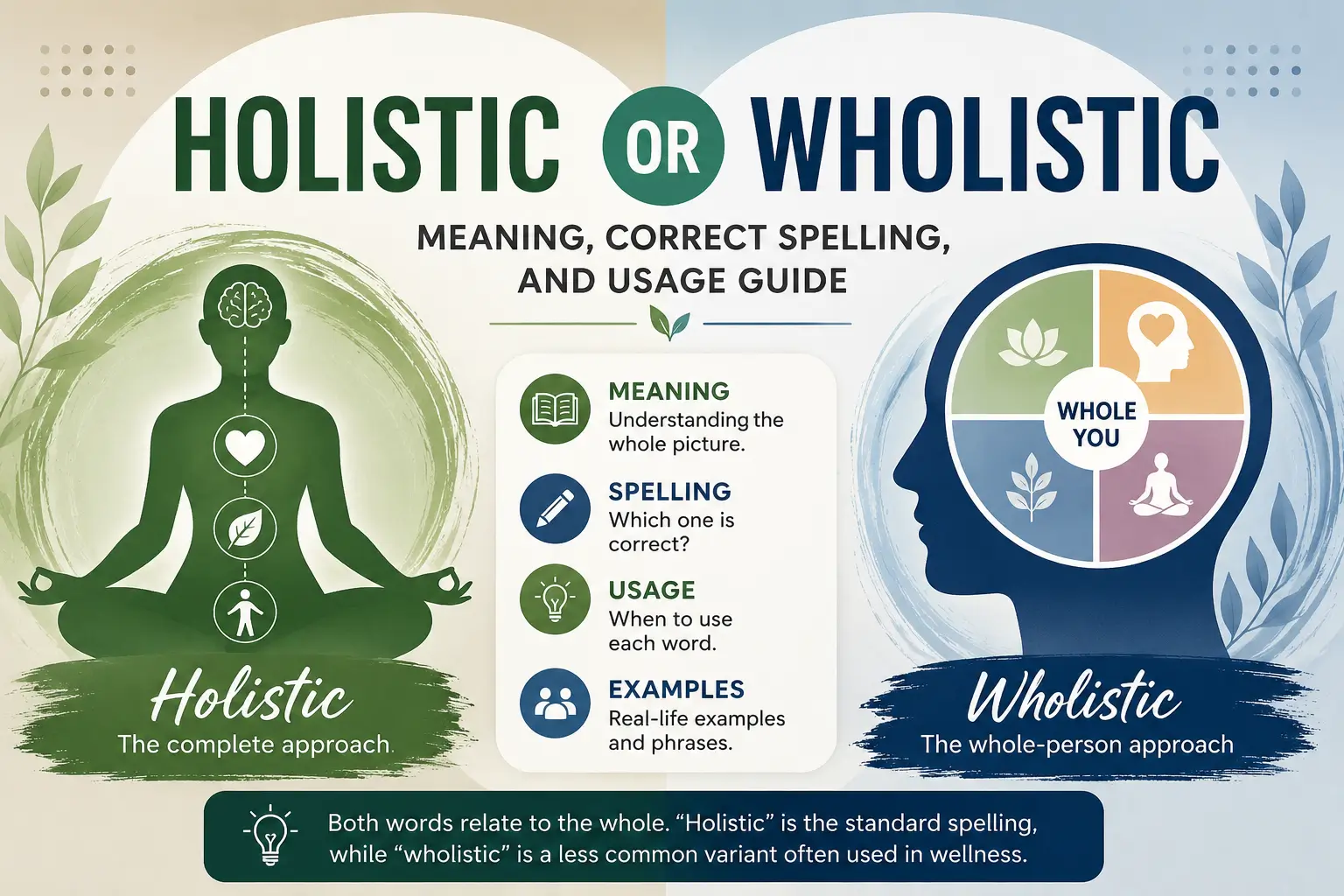
Holistic or wholistic is a common spelling question for people writing about health and wellness, personal development, and whole-person care. Both words sound the same, but they don’t always carry the same level of trust in writing.
The main purpose of this guide is simple: it helps you choose the correct usage without confusion. In most cases, holistic is the standard spelling. It works best in professional, medical, academic, and everyday writing.
Wholistic can still appear in wellness spaces because it highlights the idea of the “whole” person. However, many readers may see it as unusual.
So, if you want clear and trusted writing, use holistic. If your brand focuses on a softer whole-person approach, wholistic may fit your tone.
Quick Answer: Should You Use Holistic or Wholistic?
In most cases, use holistic.
It means looking at the full picture instead of one small part. A holistic view connects different areas, such as body, mind, habits, emotions, lifestyle, and environment.
Wholistic usually means something similar, but it’s less common. Many readers may think it looks unusual or even incorrect, especially in formal writing.
| Situation | Best Word to Use |
| Academic writing | Holistic |
| Medical or health articles | Holistic |
| Business content | Holistic |
| School essays | Holistic |
| SEO blog posts | Holistic |
| Wellness branding | Holistic or wholistic |
| Spiritual coaching | Wholistic can work |
| Unsure which one to choose | Holistic |
A good rule is easy to remember:
When trust matters, choose holistic.
Read this also: Bologna or Baloney: Meaning, Spelling, Pronunciation, and the Real Difference
What Does Holistic Mean?
Holistic means looking at something as a complete system.
Instead of focusing on one piece alone, a holistic approach studies how different parts connect. In health, that may include sleep, stress, diet, exercise, emotions, medical history, and daily routines.
In simple words, holistic means whole-picture thinking.
For example, a doctor with a holistic view may not only ask about pain. They may also ask about your sleep, work stress, meals, movement, and mood. That wider view helps them understand what may influence the problem.
A holistic approach can apply to many areas:
- Health and wellness
- Education
- Business strategy
- Personal development
- Design
- Technology
- Mental health
- Leadership
- Environmental planning
- Content strategy
The key idea stays the same. One part rarely tells the full story.
What Does Wholistic Mean?
Wholistic also points to the whole person, whole system, or whole experience.
The meaning often overlaps with holistic. However, the spelling creates a different feeling. Since wholistic includes the word “whole,” it can seem warmer, softer, and more personal.
That’s why you may see it in:
- Wellness coaching
- Natural health content
- Spiritual care
- Yoga and meditation brands
- Lifestyle programs
- Whole-person healing services
For example:
“Our wholistic wellness program supports your body, mind, emotions, and daily habits.”
That sentence works because the tone feels personal and wellness-focused.
However, wholistic can distract readers in formal settings. Some people may see it as a typo, even when the writer uses it on purpose.
Holistic vs Wholistic: Key Differences
The main difference between holistic and wholistic is not the basic meaning. Both words often describe a full-picture view.
The real difference comes from spelling, tone, audience, and trust.
| Feature | Holistic | Wholistic |
| Meaning | Whole-picture approach | Whole-person or whole-picture approach |
| Standard spelling | Yes | Less common variant |
| Professional use | Strong choice | Risky in formal writing |
| Common in health content | Yes | Sometimes |
| Common in academic writing | Yes | Rare |
| Tone | Professional and clear | Softer and wellness-focused |
| Reader trust | High | Depends on audience |
| Best use | Most writing | Intentional wellness branding |
Meaning Difference
The meanings are very close.
A holistic health plan may include nutrition, movement, sleep, stress support, and medical care. A wholistic wellness plan may include those same areas, but it may also highlight spiritual balance, emotional healing, or personal growth.
Tone Difference
Holistic sounds more polished and widely accepted.
Wholistic sounds more natural, personal, or alternative. That can work well for certain brands, but it may not fit every audience.
Usage Difference
Professional readers usually expect holistic.
Wellness audiences may accept wholistic when the spelling matches the brand voice. Still, the safer choice is almost always holistic.
Why Is It Holistic, Not Wholistic?
Many people expect the spelling wholistic because the meaning connects to the word “whole.”
That logic makes sense. However, the standard spelling comes from holism, which refers to the idea that parts of a system form a connected whole.
So, holistic developed from holism, not directly from the modern English word whole.
Think of it this way:
| Word | Role |
| Whole | The idea |
| Holism | The root concept |
| Holistic | The standard adjective |
| Wholistic | A less common variant |
The missing “w” may look strange at first, but holistic is the spelling most readers expect.
When Should You Use Holistic?
Choose holistic when your writing needs to sound clear, trusted, and professional.
This spelling works well in:
- School assignments
- Academic papers
- Medical articles
- Health blogs
- Business websites
- SEO content
- Professional bios
- Research summaries
- Product descriptions
- Marketing pages
- Personal development content
Holistic in Health Writing
In health content, holistic means considering the whole person.
That may include:
- Physical symptoms
- Medical history
- Diet
- Movement
- Sleep quality
- Stress levels
- Emotional health
- Lifestyle
- Environment
- Support systems
Example:
“A holistic care plan looks at pain, sleep, stress, nutrition, and daily movement.”
This sounds clear and professional.
Holistic in Business Writing
Business problems rarely come from one issue.
A company may blame poor sales on ads. However, the real problem may include weak messaging, a slow website, unclear pricing, poor follow-up, or low customer trust.
A holistic business strategy checks the full customer journey.
Example:
“The team used a holistic marketing strategy that connected SEO, landing pages, email follow-up, and customer reviews.”
This sentence works because it explains what “holistic” means in action.
Holistic in Education
A holistic education approach looks beyond grades.
It considers confidence, learning style, emotional needs, creativity, communication, and real-world skills.
Example:
“The school takes a holistic approach by supporting academic growth, emotional health, and practical life skills.”
Education involves more than test scores, so the word fits naturally.
When Can You Use Wholistic?
Use wholistic only when the spelling supports your message.
It can work in wellness, coaching, spiritual care, natural living, and lifestyle content. In those spaces, the word may feel intentional rather than mistaken.
Good places to use wholistic include:
- Wellness coaching pages
- Yoga studio content
- Meditation programs
- Natural lifestyle brands
- Mind-body wellness blogs
- Spiritual growth services
- Personal healing programs
- Brand names or service names
Example:
“Our wholistic sessions help you reconnect with your body, emotions, habits, and personal goals.”
That phrasing feels warm and human.
However, avoid wholistic in formal writing. Academic papers, medical research, legal content, corporate reports, and professional bios usually need holistic.
Holistic Health vs Wholistic Health
Many people search for holistic or wholistic because both terms appear in wellness content.
Both phrases often refer to whole-person wellness. The difference usually comes from style, not a major difference in meaning.
Holistic health is the more standard phrase.
Wholistic health often appears in alternative, natural, or lifestyle-focused spaces.
What Holistic Health Usually Includes
A holistic health view may consider:
- Physical health
- Mental wellness
- Emotional balance
- Nutrition
- Sleep quality
- Movement
- Stress levels
- Relationships
- Work-life balance
- Environment
- Preventive care
For example, headaches may connect to stress, posture, dehydration, poor sleep, eye strain, or medication side effects. Looking at the symptom alone can miss the bigger pattern.
What Wholistic Health Often Emphasizes
Wholistic health often focuses on personal balance.
It may include:
- Mind-body connection
- Spiritual wellness
- Emotional healing
- Natural routines
- Lifestyle alignment
- Inner balance
- Long-term well-being
- Personal growth
This can be useful in wellness content. Still, it should not replace medical care when someone needs diagnosis or treatment from a qualified professional.
Holistic Meaning Beyond Health
The word holistic is not only about wellness.
It works anywhere several connected parts shape the final result. That makes it useful in business, education, design, technology, and personal growth.
Holistic Approach in Business
A holistic business view looks at the full system.
That may include:
- Brand positioning
- Product quality
- Pricing
- Marketing
- Sales process
- Customer support
- Reviews
- Retention
- Team performance
- Profit margins
Imagine a local service company that wants more leads. Running more ads may help for a short time. But if the website loads slowly and the contact form feels confusing, traffic won’t turn into customers.
A holistic review checks the full path:
Ad → landing page → trust signals → offer → form → follow-up → sale
That is the difference between fixing one leak and checking the whole roof.
Holistic Approach in Education
A student may struggle in class for many reasons.
Weak basics, low confidence, anxiety, poor sleep, or the wrong teaching style can all play a role.
A narrow view says, “Study harder.”
A holistic view asks, “What support does this student need to learn well?”
That question leads to better teaching.
Holistic Approach in Design
A website can look beautiful and still fail.
If users can’t read the text, find the button, load the page quickly, or trust the brand, the design does not work.
A holistic design process considers:
- Layout
- Readability
- Mobile experience
- Page speed
- Accessibility
- Branding
- User intent
- Conversion goals
- Maintenance
- Content structure
Good design solves a real problem. It does not only look attractive.
Holistic Approach in Technology
Technology teams also need full-picture thinking.
A new app feature may seem useful, but it can slow performance, create security risks, confuse users, or increase support requests.
A holistic tech decision considers:
- User needs
- Data privacy
- Speed
- Security
- Scalability
- Support
- Cost
- Long-term maintenance
Strong systems hold up under pressure.
Holistic Approach in Personal Growth
Personal growth often fails when people focus on one big change.
Someone may decide to wake up at 5 a.m. But if they scroll late at night, skip meals, drink too much caffeine, and work without breaks, that goal won’t last.
A holistic personal growth plan looks at:
- Sleep
- Energy
- Habits
- Mindset
- Stress
- Relationships
- Environment
- Time management
- Accountability
Small connected changes often beat one dramatic promise.
Real-Life Examples of Holistic and Wholistic
Examples make the difference easier to understand.
Correct Holistic Examples
- The doctor recommended a holistic plan that included exercise, sleep changes, stress support, and follow-up care.
- The company needs a holistic strategy instead of another quick ad campaign.
- A holistic education model supports curiosity, confidence, discipline, and emotional growth.
- The designer took a holistic view of the website by improving speed, layout, accessibility, and trust signals.
- A holistic SEO strategy connects content quality, technical performance, internal links, and user experience.
- Good leadership requires a holistic understanding of people, goals, systems, and culture.
Correct Wholistic Examples
- Her wholistic coaching program supports the mind, body, emotions, and daily habits.
- The studio offers wholistic wellness sessions for stress, movement, and self-care.
- Their wholistic lifestyle plan focuses on food, rest, mindset, and spiritual balance.
- A wholistic approach to self-care may include journaling, stretching, prayer, nutrition, and better sleep routines.
Weak Examples to Avoid
Weak:
“We provide holistic solutions for all your needs.”
Better:
“We connect SEO, content, website speed, and conversion strategy so your site can attract visitors and turn them into leads.”
Weak:
“This is a wholistic product for everyone.”
Better:
“This wellness program helps you build healthier routines around sleep, food, movement, and stress.”
The stronger examples explain the parts. That detail makes the word useful.
Grammar Tips for Holistic or Wholistic
Both holistic and wholistic are adjectives. They describe a noun.
You can write:
- Holistic approach
- Holistic care
- Holistic view
- Holistic method
- Holistic strategy
- Wholistic wellness
- Wholistic lifestyle
- Wholistic coaching
Avoid using holistic as a noun.
Incorrect:
“She practices holistic.”
Better:
“She practices holistic wellness.”
Better:
“She uses a holistic approach.”
Common Word Forms
| Word | Part of Speech | Example |
| Holistic | Adjective | A holistic approach |
| Wholistic | Adjective | A wholistic wellness plan |
| Holistically | Adverb | The team looked at the issue holistically |
| Holism | Noun | Holism focuses on whole systems |
| Whole-person | Adjective phrase | Whole-person care |
Use holistic before a noun.
Example:
“The team created a holistic strategy.”
Use holistically to describe an action.
Example:
“The team looked at the problem holistically.”
That means the team studied the whole issue, not just one part.
Common Mistakes With Holistic and Wholistic
Small mistakes can make your writing feel less trustworthy.
Using Wholistic in Formal Writing
This is the biggest issue.
Wholistic may work in wellness branding, but it can look wrong in academic or professional content. Teachers, editors, doctors, and business readers usually expect holistic.
Better choice:
“The report uses a holistic framework.”
Risky choice:
“The report uses a wholistic framework.”
The second version may distract readers from your main point.
Thinking Wholistic Is Always Fake
Some people call wholistic a spelling error. That answer is too simple.
The word does appear as a variant. Some writers use it intentionally. However, that does not make it the best choice everywhere.
A word can exist and still be less useful.
Turning Holistic Into a Buzzword
Holistic can sound smart, but it becomes weak when you don’t explain it.
Weak:
“We take a holistic approach.”
Stronger:
“We review your content, site speed, internal links, search intent, and conversion path together.”
The stronger version shows proof.
Mixing Both Spellings Without Reason
Don’t switch between holistic and wholistic randomly.
Pick one based on your audience. Then stay consistent.
An article about holistic vs wholistic can use both terms because it explains the difference. A business service page should usually stick with holistic.
Using Holistic When You Mean “Complete”
Sometimes complete works better.
Correct:
“Please send the complete form.”
Incorrect:
“Please send the holistic form.”
A form does not need whole-system thinking. It just needs all its parts.
Memory Tricks: How to Remember Holistic or Wholistic
A few simple tricks can help.
Choose Holistic for High-Trust Writing
Think of the H in holistic as high-trust.
If your content needs credibility, choose holistic.
Connect “Whole” to Meaning, Not Spelling
The idea connects to whole.
The standard spelling is still holistic.
Remember this:
Whole idea. Holistic spelling.
Drop the “W” When Unsure
If you feel stuck, choose holistic.
It works in nearly every setting and keeps your writing clean.
Ask One Reader-Focused Question
Before choosing wholistic, ask:
Will my reader think this is a typo?
If the answer is yes, use holistic.
Better Words to Use Instead of Holistic
Sometimes holistic fits perfectly. Other times, a simpler word sounds better.
| If You Mean | Better Word Options |
| Looking at everything together | complete, full-picture, big-picture |
| Connecting many parts | integrated, connected, system-wide |
| Covering all needs | comprehensive, all-around, end-to-end |
| Focused on the whole person | whole-person, mind-body, lifestyle-based |
| Not narrow | broad, wide-ranging, multi-layered |
| Carefully planned | strategic, thoughtful, balanced |
| Not isolated | blended, unified, connected |
Use holistic when the parts truly interact.
For example, holistic SEO makes sense because content quality, site speed, structure, internal links, user experience, and trust signals all affect performance.
Clear wording always beats fancy wording.
Related Words and Phrases
These related terms can help you understand the topic better.
| Word or Phrase | Meaning |
| Whole-person care | Care that considers body, mind, emotions, and lifestyle |
| Integrated approach | A method that connects several parts |
| Comprehensive | Covering many important areas |
| System-wide | Affecting the full system |
| Big-picture thinking | Looking beyond one small detail |
| Mind-body connection | The link between mental and physical health |
| Preventive care | Health care focused on preventing problems |
| Lifestyle-based | Connected to daily habits and routines |
| Multi-dimensional | Involving several layers or factors |
| Root-cause approach | Looking for deeper causes, not only surface symptoms |
These words don’t always mean the exact same thing. Still, they often appear in similar conversations.
Mini Case Studies: Holistic Thinking in Action
Health and Daily Stress
A woman keeps getting tension headaches. A narrow plan may only suggest pain relief.
A holistic review looks deeper.
It may check:
- Sleep habits
- Work posture
- Water intake
- Screen time
- Stress levels
- Exercise
- Meal timing
- Medical history
After reviewing the full pattern, she may notice that poor sleep, long desk hours, and skipped meals trigger most headaches.
That is the value of holistic thinking. It checks the full picture instead of guessing from one symptom.
A Business With Low Leads
A small business owner says, “My ads don’t work.”
A narrow fix would increase the ad budget.
A holistic review may find deeper issues:
- Landing page loads slowly
- Headline sounds vague
- Offer lacks proof
- Form asks too many questions
- Follow-up email arrives too late
- Website has no reviews
More ad spend would not solve that. The business needs a full-funnel fix.
A Student Who Struggles in Class
A student performs poorly on tests. The easy label is “lazy.”
A holistic view asks better questions:
- Does the student understand the basics?
- Are tests making them anxious?
- How well do they sleep?
- Is support available at home?
- Does the teaching style match their needs?
- Are they afraid to ask questions?
A wider view helps teachers support the student instead of blaming them.
Holistic or Wholistic for SEO Writing
For SEO content, use holistic as the main spelling.
Most readers recognize it faster. It also looks more professional in titles, headings, introductions, and meta descriptions.
However, an article that explains the spelling difference should include wholistic naturally. That helps cover related search intent without stuffing keywords.
A smart SEO structure may include:
- Holistic or wholistic in the title
- Holistic vs wholistic in one main heading
- Wholistic meaning in a definition section
- Holistic meaning in another section
- Examples for both words
- FAQs about spelling, grammar, and usage
This keeps the content natural and useful.
FAQs About Holistic or Wholistic
Q1:Is holistic or wholistic correct?
Holistic is the standard and more accepted spelling. You should use it in most writing, especially in professional, academic, medical, and business content. Wholistic is a less common spelling, but some wellness brands use it on purpose.
Q2:What is the difference between holistic and wholistic?
The main difference is spelling, tone, and reader perception. Holistic sounds more professional and widely accepted. Wholistic often feels more personal because it clearly connects with the word “whole.”
Q3:Does wholistic mean the same as holistic?
In many cases, yes. Both words can describe a whole-person approach that looks at the body, mind, habits, lifestyle, and environment together. Still, holistic is the safer choice for clear and trusted writing.
Q4:When should I use holistic?
Use holistic when you write about health, wellness, education, business, mental health, personal growth, or strategy. It works well when you want your content to sound polished, simple, and credible.
Q5:When can I use wholistic?
Use wholistic when your brand or message focuses strongly on the whole person, natural wellness, spiritual care, or lifestyle balance. However, use it carefully because some readers may think it’s a spelling mistake.
Conclusion: Holistic or Wholistic?
Choosing between holistic or wholistic becomes easy when you understand the purpose of each word. Holistic is the best choice for most writing because it feels clear, trusted, and professional. It also works well in health and wellness, education, business, and personal development topics.
Wholistic can work when you want to highlight the “whole” person in a softer or more wellness-focused way. Still, it needs the right context.
For simple, strong, and reader-friendly writing, choose holistic first. Use wholistic only when it truly fits your brand voice or message.