
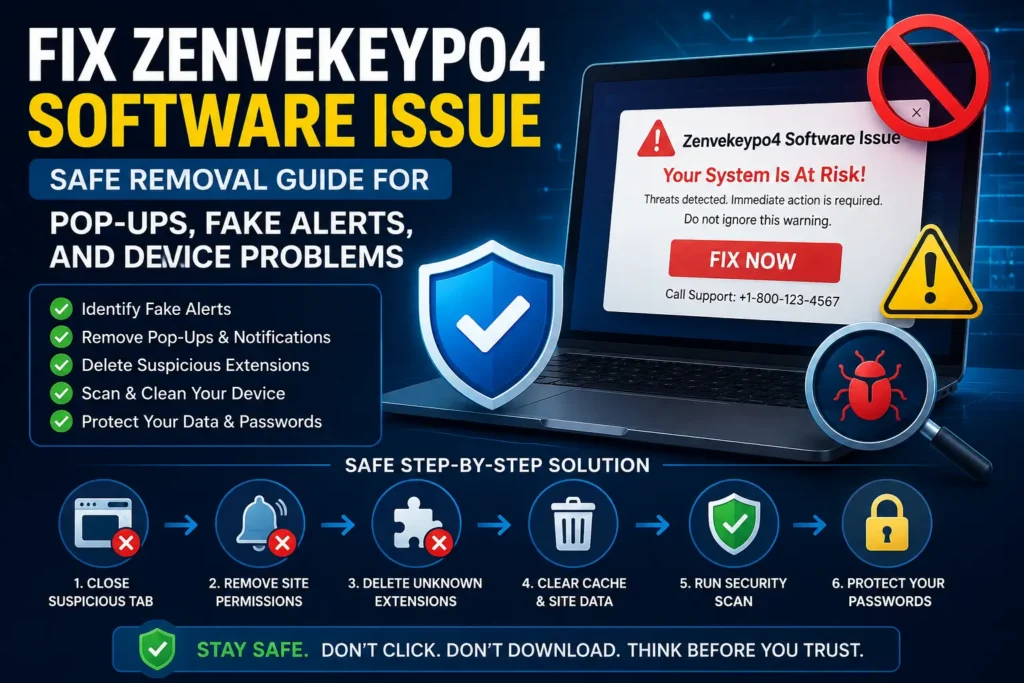
Fix Zenvekeypo4 software issue starts with one simple question: is the warning coming from your real device, or is it only a browser pop-up trying to scare you? Many users see a Zenvekeypo4 software warning after clicking an ad, visiting a risky page, or allowing an unwan notification by mistake.
Before you press “Fix Now,” download a repair tool, or call a support number, slow down. The safest move is to close the suspicious tab, clear browser data, remove unknown browser extensions, and run a trusted security scan. If the problem appears inside the actual app, check updates, cache, permissions, and system compatibility.
This guide helps you spot a fake security alert, fix real software errors, protect your passwords, and stop the warning from coming back without making the issue worse. That way, you stay in control instead of reacting to fear.
Quick Answer: How to Fix Zenvekeypo4 Software Issue Safely
To fix the Zenvekeypo4 software issue safely, first check where the warning appears. If it appears inside a browser tab, treat it as suspicious. If it appears as an installed app or system process, check your device more deeply.
Start with these safe steps:
- Close the suspicious tab or browser window.
- Do not click any button inside the warning.
- Do not call any phone number shown in the alert.
- Do not download a Zenvekeypo4 repair tool.
- Remove suspicious browser notification permissions.
- Delete unknown browser extensions.
- Check recently installed apps.
- Clear browser cache and site data.
- Run a full scan with trusted security software.
- Change passwords if you clicked, installed, paid, or entered login details.
If the warning only appears in your browser, the issue may come from a website notification, adware page, or fake security message. If the issue appears inside your apps, startup programs, or system settings, it may need deeper cleanup.
What Is the Zenvekeypo4 Software Issue?
The Zenvekeypo4 software issue usually refers to a suspicious warning, error message, pop-up, redirect, or unknown software alert linked to the name “Zenvekeypo4.” The problem is that Zenvekeypo4 does not show the clear trust signs users expect from a verified mainstream software product.
A trusted software product usually has:
- An official website
- A verified developer
- Clear documentation
- A support page
- A version history
- A privacy policy
- Safe download sources
- Real user support channels
If those details are missing, you should be careful. The warning may not be a normal software error. It may be a fake alert, browser notification scam, unwanted extension, or suspicious download prompt.
Is Zenvekeypo4 a Real App or a Fake Warning?
The safest answer is this: treat Zenvekeypo4 warnings as suspicious unless you can confirm that Zenvekeypo4 is a real installed program on your device.
The table below explains the difference.
| What You See | Likely Meaning | First Action |
| Zenvekeypo4 appears in a browser pop-up | Fake alert or suspicious website | Close the tab and remove site permissions |
| Zenvekeypo4 asks you to download a tool | Possible scam or unwanted installer | Do not download it |
| Zenvekeypo4 appears in installed apps | Possible unwanted program | Check publisher and uninstall if suspicious |
| Zenvekeypo4 warning keeps returning | Notification permission, adware, or extension issue | Remove permissions and extensions |
| Zenvekeypo4 appears after clicking an ad | Malvertising or redirect page | Clear browser data and scan device |
The name alone does not prove malware. The behavior matters more. If the warning pushes fear, urgency, downloads, payment, or phone calls, treat it as unsafe.
Warning Signs That Zenvekeypo4 May Be a Fake Alert
Fake alerts often look urgent. They may pretend to scan your device or show scary messages about viruses, stolen files, or damaged software.
Common red flags include:
- The warning appears inside a browser page.
- It says your device is infected.
- It asks you to click Fix Now.
- It pushes a repair tool download.
- It shows a phone number for support.
- It uses a countdown timer.
- It claims your photos, passwords, or files are at risk.
- It blocks the page and makes closing difficult.
- It uses fake scan animations.
- It appears after visiting a risky website.
A real system alert usually comes from your installed security software or operating system. It should not pressure you to call a random support number from a browser page.
Signs It May Be a Real Device or Software Problem
Sometimes the problem may not be just a browser pop-up. It may involve a real local issue if you see system-level symptoms.
Look for these signs:
- A similar name appears in your installed apps.
- Your browser homepage changes without permission.
- Your search engine keeps switching.
- New extensions appear by themselves.
- Pop-ups return after every restart.
- Unknown apps run at startup.
- The device becomes slow after a recent download.
- The app crashes, freezes, or refuses to open.
- You cannot save data or sync changes.
If these signs appear, clean the browser first. Then check installed apps, startup programs, downloads, and security settings.
Read this also::https://grammarspark.com/in-between-or-in-between/
Browser Pop-Up vs Installed Software Issue
A browser warning and an installed software issue are not the same problem. They need different fixes.
| Feature | Browser Pop-Up | Installed Software Issue |
| Where it appears | Chrome, Edge, Firefox, or Safari | Installed apps, startup items, system settings |
| Main cause | Suspicious website, notification permission, adware page | Bundled installer, unwanted app, fake tool |
| Risk level | Usually lower if you do not click | Higher if it runs on your device |
| Best fix | Remove site permissions and extensions | Uninstall suspicious apps and scan device |
| Password risk | Higher if you entered details | Higher if the app accessed browser data |
If you only saw the warning on one web page, start with browser cleanup. If you installed something, move to device-level cleanup right away.
What Not to Do When You See the Warning
Before you fix anything, avoid the actions that make the problem worse.
Do not:
- Click buttons inside the alert
- Download any Zenvekeypo4 repair tool
- Call the support number shown on the page
- Enter your password
- Share remote access
- Pay for emergency support
- Trust the warning because it uses a known brand logo
- Install unknown security tools from ads
Fake warnings are designed to rush you. A calm response is safer than a fast click.
How to Close the Zenvekeypo4 Warning Safely
If the warning appears in your browser, close it without clicking inside the pop-up.
On Windows:
- Press Alt + F4 to close the active window.
- Use Task Manager if the browser freezes.
- End the browser task if the page will not close.
On Mac:
- Press Command + Q to quit the browser.
- Use Force Quit if the browser is stuck.
- Reopen the browser without restoring old tabs.
On Android:
- Open recent apps.
- Swipe away the browser.
- Reopen the browser and avoid restoring the same page.
On iPhone or iPad:
- Close the browser tab.
- Clear website data if the warning returns.
- Avoid tapping any pop-up buttons.
After closing the page, do not restore previous tabs if the browser asks. That can reopen the same warning.
How to Remove Zenvekeypo4 Pop-Ups From Chrome
Chrome pop-ups often come from allowed notifications, bad extensions, or suspicious site data.
Follow these steps:
- Open Chrome settings.
- Go to Privacy and security.
- Open Site settings.
- Check Notifications.
- Remove or block unknown websites.
- Go back to Privacy and security.
- Clear browsing data.
- Review extensions and remove anything suspicious.
Remove sites that use random names, strange domains, fake security language, or download prompts. If you do not recognize a site, block it.
How to Remove Zenvekeypo4 Pop-Ups From Microsoft Edge
Microsoft Edge users should check site permissions and extensions.
Follow these steps:
- Open Edge settings.
- Go to Cookies and site permissions.
- Open Notifications.
- Remove unknown websites from the allow list.
- Check Pop-ups and redirects.
- Keep pop-ups blocked.
- Open Extensions.
- Remove unknown or recently added extensions.
If the homepage or search engine keeps changing, reset Edge settings.
How to Remove Zenvekeypo4 Pop-Ups From Firefox
Firefox can also show unwanted notifications if a site has permission.
Follow these steps:
- Open Firefox settings.
- Go to Privacy & Security.
- Scroll to Permissions.
- Open Notification settings.
- Remove unknown websites.
- Check extensions and themes.
- Remove anything you do not recognize.
- Clear cookies and site data.
After this, restart Firefox and check if the warning returns.
Read this also:https://grammarspark.com/trek-vs-treck/
How to Remove Zenvekeypo4 Pop-Ups From Safari
Safari users should remove suspicious website data and check extensions.
Follow these steps:
- Open Safari settings.
- Go to Websites.
- Check notification permissions.
- Deny or remove unknown websites.
- Open the Extensions tab.
- Remove suspicious extensions.
- Clear website data.
- Restart Safari.
If the warning appears again, check whether your device has unknown profiles or calendar subscriptions.
How to Fix Zenvekeypo4 Software Issue on Windows
If the issue appears beyond the browser, check Windows for unwanted apps and startup items.
Check Recently Installed Apps
Open Settings > Apps > Installed apps. Sort apps by install date. Look for programs added around the time the warning started.
Remove apps that:
- You do not recognize
- Have no trusted publisher
- Claim to repair, clean, boost, or scan your PC
- Came bundled with free software
- Use vague or broken names
- Have no clear purpose
Do not remove drivers or system apps unless you understand what they do.
Review Startup Apps
Open Task Manager > Startup apps. Disable unknown items that do not need to start with Windows.
Look for suspicious names connected to:
- Fake security tools
- Browser helpers
- Unknown updaters
- Download managers
- Coupon tools
- System optimizers
Disabling a startup item does not always remove the program, but it can stop it from running while you investigate.
Check the Downloads Folder
Open Downloads and sort files by date. Delete suspicious installers you did not intentionally download.
Be careful with files claiming to be:
- Driver updates
- Browser updates
- Free antivirus tools
- PC repair tools
- Media player updates
- Cracked app installers
If you did not download it from a trusted source, do not open it.
Run a Full Security Scan
Use Windows Security or another trusted security tool. Run a full scan, not only a quick scan. A full scan takes longer, but it checks more areas.
After the scan, restart your PC. Then check whether the warning returns.
How to Fix the Issue on Mac
Mac users should check applications, login items, browser extensions, and profiles.
Check Applications
Open the Applications folder. Look for apps you do not recognize. Pay attention to apps installed around the time the warning began.
Be careful with apps that call themselves:
- Cleaner
- Booster
- Search manager
- Browser helper
- Update manager
- Security repair tool
Move suspicious apps to Trash only if you are sure they are not part of your work, school, or trusted software setup.
Review Login Items
Open System Settings > General > Login Items. Remove unknown apps from startup.
If something looks suspicious, check the app name before removing it.
Check Profiles and Permissions
Some unwanted software may add configuration profiles. These can control browser settings, search behavior, or security permissions.
On a personal Mac, remove unknown profiles carefully. On a work or school Mac, ask the administrator first.
How to Fix Zenvekeypo4 Pop-Ups on Android
Android pop-ups often come from browser notifications, suspicious apps, or risky download pages.
Start with the browser:
- Open browser settings.
- Check site settings.
- Remove unknown notification permissions.
- Block pop-ups and redirects.
- Clear browser data.
Then check your apps:
- Open app settings.
- Sort by recently installed apps if possible.
- Remove apps you do not recognize.
- Review app permissions.
- Run Play Protect or a trusted mobile security scan.
Be careful with free cleaners, battery boosters, file downloaders, unknown VPN apps, and fake video players. These apps often ask for more permissions than they need.
How to Fix the Issue on iPhone or iPad
On iPhone and iPad, Zenvekeypo4-style alerts usually come from browser tabs, website data, calendar spam, or suspicious profiles.
Follow these steps:
- Close the suspicious tab.
- Clear Safari website data.
- Check browser notification settings if using Chrome.
- Remove unknown calendar subscriptions.
- Delete apps you do not remember installing.
- Check VPN and device management settings.
- Update iOS or iPadOS.
If you see strange calendar alerts, the issue may not be malware. It may be a spam calendar subscription. Remove the unknown calendar and clear browser data.
What If You Already Clicked a Zenvekeypo4 Alert?
Clicking once does not always mean your device is infected. What matters is what happened after the click.
| What Happened | Risk | What to Do |
| You clicked but nothing downloaded | Low to medium | Close the page and clear browser data |
| A file downloaded | Medium | Delete it without opening it |
| You installed a tool | High | Uninstall it and run a full scan |
| You entered a password | High | Change the password and enable 2FA |
| You paid money | High | Contact your bank or card provider |
| You gave remote access | Very high | Disconnect, remove remote tools, and get expert help |
If you entered personal information, treat the issue as an account security problem, not just a browser problem.
What If You Installed a Zenvekeypo4 Repair Tool?
If you installed a repair tool from a pop-up or unknown website, remove it quickly.
Do this:
- Disconnect from the internet if the device behaves strangely.
- Uninstall the suspicious tool.
- Remove related browser extensions.
- Check startup apps.
- Delete the installer from Downloads.
- Run a full scan.
- Change important passwords from a clean device.
- Watch your accounts for unusual activity.
Do not reinstall the same tool. If it came from a pop-up, ad, or unknown website, it is not safe enough to trust.
What If You Called a Fake Support Number?
If you called a support number shown in the alert, the next steps depend on what you shared.
If you only called and gave no details, hang up and block the number.
If you shared payment information, contact your bank or card provider.
If you gave remote access, disconnect the device from the internet and remove remote-access tools. Then change passwords from another safe device.
If you shared personal information, monitor your accounts and consider extra identity protection steps.
How to Know the Zenvekeypo4 Issue Is Fixed
You can usually tell the cleanup worked when the device and browser behave normally again.
Good signs include:
- Pop-ups stop appearing.
- Notifications return to normal.
- Browser redirects stop.
- Homepage and search settings stay unchanged.
- Unknown extensions do not return.
- Startup apps look clean.
- Security scans show no active threat.
- Accounts show no strange activity.
Bad signs include:
- Alerts return after restart.
- Browser redirects continue.
- Unknown extensions reinstall.
- Security tools turn off by themselves.
- New apps appear without permission.
- The device slows down suddenly.
- Accounts show unknown logins.
If several bad signs appear together, get professional help.
Common Mistakes to Avoid
Many users make the issue worse by trying to fix it too fast. Avoid these mistakes.
Downloading Random Repair Tools
A repair tool from an unknown pop-up can create more problems. Use trusted tools only.
Clicking Pop-Up Buttons
Buttons like Cancel, Close, or Remove Virus may still trigger redirects or downloads. Close the browser window instead.
Ignoring Notification Permissions
If a website has notification permission, it can keep sending alerts. Remove unknown sites from the allow list.
Reinstalling the Browser Too Early
A browser reinstall may not help if synced extensions or permissions return. Clean permissions and extensions first.
Reusing Passwords
If you entered a password on a suspicious page, change it anywhere else you used it.
How to Prevent Zenvekeypo4-Style Warnings in the Future
Good habits reduce most risks.
Use these prevention steps:
- Keep your browser updated.
- Keep your operating system updated.
- Block pop-ups and redirects.
- Do not allow notifications from unknown websites.
- Download software only from trusted sources.
- Avoid cracked apps and fake update pages.
- Remove unused browser extensions.
- Use strong passwords.
- Turn on two-factor authentication.
- Back up important files.
- Teach family members or employees what fake alerts look like.
During software installation, avoid the “quick install” option when possible. Choose custom install and uncheck extra offers you do not need.
When to Get Professional Help
Most browser pop-ups can be fixed at home. However, some cases need expert support.
Get help if:
- You gave remote access to a stranger.
- You entered banking details.
- You paid for fake support.
- You installed an unknown repair tool.
- The issue happened on a work device.
- Sensitive files may be exposed.
- The warning keeps returning after cleanup.
- Your antivirus or security settings keep turning off.
If money is involved, contact your bank first. Financial protection comes before device cleanup.
FAQs About Fixing Zenvekeypo4 Software Issue
Q1:What is the Zenvekeypo4 software issue?
The Zenvekeypo4 software issue usually means a strange warning, pop-up, redirect, or app error linked to Zenvekeypo4. It may be a real software problem, but it can also be a fake security alert or browser-based scam warning.
Q2:How do I fix Zenvekeypo4 software issue safely?
To fix Zenvekeypo4 software issue safely, close the warning, clear browser data, remove suspicious extensions, block unknown site notifications, restart your device, and run a trusted security scan. Don’t download unknown repair tools.
Q3:Is the Zenvekeypo4 software warning a virus?
A Zenvekeypo4 software warning is not always a virus. If it appears inside a browser page, it may be a browser pop-up, fake alert, or scam message. If it appears in installed apps, check for unwanted software and scan your device.
Q4:Why does the Zenvekeypo4 warning keep coming back?
The warning may return because of allowed site notifications, cached browser data, suspicious extensions, adware, or an unwanted app running in the background. Removing browser permissions and clearing site data often fixes the issue.
Q5:Should I download a Zenvekeypo4 repair tool?
No. Avoid any random Zenvekeypo4 repair tool from pop-ups, ads, or unknown websites. These tools can create more problems. Use trusted security software and official update sources only.
Conclusion
Fixing a Zenvekeypo4 software issue becomes easier when you first identify the source. If the warning appears in a browser, treat it as a fake alert, remove suspicious site notifications, clear browser data, and delete unknown browser extensions. If Zenvekeypo4 software is crashing, freezing, failing to sync, or refusing to save data, handle it like a real software problem by restarting the app, checking updates, clearing cache, and verifying compatibility.
Never download an unknown repair tool or call a number shown in a scary warning. A calm, safe process protects your device, accounts, and files. With regular updates, smart browsing habits, and a trusted security scan, you can stop the warning, reduce future problems, and protect your daily work safely.
