
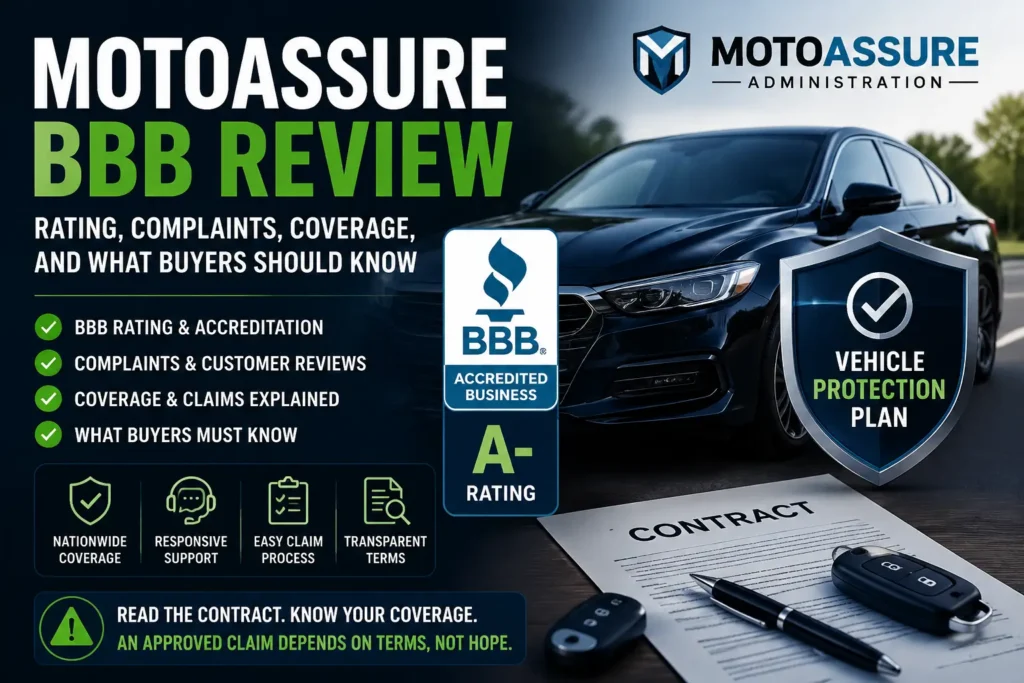
MotoAssure BBB searches help drivers check BBB reviews, claims, coverage, and complaints before buying a plan.
Many buyers, customers, and everyday users want simple facts before committing to MotoAssure, MotoAssure Administration, an extended warranty, auto warranty, or vehicle service contract. The Better Business Bureau, BBB profile, BBB rating, BBB complaints, customer reviews, and complaint history help show whether the company looks trustworthy, legit, and clear with real customers.
Still, the real test is the written contract. Check coverage limits, exclusions, waiting period, deductible, cancellation policy, and claim process before signing a contract. A plan may promise nationwide protection, customer service, peace of mind, and smooth claim handling, but denied claims, delays, and repair costs can happen.
For a safer choice, compare protection plans, review company responses, and look for transparency, clarity, reliability, responsive support, and fair claims processing. In 2026, an approved claim depends on terms, not hope.
Quick Answer: What Does MotoAssure BBB Show?
MotoAssure Administration appears to be a real vehicle protection plan administrator with BBB accreditation and an A- rating. BBB says the business has been accredited since January 24, 2024, and the profile lists 13 complaints as a reason for the rating.
That sounds reassuring at first glance. Still, buyers should not treat the BBB grade as a green light by itself.
BBB explains that its ratings are not a guarantee of a company’s reliability or performance. BBB also says customer reviews do not count toward the BBB letter grade.
So, the quick verdict is simple:
| Buyer Question | Clear Answer |
| Is MotoAssure BBB accredited? | Yes, according to BBB’s profile. |
| What is MotoAssure’s BBB rating? | BBB currently shows an A- rating. |
| Does the BBB rating guarantee claim approval? | No. |
| Does MotoAssure have complaints? | Yes, BBB lists 13 complaints as a rating factor. |
| Should buyers read the contract first? | Absolutely. No contract, no deal. |
If you remember only one thing, remember this: BBB helps you check the company. The contract tells you what you’re actually buying.
Read this also: ETSJavaApp Release Date: Current Status, eTrueSports Link, and Safe Download Guide
What Is MotoAssure Administration?
MotoAssure Administration provides vehicle protection plans and helps customers with claim processing and repair-related service support, according to its BBB business profile.
On its own website, MotoAssure lists several protection plan categories, including Platinum, Gold, Powertrain, and Pre-Paid Maintenance.
That puts MotoAssure in the world of vehicle service contracts. Many drivers casually call these plans “extended warranties,” but that wording causes confusion.
The Federal Trade Commission explains that an auto service contract or extended warranty bought separately is not a warranty under federal law because you buy it separately from the car.
That distinction matters. A factory warranty comes with the vehicle. A service contract is an extra product. It has its own rules, limits, exclusions, waiting periods, and claim process.
Definitions: MotoAssure BBB Terms Buyers Should Understand
Before digging into complaints and coverage, get the language straight. This industry loves slippery wording.
| Term | What It Means |
| BBB rating | BBB’s letter-grade opinion based on factors such as complaint history and business responses. |
| BBB accreditation | A status showing the business has committed to BBB Standards for Trust. |
| Customer review rating | A separate score from consumer reviews. BBB says reviews don’t determine the letter grade. |
| Vehicle service contract | A paid contract that may cover certain repairs or services after purchase. |
| Extended warranty | A common marketing phrase, but often legally a service contract. |
| Administrator | The company that handles claims and contract service. |
| Waiting period | The required time or mileage before coverage starts. |
| Exclusion | A repair, part, condition, or situation the contract won’t cover. |
| Limit of liability | The maximum amount the contract may pay for covered repairs. |
Here’s the easiest way to think about it:
A warranty promises. A service contract negotiates.
That may sound harsh, but it’s useful. A service contract can help a buyer, yet it only helps when the failure fits the written terms.
Read this also: Fix Zenvekeypo4 Software Issue: Safe Removal Guide for Pop-Ups, Fake Alerts, and Device Problems
MotoAssure BBB Rating Explained
The current BBB profile for MotoAssure Administration shows an A- rating, BBB accreditation, and a business category of Auto Warranty Processing. BBB also says the business has been accredited since January 24, 2024, with 3 years in business listed on the profile.
The rating looks good on the surface. Still, buyers should slow down.
BBB itself says ratings are not a guarantee of reliability or performance. BBB recommends that consumers look at the rating along with other available information about the business.
That’s the correct way to use BBB. Don’t worship the letter grade. Study the complaint patterns, review language, company responses, contract terms, and your own repair risk.
MotoAssure BBB Rating vs Customer Reviews
BBB’s rating and BBB customer reviews are two different things.
BBB says customer reviews are not used to calculate the BBB letter grade.
That means a company can have a high letter grade while some customers still feel unhappy. It also means a business can have good reviews without that score directly improving the BBB grade.
| BBB Signal | What It Tells You | What It Doesn’t Tell You |
| BBB letter rating | How BBB rates the business under its rating system | Whether your claim will be approved |
| BBB accreditation | Whether the company meets BBB accreditation standards | Whether the plan is worth the cost |
| Customer reviews | How some customers describe their experiences | Whether their contract matches yours |
| Complaints | Where problems have surfaced | Whether every customer has the same issue |
A smart buyer reads all of it. A careless buyer looks at the rating and stops.
What MotoAssure Plans Appear to Offer
MotoAssure lists four main plan categories on its website: Platinum, Gold, Powertrain, and Pre-Paid Maintenance.
The plans appear to differ by coverage depth.
| MotoAssure Plan | General Positioning | Main Buyer Intent |
| Platinum | Highest listed protection tier | Broad coverage needs |
| Gold | Intermediate coverage | Buyers who want more than basic powertrain protection |
| Powertrain | Basic listed protection | Older vehicles or essential components |
| Pre-Paid Maintenance | Maintenance-focused add-on style plan | Buyers who want help with routine maintenance costs |
MotoAssure’s Platinum page says the plan covers many major systems, including the engine, transmission, electrical system, suspension, seals, gaskets, and automatic windows.
MotoAssure’s Gold page says the Gold Program names covered systems such as air conditioning, drivetrain, steering, fuel systems, and more. It also says that if a specific part is not explicitly named, it is not covered.
That sentence matters. It’s one of the most important points in any vehicle service contract.
If the contract says only named parts are covered, don’t assume related parts qualify. A small missing word can become a big repair bill.
MotoAssure’s Powertrain page says the plan focuses on vital components such as the engine, transmission, drivetrain, transfer case, drive axle, and turbo/supercharger. It also says the program is available for most vehicles with mileage up to 200,000 miles.
MotoAssure’s Pre-Paid Maintenance page mentions services such as 3 oil changes, brake pads/shoes, battery replacement, and cooling system maintenance/lube.
MotoAssure Coverage Limits and Extra Benefits
MotoAssure says its protection programs have limits of liability of $12,500 or actual cash value, whichever is greater. Its website also says MotoAssure protection programs include bonus roadside assistance and a rental car program.
The company’s customer page also says its plans offer first-day rentals, free towing, trip interruption service, and roadside benefits.
Those benefits can matter. A repair bill hurts, but losing transportation hurts too. Rental and towing support can prevent a breakdown from turning into a work problem, family problem, or travel problem.
Still, benefits need written confirmation.
Do not rely on a sales page alone. Ask for the full sample contract. Check whether benefits have dollar caps, daily limits, location rules, reimbursement requirements, or approval steps.
Key Differences: Warranty vs Vehicle Service Contract
This section matters because many MotoAssure BBB complaints and vehicle protection complaints begin with the same misunderstanding: the buyer thinks they bought a warranty.
They often bought a service contract.
| Feature | Manufacturer Warranty | Vehicle Service Contract |
| Cost | Usually included with the vehicle | Bought separately |
| Provider | Usually the automaker | Manufacturer, dealer, or third-party company |
| Coverage | Defined by factory warranty terms | Defined by service contract terms |
| Claim process | Often handled through dealer network | Depends on administrator rules |
| Exclusions | Still exist, but often clearer | Can vary widely |
| Buyer risk | Lower when factory-backed | Depends heavily on contract wording |
The FTC warns consumers to compare any service contract with existing coverage before buying. It also says an extended warranty may not be worth the cost if the product is unlikely to need expensive repairs.
That’s not anti-service-contract advice. It’s math.
If your vehicle rarely needs costly repairs, the plan may not pay off. If your car has known expensive failures, a plan might help, but only if those failures are covered.
What MotoAssure BBB Complaints Suggest Buyers Should Watch
BBB lists complaints for MotoAssure Administration, and one visible complaint excerpt involves a dispute over a waiting period described as 30 days and 1,000 miles.
This is a classic vehicle service contract problem.
A buyer hears “30 days.” The contract may say “30 days and 1,000 miles.” That small word, and, can decide whether a claim gets paid.
Common complaint themes in this industry often include:
- Waiting period disputes
- Claim denial frustration
- Pre-existing condition arguments
- Coverage misunderstanding
- Cancellation or refund issues
- Slow communication
- Disagreement over covered parts
The lesson isn’t that every complaint proves wrongdoing. It’s that each complaint shows where buyers can get burned.
Real-Life Example: When MotoAssure Coverage Could Help
Imagine a driver with a 9-year-old SUV and 128,000 miles. The factory warranty is long gone. The owner uses the vehicle for work, errands, and school drop-offs.
Then the transmission fails.
If the driver has an active MotoAssure plan, passed the waiting period, maintained the vehicle properly, followed the claim process, and the failed transmission part is covered, the plan may reduce the repair burden.
That’s the good scenario. It’s why people buy these plans.
A covered $3,900 transmission repair can feel like someone pulled you out of financial quicksand. MotoAssure’s homepage lists a transmission repair example at $3,911 under standard vehicle repair costs.
In that situation, the plan can be useful.
Real-Life Example: When MotoAssure Coverage Could Disappoint
Now picture a different driver.
They buy a plan after noticing a rough shift, but they don’t tell the sales rep. Three weeks later, the vehicle breaks down. The shop says the issue likely started before the contract became active.
The claim gets denied as a pre-existing condition.
The buyer feels cheated. The administrator points to the contract. Both sides dig in.
That’s the ugly scenario. It happens across the vehicle service contract world.
The takeaway is simple: don’t buy coverage after a symptom appears and expect the plan to rescue you. Service contracts are not emergency parachutes you put on after jumping.
How a MotoAssure Claim May Work
Each contract can differ, but most vehicle service contract claims follow a similar path.
| Step | What Usually Happens | Buyer Mistake to Avoid |
| Breakdown happens | Vehicle shows a mechanical issue | Keep driving until damage gets worse |
| Shop diagnosis | Repair facility checks the problem | Authorize repairs before approval |
| Claim opened | Shop or buyer contacts administrator | Forget contract number or records |
| Review begins | Administrator checks coverage | Assume approval is automatic |
| Inspection may occur | Adjuster may request proof | Delay maintenance records |
| Decision issued | Claim approved, denied, or revised | Accept vague denial by phone |
| Payment or appeal | Covered repairs proceed or dispute starts | Fail to get written documentation |
The most important rule is boring but vital:
Get approval before repairs begin.
Many contracts require authorization before work starts. If you skip that step, you can lose leverage.
What MotoAssure May Not Cover
MotoAssure’s specific contract controls coverage. However, vehicle service contracts commonly exclude certain items, and buyers should look for these exclusions before paying.
Common exclusions may include:
- Wear items
- Pre-existing conditions
- Cosmetic damage
- Collision damage
- Unauthorized repairs
- Improper maintenance
- Diagnosis-only charges
- Teardown costs unless approved
- Fluids, filters, belts, hoses, or seals unless stated
- Non-covered parts that fail alongside covered parts
The FTC advises consumers to read the details of an extended warranty or service contract and compare coverage before buying.
That advice sounds basic. Yet most buyers don’t do it.
They listen to a sales call, skim the brochure, and hope the contract works like a bumper-to-bumper warranty. That’s how disappointment gets built before the first claim.
Comparison Table: MotoAssure Plan Types
Use this table as a buyer’s starting point, not a substitute for the contract.
| Plan | What MotoAssure Says | What Buyers Should Confirm |
| Platinum | Broad coverage across many parts and systems | Whether it is exclusionary or named-component coverage |
| Gold | Named covered systems, including A/C, drivetrain, steering, and fuel systems | Exact parts list and exclusions |
| Powertrain | Focuses on core systems for older vehicles | Whether your specific failed component is named |
| Pre-Paid Maintenance | Includes items such as oil changes, brake pads/shoes, battery replacement, and cooling system maintenance/lube | Surcharge, limits, timing, and redemption rules |
The key phrase is confirm in writing.
A verbal promise disappears when a claim gets denied. A contract clause stays on the page.
Grammar Tips: The Words Buyers Should Use Carefully

This may seem odd in a car protection article, but wording matters here. One wrong phrase can create the wrong expectation.
“Warranty” vs “service contract”
Use service contract when discussing MotoAssure unless the actual document uses a different legal term.
Why? The FTC says auto service contracts are sometimes called “extended warranties,” but they are not warranties under federal law.
“Covered” vs “eligible”
A repair may look eligible at first, but it becomes covered only after the administrator confirms the failure fits the contract.
“Included” vs “approved”
A benefit listed on a website may be included in the plan category. That doesn’t mean every claim gets approved automatically.
“All parts” vs “named parts”
If a plan covers named parts only, anything not listed may be excluded. MotoAssure’s Gold page says that if a specific part is not explicitly named, it is not covered.
That’s not fine print. That’s the ballgame.
Common Mistakes Buyers Make Before Choosing MotoAssure
Most bad outcomes start before the contract is signed.
Mistake: Buying based only on the MotoAssure BBB rating
The MotoAssure BBB rating is useful, but it’s not a claim approval guarantee.
Mistake: Not reading the sample contract
A brochure tells you the sales story. The contract tells you the legal story.
Mistake: Ignoring the waiting period
Ask whether coverage begins after days, miles, or both.
Mistake: Assuming older damage will be covered
A plan usually won’t cover a problem that existed before the contract became active.
Mistake: Forgetting maintenance records
Oil change receipts, shop invoices, tire rotations, inspection reports, and fluid service records can protect your claim.
Mistake: Authorizing repairs too early
Do not tell the mechanic to start repairs before claim approval unless the contract clearly allows it.
Mistake: Comparing only monthly price
A cheap plan with narrow coverage can cost more than no plan at all.
Memory Tricks for Reading a MotoAssure Contract
Use these simple memory tricks before you sign.
The “WELL” test
Before buying, check:
- Waiting period
- Exclusions
- Limits of liability
- Labor rate rules
If you can’t explain those four items, you’re not ready to buy.
The “PAIR” test
Before filing a claim, remember:
- Pause before repairs
- Ask for authorization
- Include maintenance records
- Request written decisions
That four-step habit can save you from a nasty claim fight.
See this also: Someday vs Some Day: Meaning, Difference, Examples, and Easy Rules
Synonyms and Related Words for MotoAssure BBB Research
When researching MotoAssure, buyers often use different phrases for the same topic.
| Search Phrase | What the Searcher Usually Wants |
| MotoAssure BBB | BBB rating, complaints, legitimacy |
| MotoAssure BBB rating | Current BBB grade and accreditation |
| MotoAssure complaints | Customer problems and claim disputes |
| MotoAssure reviews | Positive and negative customer experiences |
| MotoAssure warranty | Coverage details, though “service contract” is more accurate |
| MotoAssure Administration | Company profile and official business details |
| MotoAssure claims | How repair approvals and denials work |
| MotoAssure cancellation | Refund rights and cancellation process |
| MotoAssure scam | Whether the company is real or risky |
Related words include:
- Vehicle protection plan
- Auto service contract
- Extended warranty
- Claims administrator
- Powertrain coverage
- Platinum coverage
- Waiting period
- Deductible
- Liability limit
- Repair authorization
These terms help you research smarter. They also help you ask better questions before you buy.
Is MotoAssure Legit or a Scam?
Based on the available information, MotoAssure Administration appears to be a legitimate business, not an anonymous scam operation. BBB has a business profile for MotoAssure, lists BBB accreditation, shows an A- rating, and provides business details for the company.
MotoAssure also operates an official website with listed protection plan pages, contact details, claim center links, and plan descriptions.
However, “legit” doesn’t mean “right for everyone.”
That’s where buyers get sloppy. They ask, “Is it a scam?” when they should ask, “Will this contract cover the repairs my vehicle is likely to need?”
A company can be real and still be a bad fit for you. A contract can be legal and still feel disappointing. A claim denial can be frustrating without being fraudulent.
Here’s the sharper question:
Can you afford the plan, understand the exclusions, meet the maintenance rules, and follow the claim process without guessing?
If not, don’t buy yet.
Red Flags Before Buying Any MotoAssure Plan
Walk away or slow down if you see these warning signs:
- The seller won’t provide the full contract before payment.
- The salesperson says “everything is covered.”
- You can’t get a clear answer about the waiting period.
- Cancellation terms sound vague.
- The repair shop approval process isn’t explained.
- The seller pressures you to decide immediately.
- The plan cost is discussed, but exclusions aren’t.
- You don’t know who administers claims.
- You don’t know who backs the contract financially.
- The seller relies only on the BBB rating to prove value.
Pressure is not a benefit. Urgency is not proof. A confident seller should be willing to show the contract.
Buyer Checklist Before Signing a MotoAssure Contract
Use this checklist before you pay anything.
| Question | Why It Matters |
| Can I see the full contract? | You need the real terms, not marketing claims. |
| What is the waiting period? | Claims may be denied if filed too soon. |
| Is it days, miles, or both? | Many buyers miss this detail. |
| What parts are excluded? | Exclusions decide most disputes. |
| Are diagnostics covered? | Diagnosis can cost money even if repair is denied. |
| Are teardown costs covered? | Some failures require expensive teardown. |
| What labor rate does the contract pay? | Shops may charge more than the allowed rate. |
| Are OEM parts covered? | Some contracts allow aftermarket or rebuilt parts. |
| Can I use my preferred repair shop? | Shop rules affect convenience. |
| How are refunds calculated? | Cancellation terms can surprise buyers. |
| What maintenance records are required? | Records can make or break a claim. |
Print this table if needed. It’s not glamorous, but it’s the kind of boring that saves money.
Case Study: The Waiting Period Problem
A buyer purchases a vehicle service contract. The salesperson mentions a 30-day waiting period. The buyer relaxes.
Thirty-two days later, the engine fails. The buyer opens a claim.
Then the administrator asks for current mileage. The contract requires 30 days and 1,000 miles before coverage begins. The buyer has driven only 620 miles.
The claim may be denied.
The buyer feels tricked because the 30-day part was easy to remember. The mileage part was the trapdoor.
This is why you should always ask:
“Does coverage start after days, miles, or both?”
Get the answer in writing. Don’t trust memory.
Case Study: The Named-Part Coverage Problem
A driver buys a mid-tier protection plan. The plan covers the cooling system. Months later, the vehicle overheats.
The driver expects coverage.
The shop finds that a small related component failed. The part is connected to the cooling system, but the contract doesn’t name that part.
If the plan uses named-component coverage, the claim may be denied.
MotoAssure’s Gold page says that if a specific part is not explicitly named, it is not covered.
That sentence should make every buyer slow down.
“Related to a covered system” does not always mean “covered.”
Who Might Consider MotoAssure?
MotoAssure may make sense for some buyers.
It may fit:
- Drivers with older vehicles outside factory warranty
- High-mileage vehicle owners
- People who can’t comfortably absorb a major repair bill
- Drivers who keep strong maintenance records
- Owners who plan to keep the vehicle for several years
- Buyers who read contracts carefully
- People who understand claim approvals are conditional
The best buyer for this type of plan is practical, organized, and realistic. They don’t expect magic. They expect a contract.
Who Should Avoid MotoAssure?
Some buyers should probably skip it.
Avoid or delay buying if:
- You won’t read the contract.
- You expect bumper-to-bumper coverage.
- Your vehicle is still under strong factory warranty.
- You have enough savings to self-insure.
- You dislike paperwork and approval steps.
- Your car is cheap to repair.
- You already noticed mechanical symptoms.
- You feel pressured by a sales call.
No service contract fixes poor timing, weak records, or unrealistic expectations.
MotoAssure BBB Review: Pros and Cons
| Pros | Cons |
| BBB-accredited profile | BBB complaints exist |
| A- BBB rating currently listed | BBB rating doesn’t guarantee claim approval |
| Multiple plan categories listed | Contract exclusions still control claims |
| Platinum, Gold, Powertrain, and Pre-Paid Maintenance options | Buyers may confuse service contracts with warranties |
| Website mentions roadside assistance and rental benefits | Waiting periods can create disputes |
| Powertrain plan may cover many older vehicles up to 200,000 miles | Named-component plans can exclude related parts |
The pros are real. The risks are real too.
That’s the point. A useful review doesn’t cheerlead. It helps you make the better decision.
Frequently Asked Questions About MotoAssure BBB
MotoAssure BBB refers to people searching for MotoAssure on the Better Business Bureau website. They usually want to check the company’s BBB rating, complaints, reviews, and overall trust before buying a vehicle service contract.
Q2:Is MotoAssure legit?
MotoAssure appears to be a real company connected with vehicle protection plans and claims processing. Still, being real doesn’t automatically mean every plan is right for every driver. You should read the written contract before making a decision.
Look for patterns in BBB complaints, customer reviews, claim handling, cancellation issues, and repair approval problems. One bad review may not tell the full story, but repeated complaints about the same issue deserve attention.
No. A MotoAssure vehicle protection plan usually depends on the contract terms. Some repairs may be excluded because of coverage limits, waiting periods, deductibles, pre-existing issues, or parts that are not listed in the agreement.
MotoAssure may be worth considering if you own an older vehicle, worry about high repair costs, and want help with covered breakdowns. It may not be worth it if you expect every repair to be approved or you don’t want to follow contract rules.
Strong Conclusion: What the MotoAssure BBB Profile Really Tells You
A MotoAssure BBB review can help you understand how MotoAssure Administration appears through the Better Business Bureau, including its BBB profile, BBB rating, customer feedback, and complaint history. It’s a smart first step, especially if you’re unsure about buying a vehicle protection plan or auto warranty.
However, the BBB should not be your only source of trust. The most important details sit inside the service contract. Before signing anything, check the coverage, claim rules, repair approval process, cancellation policy, and exclusions.
In plain English, MotoAssure may be useful for some drivers, especially those worried about expensive repairs and unexpected breakdowns. Still, it only makes sense if you understand the terms clearly. A good decision comes from facts, not pressure.

1 thought on “MotoAssure BBB Review: Rating, Complaints, Coverage, and What Buyers Should Know”