
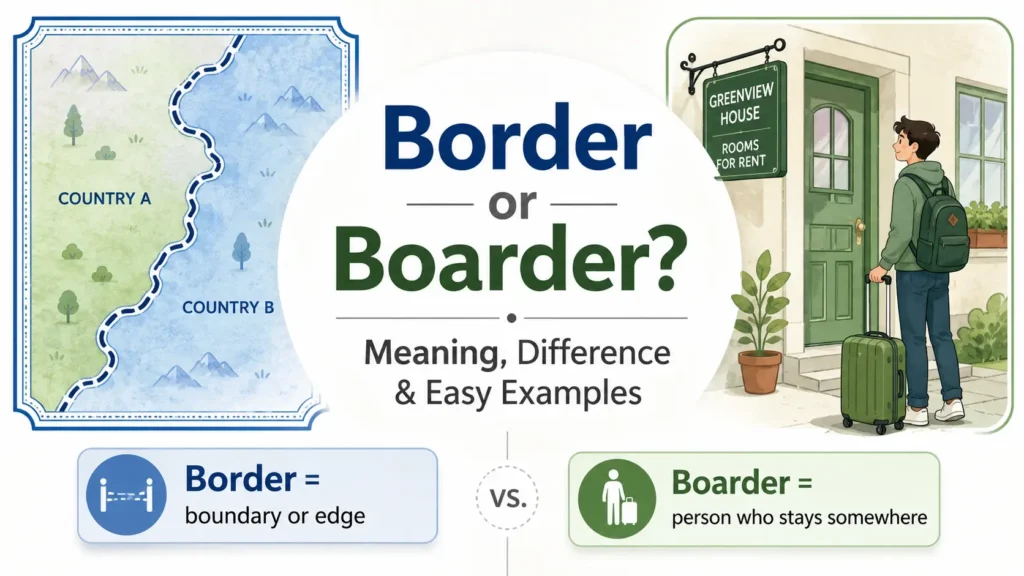
Border or boarder is a common English confusion because both words sound almost the same, but they don’t mean the same thing. The purpose of this guide is simple: to help you choose the correct word, understand the spelling difference, and use each term with confidence in real writing.
A border means an edge, boundary, or dividing line between places, objects, or areas. A boarder means a person who stays somewhere, often with room and board, meals, or lodging.
This difference matters in everyday English, formal writing, rental agreements, school notes, travel writing, and professional documents. Once you know the simple rule, the confusion disappears. Use border for a line or limit. Use boarder for a person who lives, stays, or boards somewhere.
Quick Answer: Border or Boarder
Use border when you mean a boundary, edge, or dividing line.
Use boarder when you mean a person who lives somewhere, usually while paying for room, meals, or both.
| Word | Correct Meaning | Simple Example |
| Border | A boundary, edge, or dividing line | “The town sits near the border.” |
| Boarder | A person who pays to live somewhere | “The boarder rented a room upstairs.” |
Here’s the easiest way to remember it:
A border is a line. A boarder is a person.
That one sentence solves most confusion.
What Does Border Mean?
Border is most often a noun. It refers to the edge, boundary, or dividing line between two places, areas, objects, or ideas.
You’ll often see border used with countries, states, towns, gardens, pictures, pages, and designs.
For example:
- “The United States shares a border with Canada.”
- “She added a gold border around the invitation.”
- “The garden border needed fresh flowers.”
- “The map shows every state border clearly.”
In these examples, border points to a line or edge. It can be official, like a national boundary. It can also be decorative, like a frame around a picture.
Border as a Boundary Between Places
A border can separate countries, states, cities, counties, or regions. This is the meaning most people think of first.
Examples:
- “They crossed the border before noon.”
- “The river forms a natural border between the two towns.”
- “Border security increased during the holiday weekend.”
- “The village lies close to the northern border.”
In geography, politics, travel, and news, border almost always means a dividing line between places.
Border as an Edge or Frame
Border can also mean the outside edge of something. This meaning appears in design, gardening, printing, art, and home decor.
Examples:
- “The photo needs a clean white border.”
- “A stone border surrounds the flower bed.”
- “The designer used a thin black border around the menu.”
- “Write your name inside the red border.”
This use has nothing to do with countries. It simply means the outer part or edge.
Read this also: Disorganized vs Unorganized: Meaning, Difference, and Correct Usage
Border as a Verb
Border can also work as a verb. When something borders another thing, it lies next to it.
Examples:
- “The farm borders a quiet river.”
- “The town borders the national park.”
- “Their property borders a large forest.”
- “The small restaurant borders the old market district.”
As a verb, border means “to be next to” or “to form an edge along.”
What Does Boarder Mean?
Boarder is a noun. It refers to a person who lives somewhere and usually pays for lodging, meals, or both.
The word comes from the older meaning of board, which can mean meals or regular food service. That’s why the phrase room and board means a place to stay and meals to eat.
Examples:
- “The family took in a boarder.”
- “The boarder paid rent every month.”
- “Several boarders lived in the old house.”
- “The school had both day students and boarders.”
In everyday English, boarder often appears in housing, schools, and older-style lodging situations.
Boarder as a Person Who Pays for Lodging
A boarder may rent a room in someone’s home, a boarding house, or another shared living space. In traditional use, a boarder often gets meals too.
Examples:
- “The widow rented her spare room to a boarder.”
- “The boarder ate breakfast with the family.”
- “A quiet boarder lived upstairs.”
- “The house had two tenants and one boarder.”
Today, people may say tenant, lodger, roomer, or renter more often. However, boarder still works when lodging and meals are part of the arrangement.
Boarder as a Student at a Boarding School
A student who lives at school can be called a boarder. This word still appears in school settings, especially when a school has both day students and residential students.
Examples:
- “As a boarder, Mia lived on campus during the week.”
- “The school welcomes new boarders each fall.”
- “Boarders return to their dorms after dinner.”
- “Day students leave at 3 p.m., but boarders stay overnight.”
A boarding student means the same thing. It often sounds clearer and more modern.
Boarder in Sports and Hobbies
In casual speech, boarder can also describe someone who rides a board. This may refer to a snowboarder, skateboarder, surfboarder, or wakeboarder.
Examples:
- “The boarder practiced tricks at the skate park.”
- “A skilled boarder raced down the snowy slope.”
- “The young boarder carried a skateboard under one arm.”
Still, this meaning depends on context. In most cases, snowboarder, skateboarder, or surfer sounds clearer.
Border vs Boarder Comparison Table
| Feature | Border | Boarder |
| Main meaning | Edge, boundary, or dividing line | Person who lives somewhere |
| Part of speech | Noun or verb | Noun |
| Refers to | A line, edge, place, or limit | A person |
| Common topics | Geography, maps, design, gardens | Housing, schools, lodging, sports |
| Example phrase | “national border” | “boarding school boarder” |
| Easy clue | Think “line” | Think “person” |
| Common mistake | “country boarder” | “school border” |
Key Differences Between Border and Boarder
The main difference is simple. Border refers to a thing or place. Boarder refers to a person.
That sounds easy, but the spelling mix-up happens often because the words sound alike.
Border Means a Line or Edge
Use border when the sentence talks about:
- Countries
- States
- Cities
- Maps
- Walls
- Gardens
- Pages
- Pictures
- Designs
- Edges
- Boundaries
Examples:
- “The border between the two states follows the river.”
- “The garden has a brick border.”
- “The poster looks better with a blue border.”
Boarder Means a Person
Use boarder when the sentence talks about:
- Someone renting a room
- A student living at school
- A person receiving room and board
- A person riding a board in casual sports language
Examples:
- “The boarder moved into the guest room.”
- “The school has twenty new boarders.”
- “The snowboard boarder wore a bright helmet.”
How to Use Border in Sentences
Use border when you want to describe a boundary, edge, frame, or nearby place.
Everyday Examples of Border
- “The cat sat near the garden border.”
- “The town is close to the state border.”
- “She drew a wavy border around the card.”
- “A row of trees marked the property border.”
- “The blanket had a soft blue border.”
- “The museum sits near the city’s eastern border.”
These sentences all refer to edges, lines, or limits. None of them refer to a person.
Formal Examples of Border
- “The agreement changed the border between the two regions.”
- “Officials inspected traffic near the national border.”
- “The map shows the county border in red.”
- “The dispute involved land along the southern border.”
Formal writing often uses border in legal, political, geographic, and administrative contexts.
Read this also: Yours Sincerely vs Sincerely Yours: Meaning, Difference, and Correct Use
How to Use Boarder in Sentences
Use boarder when you mean a person who stays somewhere, usually for pay.
Everyday Examples of Boarder
- “The family welcomed a new boarder.”
- “The boarder rented the upstairs room.”
- “Each boarder shared the kitchen.”
- “The school assigned every boarder a dorm room.”
- “The boarder paid for meals and lodging together.”
- “A quiet boarder lived in the back room.”
Each sentence talks about a person. That’s the key.
Context-Based Examples of Boarder
| Context | Correct Sentence |
| Housing | “The boarder paid rent on Friday.” |
| School | “The boarder stayed in the dorm over the weekend.” |
| Sports | “The boarder rode down the snowy hill.” |
| Old-fashioned lodging | “The inn accepted three boarders.” |
Real-Life Examples of Border or Boarder
Real writing gets messy. That’s where examples help.
Travel Writing
Correct: “We stopped at the border before entering the next country.”
Why it works: Travel writing usually discusses places, crossings, and official lines.
Incorrect: “We stopped at the boarder before entering the next country.”
That version accidentally refers to a person.
School Writing
Correct: “The boarder returned to the dorm after dinner.”
Why it works: The sentence describes a student who lives at school.
Incorrect: “The border returned to the dorm after dinner.”
A boundary can’t return to a dorm. Unless English has lost the plot.
Design Writing
Correct: “Add a thin border around the logo.”
Why it works: The sentence describes a visual edge.
Incorrect: “Add a thin boarder around the logo.”
That would mean adding a person around the logo. Not ideal.
Housing Writing
Correct: “The landlord rented a room to a boarder.”
Why it works: The sentence describes a person who lives in rented space.
Incorrect: “The landlord rented a room to a border.”
A border can’t pay rent. It just sits there being a line.
Common Mistakes With Border and Boarder
Small spelling errors can change the meaning fast. Here are the mistakes readers make most often.
Mistake: Using Boarder for a Country Line
Wrong: “The country shares a boarder with Spain.”
Correct: “The country shares a border with Spain.”
A country shares a boundary, not a person.
Mistake: Using Border for a Person
Wrong: “The border rented a room in our house.”
Correct: “The boarder rented a room in our house.”
A person who rents a room may be a boarder.
Mistake: Forgetting the Extra “A” in Boarder
The extra a matters. It turns border into boarder, and the meaning shifts from a line to a person.
Think of the word board inside boarder. A boarder may receive room and board.
Mistake: Thinking They Are Interchangeable
Border and boarder are not interchangeable. They sound similar, but they don’t share the same meaning.
Compare these:
- “The border is closed.”
- “The boarder is asleep.”
The first talks about a boundary. The second talks about a person.
Grammar Tips for Border or Boarder
Grammar becomes easier when you identify what the word does in the sentence.
Ask: Is It a Person?
If the word refers to a person, use boarder.
Examples:
- “The boarder lives upstairs.”
- “A new boarder joined the school.”
- “The boarder pays monthly.”
Ask: Is It an Edge or Boundary?
If the word refers to an edge, line, or limit, use border.
Examples:
- “The border runs through the valley.”
- “The border around the page is crooked.”
- “The town borders a lake.”
Check the Words Around It
Certain words often signal the correct choice.
| Common Phrase | Correct Word |
| National ___ | border |
| State ___ | border |
| Page ___ | border |
| Garden ___ | border |
| Room and ___ | board |
| School ___ | boarder |
| Paying ___ | boarder |
| New ___ moved in | boarder |
Memory Tricks for Border or Boarder
A good memory trick saves time. These three work well.
Border Has “Order”
A border creates order. It separates one place from another.
Think:
- Country line
- Page edge
- Garden edge
- Property line
A border keeps things in order by marking where one thing ends.
Boarder Has “Board”
A boarder connects to board, as in room and board.
Think:
- Lodging
- Meals
- Boarding school
- Boarding house
- Person living somewhere
If a person stays somewhere and pays for it, boarder may fit.
Think “Line” vs “Person”
This is the fastest trick:
- Border = line
- Boarder = person
When in doubt, ask yourself, “Am I talking about a line or a person?”
Synonyms for Border
A synonym is a word with a similar meaning. However, synonyms don’t always work in every sentence.
| Synonym | Best Use |
| Boundary | Official or general dividing line |
| Edge | Outside part of something |
| Limit | Point where something stops |
| Margin | Edge of a page or space |
| Frontier | Outer edge of settled or known land |
| Perimeter | Outer line around an area |
| Rim | Circular or outer edge |
| Frame | Decorative edge around something |
Examples:
- “The boundary between the farms was unclear.”
- “The photo had a white margin.”
- “The fence marked the perimeter.”
- “The old trail followed the frontier.”
Synonyms for Boarder
The best synonym for boarder depends on the context.
| Synonym | Best Use |
| Lodger | Person renting a room in a home |
| Roomer | Person renting a room |
| Tenant | Person renting property |
| Resident | Person living somewhere |
| Guest | Person staying temporarily |
| Pupil | Student, especially in school context |
| Boarding student | Student who lives at school |
| Renter | Person paying rent |
Examples:
- “The lodger stayed in the attic room.”
- “The tenant signed a lease.”
- “The boarding student returned to campus.”
- “The resident shared the kitchen.”
Be careful, though. A tenant often has a more formal rental agreement. A boarder may have a simpler lodging arrangement that includes meals.
Related Words People Confuse
Border vs Boundary
Border and boundary are close in meaning. A border often describes a visible, official, or physical dividing line. A boundary can also describe personal, emotional, legal, or abstract limits.
Examples:
- “The river marks the country’s border.”
- “She set a healthy boundary at work.”
Use border for maps, places, designs, and physical edges. Use boundary when the idea feels broader or more abstract.
Boarder vs Roomer
A roomer rents a room. A boarder usually rents lodging and may receive meals.
Examples:
- “The roomer rented a small bedroom.”
- “The boarder paid for breakfast and dinner too.”
In casual speech, people may use these words loosely. In legal or housing contexts, local rules may define them differently.
Boarder vs Boarding Student
A boarder can mean a student who lives at school. However, boarding student sounds clearer for many readers.
Examples:
- “The boarder stayed on campus.”
- “The boarding student stayed on campus.”
Both work. The second one removes confusion.
Borderline vs Border
Borderline means near a boundary, limit, or uncertain point. It can describe behavior, results, quality, or classification.
Examples:
- “The test result was borderline.”
- “That comment was borderline rude.”
- “The town is near the border.”
Don’t use borderline when you simply mean a geographic border.
Mini Case Studies: Choosing the Right Word
Case Study: A Travel Blog
Sentence: “The village sits near the northern ____.”
Correct word: border
Why: The sentence talks about location and geography. It needs the word for a boundary.
Final sentence: “The village sits near the northern border.”
Case Study: A School Newsletter
Sentence: “Each ____ must return to the dorm by 9 p.m.”
Correct word: boarder
Why: The sentence talks about students who live at school.
Final sentence: “Each boarder must return to the dorm by 9 p.m.”
Case Study: A Home Rental Notice
Sentence: “The homeowner accepted one ____ for the spare room.”
Correct word: boarder
Why: The sentence talks about a person renting lodging.
Final sentence: “The homeowner accepted one boarder for the spare room.”
Case Study: A Graphic Design Brief
Sentence: “Please add a soft gray ____ around the image.”
Correct word: border
Why: The sentence talks about a visual edge.
Final sentence: “Please add a soft gray border around the image.”
Practice Quiz: Border or Boarder
Choose the correct word for each sentence.
| Sentence | Correct Answer |
| The hotel stands near the Mexican ____. | border |
| The family took in a quiet ____. | boarder |
| Add a black ____ around the poster. | border |
| The ____ paid for meals and a room. | boarder |
| The garden ____ had fresh stones. | border |
| The school has twenty new ____. | boarders |
| The river forms a natural ____. | border |
| The young ____ carried a skateboard. | boarder |
FAQs About Border or Boarder
Q1:What is the difference between border and boarder?
The main difference is meaning. Border means an edge, boundary, or dividing line. Boarder means a person who lives somewhere, usually with lodging or meals. For example, a country has a border, while a student living at school can be a boarder.
Q2:Is it border crossing or boarder crossing?
The correct phrase is border crossing. It refers to a place where people cross a boundary between countries, states, or regions. Boarder crossing is wrong because boarder means a person, not a dividing line.
Q3:Is boarder a real word?
Yes, boarder is a real word. It usually means someone who pays to live in a house, school, boarding house, or similar place. In some cases, a boarder may also receive meals, lodging, or both.
Q4:How can I remember border or boarder?
Use this easy trick: border means a line, and boarder means a person. A border can surround a place, picture, garden, or country. A boarder may stay in a room, boarding school, or house.
Q5:Can roomer and boarder mean the same thing?
Not exactly. A roomer usually rents a room only. A boarder often receives lodging and may also receive meals. In housing or rental writing, this difference helps avoid misunderstandings and keeps the meaning clear.
Conclusion
Border or boarder becomes easy when you focus on meaning, not just sound. These two words may look and sound similar, but they serve different purposes in English. Border refers to an edge, boundary line, outer limit, or dividing area. Boarder refers to a person who lives or stays somewhere, often with room and board, lodging, or meals.
Use border when writing about countries, maps, pages, gardens, designs, or property lines. Use boarder when writing about a student, renter, lodger, or someone staying in a house or boarding place.
The simplest rule is this: a border is a line, and a boarder is a person. Keep that in mind, and your word choice, spelling accuracy, and grammar will stay clear.
