
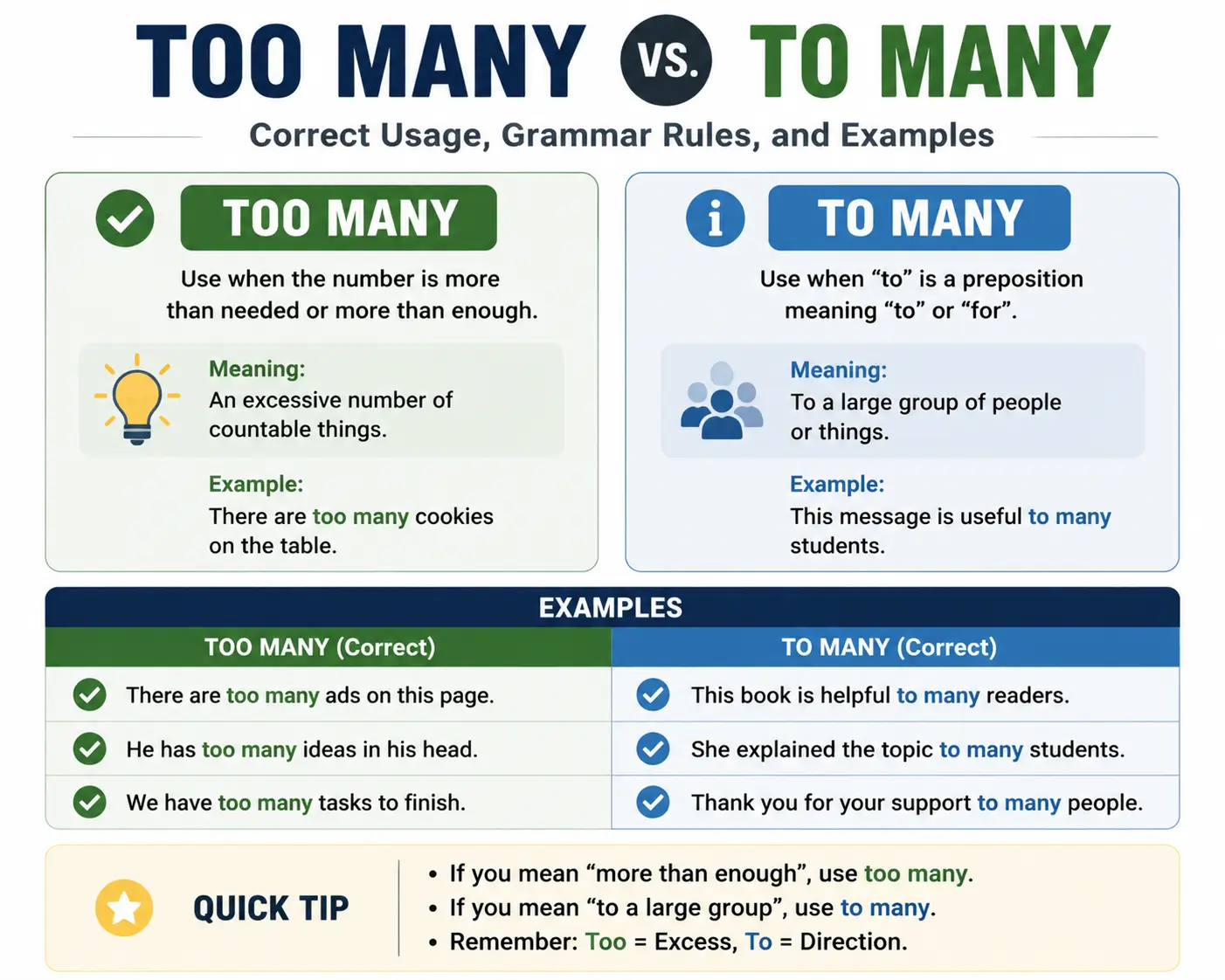
The phrase too many or to many often causes confusion because both expressions sound alike. However, when you mean an excessive number of countable things, the correct phrase is too many.Too many means more than needed, acceptable, or appropriate. For example, “There are too many people in the room” means the number of people is higher than desired.
By contrast, to many is usually incorrect when you want to express an excessive quantity. The word to generally shows direction, connection, or purpose, while too can mean “more than necessary” or “excessively.”This common grammar mistake can appear in emails, articles, essays, social media posts, business writing, and everyday messages.
Since too and to are homophones, typing quickly can easily lead to the wrong choice.A simple memory trick is: Too = extra. If something is more than you need, choose too many.The rule is the same in US English and UK English. Understanding this small distinction helps improve grammar, clarity, and professional writing.
Quick Answer: Is It Too Many or To Many?
Use too many when you mean an excessive number of countable things.
Use to many when to works as a preposition and many means “many people” or “many things.”
Here’s the easiest way to remember it:
Too many = more than enough
To many = to a large group
Look at these examples:
| Sentence | Correct? | Reason |
| There are too many ads on this page. | Yes | It means there are more ads than needed. |
| There are to many ads on this page. | No | “To” does not show excess. |
| This guide is useful to many writers. | Yes | It means many writers find it useful. |
| This guide is useful too many writers. | No | The meaning does not fit. |
If your sentence means “more than enough,” choose too many.
If your sentence means “to many people” or “for many people,” choose to many.
That one test solves most of the confusion.
What Does Too Many Mean?
Too many means more than needed, wanted, useful, safe, or suitable. It points to an excessive number.
The phrase always gives a sense of overload. Something has crossed a limit.
For example, imagine you’re packing a small bag for a one-day trip. One shirt, one charger, and one bottle of water make sense. But if you add five jackets, three pairs of shoes, six books, and a blender, you now have too many things.
The number has become unreasonable.
The same idea works in sentences.
Examples:
- “There are too many cars on the road.”
- “The report has too many spelling mistakes.”
- “You opened too many browser tabs.”
- “The recipe uses too many ingredients.”
- “The app sends too many notifications.”
In every sentence, the number creates a problem.
That’s the key point. Too many is not just about a large number. It means the number is larger than it should be.
Compare these two sentences:
- “Many people attended the event.”
- “Too many people attended the event.”
The first sentence sounds neutral. It only tells us that a large number of people came.
The second sentence sounds different. It suggests a problem. Maybe the room was crowded. Maybe there weren’t enough seats. Maybe the event became difficult to manage.
That small word too changes the whole meaning.
Read this also: Seam vs Seem: Meaning, Difference, Examples, and Easy Rules
What Does To Many Mean?
To many can be correct, but it does not mean “more than enough.” It works when to connects an idea, action, feeling, rule, or result to a large group.
Look at this sentence:
- “The answer seemed simple to many.”
This means many people thought the answer was simple. The sentence does not mean there were too many answers.
Here are more correct examples:
- “The news came as a shock to many.”
- “The rule applies to many employees.”
- “The story felt familiar to many readers.”
- “The delay was frustrating to many passengers.”
- “The lesson was helpful to many beginners.”
In these examples, to many means “to many people.”
It can also appear before a plural noun:
- “This offer applies to many customers.”
- “The warning sounded serious to many parents.”
- “The policy matters to many workers.”
These sentences are correct because to works as a preposition. It connects the sentence to a group.
However, if you want to show excess, to many is wrong.
Wrong:
- “There are to many problems.”
Correct:
- “There are too many problems.”
The difference is not spelling only. It is meaning.
The Main Grammar Rule Behind Too Many
The phrase too many follows a clear grammar pattern.
Too many + plural countable noun
A countable noun is something you can count one by one.
Examples:
- one book, two books
- one mistake, two mistakes
- one person, two people
- one question, two questions
- one email, two emails
Because you can count these nouns, you can use many with them.
When the number becomes excessive, use too many.
Examples:
| Correct Phrase | Countable Noun |
| too many books | books |
| too many people | people |
| too many emails | emails |
| too many questions | questions |
| too many problems | problems |
| too many choices | choices |
| too many mistakes | mistakes |
Now look at these full sentences:
- “The classroom has too many students.”
- “The website has too many pop-ups.”
- “She made too many changes to the design.”
- “We received too many complaints this week.”
- “The article includes too many repeated points.”
Each sentence uses too many before a plural countable noun.
That pattern makes the phrase grammatically correct.
Why To Many Is Wrong for Excess
To does not mean “extra” or “more than enough.” That is why to many is wrong when you want to talk about excess.
The word to usually shows:
- direction
- connection
- purpose
- relationship
- effect
- application
Examples:
- “She went to school.”
- “Send the file to me.”
- “This rule applies to everyone.”
- “The result was surprising to many.”
In none of these examples does to mean excess.
So this sentence is wrong:
- “There are to many people outside.”
The writer wants to say the number of people is excessive. For that meaning, only too many works.
Correct:
- “There are too many people outside.”
Here are more examples:
| Wrong | Correct |
| I have to many tasks. | I have too many tasks. |
| She made to many errors. | She made too many errors. |
| We invited to many guests. | We invited too many guests. |
| The page has to many images. | The page has too many images. |
| They asked to many questions. | They asked too many questions. |
If the sentence means “more than enough,” use too many.
No exception.
Too, To, and Two: What’s the Difference?
The words too, to, and two sound the same. However, they have different meanings.
That is why they confuse many writers.
| Word | Meaning | Example |
| Too | Also or more than enough | “I want coffee too.” / “There are too many cups.” |
| To | Direction, purpose, or connection | “Go to school.” / “This matters to many.” |
| Two | The number 2 | “I bought two pens.” |
Too
Too has two common meanings.
It can mean also:
- “I want one too.”
- “She likes tea too.”
- “He joined the meeting too.”
It can also mean more than enough:
- “The box is too heavy.”
- “The room is too hot.”
- “There are too many people here.”
In too many, the word too always shows excess.
To
To usually points toward something.
Examples:
- “I’m going to work.”
- “Give the book to Sarah.”
- “This seems strange to me.”
- “The rule applies to many users.”
In to many users, the phrase is correct because it means the rule applies to a large group of users.
Two
Two means the number 2.
Examples:
- “I need two chairs.”
- “She has two phones.”
- “They waited two hours.”
This word does not usually cause the too many mistake, but it belongs in the same group because it sounds identical.
When Is To Many Correct?
Many people think to many is always wrong. That is not true.
To many is correct when it means “to many people” or “to many things.”
For example:
- “The decision seemed unfair to many.”
- “The speech was inspiring to many.”
- “The result was surprising to many.”
- “The new rule applies to many students.”
- “The update was useful to many customers.”
These sentences are correct because they do not show excess. They show how something affects or connects to a large group.
Let’s compare the meanings.
| Sentence | Meaning |
| “Too many students missed class.” | An excessive number of students missed class. |
| “The rule applies to many students.” | The rule affects a large group of students. |
| “Too many customers complained.” | More customers complained than expected. |
| “The update helped to many customers.” | This sentence sounds unnatural. |
| “The update was helpful to many customers.” | Many customers found it useful. |
The phrase to many often needs a word before it, such as:
- applies
- matters
- seems
- sounds
- feels
- looks
- belongs
- happened
- appeared
Examples:
- “This applies to many.”
- “That matters to many.”
- “The answer seems clear to many.”
- “The ending felt strange to many.”
So, do not delete every “to many” you see. First, check the sentence meaning.
Too Many vs Too Much
Another common grammar problem is too many vs too much.
Use too many with countable plural nouns.
Use too much with uncountable nouns.
A countable noun names something you can count one by one.
Examples:
- books
- chairs
- people
- mistakes
- emails
- questions
So you write:
- “too many books”
- “too many chairs”
- “too many people”
- “too many mistakes”
- “too many emails”
- “too many questions”
An uncountable noun names something you usually treat as a whole amount.
Examples:
- water
- advice
- traffic
- furniture
- homework
- information
- money
- noise
- luggage
- equipment
So you write:
- “too much water”
- “too much advice”
- “too much traffic”
- “too much furniture”
- “too much homework”
- “too much information”
Here is a simple comparison table:
| Use | Correct | Wrong |
| Countable noun | too many emails | too much emails |
| Countable noun | too many mistakes | too much mistakes |
| Uncountable noun | too much advice | too many advice |
| Uncountable noun | too much information | too many information |
| Uncountable noun | too much traffic | too many traffic |
This mistake is common because some uncountable nouns feel countable in real life.
For example, you can count chairs and tables. But the word furniture itself is uncountable.
Correct:
- “There is too much furniture in this room.”
Wrong:
- “There are too many furniture in this room.”
You can fix it by changing the noun.
| Instead of This | Say This |
| too much furniture | too many chairs |
| too much information | too many details |
| too much advice | too many suggestions |
| too much traffic | too many cars |
| too much homework | too many assignments |
This trick helps you write more clearly.
Too Many vs Too Few
Too many means more than enough. Too few means not enough.
They are opposites.
| Phrase | Meaning | Example |
| Too many | More than needed | “There are too many rules.” |
| Too few | Fewer than needed | “There are too few examples.” |
| Many | A large number | “Many students joined.” |
| Few | A small number | “Few students joined.” |
The word too adds a problem to both phrases.
Examples:
- “Too many people joined the call.”
- “Too few people answered the survey.”
The first sentence says the number was excessive.
The second sentence says the number was not enough.
Both phrases judge the quantity.
Here are more examples:
- “The website has too many pop-ups.”
- “The website has too few useful details.”
- “The essay has too many repeated ideas.”
- “The essay has too few strong examples.”
- “The team scheduled too many meetings.”
- “The team allowed too few breaks.”
This comparison helps you understand how too works. It shows that a number has moved outside the right limit.
Read this also: SU Meaning in Text: What Does SU Mean in Texting and Social Media?
Countable and Uncountable Nouns
Understanding countable and uncountable nouns makes this grammar rule much easier.
You do not need complicated grammar terms. You only need one test.
Ask yourself:
Can I put a number before this noun?
If yes, the noun is countable.
If no, the noun is usually uncountable.
Countable Nouns
A countable noun names something you can count separately.
Examples:
- one email, two emails
- one student, two students
- one problem, two problems
- one idea, two ideas
- one sentence, two sentences
Use too many with countable plural nouns.
Examples:
- “There are too many emails in my inbox.”
- “The class has too many students.”
- “The plan has too many problems.”
- “You added too many ideas to one paragraph.”
- “The article has too many sentences that repeat the same point.”
Uncountable Nouns
An uncountable noun names something you usually measure as a whole amount.
Examples:
- advice
- information
- furniture
- traffic
- homework
- equipment
- knowledge
- research
- luggage
- patience
Use too much with uncountable nouns.
Examples:
- “You gave me too much advice.”
- “The page has too much information.”
- “There is too much furniture in the room.”
- “There is too much traffic today.”
- “The teacher gave us too much homework.”
Quick Grammar Test
Use this test when you feel unsure:
| Question | Answer | Use |
| Can I count it one by one? | Yes | too many |
| Do I measure it as a whole amount? | Yes | too much |
| Does it mean “to many people”? | Yes | to many |
| Does it mean “more than enough”? | Yes | too many |
Examples:
- “three emails” sounds natural → too many emails
- “three information” sounds wrong → too much information
- “to many readers” can mean connection → useful to many readers
- “too many readers” can mean excess → too many readers tried to access the site
Common Mistakes With Too Many and To Many
This mistake usually happens for simple reasons. It does not mean the writer is careless or weak. Still, readers may notice it fast.
Small errors can distract from strong ideas.
Writing by Sound
The biggest reason is sound.
To and too sound the same. When you speak, nobody hears the extra “o” in too.
That is why people write:
- “I have to many things to do.”
They mean:
- “I have too many things to do.”
The sound does not help. The meaning does.
Ask yourself:
Do I mean more than enough?
If yes, write too many.
Typing Too Fast
Fast typing causes many small errors.
You may know the rule, yet still type the wrong word. Your brain moves quickly, and your fingers choose the shorter spelling.
This happens often in:
- emails
- comments
- text messages
- social media captions
- school assignments
- blog drafts
- product descriptions
A quick reread can catch the error.
Look for sentences where the meaning is about overload, excess, or too much quantity.
Trusting Spell-Check Too Much
Spell-check tools do not always catch this mistake.
Why?
Because to and many are both real words. The phrase to many can also be correct in some sentences.
Correct:
- “This rule applies to many users.”
Wrong:
- “There are to many users on the server.”
A tool may not always understand the meaning. So you still need to check the sentence yourself.
Confusing “Too” With “Also”
The word too can mean also.
Example:
- “I want one too.”
It can also mean excessive.
Example:
- “There are too many people here.”
Some writers remember only the “also” meaning. Then they forget that too also shows excess.
Here is the difference:
| Sentence | Meaning of Too |
| “I’m coming too.” | also |
| “She wants coffee too.” | also |
| “The bag is too heavy.” | excessive |
| “There are too many bags.” | excessive |
In too many, the meaning is always “more than enough.”
Correct Examples With Too Many
Examples help you see the pattern faster.
Use too many when the sentence shows an excessive number.
- “There are too many people waiting outside.”
- “You added too many images to the page.”
- “The menu has too many choices.”
- “He made too many excuses.”
- “The app sends too many notifications.”
- “The classroom has too many students.”
- “This website has too many pop-ups.”
- “She keeps too many old photos on her phone.”
- “The report includes too many repeated points.”
- “They asked too many questions during the meeting.”
Each sentence uses this pattern:
too many + plural countable noun
That pattern is your best guide.
Correct Examples With To Many
Use to many when the sentence means “to many people” or “to a large group.”
- “The answer was clear to many.”
- “The announcement came as a surprise to many.”
- “The rule applies to many employees.”
- “The story felt familiar to many readers.”
- “The delay was frustrating to many passengers.”
- “The warning sounded serious to many parents.”
- “This change will matter to many small businesses.”
- “The topic seems difficult to many beginners.”
- “The result looked unfair to many viewers.”
- “The message was encouraging to many people.”
In these sentences, to does not show excess. It connects the idea to a group.
Read this also: TMO Meaning in Text: What Does TMO Mean?
Wrong Examples and Fixes
Here are common mistakes with corrections.
| Wrong Sentence | Correct Sentence | Why |
| I have to many assignments. | I have too many assignments. | The sentence means excess. |
| There are to many cars outside. | There are too many cars outside. | Cars are countable. |
| She made to many mistakes. | She made too many mistakes. | Mistakes are countable. |
| This page has to many ads. | This page has too many ads. | Ads are countable. |
| We invited to many guests. | We invited too many guests. | Guests are countable. |
| He asked to many questions. | He asked too many questions. | Questions are countable. |
| The form has to many fields. | The form has too many fields. | Fields are countable. |
Here’s a fast editing trick:
Replace the phrase with “an excessive number of.”
If the sentence still makes sense, use too many.
Example:
- “There are too many ads.”
- “There are an excessive number of ads.”
That works.
Now try this:
- “This matters to many.”
- “This matters an excessive number of.”
That does not work. So to many is correct there.
Everyday Uses of Too Many
You will see too many in everyday speech, business writing, schoolwork, and online content. People use it when they want to show overload.
In Conversation
People often use too many when something feels like more than they can handle.
Examples:
- “I have too many things on my mind.”
- “There are too many people here.”
- “You bought too many snacks.”
- “We have too many bags to carry.”
- “There are too many mosquitoes outside.”
These sentences sound natural because they describe real-life overload.
In Emails
Professional emails often use too many to discuss workload, errors, steps, or problems.
Examples:
- “There are too many pending tasks this week.”
- “The draft has too many formatting issues.”
- “We’re receiving too many duplicate requests.”
- “The process includes too many manual steps.”
- “The report has too many missing details.”
However, be careful with tone.
This sentence sounds harsh:
- “There are too many mistakes in this file.”
This version sounds more useful:
- “The file still has too many mistakes to send today, so let’s review it once more.”
The second sentence gives a clear next step.
In Academic Writing
You can use too many in academic writing, but use it with purpose. Academic writing often needs precise language.
Basic:
- “Too many students failed the test.”
Stronger:
- “A high number of students failed the test, which may suggest a gap in preparation.”
Still, too many works well when excess is the main point.
Examples:
- “Too many variables can weaken the result.”
- “Too many unsupported claims reduce the strength of an argument.”
- “Too many distractions may affect student focus.”
The phrase is not informal. It is standard English.
In Social Media
Social media writing often uses short, punchy phrases. Too many fits that style.
Examples:
- “Too many spoilers today.”
- “Too many tabs open. Not enough coffee.”
- “Too many people missed the point.”
- “Too many apps asking for my email.”
- “Too many opinions. Not enough facts.”
The phrase can sound funny, serious, annoyed, or dramatic. Context controls the tone.
In Website Copy
Website writers use too many to describe pain points.
Examples:
- “Tired of too many tools?”
- “Stop wasting time on too many manual tasks.”
- “Too many choices can slow buying decisions.”
- “Too many pop-ups can hurt user experience.”
This works because readers understand overload quickly.
Nobody likes clutter.
Comparison Table: Too Many vs To May
This table gives you a quick reference.
| Feature | Too Many | To Many |
| Main meaning | More than enough | To a large group |
| Grammar role | Shows excess quantity | Prepositional phrase |
| Common pattern | too many + plural noun | to many + people/things |
| Example | “There are too many rules.” | “This applies to many users.” |
| Shows a problem? | Usually yes | Not always |
| Can mean “excessive number”? | Yes | No |
| Common mistake? | Writing “to many” instead | Using it where “too many” is needed |
The simple difference is this:
- Too many tells you the number is excessive.
- To many tells you something connects to a large group.
Easy Trick to Remember the Difference
Here is the easiest memory trick:
Too has an extra “o,” and too many means an extra amount.
It’s simple, but it works.
Think of to as an arrow.
It points toward something:
- to school
- to work
- to her
- to many people
Think of too as overload.
It means something has gone past the limit:
- too hot
- too loud
- too late
- too heavy
- too many problems
Use this table:
| Word | Memory Tip | Meaning |
| to | arrow | direction or connection |
| too | extra “o” | extra, also, or excessive |
| two | number | 2 |
Now test it:
- “I sent the message ___ many people.”
- “There were ___ many people in the room.”
The first sentence needs to because the message goes to people.
The second sentence needs too because the number of people is excessive.
Mini Case Study: One Small Grammar Error in a Work Email
Imagine a project manager sends this email:
“There are to many changes in the design, so we need one more day.”
Most readers will understand the message. Still, the mistake makes the email look rushed.
The sentence should be:
“There are too many changes in the design, so we need one more day.”
Now the meaning is clear. The number of changes is excessive, so the deadline needs to move.
Here is another sentence:
“The design changes were helpful to many users.”
This sentence is correct. It means many users found the changes helpful.
So, the same two words can be right or wrong depending on the sentence.
That is why meaning matters more than memorizing a lazy rule.
Why This Mistake Happens
This mistake happens for several practical reasons.
The Words Sound the Same
To and too sound identical in normal speech. You cannot hear the extra “o.”
Because of that, people often write the word they use more often: to.
To Is More Common
The word to appears everywhere in English.
Examples:
- “I want to go.”
- “Send it to me.”
- “Talk to him.”
- “Go to work.”
- “Try to finish.”
Because writers type to so often, it can appear by habit.
Too Has Two Meanings
The word too can mean also.
Example:
- “Me too.”
It can also mean excessive.
Example:
- “Too many people came.”
That double meaning causes confusion, especially for English learners.
Grammar Tools Can Miss It
Grammar tools help, but they are not perfect. They may miss this mistake because to many can be correct.
Correct:
- “This applies to many.”
Wrong:
- “There are to many.”
The tool needs context. So do you.
Why Correct Usage Matters
Some people say small grammar mistakes do not matter. That is weak thinking.
A tiny mistake may not destroy your message, but it can weaken your writing. Readers judge clarity fast.
It Improves Clarity
Correct grammar helps readers understand your point without stopping.
Wrong:
- “There are to many problems.”
Correct:
- “There are too many problems.”
The correct version reads smoothly.
It Builds Trust
Clean writing makes you look careful.
That matters in:
- resumes
- essays
- emails
- blog posts
- product pages
- proposals
- business reports
- social media captions
A single typo may be harmless. Repeated mistakes are not.
They make readers question your attention to detail.
It Helps Readers Move Faster
Good writing removes friction. Readers should not have to guess what you mean.
When your grammar is clear, your ideas feel stronger.
It Makes Editing Easier
If your basic grammar is clean, you can focus on bigger improvements.
You can improve:
- flow
- structure
- examples
- tone
- argument
- clarity
- search intent
That is where strong writing gets better.
Read this also: Persue or Pursue: Correct Spelling, Meaning, and Easy Examples
Self-Check Exercise
Choose to or too.
| Sentence | Correct Answer |
| There are ___ many people in the room. | too |
| This rule applies ___ many students. | to |
| You added ___ many images to the page. | too |
| The result was surprising ___ many. | to |
| She has ___ many apps on her phone. | too |
| The warning came too late ___ many drivers. | to |
| We invited ___ many guests. | too |
| The story felt familiar ___ many readers. | to |
| I opened ___ many browser tabs. | too |
| The update was useful ___ many users. | to |
Notice the pattern.
Use too for excess.
Use to for connection.
Practical Editing Checklist
Use this checklist before you publish or submit your writing.
Ask yourself:
- Do I mean “more than enough”?
- Is the next word a plural countable noun?
- Can I replace the phrase with “an excessive number of”?
- Does the sentence show overload or excess?
- Is to working like an arrow toward a group?
- Does many mean “many people” in this sentence?
Here is the quick decision table:
| Question | Use |
| Do I mean more than enough? | too many |
| Am I talking about countable plural nouns? | too many |
| Am I showing direction or connection? | to many |
| Can I replace it with “to many people”? | to many |
| Can I replace it with “an excessive number of”? | too many |
This checklist catches the mistake quickly.
Common Sentence Patterns
Sentence patterns make this rule easier.
Pattern for Too Many
Use this pattern when the number is excessive:
- There are too many + plural noun.
- I have too many + plural noun.
- She made too many + plural noun.
- We received too many + plural noun.
- The page includes too many + plural noun.
Examples:
- “There are too many errors.”
- “I have too many deadlines.”
- “She made too many changes.”
- “We received too many complaints.”
- “The page includes too many banners.”
Pattern for To Many
Use this pattern when something connects to a large group:
- This applies to many + plural noun.
- This matters to many + plural noun.
- This seems clear to many.
- This sounded strange to many.
- This was helpful to many + plural noun.
Examples:
- “This applies to many customers.”
- “This matters to many families.”
- “This seems clear to many.”
- “This sounded strange to many.”
- “This was helpful to many beginners.”
More Real-Life Examples
Workplace Writing
Correct:
- “We have too many open tasks this week.”
- “The dashboard shows too many duplicate entries.”
- “The update was useful to many team members.”
- “The new policy applies to many departments.”
Wrong:
- “We have to many open tasks this week.”
- “The dashboard shows to many duplicate entries.”
School Writing
Correct:
- “The essay includes too many unsupported claims.”
- “Too many variables may affect the result.”
- “The explanation was confusing to many students.”
- “The rule applies to many classroom activities.”
Wrong:
- “The essay includes to many unsupported claims.”
- “To many variables may affect the result.”
Social Media Writing
Correct:
- “Too many spoilers today.”
- “Too many people missed the joke.”
- “That post felt relatable to many.”
- “The message was helpful to many followers.”
Wrong:
- “To many spoilers today.”
- “To many people missed the joke.”
Blog and Website Writing
Correct:
- “Too many pop-ups can hurt user experience.”
- “Too many choices can slow buying decisions.”
- “This guide is useful to many new writers.”
- “The rule is confusing to many English learners.”
Wrong:
- “To many pop-ups can hurt user experience.”
- “To many choices can slow buying decisions.”
What Strong Writers Do Differently
Strong writers do not only memorize grammar rules. They understand meaning.
They ask better questions:
- What am I trying to say?
- Does this sentence show excess?
- Does this phrase point toward a group?
- Does the noun after “many” make sense?
- Would “too much” work better?
That last question matters.
Sometimes the issue is not to or too. Sometimes the noun needs much, not many.
Wrong:
- “There is too many information.”
Correct:
- “There is too much information.”
Better:
- “The page gives readers too much information at once.”
Even better:
- “The page overwhelms readers with too much information.”
The final sentence sounds stronger because it improves both grammar and style.
Quick Recap
Here are the main points:
- Too many means more than enough.
- Too many works with plural countable nouns.
- To many can be correct when to works as a preposition.
- To many does not show excess.
- Too much works with uncountable nouns.
- Too few means not enough.
- To, too, and two sound alike, but they do different jobs.
- Spell-check may miss this mistake.
- Context decides the correct form.
The fastest test is simple:
If the phrase means “an excessive number of,” write too many.
FAQs About Too Many and To Many
Use too many when you mean an excessive number of countable things.
Correct:
“There are too many mistakes.”
Wrong:
“There are to many mistakes.”
However, to many can be correct in a different sentence.
Correct:
“This seems obvious to many.”
Yes. To many is correct when to works as a preposition and many means a large group.
Examples:
“This matters to many.”
“The rule applies to many students.”
“The update was helpful to many users.”
It is wrong whenenough.” you use it to mean “more than enough.”
is wrong when the sentence talks about excess.
Wrong:
“There are to many people here.”
Correct:
“There are too many people here.”
The sentence means the number of people is more than suitable. That meaning needs too.
No. Use too much with uncountable nouns.
Wrong:
“too many information”
“too many advice”
“too many homework”
Correct:
“too much information”
“too much advice”
“too much homework”
Use too many only with countable plural nouns.
oo many works with countable plural nouns.
Examples:
too many emails
too many people
too many mistakes
Too much works with uncountable nouns.
Examples:
too much water
too much noise
too much information
If you can count the noun one by one, use many. If you measure it as a whole amount, use much.
Too many works in both formal and informal English.
Examples:
Casual: “I have too many tabs open.”
Professional: “The process includes too many manual steps.”
Academic: “Too many variables may weaken the result.”
The phrase is standard English, not slang.
No. The rule is the same in US English and British English.
Use too many for excess.
Use to many when to works as a preposition.
Examples:
“There are too many cars on the road.”
“This problem is familiar to many drivers.”
Conclusion
Understanding Too Many or To Many helps you avoid a small but noticeable grammar mistake in everyday writing. Use too many when you mean an excessive number of countable things, such as emails, tasks, people, choices, or mistakes.
The phrase to many is different. It can be correct when to shows connection, direction, or effect, as in “This rule applies to many users.” However, it is wrong when you mean excess. That is where Too Many vs To Many confuses many writers.
A quick trick helps: too means extra, while to points toward someone or something. So, write too many for quantity and to many for connection. This simple grammar rule improves clarity, protects professional credibility, and keeps your emails, essays, captions, and blog writing polished.
3 thoughts on “Too Many or To Many: Correct Usage, Grammar Rules, and Examples”