
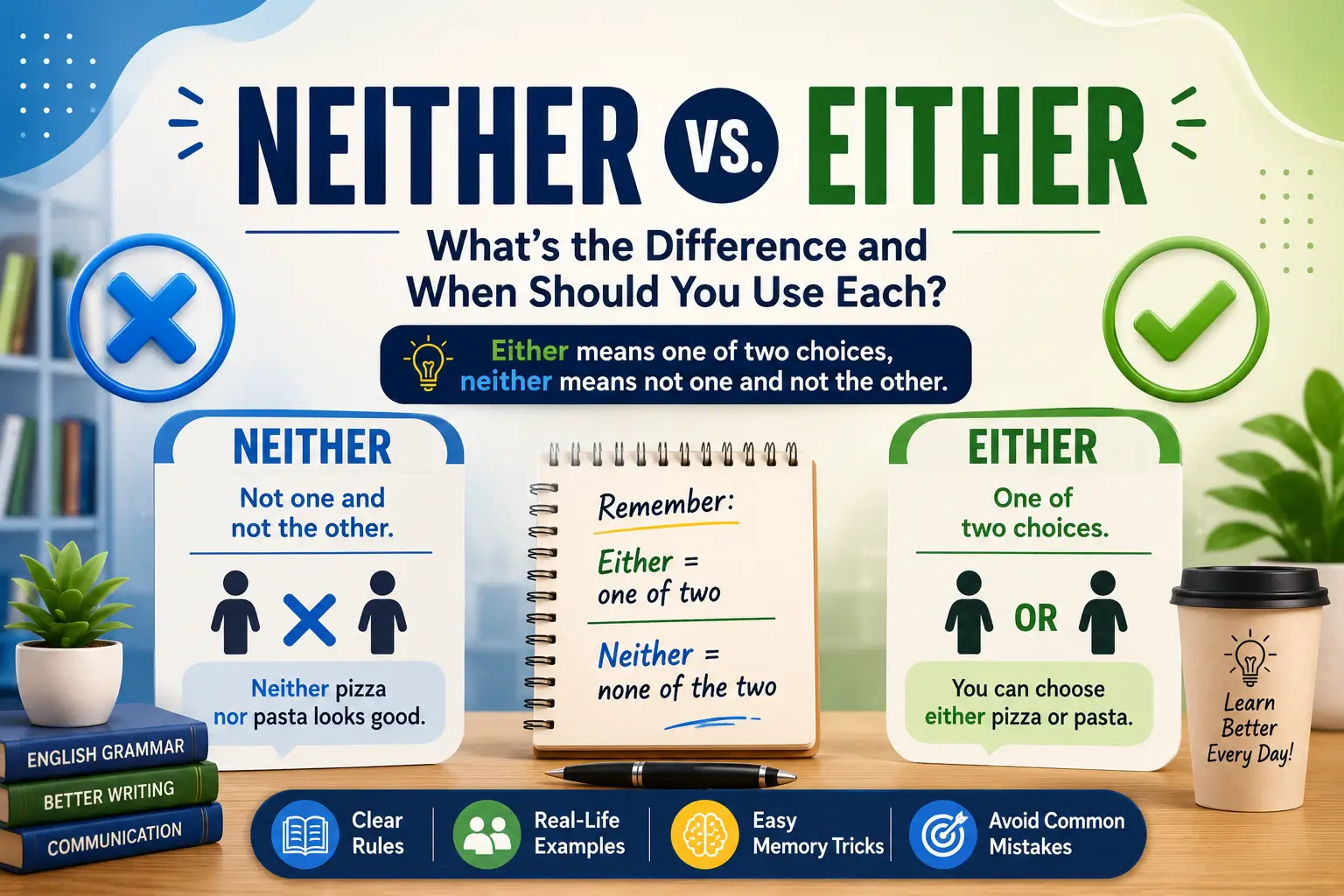
Neither vs either is one of the most searched English grammar topics because these two words look similar but have opposite meanings. Knowing when to use either, neither, either…or, and neither…nor will help you write more clearly, avoid common grammar mistakes, and speak confidently in everyday American English. If you’ve ever wondered which word is correct in a sentence, this guide gives you the answer right away.
Many learners confuse these words because both refer to two choices, but they don’t mean the same thing. Either means one of two options, while neither means not one and not the other. Once you understand this simple difference, choosing the correct word becomes much easier.
Throughout this guide, you’ll learn the difference between either and neither, how they work as a determiner, pronoun, conjunction, and adverb, how to use them with the correct subject-verb agreement, and how to avoid common mistakes. You’ll also find comparison tables, practical examples, memory tricks, and real-life situations to help you use these words naturally in speaking and writing.
Quick Answer
Here’s the easiest way to remember the difference:
| Word | Meaning | Example |
| Either | One of two choices | You can choose either pizza or pasta. |
| Neither | Not one and not the other | Neither answer is correct. |
Simple memory rule:
- Either = one of two
- Neither = not either one
If your sentence has a positive choice between two options, use either.
If you’re saying both options are unacceptable or false, use neither.
What Do “Neither” and “Either” Mean?
Although these words often appear together, they express opposite ideas. Understanding their meanings first makes every grammar rule easier to learn.
Meaning of “Either”
Either refers to one or the other of two people, things, places, or ideas.
It gives someone a choice between two possibilities.
Examples:
- You can sit in either chair.
- Either road will take you downtown.
- We can meet on Saturday or Sunday. Either day works for me.
In every example, there are only two options, and one of them is acceptable.
Meaning of “Neither”
Neither means not one and not the other.
It tells the reader or listener that both options are rejected.
Examples:
- Neither restaurant is open today.
- Neither answer is correct.
- Neither of my friends could attend the meeting.
Instead of choosing one option, neither eliminates both.
Neither vs Either: The Key Difference Explained
The biggest difference is the message each word communicates.
- Either presents a choice.
- Neither rejects both choices.
Think of them as opposites.
| Feature | Either | Neither |
| Meaning | One of two | Not one of the two |
| Positive or Negative | Positive | Negative |
| Number of choices | Two | Two |
| Indicates acceptance? | Yes | No |
| Common phrases | either…or | neither…nor |
Examples
✅ You may choose either jacket.
This means both jackets are available, but only one will be chosen.
✅ Neither jacket fits me.
This means both jackets are unsuitable.
How to Use “Either” Correctly
The word either can play several different grammar roles. Fortunately, each use follows simple rules.
Either as a Determiner
A determiner comes before a noun and identifies it.
When either is a determiner, it refers to one of two singular nouns.
Examples
- You can park on either side of the street.
- Either solution will solve the problem.
- Take either book home.
Notice that the noun following either is singular.
Correct:
- Either answer is acceptable.
Incorrect:
- Either answers are acceptable.
Either as a Pronoun
Sometimes either replaces a noun completely.
Instead of repeating the noun, you simply use either.
Examples
- Which shirt would you like?
Either is fine. - I don’t mind.
Either will work.
Because the noun is already understood, repeating it isn’t necessary.
Either as a Conjunction (“Either…Or”)
One of the most common uses is the correlative conjunction either…or.
It connects two choices.
Formula
Either + option A + or + option B
Examples
- You can either drive or take the train.
- We’ll eat either before the movie or afterward.
- She wants either coffee or tea.
This construction tells the reader that only one option will happen.
Subject-Verb Agreement with “Either…Or”
Many writers make mistakes here.
When the subjects are different, the verb usually agrees with the subject closest to it.
Correct:
- Either the teachers or the principal is attending.
Correct:
- Either the principal or the teachers are attending.
The noun nearest the verb determines whether the verb is singular or plural.
Either as an Adverb
Either can also mean also, but only after a negative statement.
Examples
- I don’t like broccoli.
I don’t like spinach either. - She isn’t coming, and he isn’t coming either.
This usage is extremely common in everyday American English.
Notice that either usually appears at the end of the sentence.
How to Use “Neither” Correctly
Like either, the word neither can function as several parts of speech.
Its meaning always stays negative.
Neither as a Determiner
When neither comes before a singular noun, it means not one and not the other.
Examples
- Neither candidate won the debate.
- Neither restaurant serves breakfast.
- Neither explanation sounds convincing.
Each noun remains singular.
Correct:
- Neither option is available.
Incorrect:
- Neither options are available.
Neither as a Pronoun
Sometimes neither replaces a noun.
Examples
- Which dessert would you like?
Neither, thanks. - Which movie did you enjoy?
Neither.
The listener already understands what is being discussed.
Neither as a Conjunction (“Neither…Nor”)
The conjunction neither…nor connects two negative choices.
Formula
Neither + option A + nor + option B
Examples
- Neither Jack nor Emma attended the meeting.
- She likes neither coffee nor tea.
- The package arrived neither yesterday nor today.
Both options are excluded.
Subject-Verb Agreement with “Neither…Nor”
The same agreement rule applies here.
The verb agrees with the noun closest to it.
Correct:
- Neither the students nor the teacher was ready.
Correct:
- Neither the teacher nor the students were ready.
This rule helps keep your sentence grammatically correct and natural.
Neither as an Adverb
Although less common, neither can also replace me neither or I don’t either in formal responses.
Examples:
Person A:
“I don’t enjoy horror movies.”
Person B:
“Neither do I.”
Another example:
“I’m not hungry.”
“Neither am I.”
This structure is common in formal English and writing.
Subject-Verb Agreement With Either and Neither
One of the biggest grammar challenges is deciding whether to use a singular or plural verb.
Fortunately, the basic rules are straightforward.
When Either or Neither Stands Alone
When either or neither acts as the subject by itself, use a singular verb.
Examples
- Either is acceptable.
- Neither seems correct.
- Either works for me.
- Neither was available.
Even though two choices are involved, the grammar treats each word as singular.
When Using “Either…Or” or “Neither…Nor”
When these paired conjunctions connect two subjects, the verb usually agrees with the subject closest to it.
| Sentence | Correct Verb |
| Either the manager or the employees are attending. | are |
| Either the employees or the manager is attending. | is |
| Neither the coach nor the players were ready. | were |
| Neither the players nor the coach was ready. | was |
This “closest subject” rule is widely accepted in American English and helps your writing sound natural.
Using “Either…Or” and “Neither…Nor” Correctly
The expressions either…or and neither…nor are called correlative conjunctions. They work in pairs to connect two equal words, phrases, or clauses.
Although they look similar, they express opposite meanings.
- Either…or presents a choice between two options.
- Neither…nor rejects both options.
Learning how to use these pairs correctly will make your writing clearer and more natural.
How “Either…Or” Works
Use either…or when one of two choices is possible.
Structure
Either + option A + or + option B
Examples
- You can either call me or send an email.
- We’ll travel either by train or by bus.
- She wants either chocolate or vanilla ice cream.
Each sentence gives two possible choices, but only one will happen.
Keep the Sentence Parallel
The words or phrases after either and or should have the same grammatical form.
Correct
- She likes either swimming or hiking.
- They will either study tonight or review tomorrow.
Incorrect
- She likes either swimming or to hike.
The first option uses a gerund (swimming), while the second uses an infinitive (to hike). Matching the forms creates smoother, more professional writing.
How “Neither…Nor” Works
Use neither…nor when both choices are negative.
Structure
Neither + option A + nor + option B
Examples
- Neither David nor Lisa answered the phone.
- We have neither milk nor juice.
- The store sells neither laptops nor tablets.
Instead of offering a choice, this structure tells the reader that both options are unavailable, untrue, or rejected.
Subject-Verb Agreement with Correlative Conjunctions
A common question is which verb to use when the subjects have different numbers.
The verb agrees with the subject closest to it.
Examples
✅ Either my parents or my brother is driving.
✅ Either my brother or my parents are driving.
✅ Neither the doctors nor the nurse was available.
✅ Neither the nurse nor the doctors were available.
This rule keeps your sentences grammatically correct and easy to understand.
Common Agreement Errors
Many learners accidentally choose the wrong verb.
| Incorrect | Correct | Reason |
| Either the teacher or the students is coming. | Either the teacher or the students are coming. | The closest subject is plural. |
| Neither the students nor the teacher are ready. | Neither the students nor the teacher is ready. | The closest subject is singular. |
| Either my friends or my cousin are visiting. | Either my friends or my cousin is visiting. | The closest subject controls the verb. |
Neither vs Either in Negative Sentences
This is one of the most confusing areas of English grammar.
Because neither already has a negative meaning, you shouldn’t add another negative word to the same idea.
Doing so creates a double negative, which is usually incorrect in standard American English.
Incorrect Double Negatives
❌ Neither of us didn’t know.
❌ Neither wasn’t ready.
❌ Neither couldn’t attend.
These sentences contain two negatives that conflict with each other.
Correct Versions
✅ Neither of us knew.
✅ Neither was ready.
✅ Neither could attend.
The word neither already means “not one and not the other,” so another negative isn’t needed.
Using “Either” After Negative Statements
When agreeing with a negative statement, Americans often use either at the end of the sentence.
Examples
- I don’t watch reality shows either.
- She isn’t coming either.
- They didn’t understand the instructions either.
Notice that either appears after the negative sentence.
Using “Neither” to Agree with Someone
Instead of repeating an entire sentence, you can answer with Neither + helping verb + subject.
Examples
Person A:
“I don’t eat seafood.”
Person B:
“Neither do I.“
Another example:
“I’m not interested.”
“Neither am I.“
This structure is common in conversations and more formal than saying Me neither.
“Either” and “Neither” With “Of”
You’ll often see these words followed by of.
This pattern has its own grammar rules.
Using “Either of”
Use either of before plural nouns or plural pronouns when referring to one member of a pair.
Structure
Either of + the/these/my + plural noun
Examples
- Either of the answers is acceptable.
- You may choose either of the apartments.
- Either of my sisters can help.
Even though the noun is plural, either is traditionally treated as singular.
Formal writing usually prefers:
- Either of the players is ready.
However, in everyday conversation, many Americans naturally say:
- Either of the players are ready.
Although you’ll hear both forms, singular verbs remain the safest choice in formal writing.
Using “Neither of”
The same pattern applies to neither of.
Examples
- Neither of the restaurants is open.
- Neither of my cousins lives nearby.
- Neither of these explanations makes sense.
Again, formal grammar prefers singular verbs.
Formal:
- Neither of the answers is correct.
Informal conversation:
- Neither of the answers are correct.
Both appear in modern English, but professional writing generally favors singular agreement.
Common Mistakes People Make
Even advanced English speakers sometimes confuse either and neither. Fortunately, these mistakes are easy to fix once you know the rules.
Using Either Instead of Neither
❌ Either answer is wrong.
✅ Neither answer is correct.
If both answers are incorrect, use neither, not either.
Using Neither Instead of Either
❌ You can choose neither seat.
✅ You can choose either seat.
If both seats are available and you’re choosing one, either is correct.
Creating Double Negatives
❌ I don’t want neither option.
✅ I don’t want either option.
OR
✅ I want neither option.
Both corrected sentences express the intended meaning without a double negative.
Using Plural Nouns Incorrectly
❌ Neither books are available.
✅ Neither book is available.
Because neither is followed by a singular noun, book should stay singular.
Forgetting the Second Half
❌ Either coffee tea.
✅ Either coffee or tea.
❌ Neither pizza burgers.
✅ Neither pizza nor burgers.
The paired conjunctions must stay together.
Using Them for More Than Two Choices
Traditionally, either and neither refer to two choices.
For more than two options, English usually prefers expressions like:
- any of
- none of
- one of the
- all of the
Although modern English sometimes stretches either to mean “any one of several,” sticking to two choices is usually the clearest option.
Real-Life Examples in American English
Understanding grammar is easier when you see it in everyday situations.
Everyday Conversation
- Either movie sounds fun.
- Neither restaurant has vegetarian options.
- I don’t like spicy food either.
- Neither do my friends.
At School
- You may answer either question.
- Neither explanation includes enough evidence.
- Either project meets the assignment requirements.
In the Workplace
- You can contact either manager for assistance.
- Neither proposal fits our budget.
- Either meeting time works for the client.
Emails
- Please send the report to either Sarah or Michael.
- Neither attachment opened correctly.
- Either version of the document is acceptable.
Text Messages
- Either works 😊
- Neither sounds good 😂
- I can’t go either.
Social Media
- Either outfit looks amazing!
- Neither team played well tonight.
- I haven’t watched that show either.
These examples show how naturally either and neither appear in spoken and written American English.
Neither vs Either vs Both
Many English learners understand either and neither but aren’t sure where both fits in. These three words all refer to two people or things, but they express different ideas.
- Both includes the two options.
- Either allows you to choose one of the two.
- Neither rejects both options.
Understanding this distinction helps you choose the right word in any situation.
| Word | Meaning | Example |
| Both | The two together | Both students passed the exam. |
| Either | One of the two | You can choose either dessert. |
| Neither | Not one and not the other | Neither answer is correct. |
When to Use “Both”
Use both when two people or things are included.
Examples
- Both restaurants are excellent.
- Both children enjoy reading.
- We both finished the project early.
When to Use “Either”
Use either when one of two choices is acceptable.
Examples
- You may sit in either chair.
- Either route will get you there.
- We can leave on either Friday or Saturday.
When to Use “Neither”
Use neither when both choices are excluded.
Examples
- Neither option fits my budget.
- Neither player scored.
- Neither explanation answers the question.
Quick Decision Guide
Ask yourself these questions:
- Do I mean both? → Use both.
- Do I mean one of two? → Use either.
- Do I mean not one of the two? → Use neither.
This simple check will help you choose the correct word almost every time.
Quick Memory Tricks to Remember Neither vs Either
Grammar rules become much easier when you have a simple memory trick.
Remember the Meaning
- Either = one choice
- Neither = zero choices
If one option is acceptable, use either.
If no options are acceptable, use neither.
Look for the Word “Not”
The word neither already contains a negative meaning.
Think of it as saying:
Not this one. Not that one.
That’s why you should never add another negative word like don’t, didn’t, or can’t with neither when expressing the same idea.
Remember the Pairs
These words always work together:
- Either…or
- Neither…nor
If you write either, make sure or appears later in the sentence.
If you write neither, make sure nor follows when connecting two choices.
Simple Visual Trick
Imagine two boxes.
📦 Box A
📦 Box B
- Either → ✔ Choose one box.
- Neither → ✘ Choose neither box.
This visual reminder is especially helpful for students learning English.
Practice Sentences (Test Yourself)
Try completing each sentence before checking the answers.
Choose the Correct Word
- You can have ________ coffee or tea.
- ________ of the answers is correct.
- I don’t like horror movies, and my brother doesn’t ________.
- She invited ________ Emma nor Olivia.
- ________ route will take about an hour.
- ________ of my neighbors owns a truck.
- We can meet on ________ Monday or Tuesday.
- ________ restaurant serves breakfast.
Answer Key
- either
- Neither
- either
- neither
- Either
- Neither
- either
- Neither
If you answered all eight correctly, you’ve mastered the basic rules.
Grammar Tips for Using Either and Neither
Keep these practical tips in mind whenever you write.
- Either usually expresses a positive choice.
- Neither already has a negative meaning.
- Use either…or to connect two alternatives.
- Use neither…nor to connect two negative alternatives.
- Avoid double negatives with neither.
- In formal writing, treat either and neither as singular when they stand alone.
- Keep sentence structures parallel after either…or and neither…nor.
- When subjects differ in number, make the verb agree with the closest subject.
These habits will improve both your grammar and your writing style.
Synonyms and Related Words
Although either and neither have unique meanings, some related words may fit depending on the context.
Words Related to “Either”
- one of two
- any one
- one or the other
- whichever
- alternatively (in some contexts)
Words Related to “Neither”
- not either
- none (for more than two)
- not one
- no one (depending on context)
Remember that these words are not always interchangeable. Always consider the sentence’s meaning before replacing them.
Quick Recap
Before you finish, here’s a quick summary of the most important rules.
- Either means one of two choices.
- Neither means not one and not the other.
- Use either…or to present alternatives.
- Use neither…nor to reject both alternatives.
- Avoid double negatives with neither.
- Use singular nouns after either and neither when they act as determiners.
- Let the closest subject determine the verb in either…or and neither…nor constructions.
- Keep parallel structure when joining words or phrases.
Conclusion
Understanding neither vs either is an important step toward improving your English grammar and everyday communication. Although these words look and sound similar, they have opposite meanings. Either refers to one of two choices, while neither means not one and not the other. Remembering this simple rule will help you avoid many common grammar mistakes.
You’ll also write more naturally when you understand how either…or and neither…nor work, how subject-verb agreement changes in these structures, and why double negatives should be avoided. These grammar rules appear frequently in conversations, emails, school assignments, and professional writing.
The best way to master either and neither is through regular practice. Read authentic English, pay attention to how native speakers use these words, and create your own example sentences. Over time, choosing the correct word will become automatic, making your writing clearer, more accurate, and more confident.
FAQS
Q1: What is the main difference between neither and either?
Either means one of two choices, while neither means not one and not the other. Use either when one option is acceptable and neither when both options are rejected.
Q2: Is “neither” a negative word?
Yes. Neither already has a negative meaning, so you should not use another negative word such as don’t or didn’t to express the same idea.
Q3: Can I use either for more than two choices?
Traditionally, either is used only when referring to two choices. For more than two options, words like any, one of, or any of are usually more appropriate.
Q4: Is it “either is” or “either are”?
When either is the subject of a sentence, use a singular verb.
Correct: Either is acceptable.
Q5: Is it “neither is” or “neither are”?
In formal American English, neither usually takes a singular verb.
Correct: Neither is available.
Although you’ll hear neither are in casual speech, neither is is preferred in formal writing.
Q6: How do you use “either…or” correctly?
Use either…or to present two alternatives.
Example: You can either study tonight or tomorrow morning.
Q7: How do you use “neither…nor” in a sentence?
Use neither…nor when both options are negative.
Example: Neither Sarah nor Emily attended the meeting.
Q8: Can I say “Neither of them are”?
Many native speakers use it in everyday conversation, but formal grammar generally prefers:
Neither of them is ready.
Q9: Why is “I don’t want neither” incorrect?
Because it creates a double negative. Instead, say:
- I don’t want either.
- I want neither.
Both are grammatically correct, depending on what you want to express.
Q10: What is the easiest way to remember neither vs either?
Use this simple memory trick:
- Either = one of two
- Neither = none of the two
If you’re choosing one option, use either. If you’re rejecting both options, use neither. This rule works in most everyday situations and makes it much easier to choose the correct word.